

UAE Entry Requirements depend on your passport, the purpose of your visit and whether you will pass through immigration. Before flying to Dubai, Abu Dhabi or another emirate, check more than whether you need a visa: passport validity, supporting documents and recent travel history can also affect your journey.
This guide covers short tourist visits and stopovers involving entry into the United Arab Emirates. Residents, people moving for work and travellers using emergency or other non-standard documents should check the conditions for their specific status.
Quick Answer: UAE Entry Requirements for Tourists
For a standard tourist visit, your passport should be valid for at least six months from arrival. You also need either eligibility for entry without an advance visa or an approved visa obtained before departure. Keep your departure booking, accommodation details and any required insurance available. Additional conditions depend on your nationality, travel document and recent travel history.
If you need an advance visa, wait for approval and check the issued document before travelling. Keep the approval available alongside your flight booking.
1. Check Your Passport Before Booking

The UAE government’s general visitor guidance specifies at least six months of passport validity from the date of entry. Count from your arrival date, not the day you book or submit your application.
Check the document’s condition as well as its expiry date. flydubai’s visa guidance specifies a machine-readable passport in good condition. If yours is damaged or you use an emergency or temporary document, confirm its acceptance before booking.
Before paying for your trip:
- Compare the passport name with your flight booking.
- Check the expiry date against your intended arrival.
- Confirm that your visa, if needed, uses the correct passport details.
- Ask your airline about any non-standard travel document.
If you renew your passport after receiving a visa, ask the issuing provider whether the visa needs updating or reissuing before departure.
2. Establish Which Entry Route Applies to You
UAE Entry Requirements vary between GCC citizens, travellers eligible for a visa on arrival and those who must arrange a visa before departure.
| Traveller group | Entry route | What to establish before flying |
|---|---|---|
| GCC citizens | Visa-free entry with an accepted GCC passport or national identity card | Whether your travel document meets the applicable conditions |
| Eligible passport holders | Visa issued on arrival | Your passport’s eligibility, permitted stay and any previous visits |
| Travellers requiring an advance visa | Approved visa obtained before departure | The correct visa type, passport details and validity dates |
Use Emirates’ UAE visa information to check visa-on-arrival eligibility for your passport and the available prearranged visa options.
Temporary restrictions can affect otherwise applicable entry arrangements. See “Check Temporary Entry and Health Measures” below if your nationality or recent travel history is relevant.
GCC Citizens and GCC Residents
Citizens of Gulf Cooperation Council countries can enter the UAE without a visa using an accepted GCC passport or national identity card.
GCC residents who hold another nationality should check their passport-based eligibility and, where relevant, the UAE eVisa route for GCC residents. Citizenship and residence follow different entry arrangements.
Travellers Eligible for a Visa on Arrival
Eligible passport holders can receive permission to visit at arrival, but the permitted stay varies. Emirates currently lists different categories, including 30-day and 90-day arrangements.
Check the category for your exact passport and how previous visits affect your remaining allowance. A friend’s experience or the conditions from an earlier trip may not match your current entitlement.
Travellers Who Need an Advance Visa
If you do not qualify for entry without an advance visa, arrange the appropriate permission before departure. Depending on the application route, tourist visas may be facilitated by UAE airlines, hotels or authorised travel agencies.
Once you have identified the appropriate route, confirm the documents required for your particular application.
Clara’s Tip: When asking your airline to check eligibility, provide your nationality, passport type, travel dates and any residence permit you intend to rely on. “Do I need a Dubai visa?” may not give them enough information.
3. Prepare Your Departure and Accommodation Documents
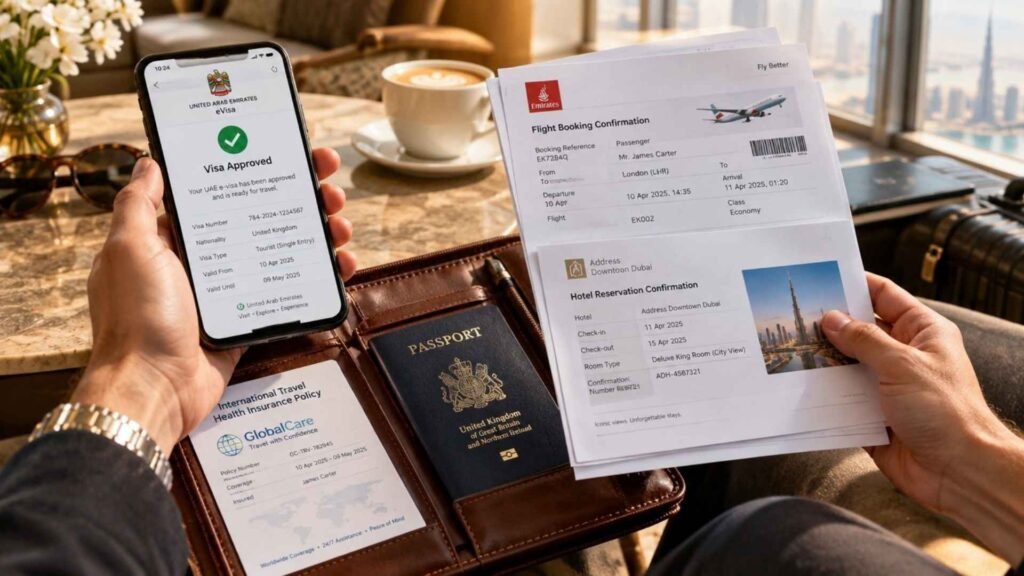
Keep a small travel folder accessible on your phone, with a printed backup of essential documents.
Include:
- Your approved visa or entry permit, if required.
- Your confirmed return or onward booking.
- Hotel confirmations or your host’s address and contact details.
- Evidence of insurance required for your entry route.
- Supporting documents requested by your visa provider.
GDRFA Dubai’s single-entry tourist visa conditions include a ticket to leave the UAE or continue the journey. Follow your application provider’s instructions for accommodation evidence and any additional documents.
Make sure the documents describe the same trip. A return flight after your permitted stay, a cancelled hotel booking or mismatched passport details can create avoidable questions.
Insurance also belongs on your UAE Entry Requirements checklist. ICP includes health insurance among tourist visa requirements, while GDRFA’s single-entry tourist visa service specifies medical cover valid in the UAE. Confirm the conditions for your own entry route.
Read the policy dates, destination coverage and exclusions. If insurance is included in a visa package, check what it covers before deciding whether you need additional protection.
How Much Money Must You Show?
Financial evidence requirements depend on the visa route. For example, ICP lists a specific bank-balance condition for the multi-year tourist visa; that condition should not be applied to every short visit.
Check whether your provider requires financial evidence and in what form. Keep access to funds for your actual itinerary.
Carrying large amounts of cash is a separate customs matter; see “Cash and Valuables” below.
4. Check Temporary Entry and Health Measures
Temporary entry restrictions and route-specific health requirements can affect your journey even when your passport and visa are otherwise in order.
Ebola-Related Entry Measures
As of 29 September 2026, Ebola-related precautionary measures remain in effect for the Democratic Republic of the Congo (DRC) and South Sudan, as confirmed in the 26 September announcement by NCEMA, MoHAP and ICP.
These measures include restrictions on entry for travellers arriving from DRC or South Sudan, including indirectly, unless they have spent more than 21 days outside those countries. Separately, new visa issuance for nationals of both countries remains suspended. Spending more than 21 days elsewhere does not by itself resolve that visa suspension; affected nationals should contact ICP about visa eligibility and their airline about boarding requirements.
The same September announcement stated that measures introduced for Ugandan nationals were being eased following the end of the Ebola outbreak in Uganda. It did not provide detailed revised entry procedures.
If you hold a Ugandan passport or have recently visited Uganda, obtain current guidance on how the eased measures apply to your journey.
These temporary measures can change quickly. Recheck them before you fly, particularly if you hold an affected passport or have recently visited one of these countries.
Vaccination Requirements
Vaccination requirements can depend on the route. Yellow fever certification may be required following travel from a risk country, so review the countries you have visited and transited through rather than checking only your nationality.
5. Check Medicines and Cash Declarations
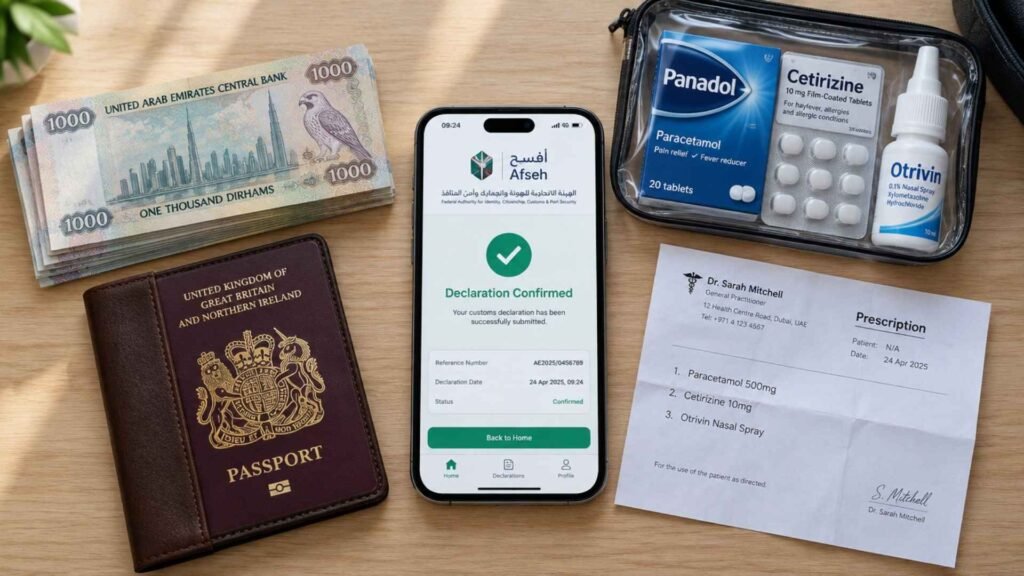
A medicine prescribed at home may be controlled in the UAE. Check the active ingredient, classification, quantity and required paperwork before placing it in your bag.
The Emirates Drug Establishment (EDE) currently describes electronic prior approval as an optional service for visiting travellers carrying narcotic or controlled medicines. Its guidance still requires supporting medical documentation for relevant medicines; optional online approval does not mean unrestricted import.
Prepare the prescription and medical report where required, and keep medicines identifiable in their original packaging. If your medicine’s classification is unclear, ask EDE for confirmation before travel.
Use the current EDE personal-medicines guidance to check the applicable conditions.
Keep customs preparation separate from visa preparation. Permission to enter the country does not authorise you to bring in restricted goods.
Cash and Valuables
Cash, bearer negotiable instruments, precious metals and stones with a combined value exceeding AED 60,000 or its equivalent must be declared when entering or leaving the UAE.
You can submit the declaration through ICP’s online disclosure service or the Afseh app. This is a customs declaration threshold, not a minimum amount tourists must carry.
6. Decide Whether Your Connection Requires UAE Entry

A connection that stays airside is different from a stopover that involves immigration. Leaving the airport to visit Dubai or sleep in a landside hotel requires permission to enter the UAE.
Airside transit passengers must also meet the entry and health requirements of their final destination.
You may also need entry permission if your itinerary requires you to collect baggage and check in again. Ask the airlines to confirm the actual baggage and transfer arrangements, particularly when travelling on separate tickets.
For the airport-side process, see our Dubai Airport Transit guide. For separate bookings, baggage collection and connection planning, use our Dubai Airport Self-Transfer guide.
If you need a transit visa for a landside stopover, establish your eligibility and arrange it through the appropriate provider before travelling.
7. Confirm Your Permitted Stay and Departure Date
Read the permission granted to you rather than relying only on the visa’s name.
Distinguish between:
- The deadline for first entering the UAE.
- The length of stay allowed after entry.
- Whether the permission allows one entry or several.
- Any cumulative limit covering repeat visits.
A visa’s entry-validity period and its permitted stay are different. For example, having several months in which to use a visa does not mean you may remain for that entire period.
For multiple-entry arrangements, check how the total allowance is calculated across visits. Returning to the UAE may use the remainder of an existing allowance rather than start a new one.
If your plans change, contact the relevant immigration authority before your authorised stay ends: GDRFA for Dubai-issued permissions or ICP for the relevant other emirates. Overstaying can result in daily fines, so plan around your confirmed departure deadline rather than an assumed grace period.
Common Mistakes to Avoid
- Assuming that everyone in a travel group has the same visa eligibility.
- Confusing GCC residence with GCC citizenship.
- Travelling with an application receipt instead of an approved visa.
- Using a previous trip’s stay allowance without checking current conditions.
Frequently Asked Questions about UAE Entry Requirements
Are UAE Entry Requirements Different for Dubai and Abu Dhabi?
Dubai and Abu Dhabi follow the UAE’s federal entry framework, but visa administration differs: GDRFA handles Dubai-issued permissions, while ICP handles the relevant services for Abu Dhabi and the other emirates.
Can I Enter the UAE with Less Than Six Months on My Passport?
For a standard tourist visit, your passport should have at least six months remaining from arrival; resident and airside-transit conditions should be checked separately.
Do I Need a Printed Visa for Dubai?
If you have an advance visa, carrying a printed copy is sensible. Emirates states that visitors referred for eye screening may need a hard copy of their visa or visa-number confirmation. Keep an offline digital copy as well.
Do UAE Entry Requirements Include Travel Insurance?
Relevant tourist visa routes require medical insurance valid in the UAE. Check your route’s conditions and whether any included policy covers your full visit.
Can I Leave Dubai Airport During a Layover?
Yes, if you qualify to enter the UAE and have enough time to complete immigration, make your visit and return for your onward flight.
Final Travel Check
Before departure, confirm your passport, entry route and authorised stay, then keep the documents for your actual itinerary together. Recheck temporary entry and health measures and medicine requirements close to travel.
For the next stage of your journey, our Dubai Airport Arrival Guide explains immigration, baggage and customs, while our Dubai Airport to City Centre guide helps you choose transport after arrivals.