
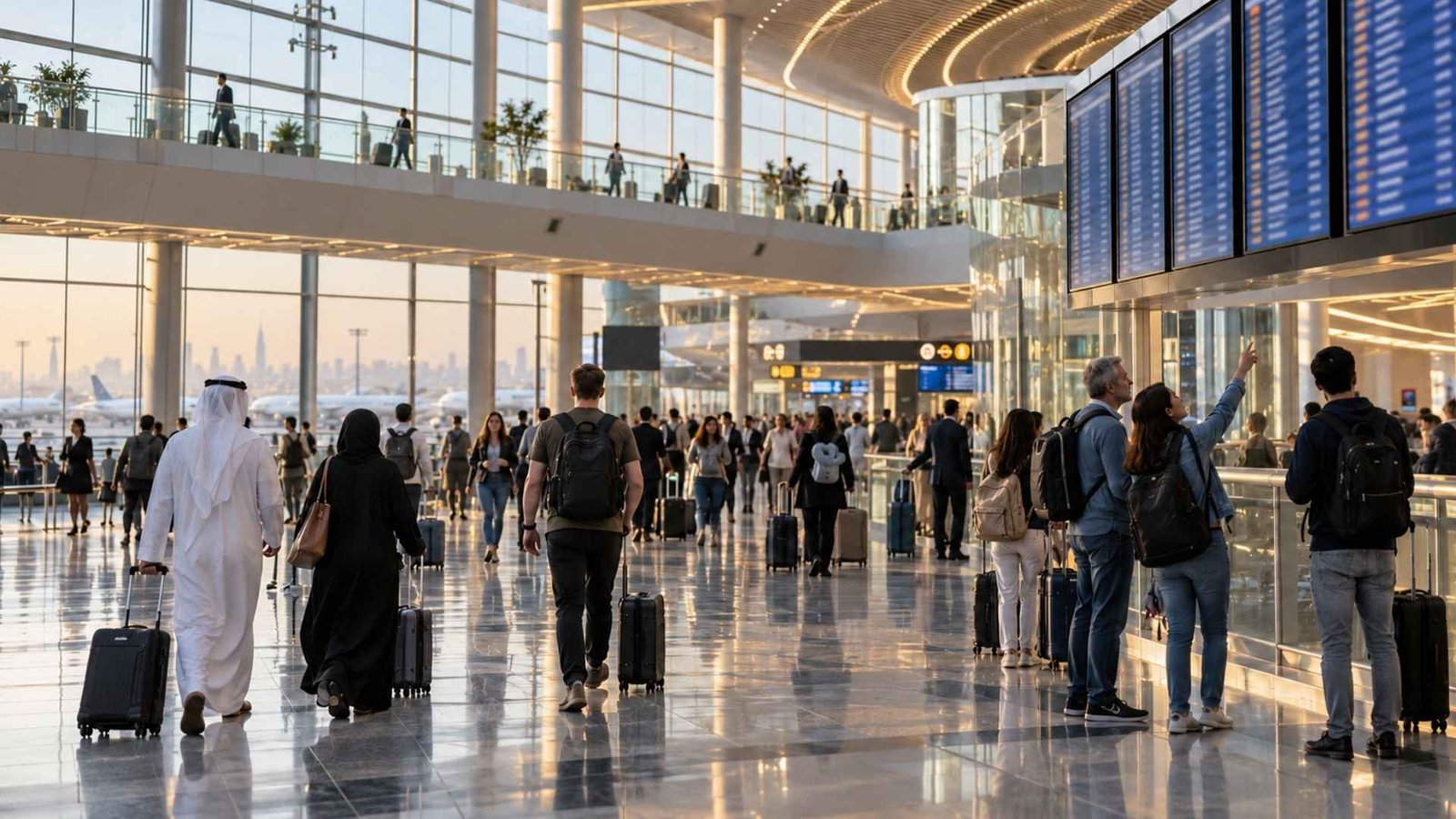
Dubai Airport transit is usually straightforward when your flights are on one protected ticket and your baggage is checked through. Most passengers remain airside and follow the Connections signs to their next gate.
Terminal changes, separate tickets or baggage collection can make the process more complicated. This guide explains the essential terminal, security, baggage, visa and connection-time rules for DXB.
Dubai Airport Transit: Quick Answer
For a protected connection at Dubai International Airport, follow Connections, not Arrivals or Baggage Reclaim.
Check the terminal and gate for your next flight, visit a transfer desk if you still need a boarding pass and complete transfer security when directed. You normally remain airside unless you must collect baggage, transfer landside, change airports or leave DXB during the layover.
| Your connection | What normally happens at DXB | Main risk |
|---|---|---|
| One through-ticket with bags checked through | Remain airside and follow Connections | Long distance to the next gate |
| One through-ticket without an onward boarding pass | Visit an airside transfer desk | Transfer-desk queues |
| Separate tickets with checked baggage | UAE entry and a new check-in may be required | Missing the onward check-in deadline |
| DXB to DWC | Enter the UAE and transfer between airports landside | Distance, traffic and entry requirements |
How Connecting Flights at Dubai Airport Work
The most important question is not whether both flights use the same airline. It is whether your journey was issued as one protected through-ticket and whether your checked baggage was accepted to the final destination.
Before leaving your origin airport, check:
- Whether your baggage tag shows your final airport code
- Whether you have received the onward boarding pass
- Which DXB terminal is currently listed
- Whether both flights operate from DXB rather than one from DWC
Keep the baggage receipt until you collect your suitcase at the final destination.
The Usual Airside Transit Process
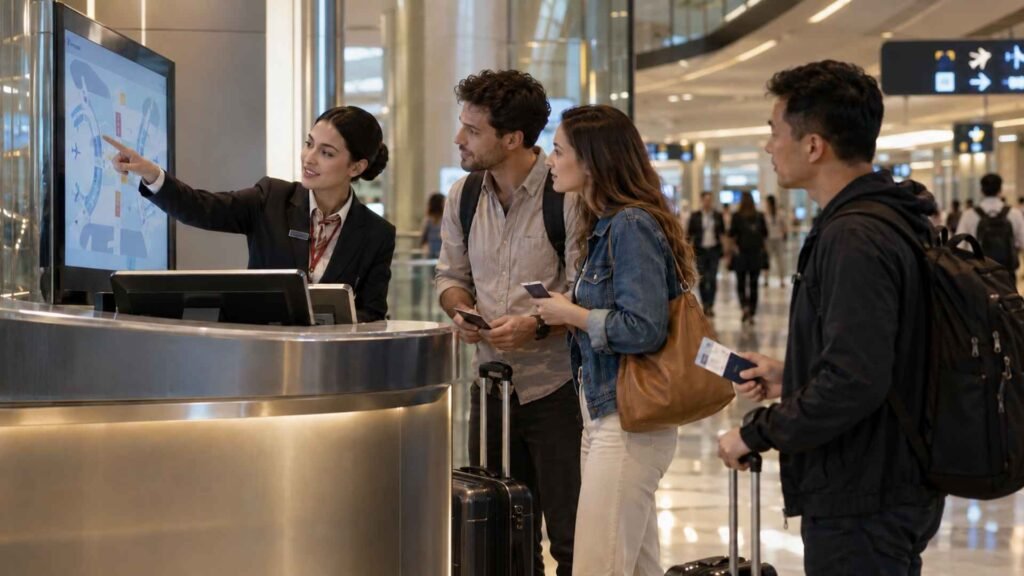
After leaving the aircraft:
- Follow the purple Connections or Transfers signs.
- Check the airport screens for your onward flight.
- Visit a transfer desk if you need a boarding pass or new instructions.
- Complete transfer security when directed.
- Follow the signed walkway, train or connection bus to the correct gate area.
- Check the screens again and reach the gate before the airline’s deadline.
Do not automatically follow other passengers towards Arrivals. Many people from your flight may be ending their journey in Dubai.
The official Dubai Airports transfer guidance confirms that transfer desks can issue onward boarding passes and help passengers find the correct connection route.
If your gate has not been announced, move towards the correct concourse and continue checking the screens rather than waiting near the arrival gate.
Understanding DXB Terminals and Concourses
DXB has three passenger terminals, but the gate letter often tells a connecting passenger more than the terminal number.
| Terminal | Gate area | Transit arrangement |
|---|---|---|
| Terminal 1 | D Gates | D Gates are reached by an airport train |
| Terminal 2 | F Gates | Physically separate from the main T1–T3 complex |
| Terminal 3 | A, B and C Gates | A uses a train; B and C are connected by airside walkways |
For a broader explanation of airlines, terminals and airport facilities, see our Dubai International Airport Guide 2026.
Airline terminal assignments and gates can change. Always prioritise the operating airline’s information, your boarding pass and the live airport screens.
Moving Within Terminal 3
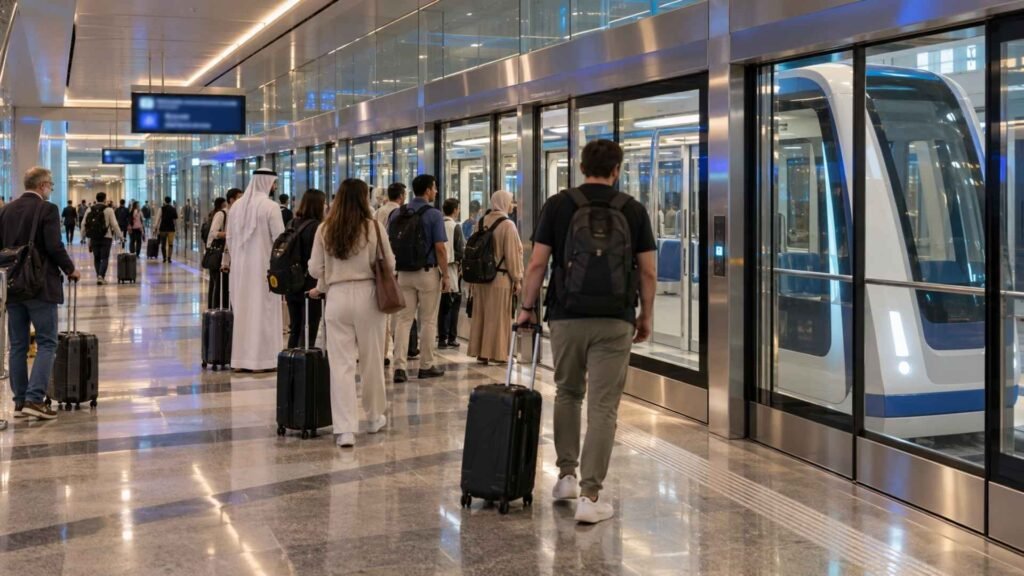
Two flights using Terminal 3 can still depart from distant concourses.
Allow time for the internal journey, particularly when moving between A and C. Follow the route displayed inside the terminal because staff may direct connecting passengers to a train, walkway or dedicated bus depending on the gates involved.
Do not stop for food, shopping or a lounge until you know your departure concourse and how long it will take to reach it.
Changing Terminals at DXB
A terminal change does not automatically mean that you must enter the UAE.
Passengers travelling on an eligible protected itinerary may be transferred airside between terminals under airline direction. This can involve a dedicated connection bus rather than a public landside journey.
Terminal 2 requires particular attention because it is physically separate from the main Terminal 1–Terminal 3 complex. Show your boarding pass to airline or airport staff and confirm the correct route before leaving the secure area.
If your airline cannot complete the transfer airside, the connection becomes a landside process and UAE entry requirements apply.
Clara’s Tip: Check the gate letter as soon as it appears. “Terminal 3” alone does not reveal whether you still need a long walk, an internal train or a connection bus.
Do You Go Through Security During Dubai Airport Transit?
Many international-to-international passengers complete another security screening at DXB.
The exact route depends on the arrival point, airline and onward gate. Plan for transfer security rather than assuming you can walk directly from one aircraft to the next.
Keep your passport and boarding pass accessible. Prepare your cabin baggage for screening and follow the instructions displayed at the checkpoint.
Security officers make the final decision about what can pass through. Liquids or duty-free purchases accepted at your departure airport may still be examined during transfer screening, so keep sealed purchases and their receipts together.
Do You Go Through Passport Control in Dubai?
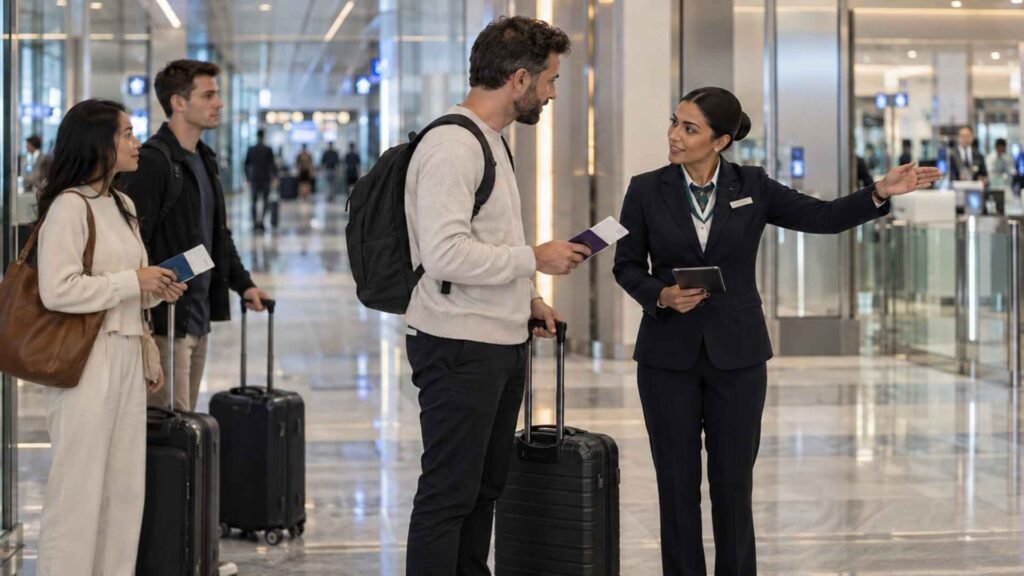
You do not normally clear UAE passport control when all of the following apply:
- You remain inside the international transit area.
- Your baggage is checked to the final destination, or you have cabin baggage only.
- You have the onward boarding pass or can obtain it at an airside transfer desk.
- Your airline supports the necessary airside connection.
You may need to enter the UAE when you must:
- Collect checked baggage
- Complete a new landside check-in
- Make a terminal transfer that your airline cannot arrange airside
- Change between DXB and DWC
- Leave the airport during the layover
- Use a landside hotel or service
The Landside Connection Process
If you must enter the UAE during a connection, the complete process may include:
- Passport control
- Baggage reclaim, when required
- Customs
- A landside terminal or airport transfer
- Check-in or baggage drop for the onward flight
- Departure security
- Travel to the new boarding gate
This sequence should be included only when calculating a landside connection. It does not apply to most protected passengers who remain within the airside transfer route.
Our Dubai Airport Arrival Guide 2026 explains immigration, baggage reclaim and customs in detail.
Do You Need a Dubai Transit Visa?
Remaining airside for a standard international connection does not normally require a UAE transit visa.
You must still satisfy the passport, visa and entry requirements for your final destination. Your airline may check those documents before allowing you to board the flight to Dubai or before issuing the onward boarding pass.
If you need to pass through UAE immigration, your nationality and travel documents determine whether you can:
- Enter without arranging a visa in advance
- Receive entry permission on arrival
- Apply for a visa before travelling
Do not assume that having a long layover automatically gives you permission to leave the airport.
Dubai’s immigration authority offers 48-hour and 96-hour transit visas for eligible travellers who need to enter the country. According to the GDRFA transit visa service, applications are submitted through approved airlines and require a passport or travel document valid for at least six months, a recent photograph and proof of onward travel.
Visa fees and service charges depend on the sponsoring airline and application channel. Check the final amount and eligibility directly with the airline before applying.
Arrange the necessary permission before travelling. A transit visa should not be treated as something that can always be obtained after landing.
What Happens to Checked Baggage During Dubai Airport Transit?
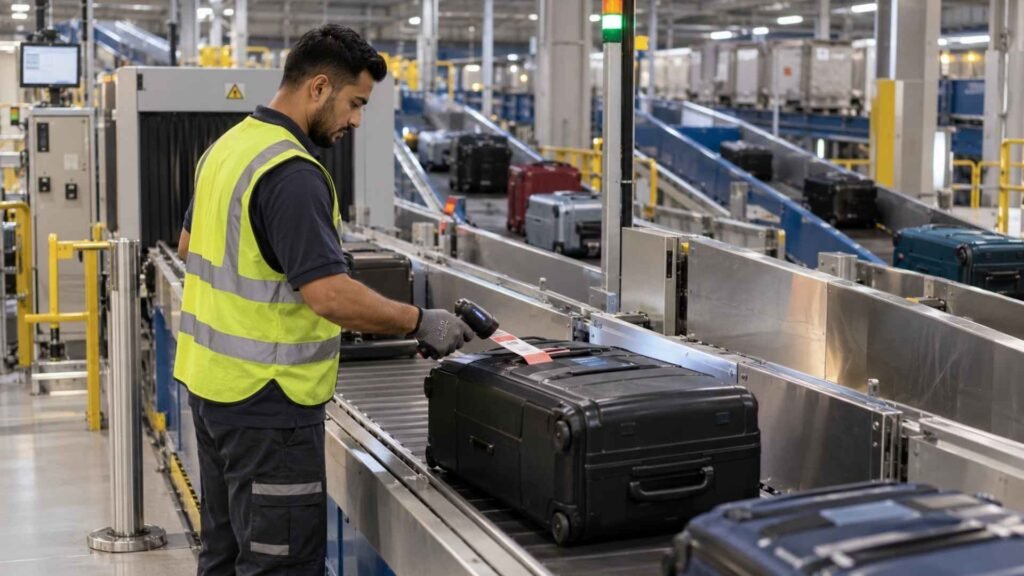
The baggage tag is the most reliable first indication of where your suitcase will be delivered.
Do not rely only on the fact that both flights appear in the same confirmation email. Ask the check-in agent and read the destination code printed on the tag.
If Baggage Is Checked to the Final Destination
Continue through Connections without visiting baggage reclaim.
Your airline or its handling partner should transfer the bag to the onward flight. Keep the baggage receipt until the suitcase reaches your final destination.
Baggage arrangements depend on the airline, partner agreement and ticket. Always confirm the destination printed on your own tag.
If Baggage Is Tagged Only to Dubai
If the baggage tag ends at DXB, you may need to enter the UAE and complete the landside connection process described above.
That requires both permission to enter the country and enough time to meet the onward airline’s check-in and baggage-drop deadlines.
Dubai Airports states that separate-ticket passengers who cannot enter Dubai may ask Marhaba Services about paid baggage-transfer assistance at a transfer desk. Availability depends on the itinerary and should not be treated as a guaranteed solution.
Protected Connection or Self-Transfer?
A protected connection is normally issued as one through-ticket. If an inbound delay causes you to miss the onward flight, the ticketing airline generally manages rebooking according to its conditions of carriage.
With separate tickets, you may need to enter the UAE, collect baggage and check in again. You are also responsible for reaching the next flight before its check-in deadline.
The airline logos alone do not confirm whether a connection is protected. Check how the tickets were issued and where the baggage will be delivered.
How Much Connection Time Do You Need at DXB?
There is no single safe connection time for every Dubai itinerary.
Airlines calculate minimum connection times according to the flights, terminals and ticket arrangements. If an airline sells the journey as one protected itinerary, the scheduled connection should meet its applicable operational minimum.
That does not necessarily make the connection comfortable.
The ranges below are ClaraTravels planning buffers, not official DXB minimum connection times.
| Scheduled layover | Practical assessment for a protected connection |
|---|---|
| Under 90 minutes | Tight; proceed directly and rely on airline protection |
| 90 minutes–2 hours | Often workable, but with limited recovery time |
| 2–3 hours | A more comfortable target for many protected connections |
| 3–4 hours | Preferable when changing terminals or airlines, or when extra assistance is needed |
| 5+ hours | Usually comfortable airside, but leaving DXB requires a separate calculation |
Allow additional time when:
- Terminal 2 is involved.
- You need to visit a transfer desk.
- Your arriving aircraft parks at a remote stand.
- You are travelling with children.
- You require mobility assistance.
- The onward gate has not yet been confirmed.
These ranges should not be used as safe self-transfer times. Separate-ticket passengers may also need to account for immigration, baggage delivery, customs, landside transport and the onward airline’s check-in closure.
Can You Leave Dubai Airport During a Layover?
You can leave DXB only if you are permitted to enter the UAE and have enough time to complete the arrival and return processes.
Your usable time in Dubai begins after immigration and transport into the city. It ends early enough for you to return to the airport, complete any necessary check-in, clear security and reach the boarding gate.
A six-hour scheduled layover therefore does not provide six full hours in the city.
If the remaining sightseeing time is limited, staying airside may be the more sensible choice. Lounges, sleeping facilities and the airside Dubai International Hotel can make a long transit more comfortable without entering the UAE.
DXB to DWC Is Not a Terminal Change
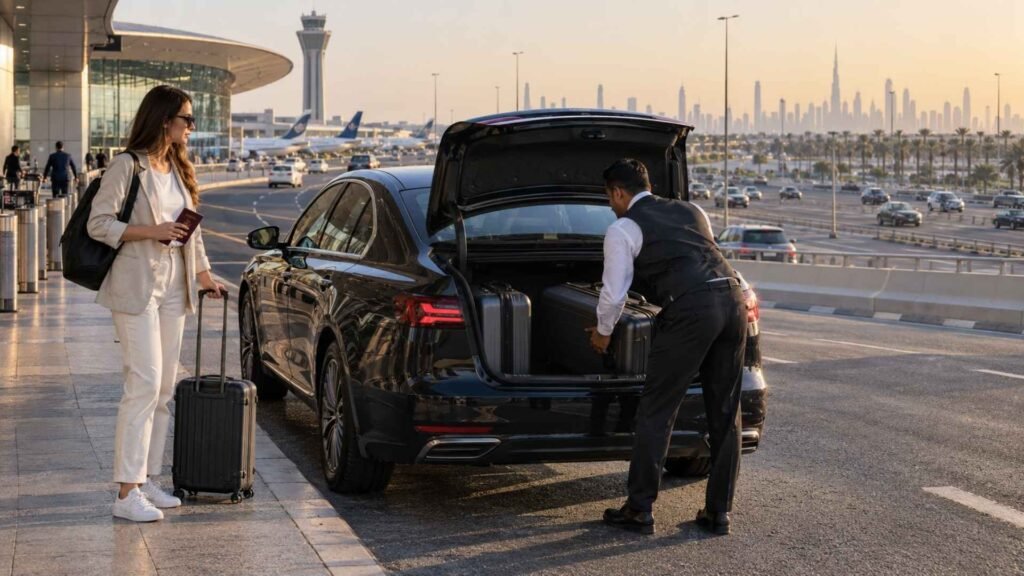
Dubai International Airport and Al Maktoum International Airport are different airports.
Dubai Airports places DXB and DWC approximately 60 kilometres apart, and there is no airside connection between them.
Passengers making this change must be eligible to enter the UAE and complete a landside journey. Checked baggage must also be collected when it is not transferred under a specific airline arrangement.
Treat DXB–DWC as an airport change requiring a generous buffer, confirmed entry permission and a reliable transport plan. Traffic and public transport can make the actual journey longer than the map suggests.
What to Do If Your Incoming Flight Is Delayed
Check the airline app before landing, but verify the final gate on the DXB flight information screens.
Once inside the terminal:
- Follow Connections immediately.
- Look for airline representatives if the connection is very short.
- Confirm the latest gate and boarding status.
- Visit the transfer desk if the onward flight has closed or disappeared from your booking.
- Avoid stopping until you know how far away the gate is.
On a protected ticket, let the airline manage any required rebooking.
With separate tickets, contact the onward airline as soon as you know you may miss check-in. The second airline may treat you as a no-show because it is not responsible for a delay affecting an independently booked flight.
Dubai Airport Transit Checklist
Before Departure
- Confirm that both flights operate from DXB.
- Check whether the journey is one through-ticket or separate tickets.
- Verify where checked baggage will be delivered.
- Save both boarding passes and the baggage receipt.
- Check UAE entry requirements if a landside step may be necessary.
- Confirm the terminal used by the operating airline.
- Request assistance in advance when required.
After Landing
- Follow Connections rather than Arrivals.
- Check the latest terminal, gate and boarding time.
- Visit a transfer desk if your onward boarding pass is missing.
- Complete transfer security when directed.
- Ask before leaving the secure area for a terminal change.
- Reach the correct concourse before stopping for food, shopping or a lounge.
Frequently Asked Questions About Dubai Airport Transit
Do I Need a Visa for Dubai Airport Transit?
Usually not if you remain airside, your baggage is checked through and your airline supports the connection.
You may need UAE entry permission if you must collect baggage, transfer landside, change airports or leave DXB during the layover.
Do I Have to Collect My Luggage During a Connection in Dubai?
Not when the baggage is tagged to your final destination on an eligible through-ticket.
If the tag ends at DXB, you may need to enter the UAE and complete a new landside check-in.
Do I Go Through Security Again at Dubai Airport?
Many connecting passengers pass through transfer security.
The exact route depends on the arrival flight and onward gate, so keep your documents accessible and follow the airport signs.
Can I Walk From Terminal 1 to Terminal 3 at DXB?
Do not plan to walk between the terminals landside.
Eligible protected passengers may be transferred airside under airline direction. Passengers travelling landside can use road transport or the Dubai Metro between Terminals 1 and 3 when it is operating.
How Do I Transfer Between Terminal 2 and Terminal 3?
Eligible through-ticket passengers may use an airside connection bus arranged under airline direction.
Separate-ticket passengers may need to enter the UAE and transfer landside. Ask at Connections before leaving the secure area.
Is a Two-Hour Layover Enough in Dubai?
A two-hour layover is often workable on a protected through-ticket, particularly when baggage is checked through.
It may still feel tight after an inbound delay, transfer security queue or terminal change. Two hours is not a universal recommendation for separate tickets.
Can I Leave DXB During an Eight-Hour Layover?
Possibly, provided you can legally enter the UAE and retain enough time for immigration, transport and the complete return-to-gate process.
Calculate the usable time in the city rather than relying only on the scheduled layover.
Final Thoughts
Dubai Airport transit is easiest when the journey is protected, the baggage tag shows the final destination and you remain within the Connections route. The gate letter and ticket arrangement usually matter more than the terminal number alone.
Confirm the details before departure, check them again after landing and do not leave the secure area until you know that a landside transfer is necessary.