

A Rome Fiumicino Airport self-transfer can be practical and economical, but it is not the same as an airline-protected connection. When flights are booked on separate tickets, you may need to enter Italy, collect checked baggage, clear customs, check in again and pass through security before reaching the next gate.
For most separate-ticket itineraries at FCO, allow at least 4–5 hours between flights. Use 5–6 hours or an overnight stay when baggage, passport control, the Entry/Exit System or a costly replacement flight increases the risk. The second airline will not normally wait or rebook you free of charge if the first flight is late.
Rome Fiumicino Airport Self-Transfer: Quick Answer
Yes, self-transfer is allowed at Rome Fiumicino Airport. However, you are responsible for completing every arrival and departure formality before the second airline’s check-in, baggage-drop and boarding deadlines.
| Question | Practical answer |
|---|---|
| Are separate-ticket connections allowed? | Yes, provided you meet the entry, transit and travel-document rules for the entire itinerary. |
| Must checked baggage be collected? | Usually yes, unless the first airline confirms that it has tagged the bag to the final destination. |
| Is a visa needed? | Possibly. If you must leave the international transit area, you need permission to enter Italy and the Schengen Area. |
| How much time is safest? | Allow at least 4–5 hours; use 5–6 hours for checked baggage or an external-border crossing. |
| Are Terminal 1 and Terminal 3 connected? | Yes. They are connected by landside pedestrian routes, but always verify the live departure terminal and gate. |
| What if the first flight is delayed? | The onward airline may treat you as a no-show because the flights are on separate bookings. |
If both flights are on one reservation and the airline is responsible for the connection, read our Rome Fiumicino Airport Transit Guide instead.
What Is a Rome Fiumicino Airport Self-Transfer?
A self-transfer occurs when you combine independently booked flights and manage the connection yourself. The tickets may involve different airlines, two separate reservations with the same airline or a booking platform that labels the itinerary as a “self-transfer.”
The important point is not whether the airlines share a brand or alliance. It is whether both flights appear on a single protected reservation and the carriers have accepted responsibility for the connection.
| Protected connection | Self-transfer |
|---|---|
| Flights are normally issued as one journey | Flights are held on separate tickets or reservations |
| Checked baggage is often transferred to the final destination | Baggage normally needs to be collected and checked again |
| The airline may rebook you after a qualifying missed connection | You may need to buy a replacement ticket |
| An airside transfer route may be available | You may have to enter Italy and return through departures |
| Airline systems recognise the onward flight | Each airline may treat its flight as a separate journey |
Why Do Travellers Choose a Self-Transfer?
Travellers usually choose a self-transfer because separate tickets can be cheaper, provide more departure-time options or create routes that are not available on one reservation.
Compare the saving with checked-baggage fees, a longer layover, an airport hotel, insurance and the cost of a replacement ticket. If the saving is small, a protected connection usually offers better value. A self-transfer makes more sense when the price difference is substantial and later flights are available.
Some booking websites offer their own guarantee, which is not the same as airline protection. Check the minimum-layover and documentation rules, claim process and whether you must pay for a replacement flight before seeking reimbursement.
Is a Rome Fiumicino Airport Self-Transfer Allowed?
Rome Fiumicino Airport does not prohibit passengers from combining separate tickets. The practical question is whether your itinerary gives you enough time and whether you can legally complete every required step.
Before booking, confirm:
- the scheduled arrival and departure terminals;
- whether the first airline will through-check baggage;
- when the second airline closes check-in and baggage drop;
- whether online check-in is available;
- whether you must pass passport control at FCO;
- your right to enter Italy if you need to go landside;
- the price and frequency of later flights if the connection fails.
A connection that looks possible from the timetable can become unrealistic once deplaning, a remote-stand bus, passport control, baggage delivery and the onward airline’s deadlines are included.
Step-by-Step Self-Transfer Process

The exact route depends on the origin, destination, baggage and airline. The following sequence covers the most common full Rome Fiumicino Airport self-transfer.
1. Check Your Baggage Tag and Onward Boarding Pass
At the first airport, ask where your checked bag is tagged. The airport code printed at the end of the baggage receipt is more reliable than a verbal assumption.
If the tag ends in FCO, collect the bag in Rome. If it shows the final destination, ask the airline to confirm that it is accepted on the separate onward booking. Through-checking depends on airline agreements and is never guaranteed.
Complete online check-in for the second flight as soon as it opens and save the boarding pass offline. A mobile boarding pass does not remove the need for a document check or baggage drop when the airline requires one.
2. Follow Arrivals Unless an Airside Transfer Is Confirmed
After landing, do not automatically follow Flight Connections signs. Those routes are mainly designed for passengers whose connection is recognised by the airline.
Follow Arrivals if you need to collect baggage, visit a landside check-in counter or change to a flight that cannot be reached through the airside route. Only remain in transit when you have carry-on baggage, a valid onward boarding pass, compatible arrival and departure zones, and confirmation that the airline does not require landside processing.
3. Complete Passport Control When Required
Passengers arriving from outside the Schengen Area and entering Italy must pass border control at Fiumicino. Travellers arriving from another Schengen country normally do not complete arrival passport control.
Non-EU short-stay travellers crossing an external Schengen border may also be processed through the Entry/Exit System. First-time biometric registration, queue conditions and document questions can make this stage less predictable.
4. Collect Checked Baggage
Check the information screens for the correct carousel and keep the baggage receipt available. Delivery may take longer after a remote-stand arrival or during busy periods.
If the bag does not arrive, report it to the first airline’s handling agent before leaving the baggage hall. Do not continue to the second flight without creating a baggage report unless the handler confirms that the bag was through-checked.
Our Rome Fiumicino Airport Arrival Guide explains passport control, baggage reclaim and customs in more detail.
5. Pass Customs and Enter the Public Arrivals Area
After baggage reclaim, use the appropriate customs channel. The green channel is for travellers with nothing to declare; use the red channel if you carry goods, cash or restricted items that must be declared.
Once you enter the public arrivals hall, the arrival portion of the journey is complete. You are now effectively starting a new departure from FCO.
6. Reach the Correct Check-In Area
Check the airport screens and the onward airline’s app before leaving the arrivals area. Follow the signs to the departure terminal and check-in row displayed for your flight. If your departure uses a different terminal, use the signed landside pedestrian route described below. Complete any required document check or baggage drop before continuing to security.
7. Pass Security, Passport Control and Reach the Gate
All landside self-transfer passengers must pass security again. If the onward flight leaves the Schengen Area, complete exit passport control after security before continuing to the assigned boarding area.
Check the gate repeatedly. Boarding Areas A and E help with orientation, but live information matters more than the terminal assumed when booking. Reach the gate before using shops, restaurants or lounges.
Do You Need to Collect and Recheck Baggage?
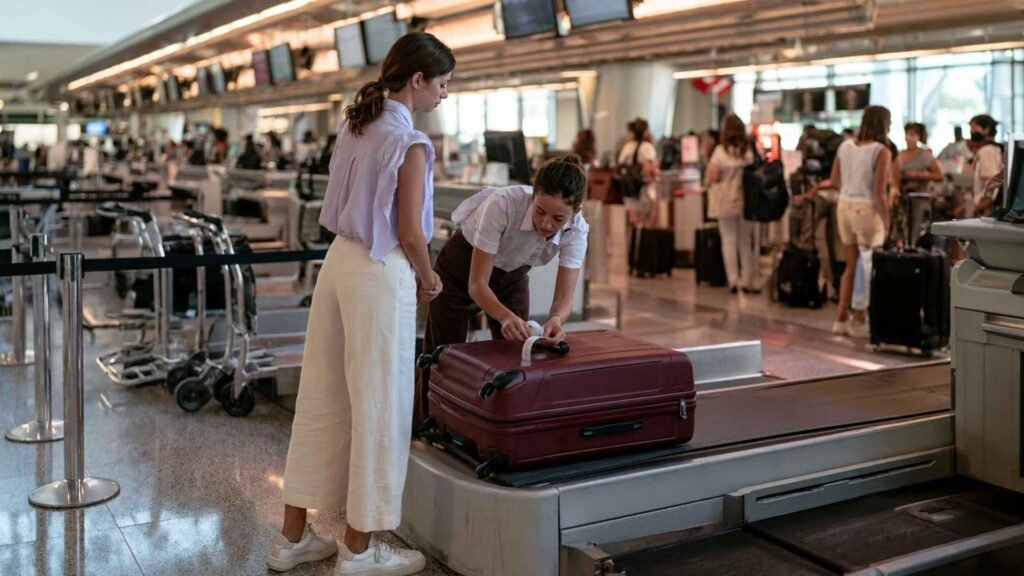
For most Rome Fiumicino Airport self-transfer itineraries with checked luggage, the answer is yes. Separate tickets create separate baggage contracts, so the first airline normally accepts responsibility only as far as FCO.
You may avoid baggage reclaim only when the airline explicitly checks the bag through to the final destination. This can depend on the carriers, ticket types, interline agreements, check-in system and the agent’s ability to link the bookings.
Check the baggage tag before leaving the first airport. If it ends at FCO—or the airline cannot confirm through-checking—follow Step 1 above and collect the bag in Rome. A shared airline group or alliance is not proof that baggage will transfer.
Check the onward baggage-drop deadline as well. A bag delivered to the carousel after that deadline can make the second flight impossible even when boarding has not started.
Passport Control, Customs and Security
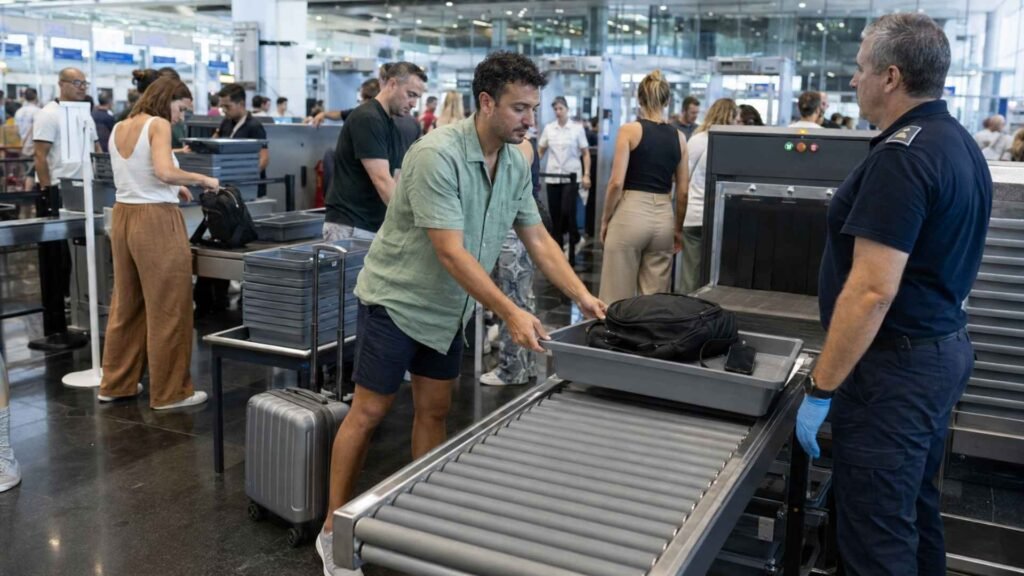
Passport control is based on whether you cross the Schengen external border. Customs is based on where you and your goods are arriving from. These are different systems, and the Schengen Area is not identical to the EU customs territory.
| Self-transfer route | Likely formalities at FCO |
|---|---|
| Schengen to Schengen | Baggage reclaim if required, customs where applicable, check-in and security |
| Non-Schengen to Schengen | Entry passport control, baggage reclaim, customs, check-in and security |
| Schengen to non-Schengen | Baggage reclaim if required, check-in, security and exit passport control |
| Non-Schengen to non-Schengen with landside processing | Entry passport control, baggage reclaim, customs, check-in, security and exit passport control |
| Non-Schengen to non-Schengen entirely airside | Transit security and airline document checks may apply; baggage and visa conditions must be confirmed in advance |
The EU Entry/Exit System began its progressive rollout in October 2025 and became fully operational at external border crossing points on 10 April 2026. It digitally records the entry and exit of eligible non-EU short-stay travellers and may include facial-image and fingerprint collection. Allow additional time if this is your first EES registration. The official EU EES and ETIAS timeline provides the current implementation schedule.
Security is required whenever you return from the public terminal to the departure area. Booking Fast Track may reduce the security-queue risk, but it does not accelerate baggage reclaim, airline check-in, customs or passport control. Check eligibility and limitations in our Rome Fiumicino Airport Fast Track guide.
Terminal 1 – Terminal 3 Transfers

Fiumicino’s two main operating terminals are in the same airport complex and connected by pedestrian routes. A landside Terminal 1–Terminal 3 change is straightforward, but it still consumes connection time.
The main risk is following an old terminal assignment. Airlines, check-in rows and gates can change. Use the airport’s live screens after arrival, then follow the terminal, security and boarding-area signs for the second flight.
Do not confuse a terminal change with the walk to a distant gate. Even within one terminal, passport control, a remote gate or an apron bus can add time.
For terminal layout and airport facilities, see our complete Rome Fiumicino Airport Guide.
Minimum Safe Connection Times
There is no official minimum connection time that protects a self-transfer on separate tickets. The following times are Clara Travels planning recommendations, not airport guarantees.
| Itinerary | Recommended time between scheduled flights |
|---|---|
| Carry-on only, Schengen to Schengen, boarding pass ready | At least 4 hours |
| Carry-on only with passport control or a terminal change | 4–5 hours |
| Checked baggage with straightforward entry and recheck | At least 5 hours |
| Checked baggage plus EES, passport control or a non-Schengen departure | 5–6 hours |
| Last flight of the day, separate long-haul tickets or expensive replacement | Overnight preferred |
Add more time during holidays and peak travel periods, or when travelling with children, reduced mobility, complex documents or oversized baggage. A longer buffer is also sensible if the first flight is frequently delayed or the onward route operates only once per day.
Clara’s Tip:
Measure the usable connection from scheduled arrival to the second airline’s check-in or baggage-drop deadline—not to departure time. If a flight lands at 10:00 and the onward bag drop closes at 14:00, a 15:00 departure gives you four usable hours, not five.
Carry-On-Only vs Checked-Baggage Connections
A carry-on-only Rome Fiumicino Airport self-transfer removes the least predictable part of the process: waiting for the first airline to deliver baggage. It may also allow an airside connection when the routing is compatible and the onward boarding pass is already issued.
However, carry-on only does not guarantee that you can remain airside. You may still need to visit a check-in desk for a passport, visa or destination-document check. Airport routing may also direct arriving passengers landside depending on the origin and departure zones.
Checked baggage makes the connection more vulnerable because you must normally:
- reach the correct baggage hall;
- wait for the carousel;
- clear customs;
- find the onward check-in area;
- recheck the bag before the airline’s deadline.
If the fare saving is small, a protected connection or a carry-on-only itinerary is usually better than a short self-transfer with checked luggage.
What Happens If the First Flight Is Delayed?

The main delay risk in a Rome Fiumicino Airport self-transfer is that the first airline’s responsibility generally ends with its own flight. The second airline may record you as a no-show if you miss check-in, baggage drop or boarding, even when the delay was outside your control.
EU missed-connection protection is associated with flights booked as part of a single reservation; it should not be assumed for independently purchased tickets. A booking platform’s self-transfer guarantee or specialist travel insurance may help, but only under its stated conditions.
If the first flight is delayed:
- check the revised arrival time and the onward flight status;
- complete online check-in if it is still available;
- contact the second airline before its deadline;
- ask whether the ticket can be moved for a fee;
- review the platform guarantee or insurance claim procedure;
- keep delay notices, boarding passes and receipts;
- check whether missing the flight will cancel later segments on the same onward booking.
Do not wait until reaching FCO to investigate alternatives. If the connection is clearly impossible, contacting the onward airline early may preserve more options than becoming an unexplained no-show.
Overnight Self-Transfers
An overnight Rome Fiumicino Airport self-transfer is the safest choice when the onward flight is the last service of the day, operates infrequently or would be expensive to replace. It also gives more flexibility if the incoming long-haul flight is delayed.
After collecting baggage, expect to remain landside until the second airline opens check-in or baggage drop. Do not assume you can enter the secure departure area immediately after arrival. Terminal seating, food options and other services may be limited overnight, so sleeping inside the airport should be treated as a backup rather than a comfortable plan.
A landside airport hotel is usually the more reliable option, especially with children, substantial luggage or an early long-haul departure. Make sure your entry permission allows you to leave the international transit zone. Our forthcoming Rome Fiumicino Airport Hotels guide will compare terminal-connected and nearby properties.
Transit Visa and Schengen Entry Requirements
Visa rules are one of the most important parts of a Rome Fiumicino Airport self-transfer. An airport transit visa and permission to enter the Schengen Area are not interchangeable.
An airport transit visa allows eligible travellers to remain within an international transit area while waiting for an onward flight. It does not allow the holder to enter Italy. The European Commission’s Schengen visa guidance makes this distinction clear.
You may need permission to enter the Schengen Area if you must:
- collect and recheck baggage;
- visit a landside airline desk;
- move through the public arrivals or departures halls;
- stay at a landside hotel;
- take a Schengen domestic or regional flight after arriving from outside Schengen.
If you are visa-exempt, check passport validity and entry conditions. If you require a Schengen visa, confirm that it covers Italy, the travel dates and the necessary number of entries. A previously used single-entry visa may not permit another entry.
As of August 2026, ETIAS is not operational and applications are not being accepted. The European Union has not announced a launch date and says the specific date will be published several months before the system starts. Visa-exempt non-EU travellers should check the official ETIAS website before departure.
Airlines check travel documents before boarding. If you cannot show that you are allowed to enter Italy or continue to your final destination, you may be refused boarding at the first airport. Check official Italian and EU requirements before booking, and contact the airline or relevant consulate if your route is unclear.
Common Self-Transfer Mistakes
Most Rome Fiumicino Airport self-transfer problems begin with one of the following planning mistakes.
Assuming the Airline Will Transfer the Bag
Separate bookings usually mean separate baggage handling. Check the printed tag and obtain confirmation instead of relying on the airlines’ alliance or shared branding.
Treating Scheduled Arrival as the Start of Free Time
Landing time does not include taxiing, deplaning, a bus from a remote stand or the walk to passport control and baggage reclaim.
Ignoring Check-In and Baggage-Drop Deadlines
The relevant deadline may be 40–60 minutes or more before departure, depending on the airline and destination. Use the airline’s published deadline for your specific flight.
Confusing an Airport Transit Visa with Entry Permission
If the process takes you landside, an airport transit visa alone does not authorise entry into Italy.
Relying on a Fixed Terminal or Gate
Terminal 1 and Terminal 3 are useful planning references, but operational assignments can change. Check live information on arrival.
Booking the Final Flight of the Day Without a Backup
A missed evening departure can create an unplanned hotel stay and a costly next-day ticket. An overnight connection is often better when alternatives are limited.
Frequently Asked Questions
Can I self-transfer at Rome Fiumicino Airport?
Yes. You can connect on separate tickets, but you are responsible for baggage, check-in, documents, security and reaching the gate on time.
How Long Should I Allow, and Is Two Hours Enough?
Allow at least 4–5 hours for most separate-ticket connections and 5–6 hours when checked baggage, passport control or EES processing is involved. Two hours is not recommended because it provides almost no protection against arrival delays, baggage delivery, check-in closure or security queues.
Can I stay airside on separate tickets at Fiumicino?
Possibly, if you have carry-on baggage only, an onward boarding pass, compatible airside routing and no landside document check. Confirm this with both airlines before travel.
Do I have to collect baggage between separate flights?
Usually yes. You can leave it in the system only when the airline has confirmed through-checking and the baggage tag shows the final airport.
Will the airline rebook me if I miss the second flight?
Not automatically. Because the tickets are separate, the onward airline may apply its normal no-show or fare-change rules.
Do I need a Schengen visa for a self-transfer at FCO?
It depends on your nationality and route. If you must enter Italy to collect baggage, check in again or stay landside overnight, you need valid Schengen entry permission; an airport transit visa alone is not enough.
Do I Need ETIAS for a Self-Transfer at FCO?
Not as of August 2026. ETIAS is not operational, applications are not being accepted and the EU has not announced a launch date. Once it begins, visa-exempt non-EU travellers entering the Schengen Area during a self-transfer may need authorisation; travellers remaining airside should verify the rules for their route.
Is an overnight self-transfer safer?
Yes, particularly when travelling with checked baggage, using an infrequent onward flight or arriving on a delay-prone long-haul service. Confirm hotel location, terminal access and visa requirements before booking.
Final Thoughts
A Rome Fiumicino Airport self-transfer is manageable when you allow at least 4–5 hours, verify the baggage destination and check the entry rules before travel. Choose a longer or overnight connection when missing the next flight would be costly.
For the safest Rome Fiumicino Airport self-transfer, work backwards from the onward airline’s deadlines and never treat separate tickets as a protected connection.