

Landing at Rome Fiumicino Airport is usually straightforward, but your route through the terminal depends on where your flight originated, whether Rome is your final destination and whether you need to collect checked baggage.
This Rome Fiumicino Airport Arrival guide follows the journey from the aircraft door to the public arrivals hall, covering passport control, EES, baggage reclaim, customs and onward transport.
Quick Answer: Rome Fiumicino Arrivals at a Glance
If Rome is your final destination, follow “Arrivals” or “Baggage Reclaim.” If you have another flight, follow “Flight Connections” or “Transiti.”
| Arrival situation | Passport control? | Collect baggage? | Next step |
|---|---|---|---|
| Arriving from Schengen | Usually no | Yes, if Rome is your final stop | Baggage reclaim and customs |
| Arriving directly from outside Schengen | Yes | Yes, if Rome is your final stop | Immigration, baggage and customs |
| Non-Schengen to Schengen connection | Yes | Depends on the baggage tag | Immigration, then connections |
| Schengen to Schengen connection | Usually no | Usually no on a through-ticket | Follow connection signs |
| Non-Schengen to non-Schengen connection | Route-dependent | Usually no on a through-ticket | Remain within the transfer route |
| Separate-ticket self-transfer | Possibly | Usually yes | Collect bags and check in again |
Allow approximately 30–60 minutes to reach the public arrivals hall in ordinary conditions. Immigration, first-time EES registration, remote stands and baggage delays may extend this time; your exact route depends on your itinerary, ticket and baggage tag.
The 9 Essential Steps After Landing at Rome Fiumicino Airport
The arrival route at Fiumicino depends on where your flight originated, whether Rome is your final destination and how your baggage has been tagged. The following nine steps explain what to expect from the moment you leave the aircraft until you reach the public arrivals hall.
For wider information about terminal layouts, airport facilities, security, shopping and lounges, see our complete Rome Fiumicino Airport Guide.
1. Leave the Aircraft and Check the First Signs
Fiumicino uses both terminal-connected gates and remote aircraft stands. If your flight arrives at a remote stand, buses will take passengers from the aircraft to the appropriate terminal entrance.
This can add time before you even reach immigration or baggage reclaim. Keep your boarding pass and passport accessible because airport or airline staff may direct different groups of passengers towards separate arrival or transfer routes.
Inside the terminal, look for one of these signs:
- Arrivals
- Baggage Reclaim
- Passport Control
- Flight Connections or Transiti
- Uscita, meaning exit
Do not automatically follow the largest group of passengers. People from the same flight may be separating into arrivals, Schengen connections and non-Schengen connections.
Clara’s Tip: Before landing, save a screenshot of your next boarding pass and baggage receipt. Mobile data may not connect immediately, and both documents can become important if your gate changes or your bag does not arrive.
2. Choose Between Arrivals and Flight Connections
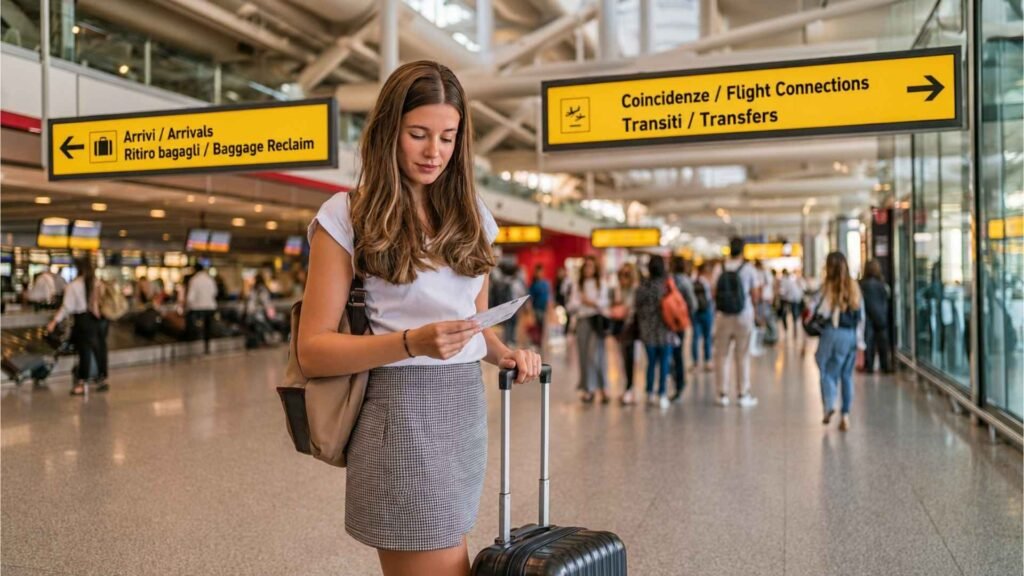
After entering the terminal, check the overhead signs before following the main passenger flow. The correct route depends on whether Rome is your final destination or you are continuing to another flight.
Follow “Arrivals” or “Baggage Reclaim” if:
- Rome is your final destination.
- Your baggage tag ends in FCO.
- You are completing a separate-ticket self-transfer and must collect checked luggage.
- Your airline has instructed you to leave the restricted area and check in again.
Follow “Flight Connections” or “Transiti” if:
- You have another flight departing from Fiumicino.
- Your checked baggage has been tagged to your final destination.
- Your itinerary allows you to remain within the designated transfer route.
Do not assume that having a boarding pass automatically means you can stay airside. Separate tickets, baggage arrangements and entry requirements may still require you to pass through immigration, collect your luggage and check in again.
Before choosing a route, confirm the final airport code printed on your baggage receipt. If it shows FCO, you will normally need to collect your bag in Rome. If it shows your onward destination, follow the connection signs unless your airline has given different instructions.
Passengers travelling on separate tickets should allow considerably more time because they may need to enter Italy, reclaim baggage, change terminal areas, complete check-in and pass through security again.
The forthcoming Rome Fiumicino Airport Transit Guide and Rome Fiumicino Airport Self-Transfer Guide will explain connection routes, baggage rules and recommended transfer times in greater detail.
3. Understand Schengen and Non-Schengen Arrivals
The most important factor after landing is not your nationality but the route from which you arrived.
Arriving from a Schengen Country
Flights arriving from another Schengen country are normally treated as internal arrivals. Passengers usually do not pass through routine border control at Fiumicino and can proceed towards baggage reclaim or their connecting flight.
For example, if you flew Istanbul–Paris–Rome and completed Schengen entry formalities in Paris, your Paris–Rome flight normally arrives as a Schengen service. You would not usually complete passport control again in Rome.
Temporary internal border controls or exceptional checks remain possible, so you should keep your passport or accepted travel document available.
Arriving Directly from Outside the Schengen Area
Passengers arriving directly from countries such as Türkiye, the United Kingdom, the United States, Canada or Japan normally pass through passport control at Fiumicino before reaching baggage reclaim.
The queue you use will depend on your passport, residency status and eligibility for automated border-control gates. Follow the lane signs displayed on the day rather than choosing a queue based only on what another passenger is doing.
Connecting Between Schengen and Non-Schengen Flights
If you arrive from outside Schengen and connect to a Schengen flight, Fiumicino is normally your point of entry into the Schengen Area. You will complete border control in Rome before continuing to the next gate.
If you arrive on a Schengen flight and connect to a non-Schengen destination, you will normally pass through exit passport control before reaching the relevant boarding area.
A connection between two non-Schengen flights may allow you to remain in a designated transit route, but the exact procedure depends on your itinerary, airline and whether your baggage is checked through.
4. Complete EES Registration and Passport Control
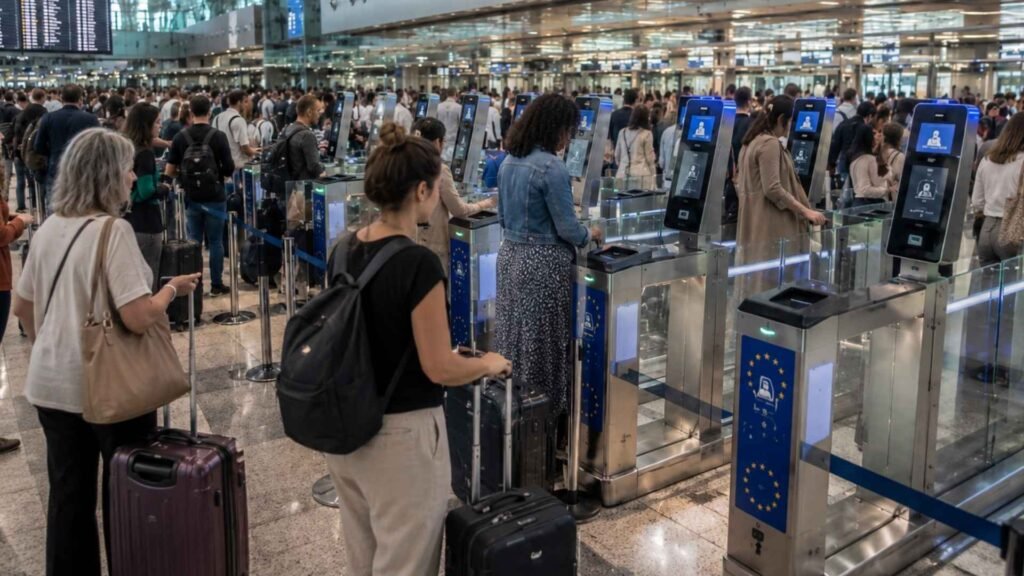
The Entry/Exit System, known as EES, is now fully operational at the external borders of participating European countries. It electronically records the entry and exit of most non-EU nationals visiting for a short stay, whether they require a Schengen visa or travel visa-free.
The system records information including:
- Name and travel-document details
- Date and place of entry or exit
- Facial image
- Fingerprints where required
- Refusals of entry
From 10 April 2026, EES replaced routine passport stamping for travellers covered by the system. The European Commission explains the current rules on its official Entry/Exit System page.
What to Expect at Fiumicino
Depending on your status and the facilities assigned to your flight, the process may include:
- Scanning your biometric passport at a self-service kiosk.
- Capturing a facial image.
- Providing fingerprints when required.
- Answering short entry-related questions.
- Presenting yourself to a border officer for the final decision.
First-time EES registration may take longer than a later journey because biometric information must be collected or verified.
Although EES has been fully rolled out, the exact registration process may temporarily vary by border crossing point when national authorities use permitted operational flexibility to manage heavy passenger traffic.
A kiosk completing preliminary steps does not itself guarantee entry; the border authority retains the final decision.
Prepare These Documents Before Reaching the Desk
Keep the following easy to access:
- Valid passport
- Visa or residence document, if required
- Accommodation confirmation
- Return or onward ticket
- Evidence of sufficient funds if requested
- Travel insurance documentation where applicable
- Supporting documents for the purpose of your visit
EU, EEA and Swiss citizens do not use EES. Several other categories are also exempt, including certain residence-permit and long-stay-visa holders. Check your status through the official EU guidance rather than assuming that every non-EU passport follows the same procedure.
Clara’s Tip: Do not book a tightly timed train or fixed transfer immediately after a non-Schengen arrival. Immigration queues can vary sharply when several long-haul flights land close together.
5. Find the Correct Baggage Reclaim Carousel
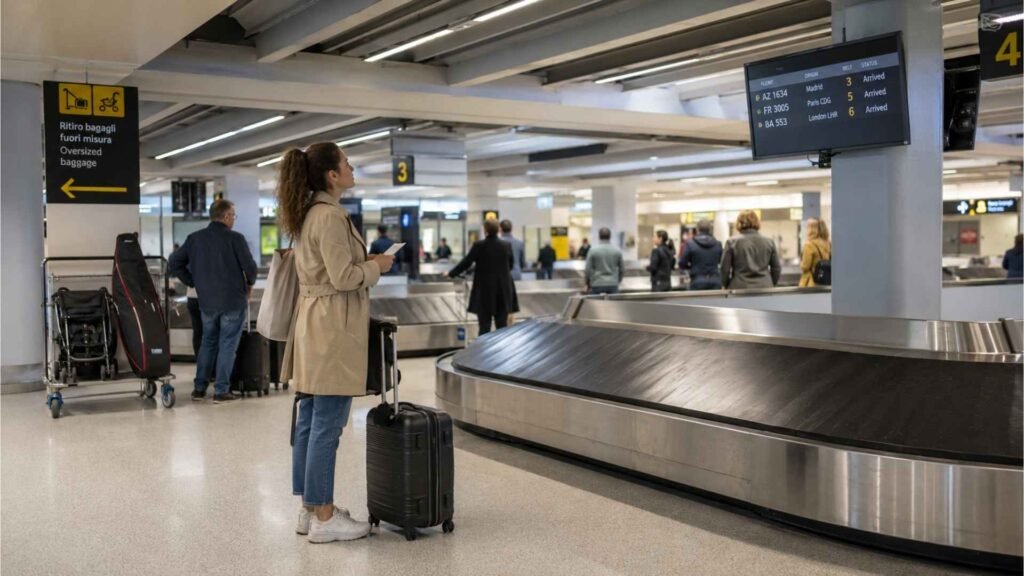
After passport control—or immediately after leaving the gate for most Schengen arrivals—follow the signs for Baggage Reclaim.
Check the electronic screens for:
- Flight number
- Origin airport
- Assigned carousel
- Status messages
- Oversized-baggage instructions
Use the flight number as your main reference. Several flights may arrive from the same city, particularly when codeshares are involved.
Baggage reclaim and the terminal exit are located on the arrivals level, Level 0, in both Terminal 1 and Terminal 3. Current terminal layouts can be checked through the official Fiumicino Airport maps.
Oversized and Special Baggage
Pushchairs, sports equipment, mobility devices and unusually large items may not appear on the standard carousel. Look for a dedicated oversized-baggage point or ask an attendant before reporting the item missing.
If a pushchair was handed over at the aircraft door, confirm whether it will be returned near the gate or at baggage reclaim. The procedure can differ by airline and arrival position.
Before leaving the carousel area:
- Check that the baggage tag matches your receipt.
- Inspect the case for major damage.
- Confirm that every checked item has arrived.
- Keep your baggage receipts until the journey is complete.
6. Report Missing, Delayed or Damaged Baggage
If your bag does not appear, do not leave the restricted baggage-reclaim area before reporting it.
Airlines and their ground-handling companies—not the airport’s general lost-property office—normally manage checked baggage that is missing, delayed or damaged.
Find the baggage-assistance desk responsible for your airline or handling company and request a Property Irregularity Report, commonly called a PIR.
You may be asked for:
- Boarding pass
- Passport or identification
- Baggage-tag receipt
- Description of the suitcase
- Local accommodation address
- Telephone number and email
- Details of distinctive contents or markings
Ask for a copy of the report and note the reference number. You will usually need it to track the case and support any later claim.
Photograph visible damage before leaving the airport. Retain receipts for essential replacement purchases, but check your airline’s rules before assuming every expense will be reimbursed.
Checked Baggage or an Item Lost in the Terminal?
These are different cases:
- A checked bag that did not arrive should be reported to the airline’s handling company.
- An item left on the aircraft should normally be reported through the airline or its handler.
- An item lost inside the terminal may fall under the airport lost-property service.
Aeroporti di Roma publishes handler contacts and procedures on its official lost baggage information page.
7. Pass Through Customs
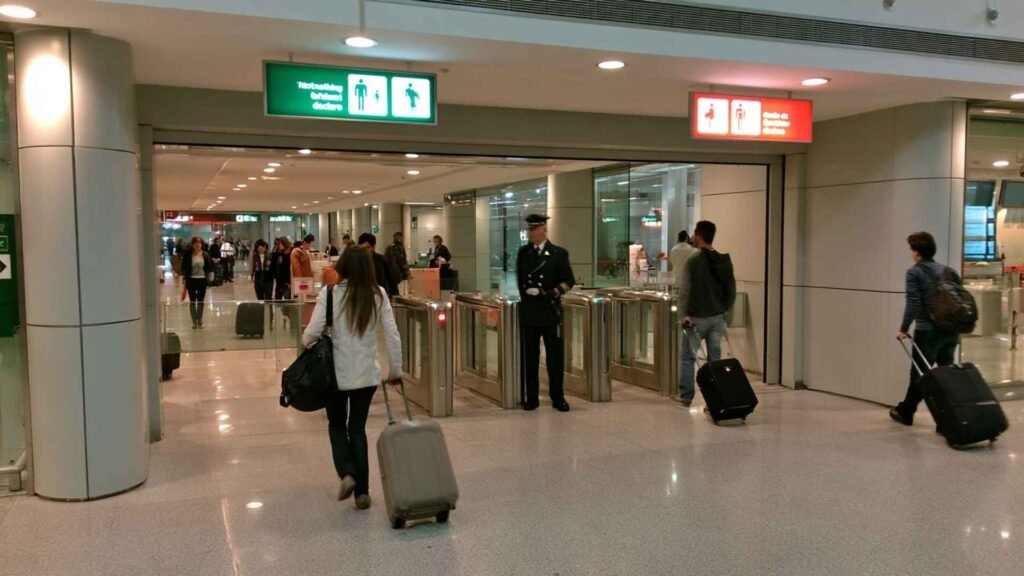
After collecting your luggage, follow the signs for customs and the exit.
The usual channels are:
- Green channel: nothing to declare
- Red channel: goods to declare
Using the green channel is itself a declaration that you are not carrying goods that must be reported. Customs officers may still conduct checks.
You may need to use the red channel if you are carrying items above the permitted allowances, restricted products, commercial goods or cash and equivalent instruments at or above the applicable declaration threshold.
Food, plants, animal products, medicines and high-value purchases may be subject to specific rules. Allowances can depend on where you travelled from rather than simply your nationality.
If uncertain, ask a customs officer before selecting a channel. Declaring an item is safer than attempting to interpret a complicated allowance at the exit.
Once you pass through customs and enter the public arrivals hall, you may not be able to return to the baggage carousels.
8. Enter the Terminal 1 or Terminal 3 Arrivals Hall
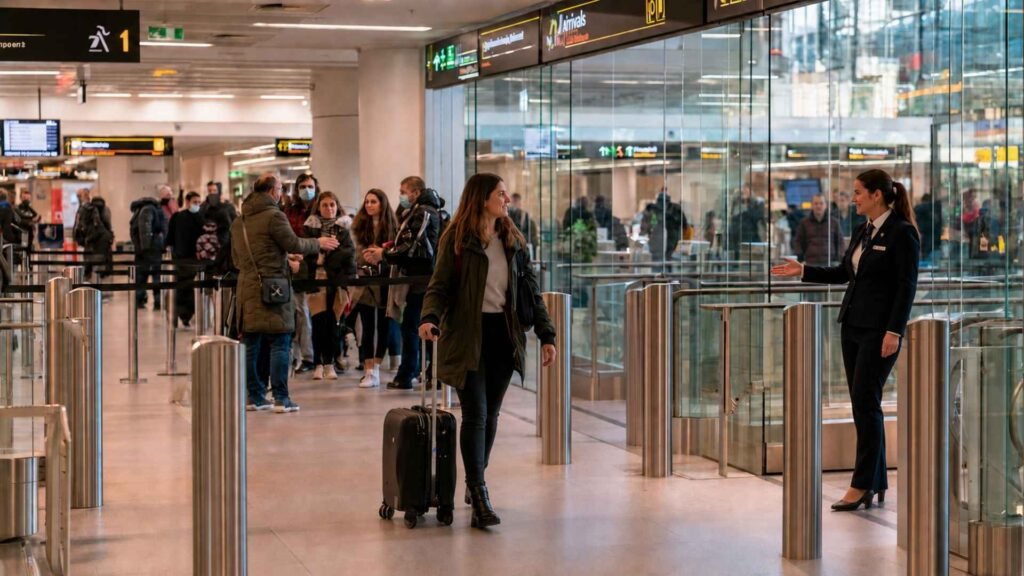
Fiumicino’s passenger arrivals are primarily handled through Terminal 1 and Terminal 3. Both public arrivals halls are on Level 0, but they serve different airline and route combinations.
Terminal 1 Arrivals
Terminal 1 generally handles many Schengen and selected domestic or European services. Its arrivals area provides access to onward transport signs, meeting points and the pedestrian route towards the airport railway station.
Terminal 3 Arrivals
Terminal 3 handles a large share of non-Schengen and long-haul arrivals, although flight allocation can change. It also provides access to airport services, ground transport and the bus hub.
Do not rely on an old airline-terminal list. Confirm the terminal through:
- Your airline
- The airport’s live flight information
- The baggage-reclaim screens
- The terminal signs after landing
Meeting Someone at Fiumicino
Drivers, friends and relatives cannot enter the restricted baggage-reclaim zone. They must wait in the public arrivals area beyond customs.
Agree in advance on:
- Terminal 1 or Terminal 3
- A named public meeting point
- A nearby numbered exit
- A backup contact method
- What to do if the arrival terminal changes
Simply saying “meet me at arrivals” can cause confusion because Fiumicino has more than one arrivals hall and several exits.
“If you have booked a private transfer, confirm whether the driver will display your name, contact you by phone or wait at a designated company desk. Keep the booking confirmation and the driver’s contact details accessible in case your arrival terminal changes.”
9. Arrange Connectivity, Money and Onward Transport
Once you enter the public arrivals hall, you can connect to airport Wi-Fi, access money services and follow the signs towards your chosen transport into Rome.
An eSIM installed before departure is usually the quickest way to obtain mobile data after landing. Physical SIM availability, prices and opening hours at airport retail points can change, so compare the plan carefully before purchasing.
ATMs and currency-exchange services are available within the terminal complex. If an ATM offers to convert the withdrawal into your home currency, choosing euros and declining dynamic currency conversion will often allow your own bank to apply its exchange rate. Always check any operator fee displayed before confirming the transaction.
Signs from the arrivals areas direct passengers towards:
- The airport railway station
- Official taxi ranks
- Bus and coach stops
- Pre-arranged transfer meeting points
- Car-rental services
Use only the organised taxi rank or a clearly identified pre-booked service. Ignore unsolicited ride offers inside the terminal, even if the person claims to represent an official taxi company.
If you are arriving late at night, check the current train and bus schedules before travelling. Immigration queues, EES registration or delayed baggage may cause you to miss a connection that appeared possible based only on the scheduled landing time.
The forthcoming Rome Fiumicino Airport to Rome City Center Guide will compare trains, taxis, buses and private transfers by travel time, cost, arrival hour and destination in Rome.
How Long Does It Take to Leave Fiumicino After Landing?
There is no single reliable processing time because the journey through the terminal depends on your route, border-control requirements and baggage.
| Arrival type | Reasonable planning range |
|---|---|
| Schengen arrival with hand luggage | About 20–40 minutes |
| Schengen arrival with checked baggage | About 30–60 minutes |
| Non-Schengen arrival with hand luggage | About 35–75 minutes |
| Non-Schengen arrival with checked baggage | About 45–90 minutes |
| First EES registration or peak immigration period | Potentially 90 minutes or longer |
These are planning ranges, not guaranteed processing times. Remote stands, multiple simultaneous arrivals, mobility assistance and baggage disruption can extend the journey.
For a pre-booked train, tour or onward departure, build in more time than the minimum estimate.
Arriving at Fiumicino Late at Night
Fiumicino operates around the clock, but transport choices become more limited late at night.
Before travelling:
- Check your scheduled landing time and the final train.
- Add time for immigration and checked baggage.
- Save current bus timetables.
- Confirm hotel check-in arrangements.
- Keep the address of your accommodation offline.
- Arrange a transfer if missing the last practical connection would leave you stranded.
- Tell the driver your flight number so delays can be monitored.
Some coaches operate after midnight, particularly towards Roma Termini, but services vary by carrier and date. A night bus may still leave you needing another taxi after reaching central Rome.
For a very late arrival, an airport hotel can be more sensible than crossing Rome with children or heavy luggage and paying for an expensive night transfer.
Arriving with Children
Families should keep essential supplies in hand luggage in case baggage reclaim is delayed.
A practical arrival kit includes:
- Water and age-appropriate snacks
- Nappies and wipes
- One change of clothes
- Required medication
- A compact carrier or approved travel pushchair
- Offline accommodation and transfer details
Aeroporti di Roma states that pushchairs are available in selected areas near arrival gates and passport control, but availability should not replace your own plan.
One adult can handle documents while the other watches children and luggage, but remain together when instructed during immigration. Every child must carry the required individual travel document.
If you booked a transfer, request an appropriate child seat in advance. Do not assume one will be supplied automatically.
Arriving with Reduced Mobility
Passengers who requested assistance through their airline should normally be met according to the arrangements made before travel. The service may help with disembarkation, terminal movement, border procedures and baggage reclaim.
Before leaving the aircraft:
- Confirm where the assistance agent will meet you.
- Do not move away from the agreed point without informing the crew.
- Make sure mobility equipment is returned in the expected location.
- Report damage immediately.
- Confirm where your taxi or transfer will wait.
If your mobility device has been checked into the hold, photograph it before the journey and keep any related baggage documents.
Common Arrival Mistakes to Avoid
Following Baggage Reclaim When You Are Connecting
Look for Flight Connections first. Entering the public arrivals area can force you into a full landside transfer.
Leaving Before Reporting a Missing Bag
File the baggage report while you are still inside the reclaim area whenever possible.
Assuming Every Non-EU Traveller Uses the Same Immigration Lane
Eligibility depends on nationality, passport type, residence status and the lanes operating at that time.
Booking Onward Transport Too Soon
A scheduled landing time is not the time you will enter the arrivals hall.
Accepting an Unsolicited Taxi Offer
Use only the official rank or a clearly identified pre-booked service.
Meeting Someone Without Naming the Terminal
Terminal 1 Arrivals and Terminal 3 Arrivals are not a single meeting point.
Rome Fiumicino Airport Arrival Checklist
Use this checklist to confirm the most important preparations before departure and the steps to complete after landing.
Before leaving home:
- Check whether your first arrival is from inside or outside Schengen.
- Confirm entry and visa requirements.
- Save your accommodation details offline.
- Install or purchase your eSIM.
- Check late-night transport options.
- Keep essential medication in hand luggage.
After landing:
- Follow Arrivals or Flight Connections as appropriate.
- Prepare your passport before immigration.
- Check the final airport code on your baggage receipt.
- Inspect checked luggage before leaving reclaim.
- Report baggage problems immediately.
- Choose the correct customs channel.
- Confirm your terminal and meeting point.
- Use only official transport services.
Frequently Asked Questions About Arriving at Rome Fiumicino
Is passport control before or after baggage reclaim at Fiumicino?
For a direct arrival from outside the Schengen Area, passport control normally comes before baggage reclaim. Most arrivals from another Schengen country proceed towards baggage reclaim without routine passport control at Fiumicino.
How long does passport control take at Rome Fiumicino?
Processing time can range from a short wait to more than an hour. Passenger volume, EES registration, passport eligibility and the number of open lanes all affect the queue.
Do I have to use EES when arriving in Rome?
EES generally applies to non-EU nationals entering for a short stay, including both visa-required and visa-exempt travellers, subject to defined exemptions. EU, EEA and Swiss citizens do not register in EES.
Do I collect my baggage in Rome during a connection?
Usually not if both flights are on one through-ticket and the baggage tag shows your final destination. You will generally need to collect it if Rome is shown as the final baggage destination or you are completing a separate-ticket self-transfer.
Can I walk between Terminal 1 and Terminal 3 after arriving?
The terminal complex has pedestrian connections, but your route will depend on whether you are airside or landside. After entering the public arrivals area, follow the signs rather than attempting to return through a restricted zone.
Where should someone meet me at Fiumicino Airport?
Arrange to meet in the public arrivals hall of your confirmed terminal and select a specific exit or named meeting point. The person meeting you cannot enter baggage reclaim or customs.
Are ATMs and SIM cards available after arrivals?
Basic money and connectivity services are available in the terminal complex, although store locations and opening hours can change. An eSIM installed before departure is often the quickest option for immediate data access.
What should I do if my baggage is missing?
Report it to the airline’s ground-handling desk before leaving baggage reclaim and obtain a Property Irregularity Report. The airport lost-property office is intended for items lost in the terminal, not normally for checked baggage that failed to arrive.
What is the easiest way to reach central Rome after landing?
The Leonardo Express is convenient for Roma Termini, while the FL1 may be better for Trastevere, Ostiense or Tiburtina. Official taxis and private transfers are often more practical for door-to-door travel, families and late-night arrivals.
Can I reach Rome after midnight?
Usually yes, but the normal rail service may have ended. Night coaches, official taxis and pre-arranged transfers may be available. Check the exact timetable for your arrival date rather than relying on a general operating claim.
Final Thoughts
A smooth Rome Fiumicino Airport Arrival depends mainly on identifying three things in advance: whether you will enter the Schengen Area in Rome, whether your baggage is checked through and how you will leave the airport if the flight is delayed.
Follow the live airport signs, complete any baggage report before customs and confirm your transport only after allowing realistic time for immigration and reclaim. Once you enter the public arrivals hall, Rome is the next—and much more enjoyable—part of the journey.