

Connecting through Italy’s busiest airport is usually straightforward when both flights are on one ticket and your baggage is checked through. This Rome Fiumicino Airport transit guide explains which route to follow, when passport control or security may be required and how much connection time to allow.
Your exact transfer process depends mainly on whether each flight operates within or outside the Schengen Area. Separate tickets, baggage collection and a new check-in create a self-transfer and require a different plan.
Quick Answer: How Does Rome Fiumicino Airport Transit Work?
During a Rome Fiumicino Airport transit, follow signs for Connections or Transiti, check the live airport screens and proceed towards the boarding area shown for your next flight.
Schengen-to-Schengen passengers normally avoid passport control. Connections between Schengen and non-Schengen flights require border control, while passengers arriving from outside Schengen may also be directed through transfer security. Checked baggage normally continues automatically only when tagged to the final destination.
| Connection route | Passport control at Fiumicino? | Another security check? | Checked baggage |
|---|---|---|---|
| Schengen → Schengen | Normally no | Usually no | Normally transferred if checked through |
| Schengen → non-Schengen | Yes, when leaving Schengen | Route-dependent | Normally transferred if checked through |
| Non-Schengen → Schengen | Yes, when entering Schengen | Often required or route-dependent | Normally transferred if checked through |
| Non-Schengen → non-Schengen | Usually no if remaining airside | May be required | Normally transferred if checked through |
| Separate tickets or baggage not checked through | Depends on the itinerary | Normally yes after check-in | Usually collected and checked in again |
These are general patterns rather than guaranteed routes. Your origin, airline arrangements, gate assignment and the airport’s operational requirements can change the process on the day.
Is Rome Fiumicino Easy for Connecting Flights?
Rome Fiumicino Airport, also called Leonardo da Vinci Airport, is a large hub, but its passenger areas are connected by marked internal routes. Most passengers with a protected connection can move between their arrival point and onward gate without entering the public arrivals area.
Fiumicino currently handles passenger flights mainly through:
- Terminal 1, generally used for domestic and Schengen flights
- Terminal 3, mainly used for international and intercontinental flights
- Boarding Area A, serving many domestic and Schengen departures
- Boarding Area E, primarily associated with non-Schengen and intercontinental departures
These divisions are useful for orientation but should not be treated as fixed airline rules. Operational arrangements and assigned gates can change.
For connecting passengers, the live boarding area and gate number matter more than the terminal number shown before departure. Check the airport screens as soon as you enter the connection route and continue monitoring them until boarding.
If you need a broader overview of the terminals, boarding areas, facilities and passenger services, read the complete Rome Fiumicino Airport Guide.
Most passengers completing a protected Rome Fiumicino Airport transit can follow marked internal routes between their flights. The official Fiumicino Airport map can help you understand the current terminal and boarding-area layout before travelling.
How to Transfer at Rome Fiumicino Airport Step by Step
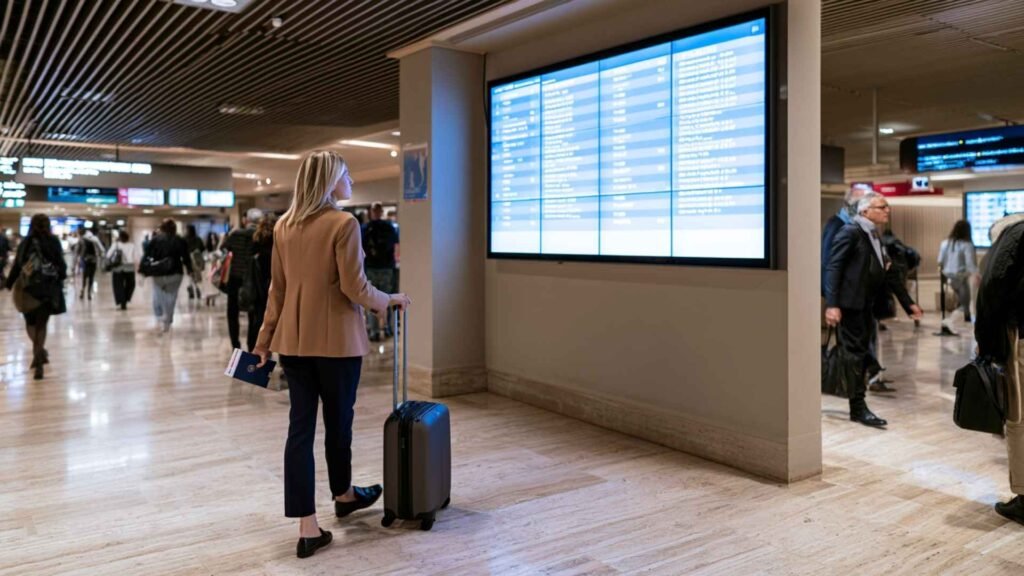
Although individual routes vary, most protected connections follow the same basic sequence.
1. Leave the Aircraft and Check Your Remaining Time
Check the current time as soon as you leave the aircraft. Measure the time remaining against the boarding and gate-closing deadline, not only the scheduled departure time.
If your inbound flight arrived late, avoid stopping for food, shopping or other airport services before locating your next gate.
2. Follow Connections or Transiti Signs
Follow signs marked Connections, Connecting Flights or Transiti.
Do not automatically follow signs for Arrivals or Baggage Reclaim. Those routes can lead towards immigration, baggage collection and the public arrivals hall, potentially taking you out of the protected connection path.
If your airline has instructed you to collect your baggage, however, you must follow the arrivals route and complete the necessary entry formalities.
3. Check the Airport Screens
Find your onward flight using its flight number and destination. Do not rely only on the gate printed on your boarding pass or displayed in the airline app before arrival.
A gate may:
- Change before boarding
- Appear only closer to departure
- Be located in a different boarding area
- Require passport control or another checkpoint along the route
You can also consult the official Fiumicino real-time flight information.
4. Complete the Required Checks
Your route may include passport control, transfer security or both. These checks depend mainly on whether you are crossing the Schengen external border and whether your arriving flight can enter an approved secure transfer route.
Keep your passport, onward boarding pass and any required visa or residence document accessible.
5. Proceed to the Correct Boarding Area
Once the required checks are complete, follow the gate signs without unnecessary stops. Walking time can be significant when the arrival and departure gates are far apart.
Do not assume that seeing Terminal 1 or Terminal 3 on your booking means you must exit one terminal and enter another from the public side. Many protected connections use internal passenger routes.
6. Recheck the Gate and Boarding Status
Check the screens again when you reach the correct boarding area. Your airline may begin boarding well before the departure time, and gate assignments can change.
Gate-closing rules vary by airline and route. Reaching the gate after boarding has closed may prevent you from travelling even if the aircraft has not yet departed.
Which Connection Route Will You Follow?

The transfer process becomes easier to predict once you identify whether the arriving and departing countries are inside or outside the Schengen Area.
The Schengen Area includes most EU countries as well as Iceland, Liechtenstein, Norway and Switzerland. Ireland is not part of Schengen. Confirm the status of both countries before travelling.
Schengen to Schengen Connections
Examples include:
- Paris → Rome → Athens
- Madrid → Rome → Vienna
- Amsterdam → Rome → Palermo
Both flights operate within the Schengen Area. Passengers on a protected connection normally leave the aircraft, follow the connection signs, check the next gate and remain within the Schengen departure zone.
Passport control is not normally required, and another security check is usually unnecessary when the passenger remains within an approved secure route.
This is generally the simplest Fiumicino connection type. Even so, allow enough time for disembarkation, walking and a possible gate change.
Schengen to Non-Schengen Connections
Examples include:
- Florence → Rome → New York
- Barcelona → Rome → Istanbul
- Frankfurt → Rome → Tokyo
You are leaving the Schengen Area at Fiumicino. Follow the connection signs towards the non-Schengen departure zone and complete exit passport control before proceeding to the gate.
The Entry/Exit System is used at the Schengen external borders for eligible non-EU short-stay travellers. Covered passengers leaving through Fiumicino should expect their border crossing to be recorded electronically.
Temporary operational flexibility may affect how checks are organised during busy periods, but passengers should not assume that EES processing will be skipped.
Avoid spending all your available time in the Schengen shopping or dining area. You must still reach passport control and continue to the correct non-Schengen gate.
Non-Schengen to Schengen Connections
Examples include:
- New York → Rome → Venice
- London → Rome → Milan
- Istanbul → Rome → Barcelona
Fiumicino is the airport where you enter the Schengen Area. Follow the connection route, complete transfer security if directed and pass through entry passport control before continuing to the Schengen departure zone.
The Entry/Exit System electronically registers eligible non-EU short-stay travellers when they cross the Schengen external border. First-time registration can involve passport scanning, a facial image and fingerprints, so allow additional time during busy arrival periods.
Your passport and, where applicable, visa, residence permit or supporting entry documents may also be checked.
Because this route involves formal entry into Schengen, it normally requires more time than a Schengen-to-Schengen connection. Passenger volume, first-time biometric registration or an individual immigration check can extend the process.
Your baggage may still transfer automatically even though you pass through immigration. Do not go to baggage reclaim unless your airline has confirmed that the bag is not checked through.
You can check the current system and traveller requirements on the official European Union Entry/Exit System website.
Non-Schengen to Non-Schengen Connections
Examples include:
- New York → Rome → Cairo
- London → Rome → Tunis
- Istanbul → Rome → Casablanca
If both flights form a protected itinerary and your baggage is checked through, you may be able to remain within the international transit area without entering the Schengen Area.
Follow Connections or Transiti signs, complete transfer security if required and proceed to the onward non-Schengen gate.
Italian entry control is normally unnecessary when a suitable airside route is available. However, your nationality, visa requirements, baggage arrangements or the route operating that day can change the process.
If you must collect baggage, enter the public area or change airports, you need permission to enter the Schengen Area. An Airport Transit Visa alone does not provide that permission.
Passport Control and Security During a Fiumicino Connection
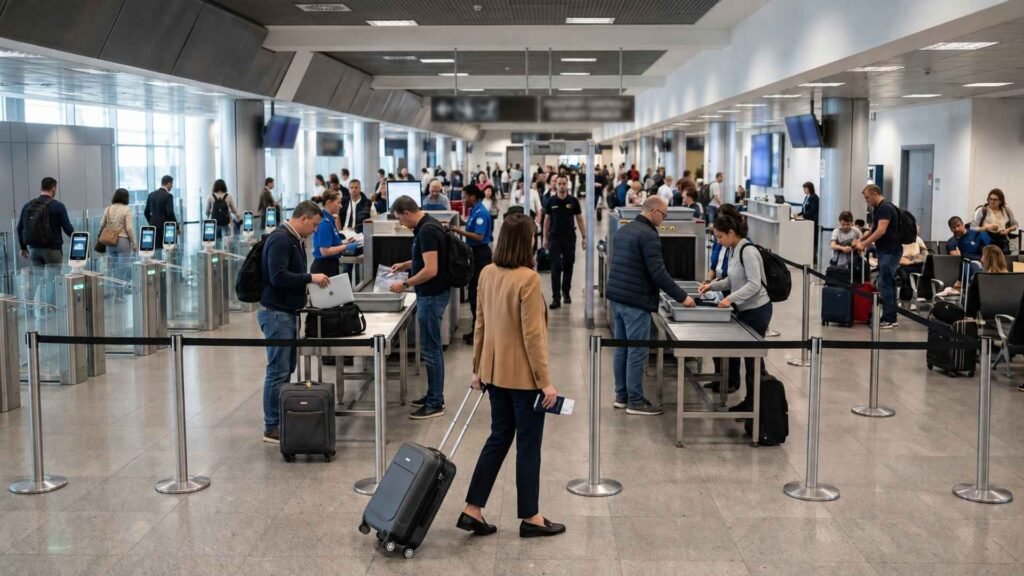
Passport control depends on whether your itinerary crosses the Schengen external border. It is normally required when travelling between a Schengen and non-Schengen flight, but usually avoided when both flights remain within the same travel zone.
Transfer security follows a less uniform pattern. Your arrival origin, assigned gates and the secure route operating at Fiumicino can determine whether another screening is required, so always follow the airport’s live signs and staff instructions.
You should expect another security check if you enter the public area to collect baggage, check in again or complete a self-transfer. Passengers remaining within an approved Schengen-to-Schengen route usually avoid another screening.
Whether security must be repeated is one of the most route-dependent parts of a Rome Fiumicino Airport transit. Prepare for a possible check by keeping liquids and electronics packed according to the instructions displayed at the checkpoint.
Fast Track is not available or useful on every transfer route because access depends on the checkpoint you are directed to. If your connection involves an eligible departure-security lane, the Rome Fiumicino Airport Fast Track Guide explains the available services, booking methods and limitations.
Will Your Checked Baggage Transfer Automatically?
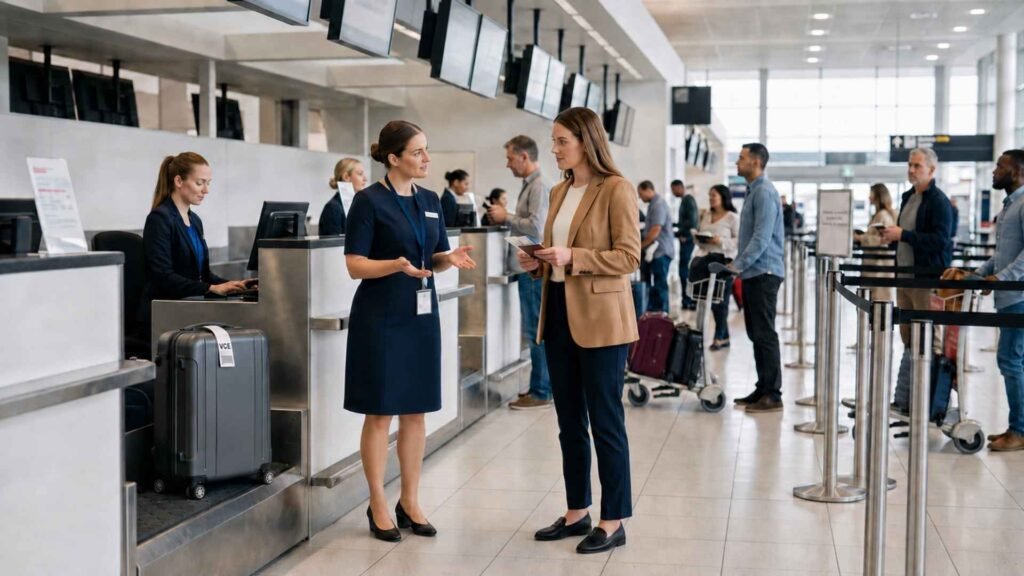
Baggage arrangements can determine whether your Rome Fiumicino Airport transit remains airside or becomes a more complicated landside transfer.
Checked baggage normally transfers automatically when:
- Both flights are issued as one protected itinerary
- The airlines have an appropriate baggage agreement
- The bag is tagged to the final destination
- No special customs or airline rule requires collection
- The connection does not involve a change of airport
The most reliable evidence is the baggage receipt issued when you check in. Look for the three-letter airport code of your final destination.
For example, if you fly:
New York (JFK) → Rome (FCO) → Venice (VCE)
Your baggage receipt should normally show VCE if the bag is checked through to Venice.
Before leaving the check-in counter, ask:
“Is my baggage checked through to my final destination?”
Do not assume baggage will transfer merely because:
- Both flights appear in the same confirmation email
- The airlines belong to the same alliance
- You booked through one travel website
- Your layover is short
- Both flights use the same terminal
- The booking displays one overall journey
Some booking platforms combine separate tickets into a single-looking itinerary. The airline booking references, ticket conditions and baggage tag determine what happens operationally.
If your bag is tagged only to FCO, you must normally enter Italy, collect it, pass through customs and check it in again. This should be treated as a self-transfer, even if the second flight uses the same airline.
Do You Need to Change Terminals at Fiumicino?
A booking may show arrival at Terminal 3 and departure from Terminal 1, or the reverse. On a protected connection, this does not automatically mean you must exit into the public area.
Follow the connection signs and live airport instructions. Internal routes may allow eligible passengers to move between boarding areas without repeating the full landside departure process.
Concentrate on three pieces of information:
- Your next flight number
- The current boarding area
- The live gate assignment
Walking distances can be substantial, and some flights may use remote stands with shuttle-bus boarding. Leave enough time to reach the actual gate rather than merely arriving in the correct terminal.
If staff direct you towards baggage reclaim or the public arrivals hall, confirm whether this is required for your ticket and baggage arrangement before proceeding.
If Fiumicino is your final destination and you need instructions for immigration, baggage reclaim, customs and leaving the terminal, use the Rome Fiumicino Airport Arrival Guide instead.
How Long Do You Need for a Connection at Fiumicino?
There is no single safe connection time for every passenger. The time required depends on the route, passport control, security, walking distance, baggage arrangements and whether the airline protects the connection.
An airline may sell an itinerary that satisfies its applicable minimum connection time. This means the connection is considered bookable within its system; it does not mean the transfer will feel relaxed or that delays are impossible.
For trip planning, the following cautious ranges provide more breathing room:
| Connection type | Recommended planning time |
|---|---|
| Schengen → Schengen | 1 hour 30 minutes–2 hours |
| Schengen → non-Schengen | 2–2 hours 30 minutes |
| Non-Schengen → Schengen | 2–3 hours |
| Non-Schengen → non-Schengen | 2–3 hours |
| Separate tickets or baggage collection | At least 4–5 hours, depending on the itinerary |
These are Clara Travels planning recommendations, not official minimum connection times or guarantees.
A one-hour connection offers little margin and should generally be considered only for a protected Schengen-to-Schengen itinerary. Two hours is more comfortable for many protected connections, but additional time is advisable when passport control, transfer security or long walking distances are involved. Neither period is suitable as a general target when baggage must be collected and checked in again.
Add more time if:
- You are travelling during a busy holiday period
- You have reduced mobility
- You are travelling with young children
- You need visa or document checks
- First-time EES registration may be required
- You are seated near the rear of a large aircraft
- Your arriving flight frequently runs late
- You must travel between distant gates
- Your onward flight operates only once per day
- Missing the connection would seriously disrupt your trip
What Should You Do During a Short Connection?

If your transfer time is limited:
- Follow Connections signs immediately.
- Check the next gate before stopping anywhere.
- Keep your passport and boarding pass ready.
- Save the onward boarding pass offline.
- Use the airport screens rather than relying only on notifications.
- Avoid restaurants, lounges and duty-free shopping.
- Tell transfer staff if boarding has begun.
- Use a staffed assistance or transit desk if the route is unclear.
- Recheck the gate after entering the correct boarding area.
- Do not leave the secure area unless instructed.
If no gate is displayed yet, proceed towards the correct boarding area if it is known and remain close to a flight-information screen.
Clara’s Tip
Save both boarding passes offline and photograph your baggage receipt before departure. These records can save valuable time if the airline app fails, the gate changes or your baggage must be traced.
What Happens If Your Incoming Flight Is Delayed?
If both flights form one protected reservation, notify the cabin crew or ground staff when the delay creates a tight connection. They may provide route information, although priority assistance is not guaranteed.
After landing:
- Check whether the onward flight is still open.
- Go directly to the gate if time remains.
- Find an airline or transfer desk if the flight has closed.
- Check the airline app for automatic rebooking.
- Keep receipts for reasonable expenses if assistance is unavailable.
- Request written confirmation of the disruption when possible.
On a protected itinerary, the airline should normally arrange an alternative route when an inbound disruption causes you to miss the connection. The exact assistance and passenger rights depend on the itinerary, operating carrier, cause of disruption and applicable law.
Do not immediately buy an expensive replacement ticket unless the airline has explained your options or you understand the reimbursement conditions.
What Happens If You Miss Your Connecting Flight?
The first question is whether the flights are part of a single reservation.
| Protected connection | Separate-ticket self-transfer |
|---|---|
| The airline normally handles rebooking after an eligible inbound disruption | The second airline may treat you as a no-show |
| Baggage is usually traced or redirected by the airlines | You may need to recover and recheck baggage |
| Assistance may be available under ticket conditions or passenger-rights rules | New travel and accommodation costs may be yours |
| Final-destination delay may be relevant to a claim | Each ticket is normally considered separately |
Under EU air-passenger rules, travellers who miss a connection within a single reservation and reach their final destination at least three hours late may qualify for compensation when EU rules apply and the disruption was not caused by extraordinary circumstances.
Compensation is not automatic. The operating carrier, route, cause of the disruption and circumstances of the journey must be assessed.
The EU also states that compensation is not due when a connection is missed because the passenger failed to respect the boarding time or was delayed at security. Consult the official EU air-passenger rights guidance before making a claim.
If your flights are on separate tickets, the missed-flight risk is normally yours. This situation will be covered in detail in the forthcoming Rome Fiumicino Airport Self-Transfer Guide.
Can You Leave Fiumicino Airport During a Layover?
You can leave the airport only if you are legally permitted to enter Italy and have enough time to complete the necessary border, transport and airport formalities.
Before leaving, consider:
- Whether you need a Schengen visa
- Passport-control queues
- Baggage arrangements
- Travel time to and from Rome
- Possible train or road delays
- Security screening when you return
- Passport control before a non-Schengen departure
- Your airline’s boarding deadline
Fiumicino is approximately 30 kilometres from central Rome. Reaching the city, returning to the airport and completing departure formalities will consume a substantial part of your layover.
As a cautious guideline:
- Under 5 hours: Remain at the airport.
- 5–7 hours: Leaving is usually rushed and rarely worthwhile.
- 8 hours or more: A short visit may be possible if entry requirements and transport conditions are favourable.
- Overnight layover: An airport or nearby hotel may be more practical than travelling into central Rome.
These are planning guidelines rather than guarantees. Never leave the transit area during a short connection simply because the next gate has not appeared.
Do You Need an Airport Transit Visa for Fiumicino?
Most passengers do not need an Italian Airport Transit Visa, but nationality and itinerary matter.
According to the Italian Ministry of Foreign Affairs, nationals of the following countries are generally subject to Italy’s Airport Transit Visa requirement:
- Afghanistan
- Bangladesh
- Democratic Republic of the Congo
- Eritrea
- Ethiopia
- Ghana
- Iran
- Iraq
- Nigeria
- Pakistan
- Senegal
- Somalia
- Sri Lanka
- Syria
- Tajikistan
- Uzbekistan
An Airport Transit Visa, also called a Type A visa, permits its holder to remain within the international transit area. It does not permit entry into Italy or the wider Schengen Area.
Exemptions may apply to some travellers, including certain holders of:
- Valid visas or residence permits issued by specified countries
- Valid residence permits from relevant EU or associated states
- Diplomatic passports
- Qualifying documents connected with EU-family rights
- Certain flight-crew documents
These exemptions depend on the exact document, nationality and direction of travel.
You may need a regular Schengen entry visa rather than an Airport Transit Visa if you must:
- Collect checked baggage
- Check in again landside
- Leave the international transit area
- Change to a Schengen flight
- Stay in a hotel outside the secure zone
- Transfer between airports
Visa rules and exemption lists can change. Confirm the current requirement for your nationality and documents through the Italian Ministry of Foreign Affairs or the official Visa for Italy portal before travelling.
Do not rely solely on the airline selling the ticket. Airlines check documents before boarding, but travellers remain responsible for meeting the applicable visa and entry requirements.
Can You Stay Overnight During a Fiumicino Connection?
Fiumicino operates around the clock, but an overnight connection does not always mean you can remain comfortably airside until morning.
Whether you can stay in the departure area may depend on:
- Your arrival and departure route
- Whether the secure zone remains accessible
- Your boarding-pass status
- Security or immigration instructions
- Whether baggage is checked through
- Your visa and entry eligibility
Facilities can become more limited late at night, and terminal seating is not designed as hotel accommodation. Keep essential medication, chargers, a warm layer and basic toiletries in your hand luggage.
For a long overnight layover, compare:
- An airport hotel
- A nearby hotel with a shuttle
- Accommodation within easy reach of the terminals
- Remaining inside the terminal as a backup
Detailed accommodation options will be covered in the forthcoming Rome Fiumicino Airport Hotels Guide.
Common Fiumicino Connection Mistakes
Following Arrivals Instead of Connections
Entering the arrivals route can lead towards immigration and baggage reclaim. Follow Connections or Transiti unless baggage collection is required.
Assuming Baggage Transfers Automatically
Check the final airport code on the baggage receipt. A single confirmation email does not guarantee that your bag has been checked through.
Confusing a Terminal With a Boarding Area
Terminal 1 and Terminal 3 do not reveal your complete walking route. Check the live boarding area and gate.
Using the Departure Time as the Deadline
Boarding closes before departure. Plan around the airline’s gate-closing time rather than the scheduled take-off time.
Relying on the Original Gate Number
Gate assignments can change. Check the airport screens more than once.
Leaving the Airport During a Short Layover
Travel to Rome, border control and security can consume several hours. Stay airside when the available time is limited.
Treating Separate Tickets as a Protected Connection
Separate bookings may leave you responsible for missed flights, baggage handling and replacement travel costs.
Stopping Before Locating the Next Gate
Find your route and estimate the walking time before visiting a shop, restaurant or lounge.
Frequently Asked Questions About Fiumicino Airport Transit
Is Rome Fiumicino Airport difficult to navigate?
Fiumicino is large, but its connection routes are signposted. Follow Connections or Transiti signs, check the live gate and allow sufficient time for walking.
Is one hour enough to connect at Fiumicino?
It may be enough for a punctual protected Schengen-to-Schengen connection, but it offers little margin for delays, long walks or gate changes.
Is two hours enough for an international connection?
Two hours can be reasonable for many protected connections. Allow more time when passport control, transfer security or first-time biometric registration is expected.
Do I go through immigration when connecting in Rome?
You normally pass through passport control when entering or leaving the Schengen Area. Schengen-to-Schengen passengers generally avoid it.
Do I have to collect my checked baggage?
Not when it has been tagged through to your final destination. Confirm the final airport code on your baggage receipt before departure.
Can I transfer between Terminal 1 and Terminal 3 airside?
Eligible passengers on protected connections may use internal routes without entering the public area. Follow the live airport signs because the available path depends on your gates and required checks.
Do I need a transit visa for Rome Fiumicino?
Only certain nationalities and itineraries require an Airport Transit Visa, and exemptions may apply. If you must enter Italy, you may need a regular Schengen visa instead.
Can I leave the airport during a layover?
Yes, if you meet Italy’s entry requirements and have sufficient time. At least eight hours is a more realistic starting point for a brief visit to Rome.
Final Checklist for a Smooth Fiumicino Connection
Before travelling:
- Confirm that both flights are on one protected ticket.
- Ask whether your baggage is checked through.
- Check the visa rules for your complete route.
- Save both boarding passes offline.
- Allow extra time for passport control and EES processing.
At Fiumicino:
- Follow Connections or Transiti signs.
- Check the live gate immediately.
- Complete passport control or security when directed.
- Avoid unnecessary stops during a short transfer.
- Reach the gate before boarding closes.
A Rome Fiumicino Airport transit is usually manageable when you know whether your route crosses the Schengen border and your baggage is tagged to the final destination. Confirm both details before departure, then follow the live airport signs and gate information after landing.