
A Madrid Barajas Airport Self Transfer can save money or make useful flight combinations possible, but separate tickets come with more responsibility than a protected airline connection. You may need to collect baggage, change terminals, check in again, clear security, and pass passport control before your next flight.
The key is leaving enough time for the entire process—not just getting from one gate to another. This guide explains realistic connection buffers, baggage re-checks, T1–T4 terminal changes, T4S, visa considerations, and what happens if your first flight is delayed.
Quick Answer: Madrid Barajas Airport Self Transfer
| Situation | Recommended Planning Approach |
|---|---|
| Separate tickets | Treat each flight as a separate journey |
| Same terminal, carry-on only | 3+ hours |
| Same terminal with checked baggage | 4+ hours |
| T1/T2/T3 ↔ T4/T4S, carry-on only | 4+ hours |
| Terminal change with checked baggage | 5+ hours |
| Baggage + terminal change + border formalities | 5–6+ hours |
| Expensive onward long-haul flight | Consider a larger buffer or overnight stop |
| First flight delayed | Your separately booked onward flight may not be protected |
These are conservative ClaraTravels planning buffers rather than official airport minimum connection times.
The safest approach is to calculate your connection around baggage collection, terminal movement, airline check-in deadlines, security and passport control—not simply the scheduled gap between flights.
What Is a Madrid Barajas Airport Self Transfer?
A self-transfer usually means arriving in Madrid on one booking and departing on another independently booked ticket.
For example:
Ticket 1: London → Madrid
Ticket 2: Madrid → Bogotá
Instead of the airlines managing Madrid as one protected connection, you may effectively complete the first journey and begin another.
Depending on your itinerary, that can mean:
- completing the arrival process,
- passing passport control when required,
- collecting checked baggage,
- entering the public terminal area,
- changing terminals,
- checking in for Flight 2,
- re-checking your baggage,
- clearing security,
- passing departure passport control when required, and
- reaching the gate before boarding closes.
The crucial difference is protection. With separate tickets, the airline operating your second flight generally does not have the same responsibility for a delay to your first flight as it would on a protected through-itinerary.
If both flights are on a protected booking instead, use our Madrid Barajas Airport Transit article. That guide covers protected connections; this article focuses specifically on separate-ticket transfers.
Madrid Self-Transfer vs Protected Connection
| Protected Connection | Self-Transfer |
|---|---|
| Usually one protected itinerary | Usually separate bookings |
| Airline manages the connection | Passenger manages the connection |
| Baggage may be checked through | Baggage may need to be collected |
| Missed connection may be protected | Missed onward flight may be your responsibility |
| Airline connection procedures apply | Larger personal safety buffer needed |
This distinction matters at Madrid-Barajas because baggage collection, terminal changes and border formalities can turn what looks like a short connection into a much longer process.
How Much Time Do You Need for a Madrid Barajas Airport Self Transfer?
There is no universal safe connection time.
A same-terminal journey with cabin baggage is very different from arriving at T1, collecting a suitcase, travelling to T4, checking in again and continuing from T4S.
As a practical rule, I would allow at least three hours for the simplest carry-on-only self-transfer. Four hours becomes more sensible when checked baggage or additional procedures are involved.
For a separate-ticket connection between T1/T2/T3 and T4/T4S, I would normally plan around four hours or more with carry-on baggage and five hours or more with checked baggage. If baggage collection, a major terminal change and Schengen border formalities all apply, five to six hours or more provides a much safer margin.
These are planning recommendations rather than official minimum connection times. AENA also notes that connection time varies according to the route, airline, baggage situation and terminal combination. Check the official AENA connecting flights information when planning your route.
Is Two Hours Enough for a Self-Transfer in Madrid?
For anything beyond a very simple situation, I would not deliberately book a two-hour Madrid Barajas Airport Self Transfer.
A flight scheduled to arrive at 12:00 followed by another departing at 14:00 does not give you two full usable hours.
Taxiing, disembarkation and walking consume part of that time before you even begin the transfer. Passport control, baggage reclaim, terminal transport, check-in, security and another walk to the gate can reduce the remaining window quickly.
Your most important deadline may actually be the second airline’s check-in or bag-drop closing time, not its published departure time.
Step-by-Step Madrid Barajas Self-Transfer
Once you know how much time to allow, the next step is understanding the order of the transfer itself. The exact route depends on your terminals, baggage and travel documents, but the process always starts with checking where both flights operate.
Step 1: Check Both Terminals Before Flying
Madrid-Barajas has T1, T2, T3 and T4, plus the T4 Satellite building known as T4S.
T1, T2 and T3 form one terminal complex. T4 is separate, while T4S is connected to T4 by the underground Automated People Mover (APM).
Before travelling, confirm:
- your arrival terminal,
- your departure terminal,
- whether Flight 2 uses T4S,
- whether checked baggage must be collected, and
- whether you already have a valid boarding pass.
Our Madrid Barajas Airport Guide explains the overall terminal layout in more detail.
Step 2: Complete the Arrival Process
After leaving the aircraft, follow the appropriate arrivals route.
If Madrid is where you enter the Schengen Area, passport control may form part of the process.
Do not assume that the standard connecting-flight route automatically applies because you have another flight. With separate tickets, baggage collection or a new check-in may require you to complete arrivals first.
Our Madrid Barajas Airport Arrival Guide covers immigration, baggage reclaim and the Madrid arrival sequence separately.
Step 3: Collect Checked Baggage When Required
If your baggage tag ends at MAD, collect the suitcase in Madrid.
Do not assume independently booked airlines will automatically transfer your luggage.
At your first airport, ask:
“Is my baggage checked through to my final destination?”
Then verify the baggage tag yourself.
If it shows your final airport, confirm that the airline has genuinely through-checked it. If it shows MAD, plan for baggage reclaim and another bag drop.
This is one of the biggest differences between a simple carry-on connection and a more time-consuming self-transfer.
Step 4: Change Terminals if Necessary
AENA provides free transport between the Madrid-Barajas terminal complexes.
According to the official AENA terminal transport information, the main free transit bus operates 24 hours a day.
Current published frequencies are approximately:
- 06:00–22:00: every 5 minutes
- 22:00–06:00: every 20 minutes
Passengers can also walk between T1, T2 and T3.
The bus ride is only one part of your transfer. Walking to the stop, waiting, locating the second airline, clearing security and reaching the next gate all need to fit inside your connection window.
Step 5: Check In and Re-Check Baggage
If you do not already have a usable boarding pass for Flight 2, find the second airline’s check-in area.
If you collected checked baggage, you will normally need to drop it again.
Check your airline’s own deadline before travelling because check-in and baggage acceptance times vary by carrier and route.
For separate tickets, plan backwards from:
bag-drop deadline → security → passport control → gate closing
rather than from departure time alone.
Step 6: Clear Security and Passport Control
If your route takes you into the public arrivals area for baggage collection, check-in or a terminal change, expect to clear security again.
Passport control depends on your route. A non-Schengen arrival followed by a Schengen flight may require you to enter the Schengen Area in Madrid, while a Schengen arrival followed by a non-Schengen departure can involve exit passport control.
Carry-on baggage can make the process faster, but it does not guarantee that you can remain airside.
Step 7: Check Whether Your Flight Uses T4S
Seeing T4 on your itinerary does not always mean your gate is in the main T4 building.
Check the airport flight-information screens after security to confirm whether your flight departs from T4 or T4S. If it uses T4S, allow additional time for the satellite-terminal transfer described below.
T1/T2/T3 to T4 or T4S – Allow Extra Time
AENA currently lists the shuttle journey from T1 departures to T4 departures at about 10 minutes and from T2 departures to T4 departures at about 8 minutes.
Those figures are useful for understanding the airport’s geography, but they represent only the shuttle journey.
For a self-transfer, baggage reclaim, waiting for transport, check-in, security, passport control and the possible T4S journey must be added separately.
That is why a T1/T2/T3 ↔ T4/T4S connection deserves a much larger buffer than the bus journey itself suggests.
T4 to T4S – Include the Satellite Transfer
T4S should not be treated as a nearby T4 gate.
Passengers use the underground APM between the main T4 building and the satellite terminal. The train ride is relatively short, but the complete process also includes reaching the station, waiting and continuing to the correct boarding area.
For planning purposes, simply treat T4S as an additional stage of your journey rather than trying to build a tight connection around the shortest published train time.
Is Carry-On Only Better for a Madrid Self-Transfer?
Usually.
Travelling without checked baggage removes baggage reclaim and re-check from the process, which can make a Madrid Barajas Airport Self Transfer considerably easier.
It is particularly useful when you already have the second boarding pass and can check in online.
However, cabin baggage does not remove terminal, security or immigration requirements. Depending on your route, you may still need to enter the public terminal area, use the terminal shuttle or pass through another checkpoint.
Do You Need a Visa for a Madrid Self-Transfer?
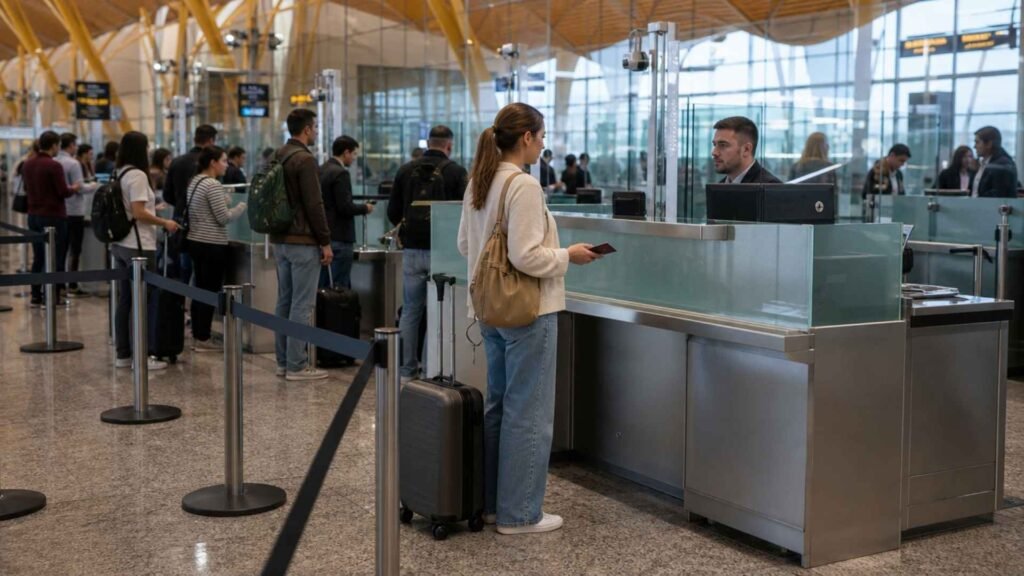
A separate-ticket journey can create immigration requirements that would not apply to a straightforward protected airside transit.
An airport transit visa does not automatically provide permission to enter the Schengen Area. If your transfer requires baggage collection, border control or a landside terminal movement, you must satisfy the entry requirements that apply to your nationality and travel documents.
The important distinction is:
Being permitted to transit through Madrid does not automatically mean you are permitted to complete every type of self-transfer at Madrid-Barajas.
Visa requirements are nationality-specific. Check the Spanish Ministry of Foreign Affairs consular information before booking separate tickets if your itinerary may require entry into Spain.
EES and ETIAS for Madrid Self-Transfers in 2026
EES – Fully Operational
The European Entry/Exit System (EES) was progressively introduced from October 2025 and has been fully operational since 10 April 2026.
It applies to relevant non-EU nationals travelling for short stays when crossing the external borders of the European countries using the system.
If your self-transfer requires a Schengen external-border crossing in Madrid, EES procedures can therefore form part of your journey.
Check current requirements on the EU’s official Entry/Exit System information before travelling.
ETIAS – Not Yet Operational
ETIAS is not operational as of 28 August 2026, and applications are not currently being collected.
ETIAS is separate from EES, so the operation of EES does not mean travellers already need an ETIAS authorization.
Check the EU’s official ETIAS information before future travel rather than using unofficial application websites.
What Happens If Your First Flight Is Delayed?
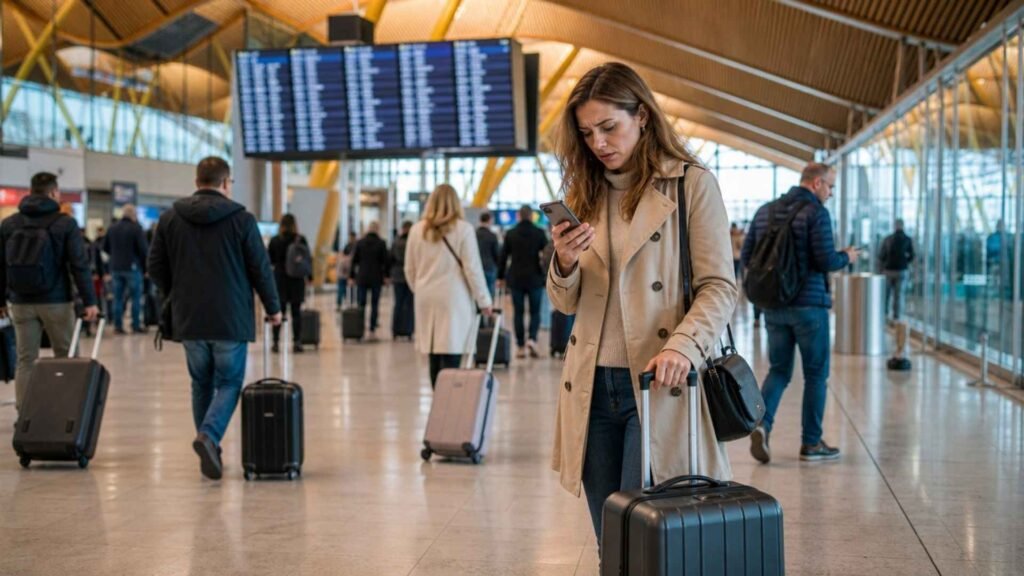
This is the main financial risk of a Madrid Barajas Airport Self Transfer.
Suppose you independently book:
Flight 1: Paris → Madrid
Flight 2: Madrid → New York
If Flight 1 arrives late enough for you to miss Flight 2, the second airline may treat you as a no-show rather than as a passenger with a protected missed connection.
Depending on your fare conditions, you may need to buy another ticket.
Any passenger rights relating to the delayed first flight are a separate issue from whether the second airline has responsibility for an independently booked onward journey.
Before booking, compare the amount saved by using separate tickets with the potential cost of replacing Flight 2.
Can Travel Insurance Protect a Self-Transfer?
Sometimes, but never assume that it does.
Some travel insurance policies or separate-ticket booking protections may cover certain missed connections, delays or replacement transport. Coverage varies considerably, and policies can impose conditions such as minimum scheduled connection times or specific causes of delay.
Before relying on a policy, check whether independently booked flights and missed onward connections are explicitly covered.
When an Overnight Connection Makes Sense
Consider a longer or overnight connection when:
- your onward ticket is expensive,
- Flight 2 is long-haul,
- checked baggage is involved,
- you must move between T1/T2/T3 and T4/T4S,
- border formalities apply, or
- missing the next flight would seriously disrupt your trip.
An overnight stay is not necessary for every separate-ticket connection. But when the financial consequences of missing Flight 2 are high, extra time can be more valuable than choosing the shortest itinerary.
Common Madrid Self-Transfer Mistakes
Planning from Landing Time
Scheduled arrival does not include taxiing, disembarkation and the walk through the terminal.
Assuming Baggage Will Transfer
Separate tickets do not guarantee through-checked luggage. Always verify the baggage tag.
Treating T4S Like a Normal T4 Gate
T4S requires the APM, so include the satellite transfer in your timing.
Ignoring Airline Deadlines
Check-in, bag-drop and boarding can close before the published departure time.
Overlooking Entry Requirements
A landside self-transfer can require different travel documents from an airside transit.
Choosing the Tightest Possible Connection
If your itinerary succeeds only when every stage runs perfectly, choose a larger buffer.
💡 Clara’s Tip:
Before your first flight, save both booking references, boarding passes, baggage receipts and the second airline’s check-in deadline offline.
When you arrive at Madrid-Barajas, check both the terminal and boarding area immediately. If your onward flight uses T4S, knowing that early gives you a much clearer picture of how much of your connection time remains.
Is a Madrid Barajas Airport Self Transfer Worth It?
It can be.
Separate tickets may unlock lower fares or useful airline combinations that cannot be booked as one itinerary. A Madrid Barajas Airport Self Transfer works best when you have a generous connection window, straightforward entry requirements and enough flexibility to absorb a delay.
It becomes less attractive when checked baggage, a major terminal change or an expensive onward ticket increases the consequences of disruption.
A useful final test before booking is:
Would this connection still be realistic if my first flight arrived 45–60 minutes late?
If the answer is no, choose a longer buffer.
Frequently Asked Questions
How much time do I need for a Madrid Barajas Airport Self Transfer?
Allow around three hours or more for a straightforward same-terminal carry-on connection. Four hours is more comfortable when additional procedures are involved, while checked baggage, a T1/T2/T3 ↔ T4/T4S transfer and border formalities can justify five to six hours or more.
Is two hours enough for a self-transfer at Madrid Airport?
Two hours is risky for separate tickets, particularly when checked baggage, a terminal change, security or passport control is involved. A relatively small delay to your first flight can remove most of the usable connection window.
Do I need to collect baggage on separate tickets?
Plan to collect and re-check baggage unless the airline explicitly confirms that it is checked through to your final destination. Check the baggage tag before leaving your first airport.
Can I self-transfer between T1 and T4?
Yes. AENA provides free terminal transport between the complexes, but you should allow substantially more time than the shuttle journey itself.
Is the Madrid Airport terminal shuttle free?
Yes. AENA’s main T1–T4 transit bus is free and operates 24 hours a day.
How do I get from T4 to T4S?
Use the underground Automated People Mover. Include time for reaching the station, waiting and continuing to your boarding area.
Can I walk from T1 to T4?
Do not plan to walk between the T1/T2/T3 complex and T4. Use the free terminal transport. Walking is possible between T1, T2 and T3.
Do I have to clear security again?
Often yes, particularly if you collect baggage, enter the public arrivals area, check in again or make a landside terminal transfer.
Do I need a Schengen visa to collect baggage in Madrid?
If collecting baggage requires you to enter Spain, you must satisfy the Schengen entry requirements that apply to your nationality and travel documents. An airport transit visa alone does not automatically grant permission to enter the Schengen Area.
What happens if I miss my second flight?
With separate tickets, the onward airline may not be required to rebook you. Depending on your ticket conditions and any applicable protection, you could need to purchase another flight.
Is self-transfer easier with carry-on baggage only?
Usually. Avoiding baggage reclaim and re-check removes one of the most unpredictable parts of the process, although terminal, security and immigration requirements can still apply.
Final Thoughts
A Madrid Barajas Airport Self Transfer is manageable when you treat separate tickets as separate journeys and leave enough time for the steps your itinerary actually requires.
Carry-on-only transfers are usually simpler. If checked baggage, T4S, a T1/T2/T3 ↔ T4 change or border formalities are involved, a larger buffer is usually worth the extra waiting time.