

Madrid Barajas Airport (MAD) is Spain’s busiest airport and one of Europe’s major international hubs. With four main terminals plus the T4S satellite building, knowing where your flight operates is essential before you arrive.
The airport is manageable once you understand its terminal layout and transport connections. This guide covers the essential information you need to navigate Madrid Barajas Airport confidently in 2026.
Quick Answer: Madrid Barajas Airport at a Glance
| Question | Quick Answer |
|---|---|
| Airport name | Adolfo Suárez Madrid-Barajas Airport |
| Airport code | MAD |
| Main terminals | T1, T2, T3 and T4 |
| Satellite building | T4S |
| Main terminal complexes | T1–T2–T3 and T4–T4S |
| T1 ↔ T2 | Walk or use airport transport |
| T1/T2/T3 ↔ T4 | Free airport shuttle bus |
| T4 ↔ T4S | Underground Automated People Mover (APM) |
| Can you walk between every terminal? | No |
| Main Iberia terminal | T4, with some flights using T4S |
| Ryanair terminal | T1 |
| Metro stations | Airport T1-T2-T3 and Airport T4 |
| Cercanías station | T4 |
| Airport Express bus | Line 203 |
| Best first step | Check your exact terminal before travelling |
The most important rule: never assume that “Madrid Airport” means one building. Check your terminal before leaving for the airport, and check it again before a connection.
Understanding Madrid Barajas Airport
Madrid Barajas is easier to navigate if you think of it as two major terminal zones rather than five completely separate terminals.
The first complex contains:
T1 → T2 → T3
The second contains:
T4 → T4S
T1 and T2 are close enough that some journeys between them can be made on foot. T3 is also part of this older terminal complex.
T4, however, is physically separate from T1–T2–T3 and generally requires the airport’s free shuttle service when travelling landside between the complexes.
T4S creates another layer of confusion. The “S” stands for Satellite. It is not simply another concourse you can walk into from T4. T4 and T4S are linked by an underground Automated People Mover (APM).
According to Aena’s official Madrid Airport connection information, Madrid Airport has four terminals, with T4 connected internally by train to the T4S satellite building.
Understanding this layout before you arrive can prevent one of the most common mistakes at MAD: discovering that your departure gate is in a different terminal complex when you are already short on time.
Madrid Barajas Airport Terminals Explained

Terminal 1 (T1)
Terminal 1 handles a mixture of European and international services and is particularly important for passengers flying with several low-cost and long-haul carriers.
Ryanair and easyJet currently operate from T1. Several intercontinental airlines also use the terminal.
T1 is relatively close to T2 but much farther from T4. The airport shuttle journey from T1 Departures to T4 Departures is approximately 10 minutes, before accounting for waiting and walking.
If your itinerary involves changing between T1 and T4, allow additional time for any security, passport-control or baggage procedures required by your journey.
Terminal 2 (T2)
Terminal 2 handles many European and Schengen services.
Airlines operating from T2 include KLM and Lufthansa, while Air Europa uses both T1 and T2 depending on the flight.
T1 and T2 are close together. The walk between the T1 and T2 departure areas can take only a few minutes, although your actual journey will depend on where you start and where your gate is located.
T2 is also connected to the wider T1–T2–T3 complex and has access to the Airport T1-T2-T3 Metro station.
Terminal 3 (T3)
Terminal 3 is best understood as part of the T1–T2–T3 complex rather than as an isolated airport building.
Passengers should still follow their boarding pass and airport signage carefully instead of assuming that arriving somewhere within the T1–T2–T3 area automatically places them close to their gate.
The airport transport network connects this complex with T4 when a journey between the two airport zones is required.
Terminal 4 (T4)
Terminal 4 is the newer major terminal complex and one of the most important buildings at Madrid Barajas Airport.
It is especially associated with Iberia and its network, although other airlines also operate here.
T4 has its own Metro station and the airport’s Cercanías railway station, making its public transport situation different from T1–T2–T3.
But the most important thing for connecting passengers is that T4 and T4S are not the same building.
If your boarding gate is shown with an “S”, you may need to continue from the main T4 building to the satellite terminal.
Terminal 4 Satellite (T4S)
T4S is Madrid Airport’s satellite terminal building and is connected to T4 by an underground automated train.
You cannot simply walk from T4 to T4S.
The underground APM ride between the two buildings takes only a few minutes, but your total journey will be longer once walking, reaching the station and getting to your departure gate are included.
The APM operates continuously throughout the year.
This distinction becomes especially important for international connections. Seeing “T4” on an airline listing does not necessarily mean your final boarding gate will be inside the main T4 building.
Always check the gate as well as the terminal.
💡 Clara’s Tip:
If your boarding pass shows T4S, don’t treat it as just another gate area inside T4. Follow the T4S signs as soon as you enter the secure route and allow extra time for the underground train and the walk to your gate.
Which Terminal Does Your Airline Use at Madrid Airport?
Madrid Barajas Airport serves dozens of airlines, so a complete static list can become outdated quickly.
These are some useful examples based on current airport information:
| Airline | Typical Terminal |
|---|---|
| Iberia | T4 / flights may use T4S gates |
| British Airways | T4 |
| Ryanair | T1 |
| easyJet | T1 |
| Air Europa | T1 and T2 |
| KLM | T2 |
| Lufthansa | T2 |
| LATAM | T4 |
| Qatar Airways | T4 |
| Vueling | T4 |
| Wizz Air | T2 |
Terminal assignments can change, and some airlines use more than one terminal depending on the route.
Use this table for orientation rather than as a substitute for live flight information. Before travelling, confirm your terminal on your boarding pass and check the official Aena Madrid-Barajas airline directory.
How to Get Between Madrid Airport Terminals

Terminal transfers are one of the most important things to understand before using Madrid Barajas Airport.
There is no single method that works for every terminal combination.
T1 ↔ T2 ↔ T3
T1 and T2 are close enough for some journeys to be made on foot.
For example, the walk between the T1 and T2 departure areas can take approximately four minutes.
Walking times depend heavily on your actual starting point and destination, however. Being inside “T1” does not mean you are standing at the exact point used for an official terminal-to-terminal estimate.
Follow airport signs rather than relying solely on a time estimate.
T1/T2/T3 ↔ T4
T4 is separate from the T1–T2–T3 complex.
A free airport transit bus connects the terminal areas 24 hours a day. The current scheduled frequency is approximately:
- every 5 minutes from 06:00 to 22:00
- every 20 minutes from 22:00 to 06:00
Typical shuttle travel estimates include:
- T1 Departures → T4 Departures: about 10 minutes
- T2 Departures → T4 Departures: about 8 minutes
- T4 Arrivals → T3 Arrivals: about 8 minutes
- T4 Arrivals → T2 Arrivals: about 10 minutes
- T4 Arrivals → T1 Departures: about 15 minutes
These figures describe the shuttle journey between specific airport points, not the total time required to make a flight connection.
Check the latest stops and operating information on Aena’s official free transport between terminals page.
T4 ↔ T4S
Use the underground Automated People Mover (APM).
The train operates continuously and connects the main T4 building with the T4 Satellite building in only a few minutes.
If your boarding pass shows T4S, follow the airport signs for the satellite building and APM rather than looking for the landside terminal shuttle.
How Much Time Should You Allow Between Terminals?
There is no single safe terminal-transfer time that applies to every itinerary at Madrid Barajas Airport.
A connection can involve very different procedures depending on:
- your arrival and departure terminals
- whether the flights are Schengen or non-Schengen
- whether baggage is checked through
- whether you already have your next boarding pass
- whether passport control is required
- whether another security check is required
- whether the flights are on one protected ticket or separate bookings
This is why a short shuttle or train journey does not automatically mean a short connection is safe.
The distinction is particularly important when moving between the T1–T2–T3 complex and T4/T4S. Build your connection around the complete passenger journey, not just the advertised terminal transport time.
Schengen vs Non-Schengen Flights at Madrid Airport
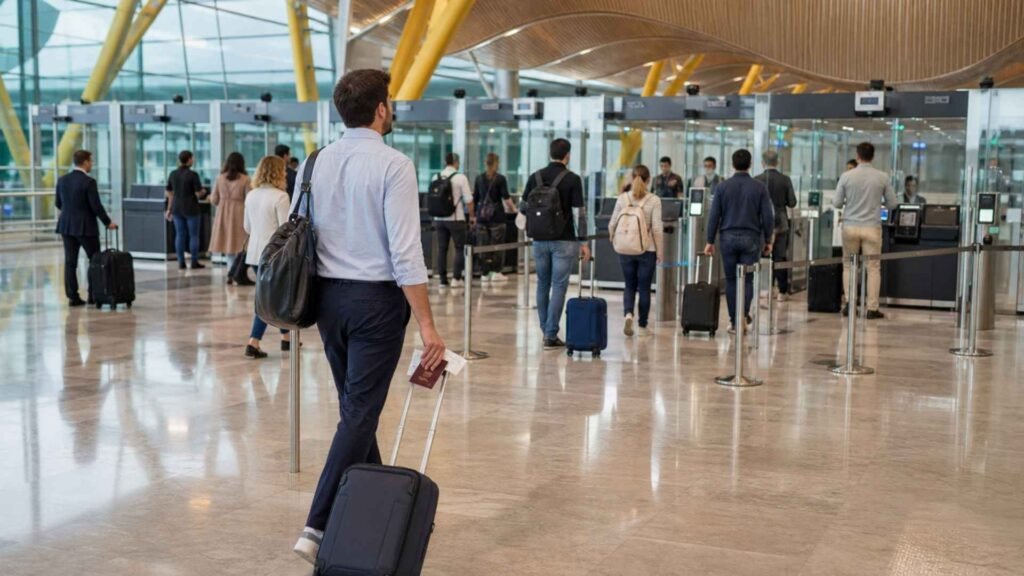
Madrid is both a major Schengen hub and an important gateway between Europe and destinations in the Americas, Africa, the Middle East and elsewhere.
That means your connection procedure depends not only on the terminal but also on where you are arriving from and where you are flying next.
A Schengen-to-Schengen journey normally does not involve routine Schengen border control during the connection.
A non-Schengen-to-Schengen itinerary is different. Madrid may be the point where you formally enter the Schengen Area, meaning passport control may be required before continuing.
Similarly, passengers travelling from the Schengen Area to a non-Schengen destination may need to clear exit passport control.
For example:
Istanbul → Madrid → Barcelona
Madrid is normally the first Schengen entry point, so the traveller would generally complete Schengen border formalities in Madrid before continuing to Barcelona.
By contrast, an international connection that remains outside the Schengen Area may follow a different airside procedure.
Do not assume that every Madrid connection follows the same route. Nationality, visa status, baggage arrangements and the exact itinerary can all affect what happens.
For a broader explanation, read our Transit Visa Explained guide.
Passport Control and EES at Madrid Airport in 2026
Travellers crossing the Schengen external border at Madrid may need to pass passport control.
The European Entry/Exit System (EES) is now part of the border environment eligible non-EU short-stay travellers may encounter when crossing participating Schengen external borders. Border processing can involve electronic registration and biometric procedures rather than relying solely on traditional passport stamps.
EES does not change the fundamental Schengen short-stay limit. Travellers subject to the rule are still generally limited to 90 days within any rolling 180-day period.
If you are entering Spain from outside the Schengen Area, check our full Spain Entry Requirements 2026 guide before departure.
Frequent visitors can also use our Schengen 90/180 Rule Explained guide to understand how previous stays affect the number of days remaining.
Important: immigration requirements depend on nationality and travel status. Airport layout information should never be treated as confirmation that you have permission to enter Spain or transit through the Schengen Area.
Security at Madrid Barajas Airport
Passengers entering a boarding area must pass the applicable aviation security checks.
This generally means presenting a valid boarding pass and sending cabin baggage and required personal items through security screening.
Madrid Airport also offers priority security access at T1, T2 and T4. Access may be included for eligible premium passengers or loyalty-programme members, while paid access may also be available.
Fast Track speeds up access to the security checkpoint; it does not allow passengers to skip aviation security, passport control or other required formalities.
Because availability and operating arrangements can change, check Aena’s official Madrid Airport Fast Track information before travelling.
Arriving at Madrid Barajas Airport
Your arrival process depends primarily on where your flight originated.
For many passengers arriving from outside the Schengen Area, the basic sequence may look like:
Aircraft → Passport Control → Baggage Claim → Customs → Arrivals Hall
Passengers arriving on eligible Schengen flights may follow a simpler route without Schengen entry passport control.
Your terminal also affects where you emerge and which transport options are immediately available.
If you are unfamiliar with European arrival procedures, our Europe Airport Arrival Guide explains passport control, baggage claim and customs in more detail.
Connecting at Madrid Barajas Airport
Madrid is a major connecting airport, but two connections with identical layover lengths can be completely different in practice.
A straightforward connection within the same terminal complex may be relatively simple. A connection involving T1/T2/T3 ↔ T4/T4S, however, can require substantially more movement.
When you land:
- Check the airport flight-information screens.
- Confirm your departure terminal and gate area.
- Follow Connections/Flight Connections signage where applicable.
- Do not automatically follow the Arrivals/Exit route unless your itinerary requires you to go landside.
- Complete passport control or security where your route requires it.
Your connection procedure ultimately depends on your route, airline, terminal and baggage arrangements.
Self-Transfers and Separate Tickets
A self-transfer is different from a normal protected airline connection.
If you booked separate tickets, you may have to:
Arrive → Enter Spain if required → Collect baggage → Leave the secure area → Change terminals → Check in again → Clear security → Clear passport control if applicable → Reach the new gate
That can transform what looks like a comfortable layover into a much tighter connection.
The risk is greater when the two flights use different terminal complexes. Visa and immigration requirements can also change when you must enter Spain to retrieve baggage.
For separate tickets, plan around the entire self-transfer process rather than the physical distance between terminals.
Getting from Madrid Airport to the City Centre

Madrid Barajas Airport has several public and private transport options.
The best choice depends on your terminal, arrival time, luggage and final destination.
Metro
Metro Line 8 connects the airport with Nuevos Ministerios.
There are airport Metro stations serving:
- T1-T2-T3
- T4
The Metro normally operates from approximately 06:05 to 02:00, and an airport supplement applies to relevant journeys.
Check current information on Aena’s official Madrid Airport Metro page.
Cercanías Train
Cercanías provides another useful rail option, particularly for passengers using T4.
The C1 line connects Airport T4 with major stations including Chamartín, Atocha and Príncipe Pío.
Unlike the Metro, the Cercanías airport station is at T4, so passengers arriving at or departing from another terminal need to account for the terminal transfer.
Airport Express Bus
Madrid’s Line 203 Airport Express connects the airport with central Madrid.
The service operates 24 hours a day, making it particularly useful when rail services are less convenient.
Taxi
Official taxis are available outside the arrivals areas of all terminals.
Use the clearly marked official taxi ranks rather than accepting unsolicited transport offers inside the terminal. Official Madrid taxis are white with a red stripe.
Private Transfer
A pre-booked private transfer can be useful for:
- families with substantial luggage
- larger groups
- late-night arrivals
- travellers who prefer door-to-door transport
- passengers prioritising convenience over price
Before choosing your transport, check which terminal you will arrive at because access to rail services differs between T1–T2–T3 and T4.
Madrid Barajas Airport Lounges
Madrid has multiple VIP lounges spread across its terminal buildings.
The current selection includes:
- Altitude and Cibeles — T1
- Puerta de Alcalá — T2
- Puerta del Sol — T3
- Plaza Mayor and Retiro — T4
- Neptuno and Gran Vía — T4S
Access conditions vary by lounge, airline, ticket type, membership and paid-entry availability.
Your terminal matters more than simply choosing the lounge that sounds best. Some lounges are restricted to passengers departing from particular terminal areas.
Check the latest access rules and facilities on Aena’s official Madrid Airport VIP lounges page.
Where to Stay Near Madrid Barajas Airport

An airport hotel can be useful if you have:
- a very early departure
- a late-night arrival
- an overnight layover
- a long self-transfer
- separate tickets with significant connection risk
But “near Madrid Airport” does not automatically mean equally convenient for every terminal.
A hotel that works well for a T1 departure may not provide the same experience for a passenger leaving from T4, particularly if its shuttle has limited operating hours or terminal stops.
Before booking, check:
- distance from your terminal
- airport shuttle availability
- shuttle operating hours
- first morning departure
- late-night pickup arrangements
- whether advance reservations are required
For an overnight stay, terminal convenience can be just as important as the hotel’s physical distance from the airport.
Practical Tips for Using Madrid Barajas Airport
1. Check Your Terminal Before Leaving
Do not enter “Madrid Airport” into your transport plan and assume every terminal shares the same entrance or station.
Confirm T1, T2, T3, T4 or T4S first.
2. Check the Gate Again at the Airport
Terminal information is only part of the journey.
This is especially important in the T4 complex because your gate may require travelling onward to T4S.
3. Treat T4S as a Real Transfer
The APM ride is short, but reaching the train and then walking to your gate takes additional time.
Do not wait until boarding begins to start moving toward T4S.
4. Allow Extra Time When Changing Terminal Complexes
T1–T2–T3 and T4/T4S should be treated as separate zones when planning your journey.
5. Do Not Assume You Can Walk Everywhere
You can walk between some parts of the T1–T2–T3 complex.
You cannot simply walk from T1 to T4 or from T4 to T4S.
6. Know Whether Your Baggage Is Checked Through
This single detail can completely change a connection.
If your baggage is not checked to your final destination, you may need to collect it and complete another check-in.
7. Keep Passport Control in Mind
A Schengen/non-Schengen connection may add border formalities even if your flights use the same airport.
8. Use Live Airport Information
Flight gates and operational arrangements can change. Use your airline’s updates and Aena’s live airport information rather than relying on an old terminal map or screenshot.
Common Mistakes at Madrid Barajas Airport
Assuming T4 and T4S Are the Same Building
They belong to the same terminal complex, but passengers travel between them by underground APM.
A gate in T4S requires additional movement.
Going to the Wrong Terminal
This is more serious at Madrid than at an airport where every terminal is connected by a short indoor walk.
Always check your terminal before travelling.
Underestimating a T1 ↔ T4 Transfer
The physical shuttle journey is only one part of the transfer.
Walking, waiting and any required baggage, security or border procedures can make the complete journey considerably longer.
Assuming Every Connection Stays Airside
Some itineraries require passengers to enter Spain, particularly when baggage must be collected or separate tickets are involved.
Check your exact itinerary rather than assuming that having another flight automatically keeps you in transit.
Relying Only on an Airline’s “Usual” Terminal
An airline’s normal terminal is useful for planning, but the actual flight information is what matters.
Check your boarding pass and live airport screens.
Going Landside During a Protected Connection Without Checking
If you already have a boarding pass and your baggage is checked through, following the wrong signs toward baggage claim or the public arrivals area can make a simple connection more complicated.
Follow connection signage unless your itinerary specifically requires baggage collection or landside processing.
FAQ: Madrid Barajas Airport
How many terminals does Madrid Barajas Airport have?
Madrid Barajas Airport has four main terminals: T1, T2, T3 and T4. T4 also has a separate satellite building called T4S, connected by an underground automated train.
Is Madrid Airport easy to navigate?
Yes, once you understand the two main terminal complexes: T1–T2–T3 and T4–T4S. The biggest problems usually arise when passengers go to the wrong terminal or underestimate the time required to change complexes.
Can you walk between terminals at Madrid Airport?
You can walk between some terminals in the T1–T2–T3 complex, including T1 and T2. You cannot walk between all Madrid Airport terminals. T1/T2/T3 and T4 are connected by airport transport, while T4 and T4S use the underground APM.
How do I get from T1 to T4 at Madrid Airport?
Use the free airport transit bus. The T1 Departures-to-T4 Departures shuttle journey takes roughly 10 minutes under normal conditions, but allow additional time for the complete terminal change.
How do I get from T4 to T4S?
Follow signs for T4S and take the underground Automated People Mover (APM). The train ride takes only a few minutes, with additional time needed to reach the station and your gate.
Is T4S a separate terminal?
T4S is a satellite building belonging to the T4 complex. It is physically separate from the main T4 building and connected by an underground automated train.
Which terminal does Iberia use at Madrid Airport?
Iberia primarily operates from T4, with flights potentially using gates in the wider T4/T4S complex. Always check your actual flight and boarding gate.
Which terminal does Ryanair use at Madrid Airport?
Ryanair currently operates from Terminal 1 (T1) at Madrid Barajas Airport. Confirm your terminal before departure in case operational arrangements change.
How early should I arrive at Madrid Barajas Airport?
Follow your airline’s recommended check-in time. International flights, checked baggage, passport control and travel to T4S can all require additional time, so there is no single arrival time that suits every flight.
Do I need passport control when connecting in Madrid?
It depends on your route. Passengers entering or leaving the Schengen Area may need passport control, while many Schengen-to-Schengen connections do not. Nationality, immigration status and the exact itinerary can also affect the process.
Final Verdict
Madrid Barajas Airport is large but relatively straightforward once you understand its terminal layout. The main point to remember is that T1–T2–T3 and T4–T4S form two distinct terminal complexes, so changing between them can require extra time.
Check your terminal and gate before travelling, follow live airport information, and allow additional time whenever your journey involves a terminal change.
Last fact-checked: August 22, 2026. Airport services, airline terminal assignments, operating hours and border procedures can change. Always confirm time-sensitive information with your airline and Aena before travelling.