
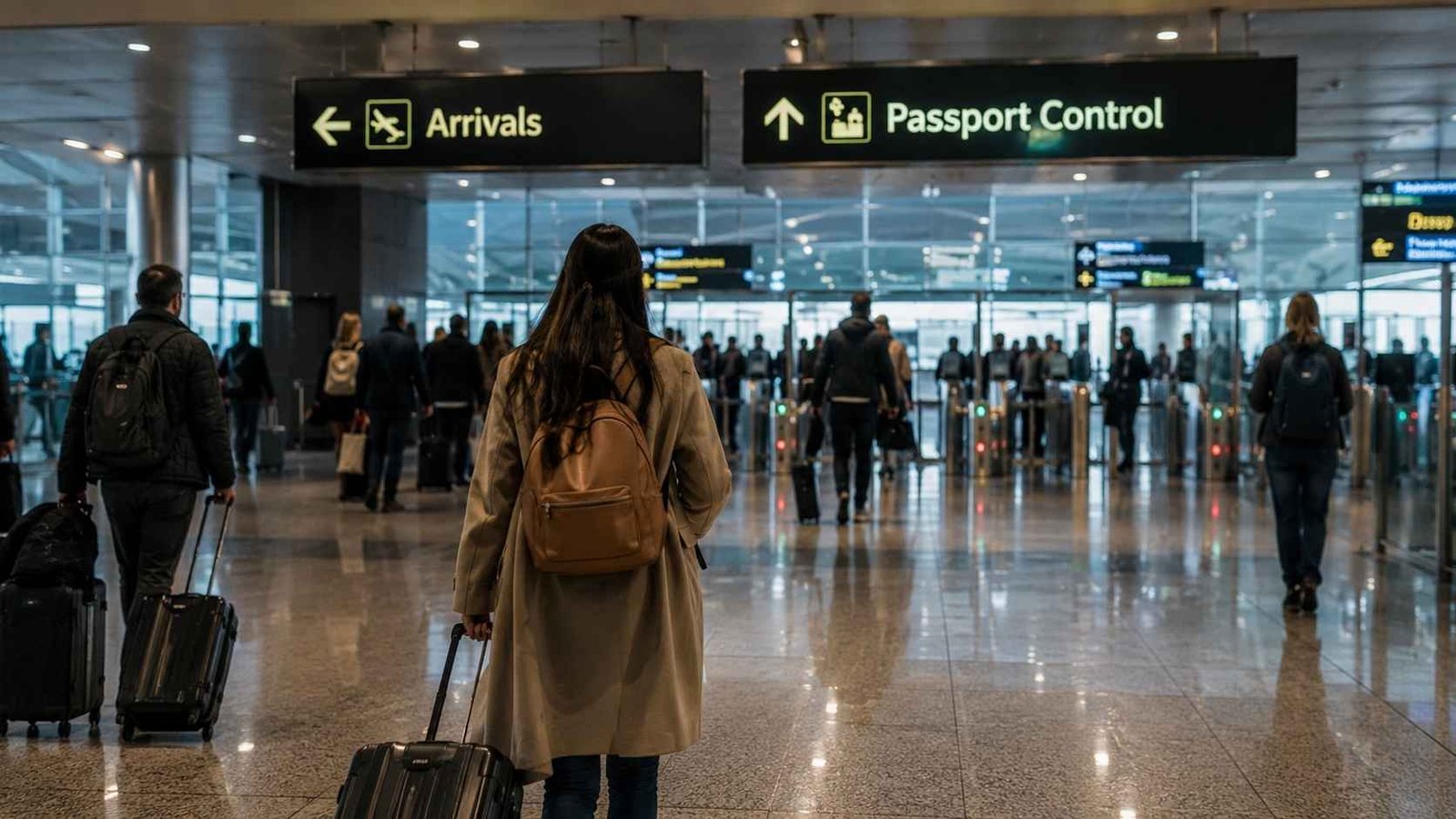
After a long international flight, arriving at a European airport can feel overwhelming, especially for first-time travelers.
Passport control queues, biometric checks, baggage claim halls, and unfamiliar airport signs often create stress immediately after landing.
The good news is that most European airport arrivals follow a fairly predictable structure.
This Europe Airport Arrival guide explains exactly what travelers should expect after landing in Europe in 2026 — from passport control and baggage claim to customs, eGates, and finally exiting into the arrivals hall.
Europe Airport Arrival Quick Answer
For most international travelers, airport arrivals in Europe usually follow the same basic flow:
Landing → Immigration → Passport Control → Baggage Claim → Customs → Arrivals Hall
Depending on the airport, passport queues, Schengen rules, baggage delivery times, and biometric systems such as EES may slightly change the experience.
Once you understand the overall process, navigating a European airport becomes much easier and significantly less stressful.
Step 1 — Leaving the Aircraft
The arrival process begins the moment passengers leave the aircraft.
Depending on the airport, travelers usually exit the plane in one of two ways:
- through a jet bridge connected directly to the terminal
- or by shuttle bus on the airport tarmac
Large European hubs such as Frankfurt, Amsterdam Schiphol, Paris Charles de Gaulle, Madrid Barajas, Rome Fiumicino, or Barcelona El Prat often involve long walks after landing.
For tired travelers arriving after overnight flights, these terminals can initially feel confusing.
Inside the terminal, airport signs usually separate passengers into different directions such as:
- Arrivals
- Transfers
- Passport Control
- Baggage Claim
- EU Passports
- All Passports
For travelers entering Europe as their final destination, the correct direction is usually:
Arrivals or Passport Control
One of the most common mistakes is accidentally following “Transfers” signs instead of “Arrivals.”
At this stage, staying calm and carefully following official airport signage is usually the best approach.
Step 2 — Following Immigration & Passport Control Signs
After leaving the arrival corridor, passengers are normally guided toward immigration and passport control areas.
At many European airports, travelers are separated into different lanes depending on nationality and passport eligibility.
Common airport lanes include:
| Lane | Usually For |
|---|---|
| EU / EEA / Swiss | European citizens |
| All Passports | International travelers |
| eGates | Eligible biometric passports |
| Transfers | Connecting passengers |
If you are entering the Schengen Area from outside Europe, this is usually where formal border checks happen.
For many visitors, this is where airport anxiety increases most.
Questions such as:
- “Am I standing in the correct queue?”
- “What documents should I prepare?”
- “Will immigration officers ask difficult questions?”
are extremely common.
In most cases, immigration checks are routine and relatively straightforward when travelers prepare documents in advance.
Before reaching passport control, it helps to have ready:
- passport
- Schengen visa (if required)
- hotel reservation
- return or onward flight ticket
- supporting travel documents if requested
Having documents ready before reaching the officer usually makes the process smoother and faster.
Step 3 — Passport Control in Europe
Passport control is one of the most important parts of arriving in Europe because this is where border officers officially authorize entry.
The exact experience depends on:
- nationality
- visa status
- Schengen rules
- airport technology
- border queue volume
In many cases, immigration officers may ask short and routine questions such as:
- What is the purpose of your trip?
- How long are you staying?
- Where will you stay?
- When is your return flight?
For most travelers, the interaction lasts only a few minutes.
Border officers may also verify:
- passport validity
- visa conditions
- accommodation details
- proof of onward travel
- available Schengen stay duration
Read the full Schengen 90/180 Rule Explained (2026) guide before planning longer stays in Europe.
Some airports still use traditional passport stamps, while many European border systems increasingly rely on biometric registration infrastructure connected to EES.
For many travelers, passport control feels far more intimidating before the trip than it does in reality.
👉 Read the full ETIAS & EES Explained (2026) guide.
Step 4 — eGates & Biometric Border Checks
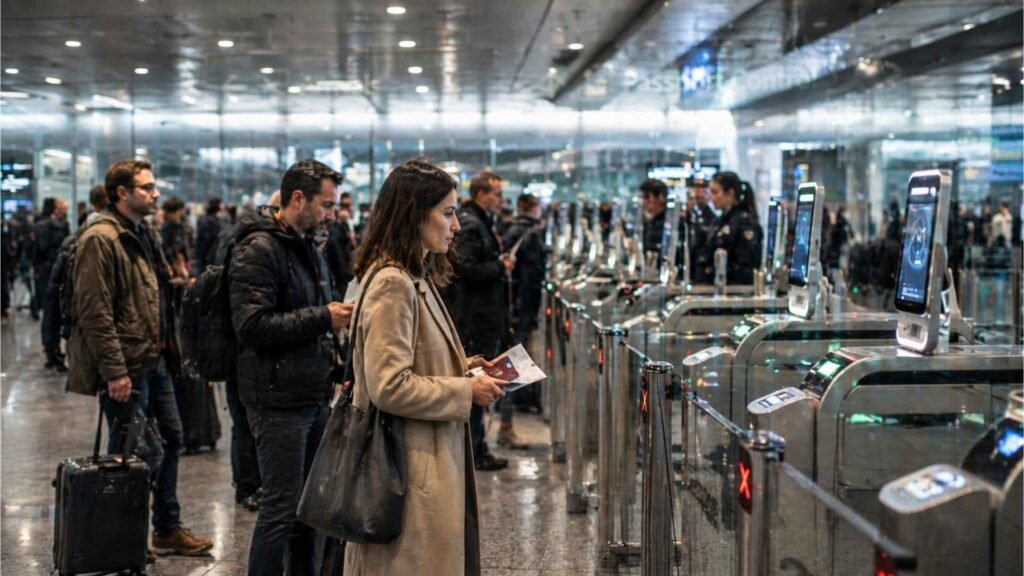
One of the biggest airport changes across Europe in 2026 is the continued expansion of automated border systems.
Many airports now use:
- facial recognition
- biometric passport scanning
- fingerprint registration
- automated eGates
Under the Entry/Exit System (EES), many non-EU travelers may increasingly encounter digital biometric registration when entering the Schengen Area.
For first-time registration, the process may include:
- facial image capture
- fingerprint scans
- passport verification
This can sometimes create longer queues during busy travel periods, particularly at major international airports.
However, once registration is completed, future border crossings may become faster through expanded eGate usage.
eGate eligibility varies depending on nationality, airport systems, and passport type. Many EU, EEA, UK, US, Canadian, Australian, and biometric passport holders may be eligible at selected airports.
For most travelers, biometric border checks are gradually becoming a more normal part of arriving in Europe.
Step 5 — Baggage Claim
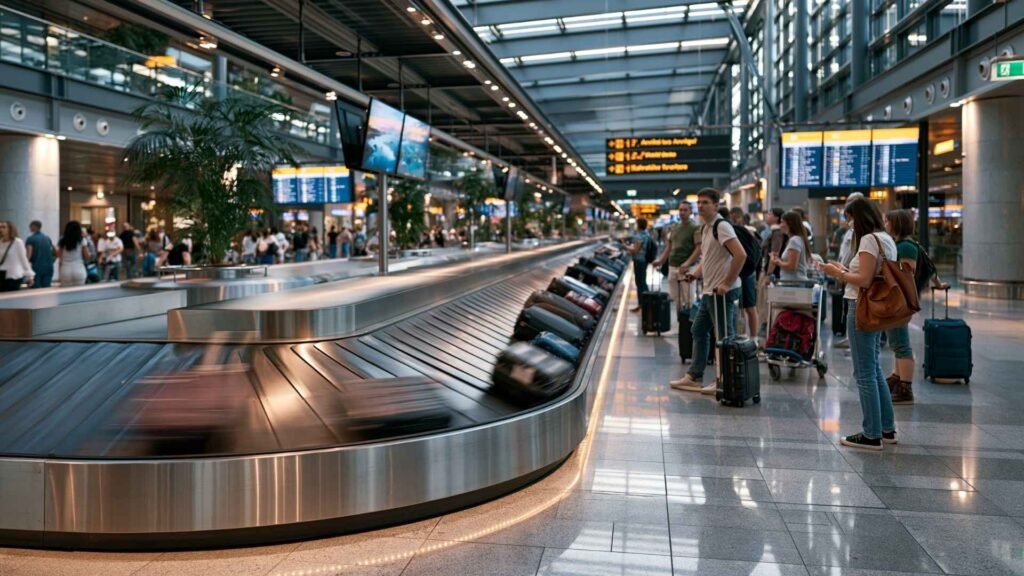
After immigration and border checks, passengers usually continue toward baggage claim.
For many travelers, finally reaching the baggage hall feels like the moment the most stressful part of the arrival process is over.
Arrival screens inside the baggage area normally display:
- flight number
- origin city
- baggage carousel number
Large European airports can still feel chaotic during busy arrival periods because several international flights may arrive simultaneously.
Some common mistakes travelers make include:
- standing at the wrong carousel
- confusing similar flight numbers
- forgetting baggage tags
- leaving luggage unattended
- missing oversized baggage collection areas
Oversized luggage such as bicycles, skis, strollers, or sports equipment may arrive separately from normal baggage.
Traveling With Carry-On Only
Passengers traveling without checked baggage may skip baggage claim entirely and continue directly toward customs after passport control.
At busy European airports, this can save a significant amount of time after landing.
If luggage does not arrive, travelers should follow signs for:
Lost Baggage or Baggage Services
Most airports have airline support desks directly inside the baggage hall.
Step 6 — Customs After Landing
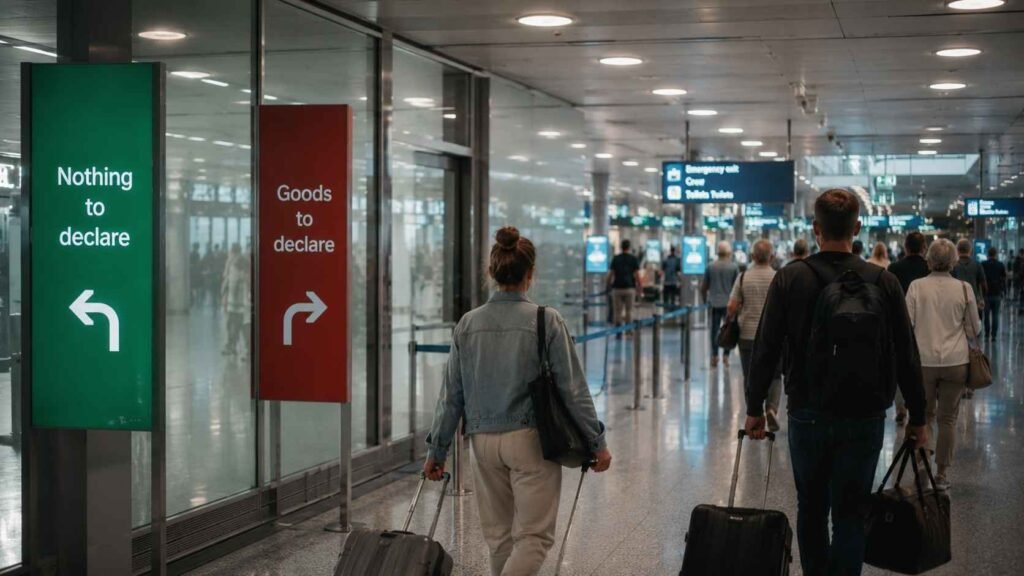
After collecting baggage, travelers usually pass through customs before entering the public arrivals area.
This stage is often misunderstood because many travelers assume passport control and customs are the same process.
In reality, they are separate systems.
At many European airports, customs operates through channel systems:
| Channel | Meaning |
|---|---|
| Green Channel | Nothing to declare |
| Red Channel | Goods to declare |
Most tourists carrying normal personal belongings typically use the green channel.
However, customs declarations may still be required for:
- large amounts of cash
- commercial goods
- restricted food products
- certain medications
- expensive electronics
- high-value purchases
Travelers entering the EU with €10,000 or more in cash generally must declare it to customs authorities.
Passengers arriving from outside the EU may also have personal goods allowance limits — often around €430 for air travelers and lower for some land or sea arrivals.
Even after leaving passport control, customs officers may still perform inspections or baggage checks.
For most travelers, customs ends up being much faster and less stressful than expected.
👉 Read the complete UK Customs Rules (2026) guide.
Step 7 — Entering the Arrivals Hall
After customs, passengers finally enter the public arrivals hall.
This is usually the moment when the airport experience starts feeling significantly less stressful.
Inside arrivals halls across Europe, travelers commonly find:
- SIM card kiosks
- ATMs
- currency exchange counters
- airport train signs
- taxi pickup zones
- rideshare pickup instructions
- hotel shuttle information
- airport transfer desks
Large European airports sometimes separate:
- taxis
- rideshares
- private transfers
- train stations
- inter-terminal shuttles
This can initially feel confusing, especially after long international flights and immigration queues.
In most cases, carefully following official airport signs remains the easiest and safest approach.
Many European airports also offer free Wi-Fi, although some may require SMS verification or email registration before access.
Europe Airport Arrival: Common Airport Signs
One surprisingly stressful part of arriving at a European airport is understanding airport signage quickly after landing.
Fortunately, most European airports use very similar terminology.
Some of the most common airport signs include:
| Airport Sign | Meaning |
|---|---|
| Arrivals | Exit toward the city |
| Transfers | Connecting flights |
| Passport Control | Immigration checks |
| Baggage Claim / Reclaim | Luggage collection area |
| Customs | Declaration checkpoint |
| Exit | Public arrivals hall |
| eGates | Automated biometric passport gates |
Understanding these basic airport signs can make the arrival process feel significantly easier and more manageable.
Schengen vs Non-Schengen Airport Arrivals
The airport arrival process in Europe can vary depending on whether your flight arrives from inside or outside the Schengen Area.
For flights arriving from another Schengen country, passengers often experience a simpler arrival process because formal passport control may not happen after landing.
However, travelers entering the Schengen Area from outside Europe usually complete:
- immigration checks
- passport control
- biometric border procedures
- customs processes
The first airport where a traveler officially enters the Schengen Area is usually where passport control takes place.
For example, if a traveler flies from New York to Rome through Amsterdam, passport control normally happens in Amsterdam because it is the first Schengen entry point.
After that, the Amsterdam–Rome flight often operates similarly to a domestic European flight.
This is one of the most misunderstood parts of the European airport arrival process.
What Happens During Connecting Flights in Europe?
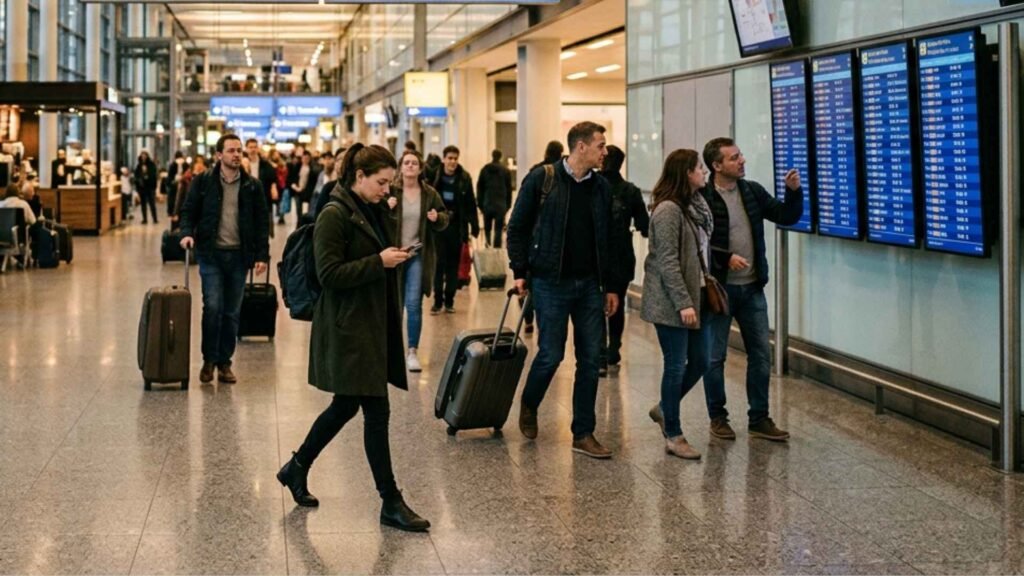
Passengers with connecting flights may follow “Transfers” signs instead of “Arrivals” after leaving the aircraft.
Depending on the airport, connecting passengers may still need to complete:
- passport control
- security screening
- terminal transfers
- baggage re-check procedures
This becomes especially important on self-transfer itineraries booked under separate tickets.
At some airports, travelers may even need to formally enter the country before continuing to the next flight.
Some travelers may still need a transit visa depending on nationality and airport routing.
Travelers can also verify airline and transit document requirements before departure.
Common Mistakes First-Time Travelers Make
Many airport problems in Europe are caused by small misunderstandings rather than serious immigration issues.
Some of the most common mistakes include:
❌ standing in the wrong immigration queue
❌ following “Transfers” instead of “Arrivals”
❌ forgetting baggage carousel numbers
❌ misunderstanding customs channels
❌ failing to prepare documents before passport control
❌ panicking during biometric checks
❌ assuming every European airport works identically
Most of these situations are easy to solve once travelers slow down and carefully follow airport instructions.
How Long Does Airport Arrival Usually Take?
Arrival times at European airports vary significantly depending on:
- airport size
- season
- immigration queues
- baggage delivery speed
- Schengen vs non-Schengen arrivals
- biometric registration requirements
Typical airport arrival estimates:
| Process | Typical Time |
|---|---|
| Passport control | 10–60 minutes |
| Baggage claim | 15–45 minutes |
| Customs | 1–10 minutes |
| Full airport exit | 30–120 minutes |
During summer travel peaks or major holiday periods, arrival times may increase considerably at busy European hubs.
EES Changes in European Airports (2026)
One of the biggest developments affecting European airport arrivals in 2026 is the continued expansion of biometric border systems connected to EES.
Travelers entering the Schengen Area may increasingly encounter:
- digital entry registration
- fingerprint collection
- facial recognition systems
- expanded eGate infrastructure
- reduced physical passport stamping
For first-time visitors, this may initially feel intimidating.
Most of the process is highly automated and designed to improve long-term border efficiency while strengthening entry monitoring across the Schengen Area.
However, first-time biometric registration may still increase waiting times at some airports during busy travel periods.
Travelers can also verify official EES information through the European Union’s border management resources.
FAQ About European Airport Arrivals
What happens after landing in Europe?
Most travelers proceed through immigration, passport control, baggage claim, customs, and finally enter the arrivals hall.
Why do European airport arrivals feel stressful for first-time travelers?
Long immigration queues, unfamiliar airport layouts, biometric border checks, and customs procedures can initially feel overwhelming for first-time visitors entering Europe.
Do they stamp passports in Europe?
Some airports still use traditional passport stamps, while others increasingly rely on biometric EES registration and automated border systems.
Are European airports strict?
Most European airport procedures are routine rather than aggressive. Travelers with valid documents and clear travel plans usually complete the process without major issues.
What is the green channel at customs?
The green channel is generally used by travelers who have nothing to declare.
Do I always go through customs after landing?
Usually yes, especially when arriving internationally and collecting checked baggage before exiting into the public arrivals area.
How long does it usually take to leave a European airport?
For most travelers, the full airport arrival process usually takes between 30 minutes and 2 hours depending on queues, baggage delivery times, airport size, and biometric checks.
Final Thoughts
For first-time travelers, European airport arrivals often feel far more stressful before the trip than they do in reality.
Once you understand the basic airport flow — immigration, passport control, baggage claim, customs, and arrivals — the entire process becomes much easier to navigate confidently.
Modern systems such as biometric eGates and EES are gradually changing how Europe manages airport arrivals, but the overall structure still remains relatively predictable across most major airports.
Understanding the steps involved in a Europe Airport Arrival before departure can make the entire experience feel far more manageable and less intimidating.