

A Madrid Barajas Airport transit is usually straightforward when your flights are on one protected itinerary, but the exact process depends on your terminals and whether you are travelling between Schengen and non-Schengen countries.
Connections within T4 and T4S are generally the easiest to navigate, while transfers between T1–T3 and T4/T4S can involve a terminal shuttle, another security check and passport control. This guide explains how connecting flights at Madrid Barajas work in 2026, including terminal changes, the T4S train, baggage, security, immigration and airport transit visa rules.
Madrid Barajas Airport Transit: Quick Answer
For a smooth Madrid Barajas Airport transit, check three things before you fly: your arrival terminal, departure terminal and whether each flight is Schengen or non-Schengen.
T4 and T4S operate as one connected terminal system using an underground train. T1, T2 and T3 form a separate terminal complex, so changing between these areas and T4/T4S can require more steps.
| Connection | What to Expect |
|---|---|
| Schengen → Schengen | Normally no passport control |
| Schengen → Non-Schengen | Exit passport control |
| Non-Schengen → Schengen | Entry passport control |
| Non-Schengen → Non-Schengen | You may remain in international transit if your route allows it |
| T4 ↔ T4S | Underground APM train |
| T1/T2 ↔ T4/T4S | May require a free terminal shuttle and another security check |
| Checked baggage | Usually transferred automatically when tagged to your final destination |
| Security | May be required again depending on your route |
| Separate tickets | Treat the journey as a self-transfer rather than a normal protected connection |
The easiest way to understand Madrid is to think of the airport as two main terminal groups: T1–T3 and T4–T4S.
How Connecting Flights Work at Madrid Barajas
Madrid Barajas has four main terminals — T1, T2, T3 and T4 — plus the T4 Satellite building, known as T4S.
T1, T2 and T3 form one terminal complex. T4 is a separate building, while T4S is connected to T4 by an underground Automated People Mover (APM).
This layout means two connections that look similar on an itinerary can work very differently.
A protected T4-to-T4S connection can normally be completed within the T4 system. A T2-to-T4 connection, however, may require you to enter the arrivals hall, use the free terminal shuttle and clear security again.
Aena, Spain’s airport operator, recommends checking your arrival and departure areas, documentation and available connection time before travelling. Its official Madrid Barajas connecting flights information also provides connection routes for different terminal and Schengen combinations.
For a wider overview of terminals, airport facilities and how T4S works, see our Madrid Barajas Airport Guide.
Whatever your itinerary, check the airport flight-information screens as soon as you arrive. Gate assignments can change, and your current gate is more useful than the terminal information saved when you originally booked.
Schengen and Non-Schengen Connections at Madrid Airport
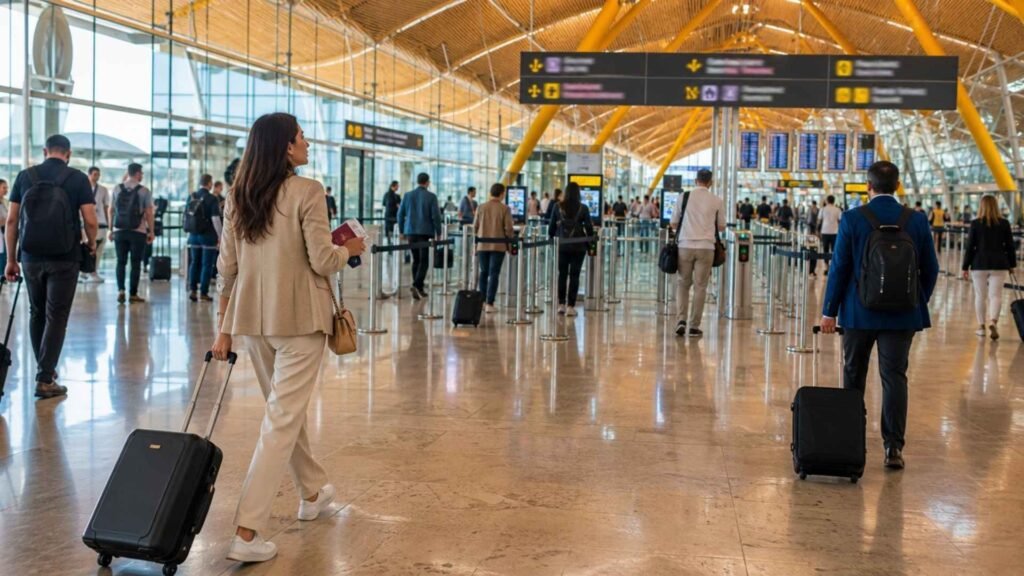
Whether you cross the Schengen external border is one of the biggest factors determining what happens during your connection.
Schengen to Schengen – Usually the Simplest Connection
If both flights operate within the Schengen Area, you generally do not pass through passport control in Madrid.
A connection entirely within T4 can be as simple as following the signs to your new gate.
However, changing between the T1–T3 complex and T4 can still require you to use the terminal shuttle and clear security again.
So while Schengen → Schengen normally means no passport control, it does not necessarily mean there will be no additional airport procedures.
Schengen to Non-Schengen – Expect Exit Passport Control
If you arrive from a Schengen country and continue to a non-Schengen destination, Madrid is normally where you leave the Schengen Area.
For example:
Rome → Madrid → New York
You arrive in Madrid as a Schengen passenger and pass through exit passport control before reaching your non-Schengen departure area.
If you arrive in T4 and depart from an S gate in T4S, follow the connection signs to the APM, travel to T4S and pass through passport control before continuing to your gate.
Non-Schengen to Schengen – Enter Schengen in Madrid
If you arrive from outside the Schengen Area and continue to a Schengen destination, Madrid is normally your first Schengen entry point.
For example:
New York → Madrid → Rome
You complete Schengen entry formalities in Madrid rather than Rome.
For a typical S-gate arrival at T4S followed by a departure from T4, the connection normally involves passport control, the APM toward T4 and the designated connection route, including security where required.
Border-control queues can therefore make a meaningful difference to this type of connection.
Non-Schengen to Non-Schengen – You May Stay in International Transit
If both flights are outside the Schengen Area, you may be able to remain in international transit without formally entering Spain.
Passengers connecting between S gates within T4S who do not need to collect baggage or check in again can follow the international connection signs and complete the required connection security before proceeding to the departure gate.
Madrid also has an internal transfer procedure for certain non-Schengen connections between T1 and T4S. Eligible passengers can be directed to the appropriate internal transfer service rather than entering Spain.
Do not leave the designated international transit route unless airport or airline staff instruct you to do so, particularly if your nationality requires an Airport Transit Visa.
T4 and T4S Connections: How the APM Works
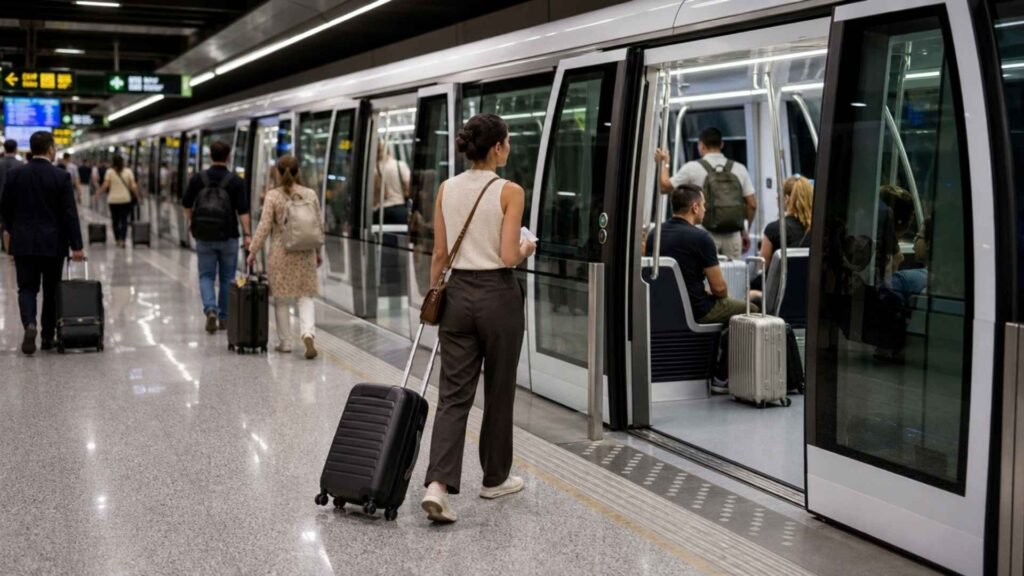
You cannot walk between T4 and T4S.
The two buildings are connected by an underground Automated People Mover (APM). Aena lists the train journey itself at approximately 3 minutes, although the total connection takes longer once walking, changing levels, waiting and any required passport or security checks are included.
For a typical T4 → T4S connection, follow the signs toward your assigned gate and descend to the APM station on Level -2. After reaching T4S, continue to the appropriate level for your gate and complete passport control when required.
The reverse journey depends on whether you arrive from a Schengen or non-Schengen destination.
Don’t worry simply because one flight shows T4 and another T4S. These buildings are designed to work together, and this is generally a more integrated connection than changing between T1/T2 and T4.
One useful exception to remember is that some Schengen flights operated by Iberia, Iberia Express and Air Nostrum can use the M gates in T4S. T4S therefore does not automatically mean your flight is non-Schengen.
Connecting Between T1/T2 and T4/T4S
This is usually the terminal change that requires the most attention during a Madrid Barajas Airport transit.
T4 is physically separate from the T1–T3 complex. Madrid Barajas provides free transport between the terminals, but there is no single transfer procedure that applies to every passenger.
For example, a passenger travelling Schengen → Schengen from T2 to T4 without needing to collect baggage or check in again may still need to enter the arrivals hall, take the free terminal shuttle to T4 and clear security again.
A Schengen → non-Schengen connection from T2 to an S gate in T4S adds further steps: terminal shuttle to T4, security, APM to T4S and passport control.
Travelling in the opposite direction can similarly require the public terminal shuttle and another security check.
Non-Schengen → non-Schengen passengers may follow a different procedure. Madrid provides an internal transfer service for certain eligible passengers travelling between the international areas of T1 and T4S without entering Spain.
The key point is that T1/T2 ↔ T4/T4S is not simply another gate change. Follow Aena’s blue connection signs and use the route specified for your itinerary rather than assuming you can remain airside throughout the transfer.
What Happens to Your Checked Baggage?
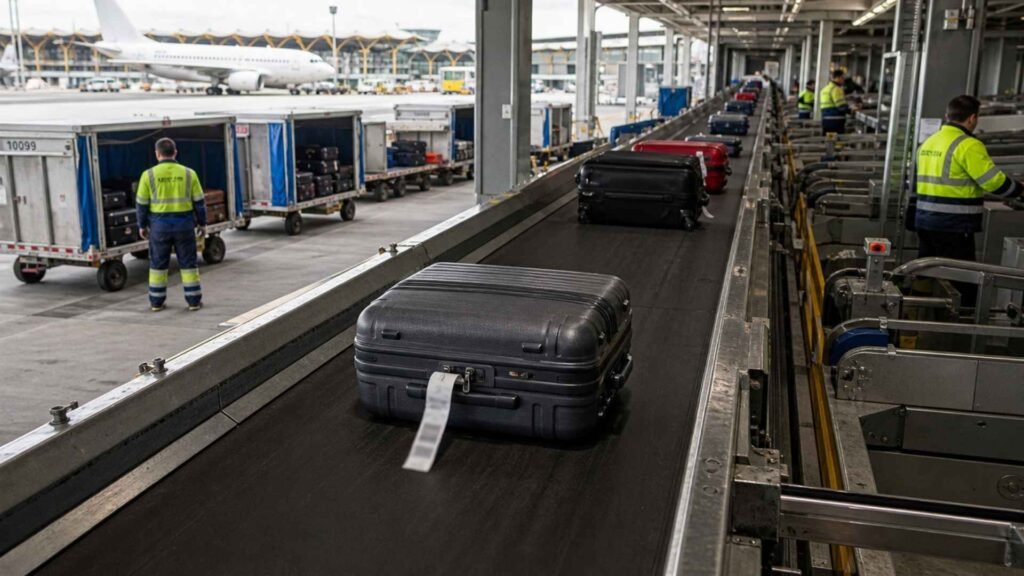
On a normal protected connection, checked baggage is usually transferred automatically when it has been tagged through to your final destination.
Always check the baggage tag when you first check in.
For example, if your itinerary is:
New York → Madrid → Rome
the baggage tag should normally show your final destination if the airline is transferring your bag through Madrid.
If the tag shows only MAD, you may need to collect your baggage in Madrid and check it in again. That changes the connection significantly because baggage collection can take you into the arrivals process and require check-in and security again.
The same issue can arise with separate tickets when the airlines do not transfer baggage between them.
Separate-ticket connections involve different procedures and considerably more personal risk, so they should be treated as a self-transfer, not as the protected connection covered in this article.
What If You Don’t Have Your Onward Boarding Pass?
Try to obtain your onward boarding pass through your airline’s app before travelling or during your first journey.
If that isn’t possible, follow the connection signs after landing and look for your airline or handling agent’s transfer desk. Madrid Barajas has airline and handling desks within the boarding areas for passengers in transit.
Do not automatically leave the secure connection route and head for the public check-in hall unless airport or airline staff tell you to do so.
Depending on your nationality and terminal combination, leaving international transit can introduce immigration or visa requirements that would not apply if you remained within an eligible airside connection.
Do You Need an Airport Transit Visa for Madrid?

Some travellers need an Airport Transit Visa (ATV) to remain in the international transit area of a Spanish airport while connecting onward to a country outside the Schengen Area.
Whether you need one depends on your nationality and whether you qualify for an exemption.
An Airport Transit Visa is not the same as a Schengen short-stay visa. It permits eligible transit through an airport’s international area; it does not by itself give you permission to enter Spain.
That distinction is particularly important at Madrid because T1–T3 and T4/T4S are separate terminal complexes and not every connection follows the same international-airside route.
If your connection requires you to enter Spain, you need to meet the applicable Schengen entry requirements rather than assuming an Airport Transit Visa will be sufficient.
Visa requirements can change, so verify the current rules with the relevant Spanish consulate before travelling.
Airport Transit Visa Rules for Turkish Citizens
Turkish citizens currently require an Airport Transit Visa for qualifying international-airside transits through Spanish airports unless an applicable exemption applies.
The Spanish Consulate in Istanbul’s Airport Transit Visa information specifically highlights Madrid’s terminal layout and gives additional instructions for Turkish passengers who need to change between the T1–T3 and T4 terminal groups.
Some travellers are exempt from the Airport Transit Visa requirement because of qualifying visas, residence permits or other circumstances.
Turkish travellers should therefore check both the visa requirement and their Madrid terminal combination before booking, rather than assuming that remaining inside an airport automatically removes the visa requirement.
EES and ETIAS for Madrid Transit Passengers in 2026
The Entry/Exit System (EES) has been fully operational across Schengen external border crossing points since 10 April 2026.
For a Madrid transit passenger, EES becomes relevant when the connection requires crossing the Schengen external border.
For example:
London → Madrid → Barcelona
Madrid is your Schengen entry point, so eligible travellers complete the applicable border procedure there.
By contrast:
London → Madrid → Mexico City
A passenger who remains in eligible international transit is not entering the Schengen Area simply because the connection takes place in Madrid.
ETIAS is different from EES and is not yet operational as of August 2026. The European Union currently plans to start ETIAS in the last quarter of 2026, with the specific launch date to be announced in advance.
Travellers therefore do not need to submit an ETIAS application for a Madrid connection at the time this article is published.
How Much Connection Time Do You Need at Madrid Barajas?
There is no single connection time that works for every Madrid itinerary.
A protected T4 → T4 Schengen connection is very different from a journey involving:
T2 → terminal shuttle → T4 → security → APM → T4S → passport control
For protected itineraries, airlines generally sell connections according to the connection rules applicable to the itinerary. A connection being bookable, however, does not necessarily mean it will feel relaxed.
When comparing flights, consider:
- whether you remain within the same terminal group;
- whether T4S and the APM are involved;
- whether you cross the Schengen border;
- whether another security check is required;
- and how much personal buffer you prefer for delays and queues.
A longer layover is particularly useful when changing between T1/T2 and T4/T4S or when passport control is involved.
Don’t apply self-transfer “safe connection time” recommendations to a protected itinerary. Separate tickets involve a different level of risk because the onward airline may have no responsibility if your first flight arrives late.
💡 Clara’s Tip:
At Madrid Barajas, check the gate letter as well as the terminal number.
H, J and K gates are in the main T4 boarding areas, while S gates are in T4S and normally involve the APM plus passport control when you are leaving the Schengen Area. M gates are also in T4S but can be used for some Schengen flights.
Knowing whether your next flight uses H/J/K, M or S often tells you more about the connection ahead than simply seeing “Terminal 4” on your itinerary.
What Happens If You Miss a Protected Connection?
If both flights are on the same protected itinerary and a delay causes you to miss the onward flight, check your airline’s app and contact the airline or its transfer desk.
In some cases, your booking may already show a replacement flight or new boarding pass by the time you land.
The airline will handle rebooking according to the conditions applying to your itinerary and the circumstances of the disruption.
This protection is one of the biggest differences between a normal connecting ticket and a self-transfer. With separate tickets, the second airline is generally not responsible simply because your first flight arrived too late.
Common Madrid Barajas Airport Transit Mistakes to Avoid
Most Madrid Barajas Airport transit problems come from misunderstanding the terminal layout rather than the connection itself.
Keep these points in mind:
- Don’t confuse T4 with T4S. They are separate buildings connected by the APM.
- Don’t assume Schengen → Schengen means no security. Changing terminal complexes can still require another security check.
- Don’t automatically follow baggage claim signs. Follow the connection route unless you need to collect baggage or the official route takes you through that area.
- Don’t assume your baggage is checked through. Confirm the final destination printed on the tag.
- Don’t ignore transit visa requirements. Staying inside an airport does not automatically mean every nationality can transit visa-free.
- Don’t treat separate tickets as a protected connection. Self-transfers require a different risk and time assessment.
If Madrid is your final destination rather than a connection, our Madrid Barajas Airport Arrival Guide explains passport control, EES, baggage claim and customs from landing to the arrivals hall.
Madrid Barajas Airport Transit FAQ
Is Madrid Barajas easy for connecting flights?
Yes, particularly within T4/T4S. Transfers between T1/T2 and T4/T4S can require additional terminal transport, security and passport-control procedures.
Do I have to go through passport control when connecting in Madrid?
Only when your connection requires you to enter or leave the Schengen Area. Schengen-to-Schengen connections normally have no passport control.
Can I walk from T4 to T4S at Madrid Airport?
No. You must use the underground APM between T4 and T4S; the train journey itself takes about three minutes.
Do I have to go through security again in Madrid?
Possibly. Your origin and terminal combination determine whether another security check is required, including on some Schengen connections.
Will my checked baggage transfer automatically in Madrid?
Usually, if it is tagged through to your final destination on a protected itinerary. Confirm the destination printed on your baggage tag when you first check in.
Can I transit through Madrid without a Schengen visa?
Potentially, if you remain in eligible international transit. Some nationalities still require an Airport Transit Visa, while entering Spain can trigger different visa requirements.
Do Turkish citizens need a transit visa for Madrid?
Turkish citizens currently need an Airport Transit Visa for qualifying international transits unless an exemption applies. Always check current Spanish consular requirements before travelling.
Is EES used for connecting flights at Madrid Airport?
Yes, when an eligible traveller crosses the Schengen external border in Madrid. Remaining in eligible non-Schengen international transit does not itself constitute Schengen entry.
Is ETIAS required for a Madrid connection in 2026?
Not as of August 2026. ETIAS is not yet operational, and the EU says its specific launch date will be announced before implementation.
What happens if I miss my connecting flight at Madrid Airport?
On a protected itinerary, check your airline app and contact the airline or transfer desk. Rebooking is handled according to your ticket conditions and the circumstances of the disruption.
Final Thoughts
A Madrid Barajas Airport transit becomes much easier once you know your terminal group and whether your journey crosses the Schengen border. T4 and T4S are closely integrated through the APM, while connections between T1–T3 and T4/T4S deserve more attention.
Check your gate after landing, follow the connection signs and confirm that your baggage is tagged through. If your flights are on separate tickets, treat the journey as a self-transfer rather than a normal protected connection.