
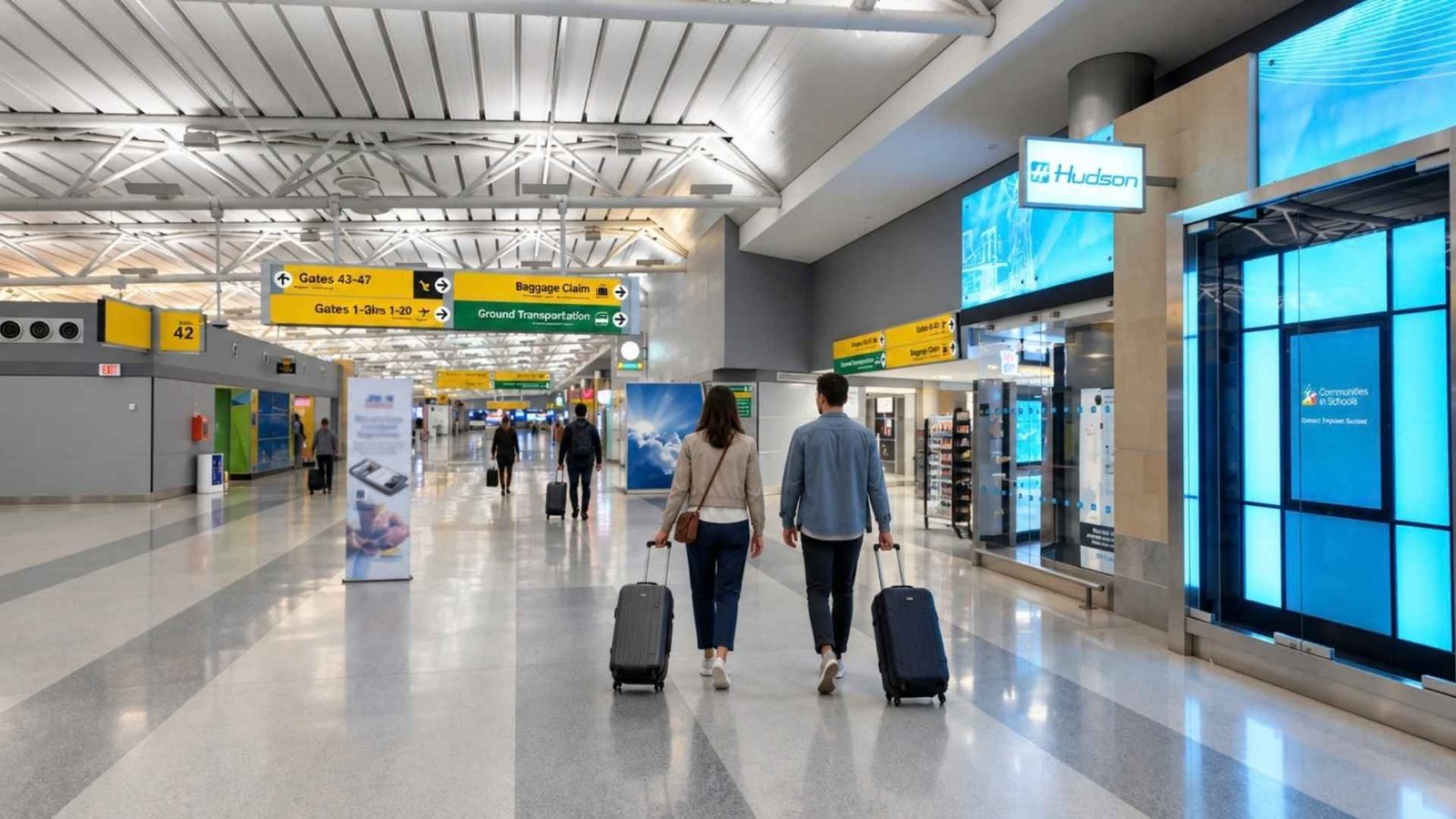
Arriving at JFK after a long flight means navigating passport control, finding your luggage and clearing customs before heading into New York. Knowing which documents to keep ready and where to go next makes the process easier to follow.
This JFK Airport Arrival guide takes you through immigration, baggage reclaim, customs and terminal exit arrangements. It focuses on international travellers ending their flight journey at JFK, with the key differences for domestic and precleared arrivals explained below.
Quick Answer: JFK Airport Arrival Process
On a standard international arrival at JFK, complete passport control, collect your checked baggage and clear customs before entering the public arrivals hall.
The usual sequence is:
Aircraft → Passport control → Baggage reclaim → Customs → Arrivals hall → Ground transport.
Passengers who completed U.S. preclearance before departure normally bypass CBP arrival processing at JFK. Domestic passengers also follow a simpler route towards baggage claim and the exit.
As a cautious planning buffer, keep approximately two hours after scheduled landing free before an inflexible arrangement that depends on leaving the terminal. This is a planning suggestion, not a measured average or maximum; delays and additional checks can require longer.
1. Follow the Correct Arrival Route After Leaving the Aircraft
Your JFK Airport Arrival begins with following the signs for your flight’s arrival route. Keep your passport accessible and look for Arrivals, Passport Control or Immigration.
On a standard international arrival, passport control normally comes before checked baggage collection. Complete immigration first, then continue to the baggage reclaim hall.
Which Arrival Route Applies to You?
- Standard international arrival: If you have not completed U.S. preclearance, follow the route through passport control, baggage reclaim and customs.
- Precleared arrival: If you completed U.S. immigration and customs at a participating overseas airport before boarding, you normally continue towards baggage claim without repeating the standard CBP arrival process.
- Domestic arrival: Follow signs to baggage claim and ground transportation. If you entered the United States through another airport earlier in your journey, your entry inspection would generally have taken place there.
Preclearance depends on your particular flight. Check your airline’s instructions rather than relying only on the country you departed from.
If You Need Arrival Assistance
Arrange wheelchair or other mobility assistance through your airline before travelling. Explain whether you need support through immigration, baggage reclaim and the journey to your pick-up point.
If assistance does not appear when you arrive, speak to airline staff before attempting a long terminal walk. JFK directs passengers to their airline for advance assistance arrangements.
2. Prepare for JFK Passport Control
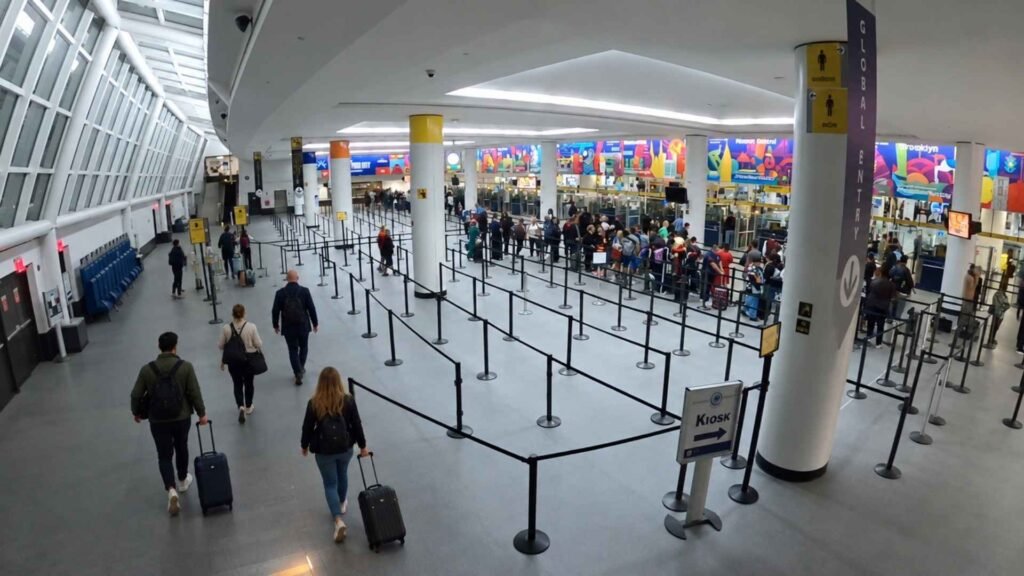
Passport control is the stage of your JFK Airport Arrival where U.S. Customs and Border Protection, or CBP, checks your identity and, for visitors, eligibility to enter the United States.
An approved ESTA or a valid U.S. visa does not guarantee admission. ESTA applies to eligible travel under the Visa Waiver Program; travellers who require a visa must hold the appropriate one for their visit.
Keep Your Travel Details Within Reach
Before joining the queue, make sure you can access:
- Your passport and any other required entry documents.
- The address of your first hotel or accommodation.
- Your return or onward travel details, where applicable.
- A clear outline of your visit, including its purpose and length.
- Supporting documents relevant to your immigration category.
If you are staying with friends or family, have their full address and contact details ready rather than only the name of the neighbourhood.
What Questions Might the Officer Ask?
Be ready to explain why you are visiting, how long you intend to stay and where you will be staying. Further questions depend on your circumstances.
Answer truthfully and directly. If you do not understand a question, ask the officer to repeat or explain it.
The inspection may include a photograph and fingerprints. Follow the officer’s directions and any restrictions on phone use or photography in the inspection area. CBP combines identity checks with an assessment of the traveller’s purpose and eligibility to enter.
What Happens During Secondary Inspection?
Some passengers are directed to a separate area for additional checks, known as secondary inspection.
A referral can relate to documents, information requiring clarification, a system alert or random screening. Being referred does not, by itself, mean that entry has been refused.
Follow instructions and keep relevant documents available. Tell the officer if you have an urgent medical or accessibility need.
If your checked bag is still in the reclaim area, ask staff how it will be handled while you wait. Processing time varies, so update anyone collecting you when you are permitted to do so.
Check Your Admission Record After Arrival
If you are issued an electronic I-94, check your personal details, admission category and authorised stay after entry. Use the admission record to confirm your permitted stay rather than the expiry date printed on your visa. CBP’s I-94 service provides the relevant admission information and, where applicable, the “admit until” date.
Clara’s Tip
Before departure, save your accommodation address, return-flight details and supporting documents in one offline folder. Keep your passport somewhere easy to reach, so you can answer questions without searching through several bags or loading emails at the desk.
3. Choose the Immigration Lane You Are Eligible to Use
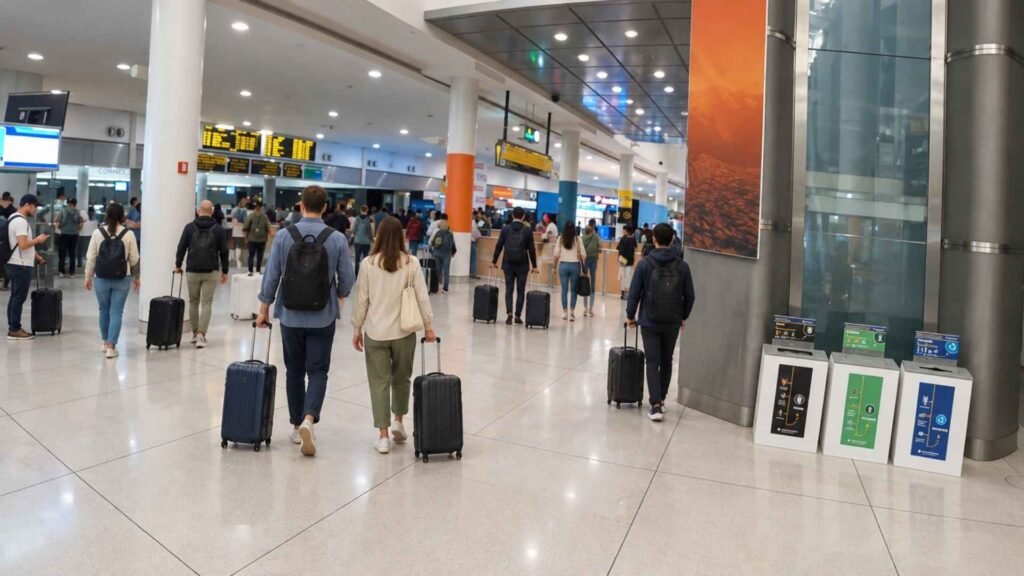
The correct lane for your JFK Airport Arrival depends on your citizenship, immigration status and eligibility for an expedited programme.
Read the signs and follow the staff member directing passengers. If your companions have different passports or immigration statuses, ask where your group should queue before separating.
Standard Passport-Control Lanes
Use the lane appropriate to your citizenship or status unless directed otherwise.
A biometric passport alone does not entitle every international visitor to use an expedited lane. Business-class or first-class travel also does not replace CBP arrival processing.
Mobile Passport Control at JFK
Mobile Passport Control, or MPC, is a free CBP app that allows eligible travellers to submit travel-document information, a photograph and customs information electronically.
Eligible groups include:
- U.S. citizens.
- U.S. lawful permanent residents.
- Canadian citizen visitors travelling in the eligible B1/B2 visitor category.
- Returning Visa Waiver Program travellers with an approved ESTA.
JFK participates in MPC. Check the official Mobile Passport Control guidance, complete the app’s required steps and follow the designated lane instructions at your arrival facility.
Keep your physical passport ready: MPC streamlines information submission but does not replace your passport or CBP inspection.
Global Entry
Global Entry provides expedited arrival processing for approved members. Follow the designated signs and instructions at the processing point.
Conditional approval is different from active membership. Eligible conditionally approved applicants may be able to complete their interview through Enrollment on Arrival.
TSA PreCheck concerns security screening before departure; it does not provide an expedited immigration lane after an international arrival.
4. Collect Your Checked Baggage
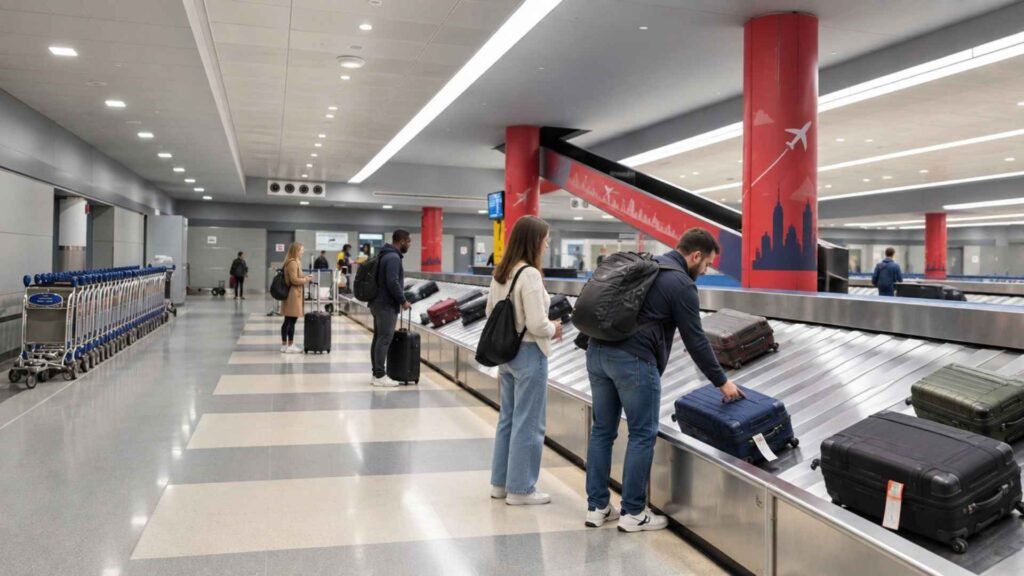
After passport control, follow signs to Baggage Claim. Find your flight number on the screens and confirm the assigned carousel.
Use the flight number as your main reference, especially when several flights have arrived from the same city. Check the screens again if the carousel is empty or displays a different service.
Check the Bag Before Walking Away
Compare the baggage tag and identifying details before taking a suitcase from the belt. Similar bags can be difficult to distinguish after an overnight flight.
Before leaving the area:
- Count all checked bags.
- Check for visible damage.
- Look for separate delivery instructions for oversized items.
- Keep your baggage receipts until you have everything.
If a pushchair, sports bag or other oversized item does not appear, ask airline baggage staff where it will be delivered.
If Your Bag Does Not Arrive
Contact your airline’s baggage service before leaving the airport wherever possible. JFK directs passengers with lost or delayed baggage to their airline first.
Have your baggage-tag receipt, boarding pass, bag description and delivery address ready. Obtain a written reference number and instructions for tracking the report.
If you are changing hotels, explain which address will be valid when the bag is likely to arrive. Keep receipts for necessary purchases and check the airline’s reimbursement rules.
If Your Bag Is Damaged
Photograph the damage and report it promptly through the airline’s process. Keep the bag, baggage tag and report details until the airline explains the next steps.
For a checked bag that failed to arrive or an item left on the aircraft, contact the airline. Airport lost property handles other items lost within the airport.
Travelling with Hand Luggage Only
Travelling without checked bags removes the carousel wait from your JFK Airport Arrival. Continue along the customs route after passport control, following the signs and staff instructions.
Hand luggage remains subject to customs requirements and possible inspection.
5. Complete U.S. Customs Before Entering the Arrivals Hall
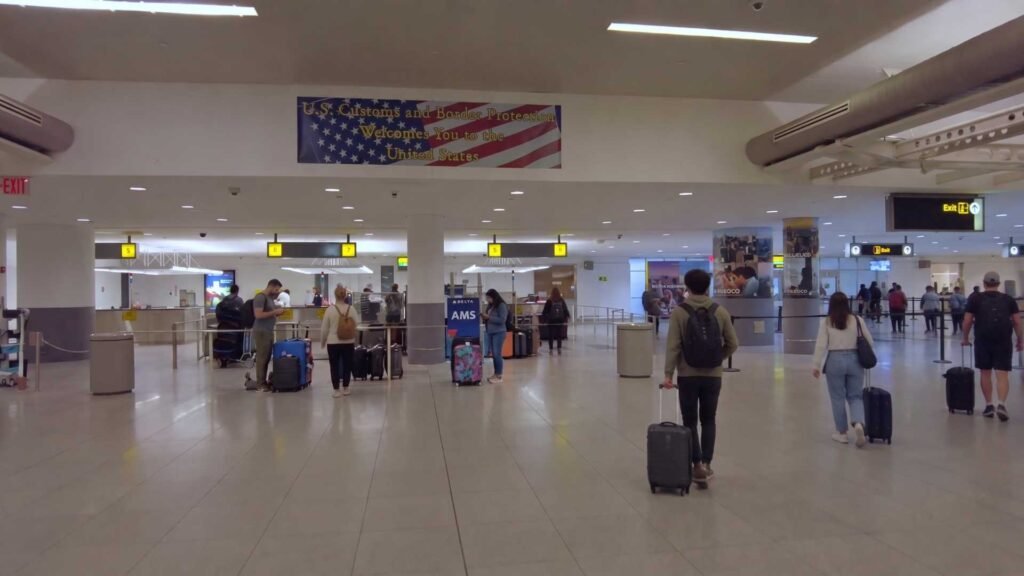
Passport control concerns your admission to the United States. Customs and agriculture checks concern what you are bringing into the country.
If you use MPC, answer the customs questions in the app. Otherwise, follow the declaration instructions provided by CBP and tell the officer about items that must be declared. If you are unsure about an item, ask a CBP officer before leaving the customs area.
Declare Food and Agricultural Products
Declare food, plants and agricultural items, including snacks or food packed by someone else.
A product being sealed, commercially packaged or sold at an airport does not automatically make it admissible. Meat, fresh produce, seeds and other agricultural products can be restricted depending on the item and its origin.
Declaration allows officers to assess the product; it does not guarantee that you may keep it. CBP requires agricultural items to be declared and determines whether they may enter after any necessary inspection.
Include any fruit or sandwiches left from your flight when answering questions about food.
Understand the Cash-Reporting Threshold
You may legally carry more than US$10,000 into the United States, but currency and covered monetary instruments with a combined value exceeding US$10,000 must be reported.
The calculation includes the equivalent value of foreign currency. This is a reporting requirement, and CBP identifies FinCEN Form 105 as the relevant form.
If you are carrying substantial cash or are unsure whether an instrument counts, clarify the requirements before departure and tell CBP during inspection.
Duty-Free Purchases
Duty-free purchases remain subject to U.S. import restrictions and the allowance applicable to your circumstances. Keep receipts for items you may need to declare; allowances can differ between returning residents and visitors.
If You Are Selected for a Bag Check
Follow the officer’s instructions and make the requested items accessible. Retain packaging or labels for food products where possible, as these can help identify ingredients and origin.
Once cleared, continue towards the public arrivals hall. Check that you have your passport, phone and every bag before passing through the exit.
6. Find Your Terminal Exit and Ground Transport
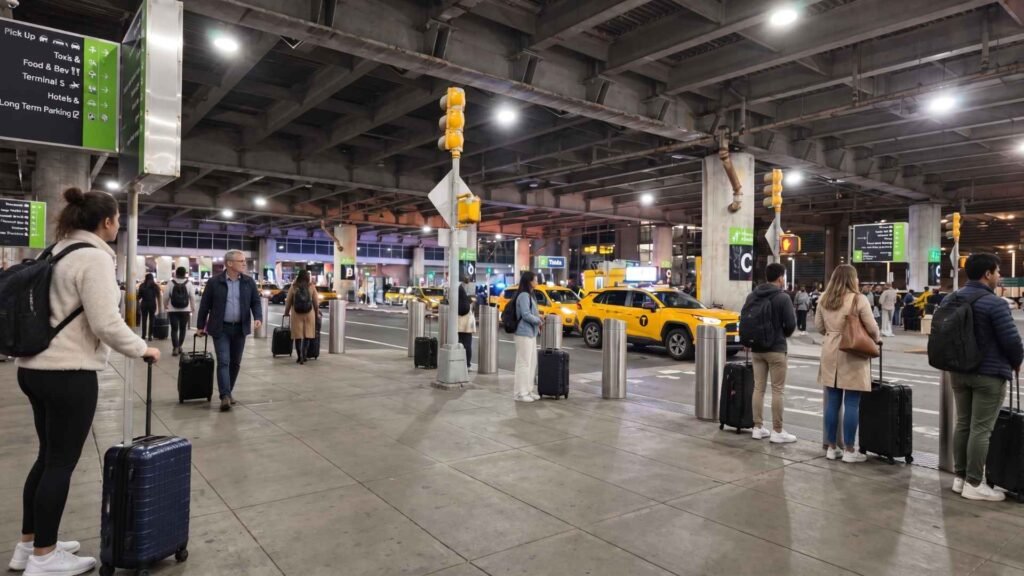
The final stage of your JFK Airport Arrival is finding the correct meeting point or transport connection.
Before walking outside, confirm your actual terminal and collection location. Construction can affect roads and pick-up arrangements, so use your airline’s flight information and current terminal signs.
Terminal Pick-Up Differences
As of 4 October 2026, these are the main ride-app distinctions to keep in mind:
| Arrival terminal | Ride-app pick-up guidance |
|---|---|
| Terminals 1 and 8 | Uber directs pick-ups to the Arrivals level. Follow the exact meeting point shown in your app. |
| Terminal 4 | Uber directs pick-ups to the Arrivals kerb in Zone B. Zone B1 PIN arrangements apply specifically to Uber Black; follow your booking’s instructions. |
The T1, T4 and T8 details above reflect Uber’s published instructions. For another provider, check its collection point rather than assuming the same zone applies. JFK advises passengers to follow current signs and their app’s directions.
Meeting Friends or Family
Arrange to meet in the public arrivals hall after customs, rather than at international baggage reclaim.
Send your terminal number and agree on an identifiable door, sign or information point. Drivers should use a permitted waiting area until you are ready; terminal kerbs are for active pick-ups and drop-offs.
Taking an Official Taxi
Follow signs and staff directions to the official taxi stand. Avoid unsolicited offers from people approaching you inside the terminal.
For assistance, use an official airport information point or taxi-stand staff. JFK specifically advises passengers to use authorised transport and avoid unsolicited drivers.
Using Uber, Lyft or a Booked Car
Confirm the designated collection point before requesting a ride. The nearest exit may not be the permitted pick-up area for your service.
Before entering the vehicle, match its registration and driver details with your booking. For a prebooked transfer, check whether it includes flight tracking, where the driver will meet you and when waiting charges begin.
AirTrain and the Journey into New York
For onward travel into New York, your main options include:
- AirTrain + subway: Connect through Jamaica or Howard Beach for the subway journey towards your destination.
- AirTrain + Long Island Rail Road: Travel through Jamaica for an onward LIRR connection.
- Official taxi or ride-app service: Follow the relevant collection instructions for a road transfer.
AirTrain connects the airport with onward public transport; it does not run directly into Manhattan.
Free AirTrain travel to the Howard Beach ride-app pick-up lot does not include onward public transport. An AirTrain fare applies when entering or leaving the system through the Jamaica or Howard Beach public-transport fare gates; subway and LIRR fares are separate.
For the broader transport overview and airport facilities, see our JFK Airport Guide.
Temporary AirTrain Closures: October 2026
JFK has announced full overnight AirTrain closures during the following periods, using New York local time:
- 5 October, 10 pm, to 6 October, 6 am.
- 6 October, 10 pm, to 7 October, 6 am.
- 13 October, 10 pm, to 14 October, 6 am.
- 14 October, 10 pm, to 15 October, 6 am.
Free replacement buses will serve the terminals and AirTrain stations. Journeys between Jamaica and the terminals require a transfer at Lot 66; direct buses are provided between the terminal frontages and Howard Beach or Lefferts Boulevard.
If you arrive at Terminal 5 or 7 and need the Howard Beach ride-app pick-up area during these closures, follow terminal signs for the free replacement bus to Howard Beach, then follow staff directions to your collection point.
Allow extra transfer time during the closures and check the official JFK AirTrain service advisory before travelling.
What Affects Your JFK Airport Arrival Time?
Passport-control waiting time is only one part of the journey from aircraft to ground transport.
CBP’s Airport Wait Times tool can help you review available JFK processing records for a selected period. Treat those records as historical context rather than a prediction for your flight. CBP specifies that its figures exclude baggage collection and the time needed to navigate the airport.
Your total exit time also depends on disembarking, walking to immigration, any additional inspection, baggage delivery and reaching your transport collection point.
Keep collections flexible, especially when a missed booking would be costly. A short immigration queue does not necessarily mean your bags or driver will be ready immediately.
Frequently Asked Questions About JFK Airport Arrival
What Is the Usual JFK Airport Arrival Process for International Passengers?
The standard JFK Airport Arrival process is passport control, baggage reclaim and customs, followed by the public arrivals hall. Passengers who completed U.S. preclearance before departure normally bypass the standard CBP arrival checks.
Can First-Time ESTA Travellers Use Mobile Passport Control?
An approved ESTA alone does not make a first-time visitor eligible. The relevant MPC category covers returning Visa Waiver Program travellers with an approved ESTA.
Does Having Nothing to Declare Mean I Can Skip Customs?
No. Follow the customs route and answer declaration questions accurately. Food and agricultural items must be declared even when you believe they are permitted.
What Should I Do If My Suitcase Is Missing?
Report it to your airline’s baggage service, ideally before leaving the airport. Keep the report reference and provide a delivery address where you can receive the bag.
Should I Order a Car as Soon as My Flight Lands?
Wait until you have cleared the arrival formalities and can reach the designated pick-up point within the service’s waiting window. If you have prebooked, follow the agreed meeting instructions.
Final Thoughts
A smoother arrival starts with accessible documents, the correct immigration lane and a clear understanding of customs requirements.
Deal with baggage issues before leaving the reclaim area, then follow the current signs for your chosen transport. With these steps organised, you can focus on beginning your New York visit.