
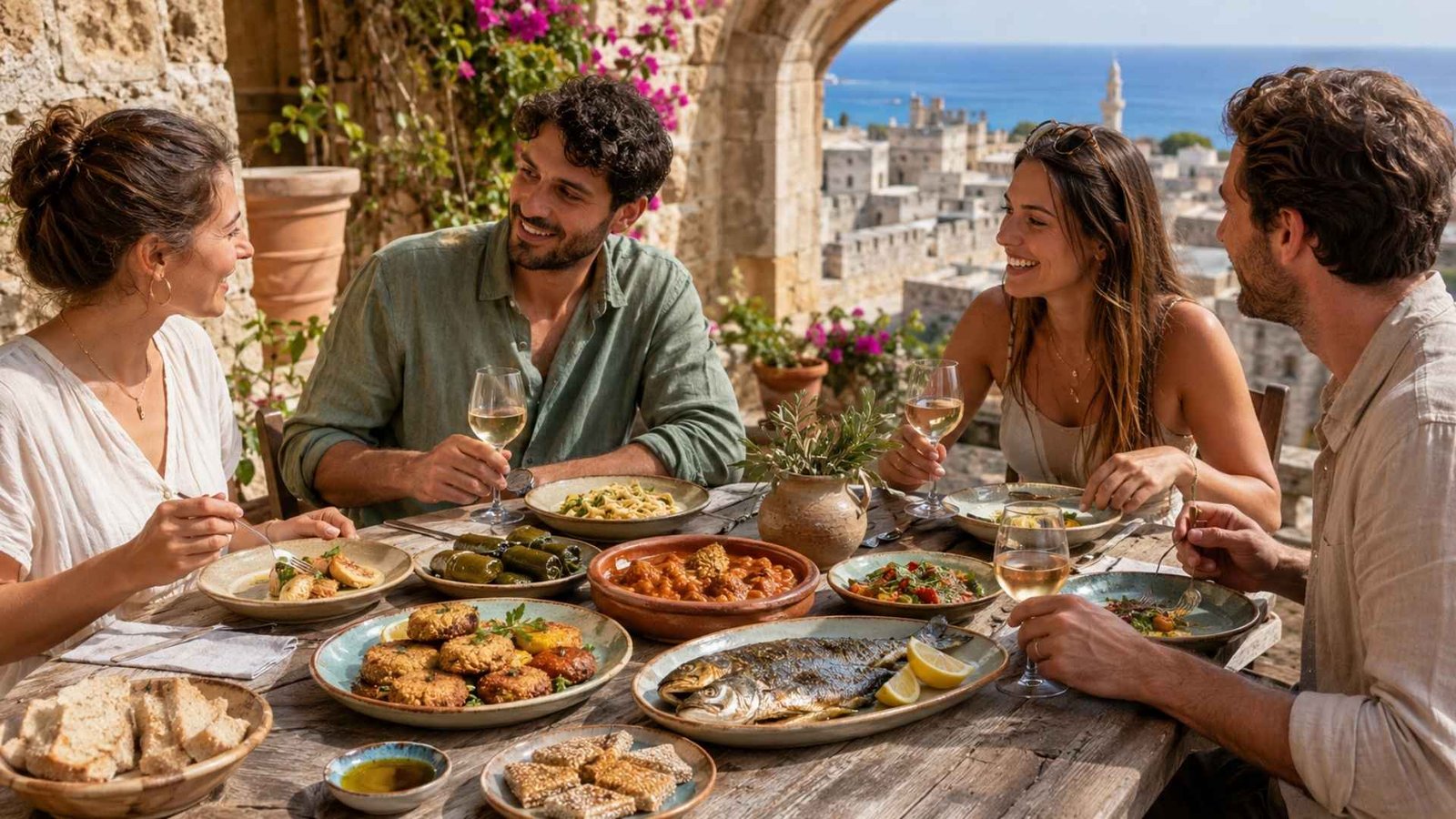
Rhodes is known for its medieval Old Town, beaches, and long summer season, but the island also has one of the Dodecanese’s most distinctive food traditions.
If you are wondering what to eat in Rhodes, look beyond familiar Greek dishes and seek out chickpea fritters, clay-pot meat, handmade pasta, stuffed vine leaves, local fish, and sesame-and-honey sweets.
This guide covers 12 traditional Rhodian foods, where to find them, what else to try, and the practical details that can help you order well.
Quick Answer: What to Eat in Rhodes
These are the Rhodian specialties worth prioritizing:
| Rhodian Specialty | What It Is | Best For |
|---|---|---|
| Pitaroudia | Fried chickpea, onion, tomato, and herb fritters | Meze or starter |
| Giaprakia | Small vine leaves filled with meat, rice, and herbs | Shared starter |
| Karavoli | Snails cooked with tomato, onion, and cumin | Traditional meze |
| Lakani | Meat and wheat baked slowly in a covered clay pot | Hearty main course |
| Rifiki | Stuffed kid or lamb cooked slowly in a clay pot | Village meal |
| Koulouria | Handmade pasta traditionally served at weddings | Main course |
| Matsi | Handmade pasta with butter and grated cheese | Comfort food |
| Fakoryzo | Lentils and rice cooked together | Vegetarian meal |
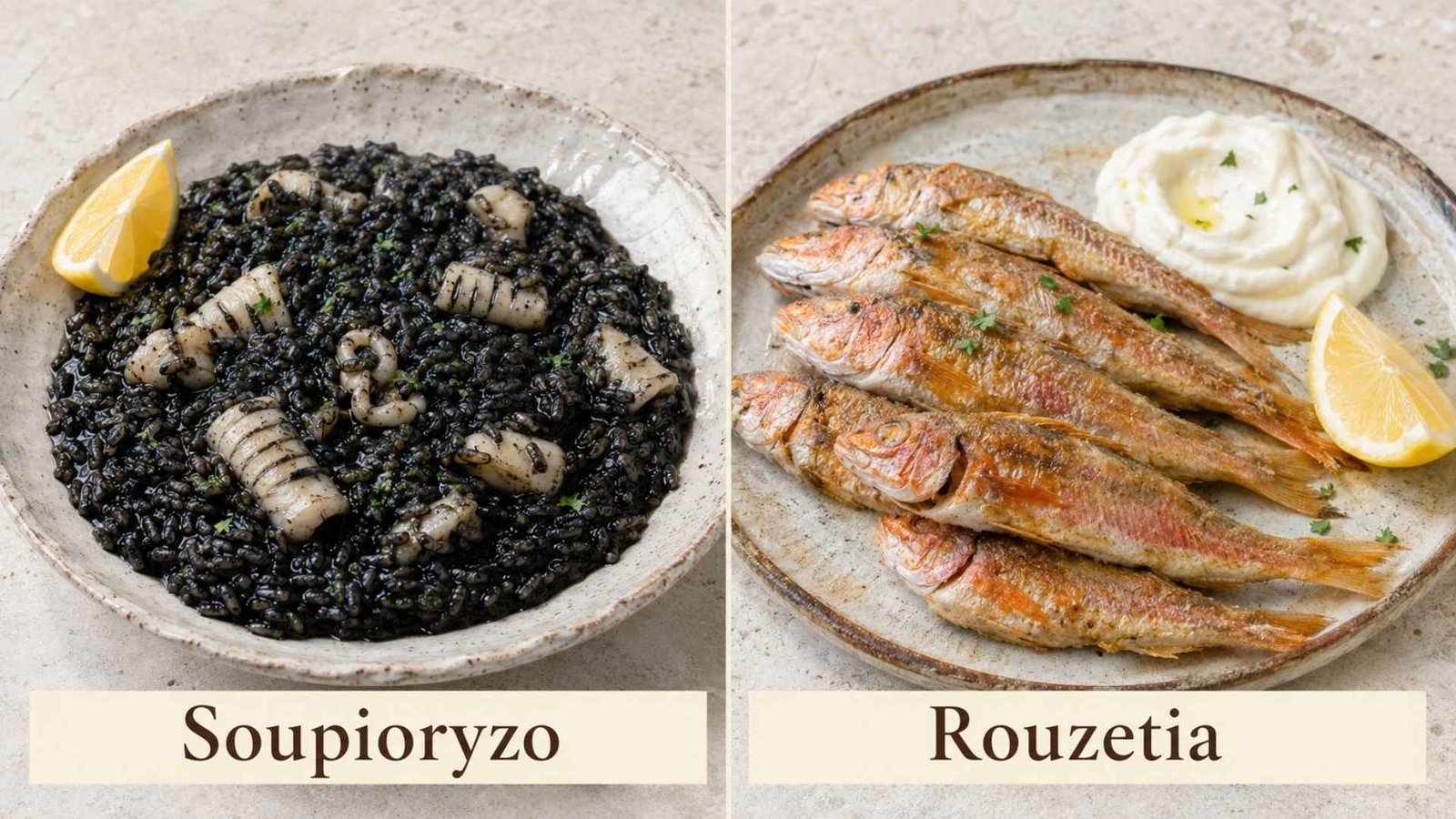
| Soupioryzo | Rice cooked with cuttlefish and its ink | Seafood main course |
| Rouzetia | Small fried local fish served with garlic dip | Seafood meze |
| Melekouni | Soft sesame-and-honey sweet with almonds and spices | Dessert or food souvenir |
| Talagoutes | Small pancakes served with honey, walnuts, and sesame | Traditional dessert |
If you only have time for five, try pitaroudia, lakani, giaprakia, melekouni, and one handmade pasta dish.
What Makes Rhodian Cuisine Different?
Rhodes sits at a historic crossroads between the Aegean, Asia Minor, the eastern Mediterranean, and southern Europe. Its cooking reflects those connections while remaining strongly rooted in local agriculture.
Wheat, pulses, olive oil, honey, vegetables, goat, lamb, handmade pasta, and wine have traditionally played important roles. Seafood is naturally available around the coast, but many of the island’s most characteristic recipes come from inland villages and family celebrations rather than waterfront tavernas.
Several features distinguish Rhodian food:
- Wheat and handmade pasta: Bulgur, pasta, bread, rusks, and wheat-based celebration dishes appear throughout the island’s culinary traditions.
- Pulses: Chickpeas, lentils, and beans form the basis of several inexpensive but flavorful dishes.
- Slow village cooking: Meat may be baked for hours in covered clay pots with wheat, rice, or spices.
- Honey and sesame: These ingredients define melekouni and several other traditional sweets.
- Local wine: Vineyards around Embonas, Siana, and the western highlands produce wines from indigenous and long-established grape varieties.
- Regional variation: Lindos, Archangelos, Psinthos, Messanagros, and other villages preserve their own specialties.
The official Rhodes municipal food overview documents many of these village dishes, while the South Aegean’s Rhodes profile provides additional detail about the island’s pasta, sweets, seafood, and wine traditions.
Traditional Rhodian Starters and Small Plates
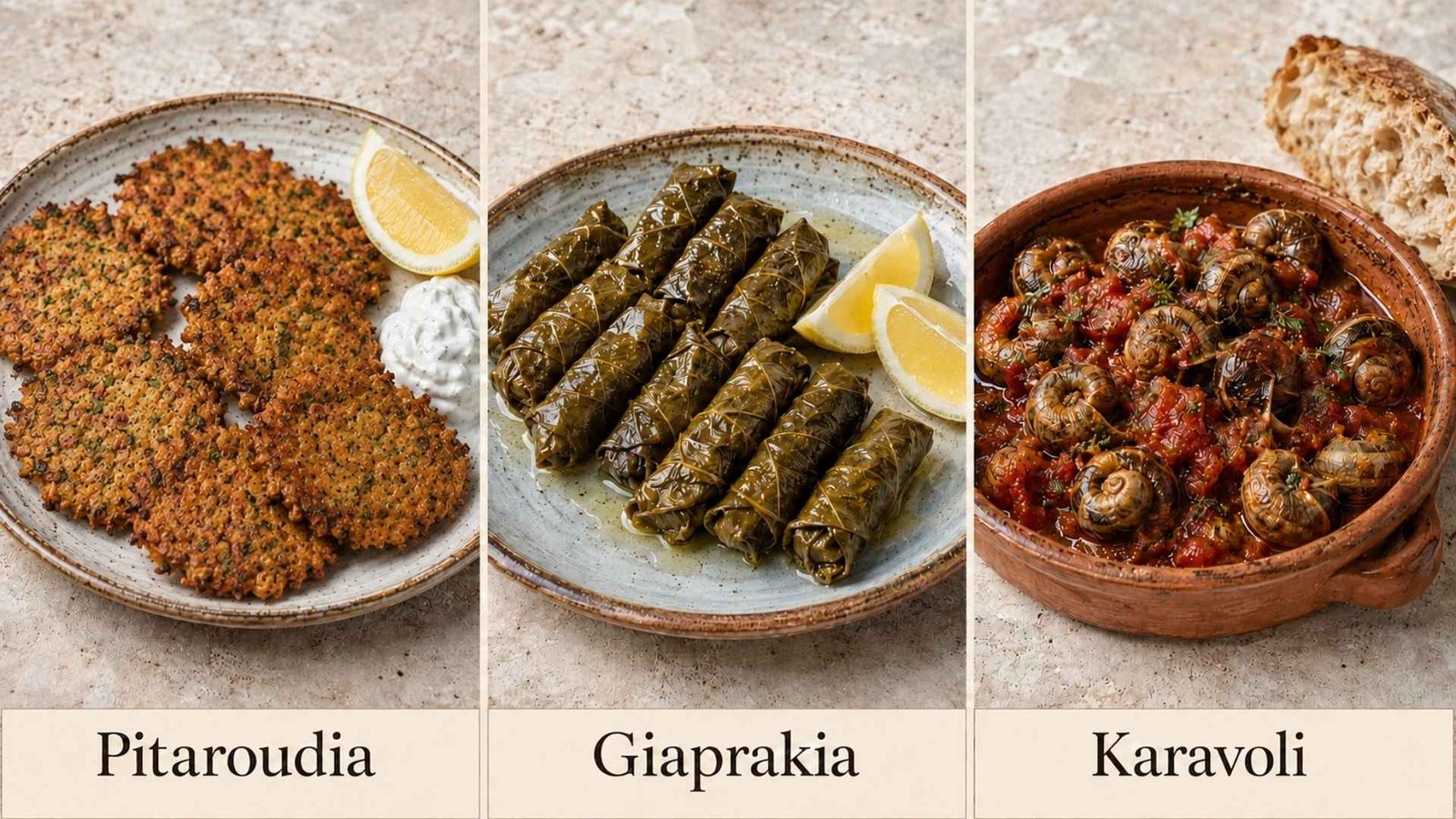
Sharing several starters is one of the easiest ways to explore the island’s food. Begin with two or three local dishes rather than filling the table immediately; portions can be generous.
1. Pitaroudia – Rhodes’ Essential Chickpea Fritters
Pitaroudia are among the most recognizable foods in Rhodes. The best-known version combines crushed chickpeas with finely chopped onion, tomato, mint, flour, and seasoning before the mixture is fried into thin, crisp-edged fritters.
Recipes vary. Some kitchens prepare pitaroudia primarily with chickpeas, while others emphasize onion, courgette, or occasionally minced meat.
The texture should be crisp outside and soft inside, with fresh herbs preventing the fritter from feeling too heavy. Pitaroudia work particularly well as part of a meze table with salad, local cheese, and wine.
Eat them while they are hot; they lose some of their appeal once the exterior softens.
2. Giaprakia – Small Stuffed Vine Leaves from Lindos
Giaprakia are closely associated with Lindos. Small vine leaves are wrapped around a filling commonly made with minced meat, rice, onion, tomato, and dill, then cooked with tomato, lemon, and olive oil.
They resemble dolmades, but the local filling and preparation give them a distinct Rhodian identity. Their small size makes them ideal for sharing alongside yogurt, salad, or other vegetable dishes.
Some local recipes use lentils and rice instead of meat and may wrap the filling in vine or cyclamen leaves.
Availability varies, so ask whether giaprakia have been prepared that day rather than assuming they will appear on every menu.
3. Karavoli – Rhodian Snails with Tomato and Cumin
Karavoli are snails, a traditional ingredient that connects Rhodian cooking with several other island cuisines.
One local preparation, karavoli giachnistoi, cooks the snails slowly with onion, olive oil, tomato, pepper, bay leaves, and cumin. The sauce is aromatic and savory, while the snails retain a firm texture.
This version differs from Crete’s rosemary-and-vinegar chochlioi boubouristi. Trying both is an interesting way to see how neighboring island cuisines use the same ingredient differently. For a broader comparison, see our guide to what to eat in Crete.
If snails are new to you, order one plate for the table rather than choosing an individual portion.
Traditional Rhodian Meat and Pasta Dishes
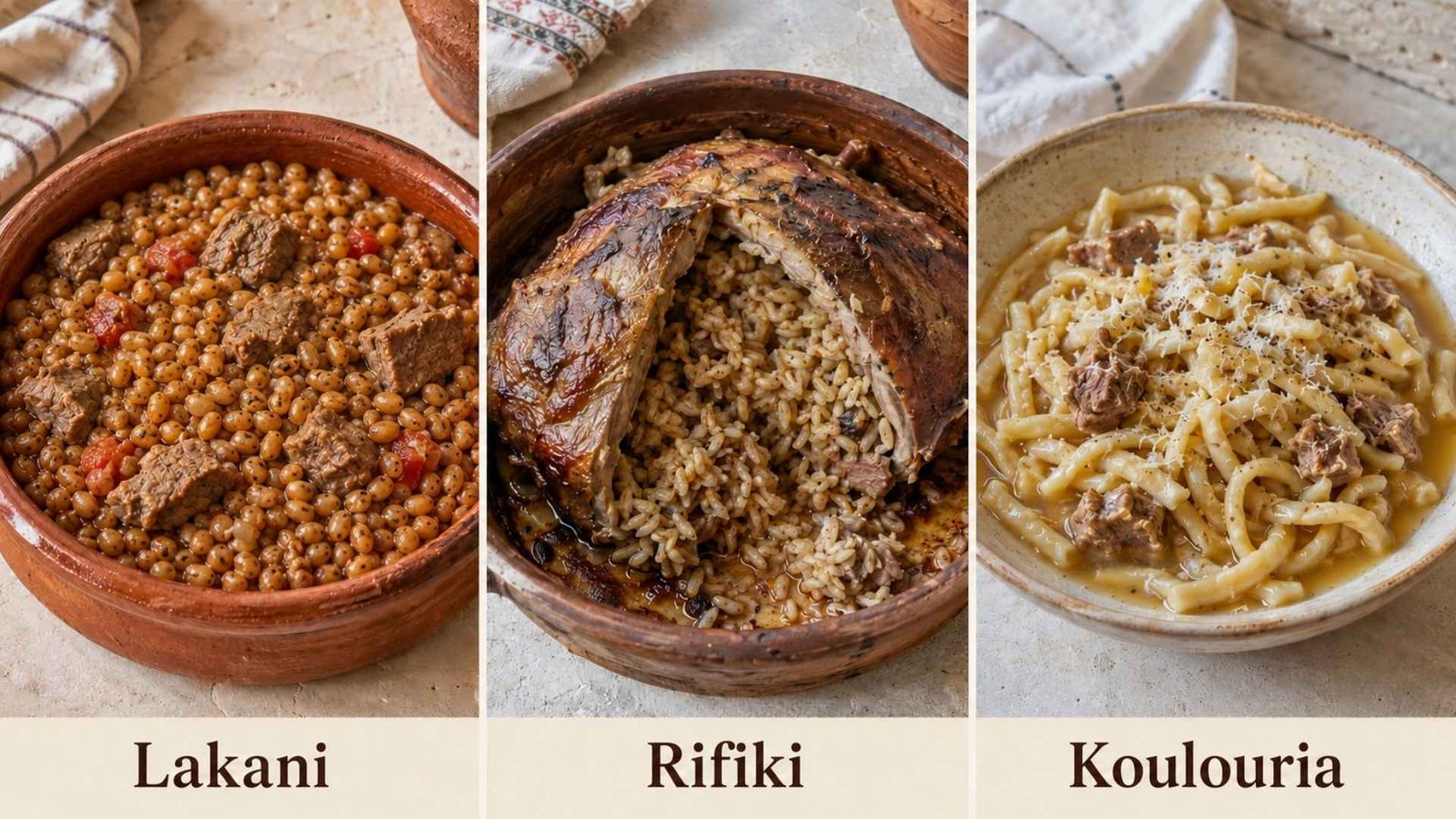
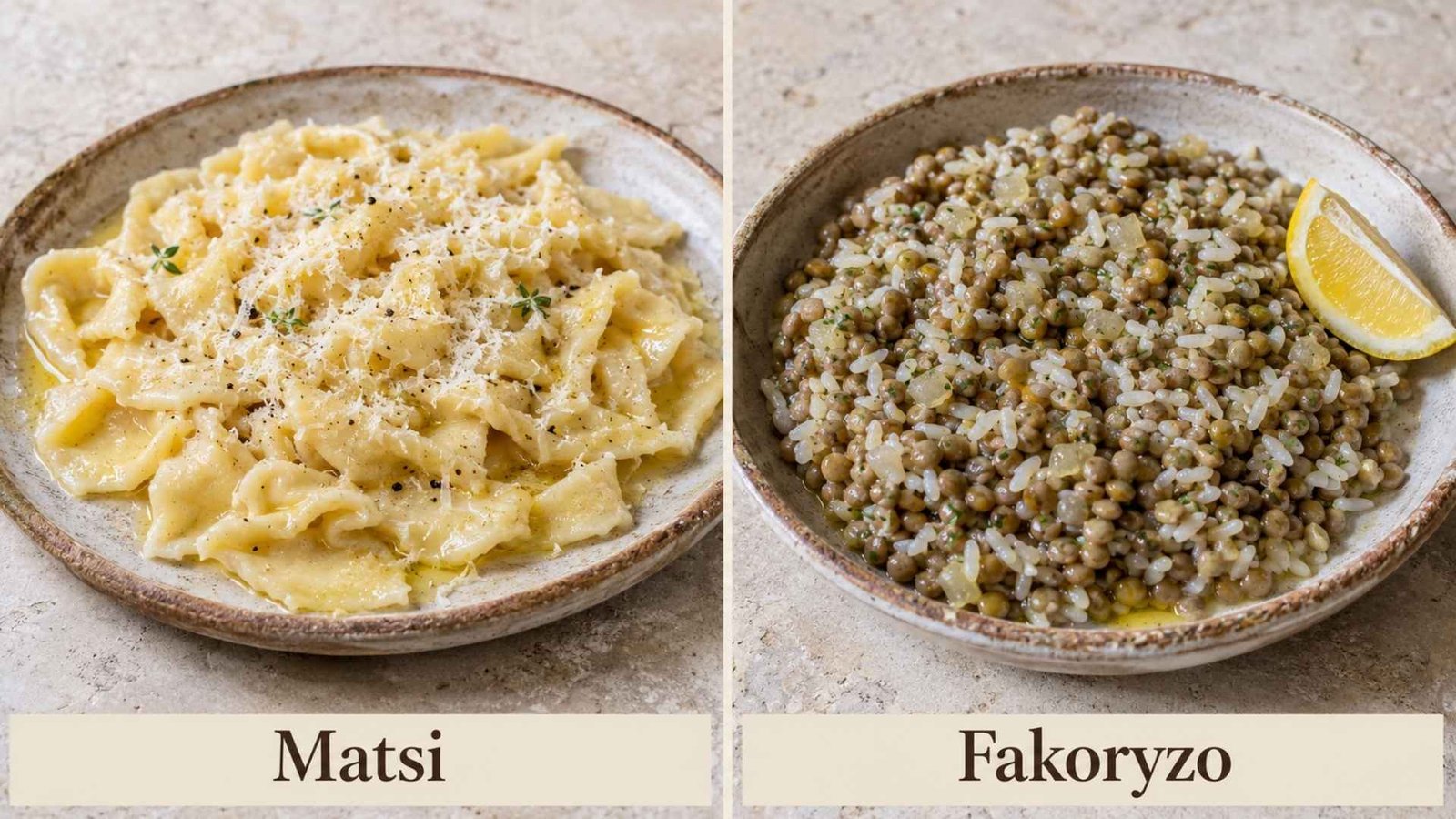
Several of Rhodes’ most distinctive main courses were originally prepared for weddings, religious celebrations, or large family meals. They depend on slow cooking rather than elaborate presentation.
4. Lakani – Meat and Wheat Cooked in a Clay Pot
Lakani, sometimes written as lacan, is one of the island’s most substantial traditional dishes. Goat, lamb, or beef is combined with wheat and cooked slowly in a covered clay vessel.
The long cooking time allows the wheat to absorb the meat juices and seasoning, creating a rich dish somewhere between a casserole and a thick pilaf.
Recipes differ by village and family, and the dish is closely connected with weddings and other celebrations.
Because lakani takes time to prepare, it may only be available on particular days or by advance request. Ask before making a special journey for it.
5. Rifiki – Stuffed Kid or Lamb from Archangelos
Rifiki is associated with Archangelos. Kid or lamb is stuffed with seasoned rice and cooked slowly in a clay pot, traditionally overnight.
The long, enclosed cooking process keeps the meat tender while allowing the rice to absorb the rendered juices and spices. The result is a celebratory dish rather than an everyday grilled-meat order.
Rifiki is not as widely available as souvlaki or lamb chops. That limited availability is part of its value: when properly prepared, it provides a much more specific introduction to Rhodian village cooking.
Look for it in Archangelos or at restaurants that clearly identify regional Rhodian dishes.
6. Koulouria – Rhodian Wedding Pasta
In Rhodes, koulouria can refer to handmade, elongated pasta traditionally served at weddings and village celebrations. It should not be confused with the sesame bread rings sold elsewhere in Greece under a similar name.
In Messanagros, the pasta is traditionally associated with a celebratory dish served with goat meat. Other preparations may combine it with broth, butter, or grated cheese.
Koulouria demonstrates how important wheat and handmade pasta are to Rhodian cuisine.
If it appears as a daily special, ask how that particular restaurant prepares it; there is no single presentation used across the island.
7. Matsi – Handmade Pasta with Cheese and Butter
Matsi is another traditional Rhodian pasta. The hand-shaped noodles are commonly served with grated cheese and fresh butter, creating a simple and comforting dish.
Some versions are accompanied by lentils, chickpeas, or beans. This combination reflects the island’s older reliance on cereals and pulses and can create a filling meal without an elaborate sauce.
Matsi is worth ordering when you want something distinctly local but less heavy than slow-cooked meat.
When possible, confirm whether the restaurant makes the pasta in-house.
8. Fakoryzo – Lentils and Rice
Fakoryzo combines lentils and rice in a humble dish that illustrates the everyday side of island cooking.
It may be seasoned with onion, herbs, olive oil, or citrus, depending on the kitchen. The combination of pulses and grains makes it satisfying without meat and provides a useful alternative to cheese-heavy vegetarian options.
Fakoryzo may not appear on polished tourist menus because it is strongly associated with home cooking.
In a family-run taverna, ask whether any lentil, chickpea, or bean dish has been cooked that day.
Rhodian Fish and Seafood
Rhodes has no shortage of waterfront restaurants, but a sea view does not guarantee locally caught fish.
Ask what was landed recently and which seafood is genuinely local.
9. Soupioryzo – Cuttlefish and Rice
Soupioryzo is rice cooked with cuttlefish, often including its ink. The ink gives the rice a dark color and a concentrated marine flavor.
This is a more regionally interesting choice than a generic seafood risotto. Cuttlefish has a firmer texture than many fish, while slow cooking helps it become tender and allows the rice to absorb the sauce.
Menus and English spellings vary, so look for cuttlefish with rice or ask whether the kitchen prepares a traditional ink-based rice dish.
Choose a seafood taverna serving local preparations rather than one offering only grilled fish and generic mixed platters.
10. Rouzetia – Small Fried Fish with Skordalia
Rouzetia are small reddish fish associated with the sandy seabed around Rhodes. They are normally fried and served with skordalia, the Greek garlic dip.
Their appeal comes from contrast: crisp fish, soft garlic dip, lemon, and a cold drink. They work better as a shared meze than as a formal main course.
Rouzetia are not guaranteed throughout the year. Availability depends on the catch, and English menus may use a translated fish name rather than the local term.
Fish tavernas around Stegna are among the most likely places to serve them when available.
Traditional Rhodian Sweets
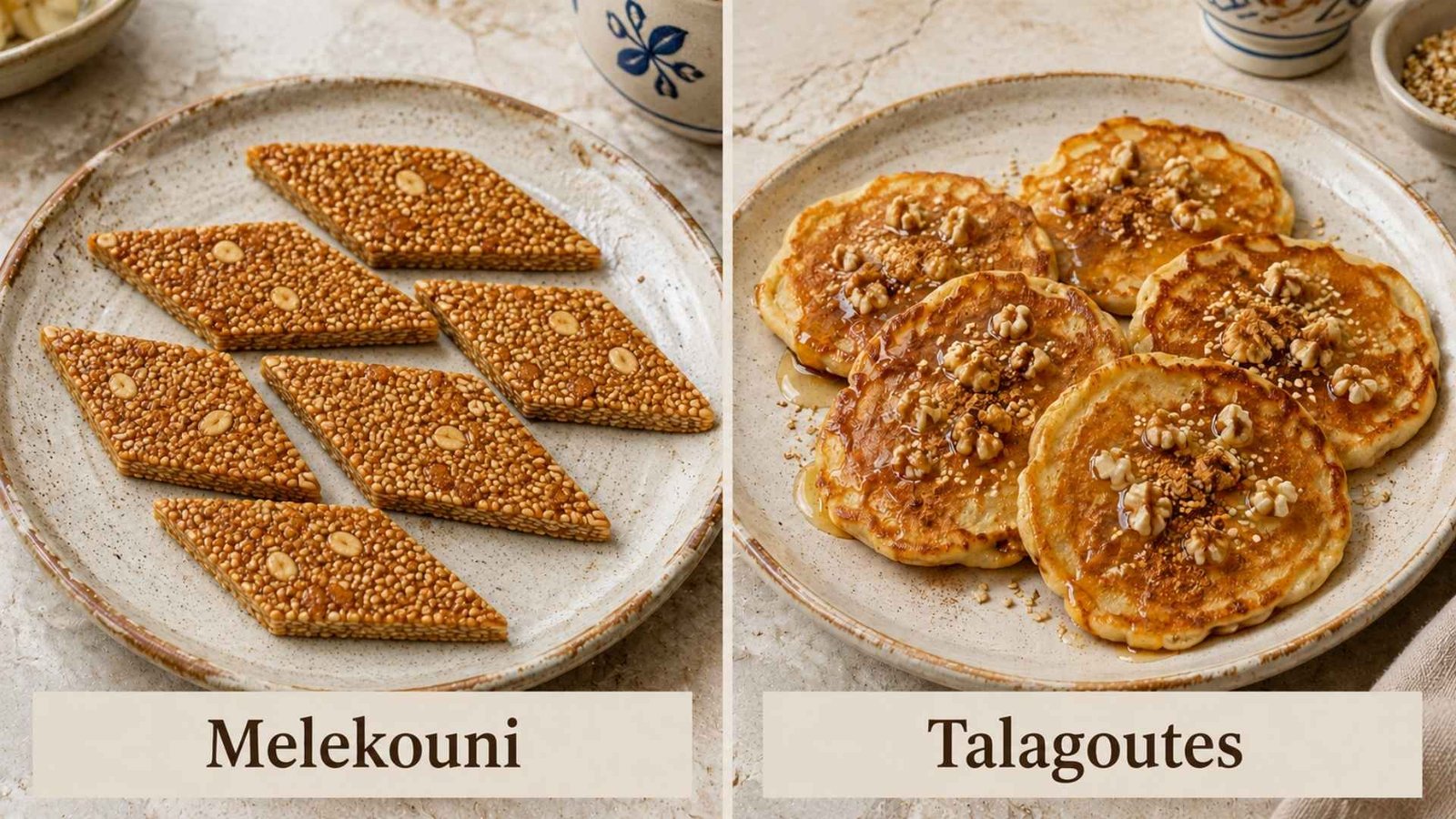
Honey, sesame, nuts, grape must, and preserved fruit appear repeatedly in the island’s sweeter traditions.
11. Melekouni – Rhodes’ Sesame-and-Honey Sweet
Melekouni is Rhodes’ best-known sweet and one of the island’s most meaningful food traditions. Toasted sesame seeds are combined with thyme honey, almonds, orange zest, and cinnamon, then shaped into a soft diamond.
Unlike a very hard sesame brittle, good melekouni remains pleasantly chewy. It has traditionally been offered at weddings, christenings, and other celebrations.
Melekouni is easy to pack and makes a practical food souvenir.
Look for it in bakeries, confectionery shops, women’s cooperatives, and local-product stores. Choose sealed products with clear ingredient labels if you plan to take it home.
12. Talagoutes – Rhodian Honey Pancakes
Talagoutes are small pancakes served with honey, walnuts, sesame, and cinnamon.
They are best eaten warm, when their edges are still fresh and the honey remains aromatic. The combination is simple, but it reflects the importance of honey, sesame, and nuts in Rhodian sweets.
Talagoutes are less widely available than melekouni.
Ask at traditional bakeries, village festivals, cooperatives, or restaurants that prepare regional desserts.
Other Rhodian Foods and Drinks Worth Trying
The 12 numbered foods provide the clearest introduction, but several additional specialties are worth trying when available.
Symi Shrimp and Fresh Seafood
Although associated with the neighboring island of Symi, tiny Symi shrimp are widely enjoyed across the Dodecanese and often appear in Rhodes seafood tavernas.
They are fried whole and eaten with their shells, giving them a crisp texture and concentrated flavor.
Fresh whole fish, grilled octopus, calamari, and small fried fish are also widely available. Order Symi shrimp when they are available and ask which larger fish are fresh that day.
Rhodian Breads and Savory Pies
Traditional bakeries may sell olive bread, onion bread, anise-scented bread, barley rusks, eptazimo, fried bread, and pastries filled with greens.
One local pastry category, pouggia, includes pies filled with wild or cultivated greens.
Visit bakeries early in the day, when the selection is widest and the savory pies are more likely to be fresh.
Ritseli and Other Sweets
Ritseli is a preserve made with grape must and fruit such as dried figs, quince, or watermelon peel.
You may also encounter tahini pies, xerotigana, almond sweets, grape pudding, halva, and fruit preserves in bakeries and village cooperatives.
Rhodian Wine and Souma
Rhodes has one of the Aegean’s longest wine traditions. The western highlands—particularly around Embonas, Siana, and Agios Isidoros—are important wine-producing areas.
Grape varieties to look for include:
- Athiri: Used for fresh, dry white wines
- Muscat: Used for aromatic and sometimes sweet wines
- Mandilaria or Amorgiano: Used for structured red wines
Rhodes also produces sparkling wine.
Souma is the island’s traditional grape-pomace spirit. It may be single or double distilled and is considerably stronger than wine, so sip it slowly.
What to Order for Breakfast, Lunch, and Dinner
You do not need to fit every specialty into one meal.
| Meal | What to Order |
|---|---|
| Breakfast | Olive bread, savory pies, rusks, local honey, yogurt, or cheese |
| Lunch | Pitaroudia, giaprakia, salad, seafood, and seasonal vegetables |
| Dinner | Lakani, rifiki, handmade pasta, or another daily cooked dish |
| Dessert | Melekouni, talagoutes, ritseli, or a small glass of souma |
Rhodian-style shared dining works best when you begin with fewer dishes and order more only if necessary.
Once you know which dishes fit naturally into each meal, the next decision is where to look for them. Exploring different parts of the island can reveal how strongly Rhodian food reflects its local landscape and regional identity.
Where to Find Traditional Food in Rhodes
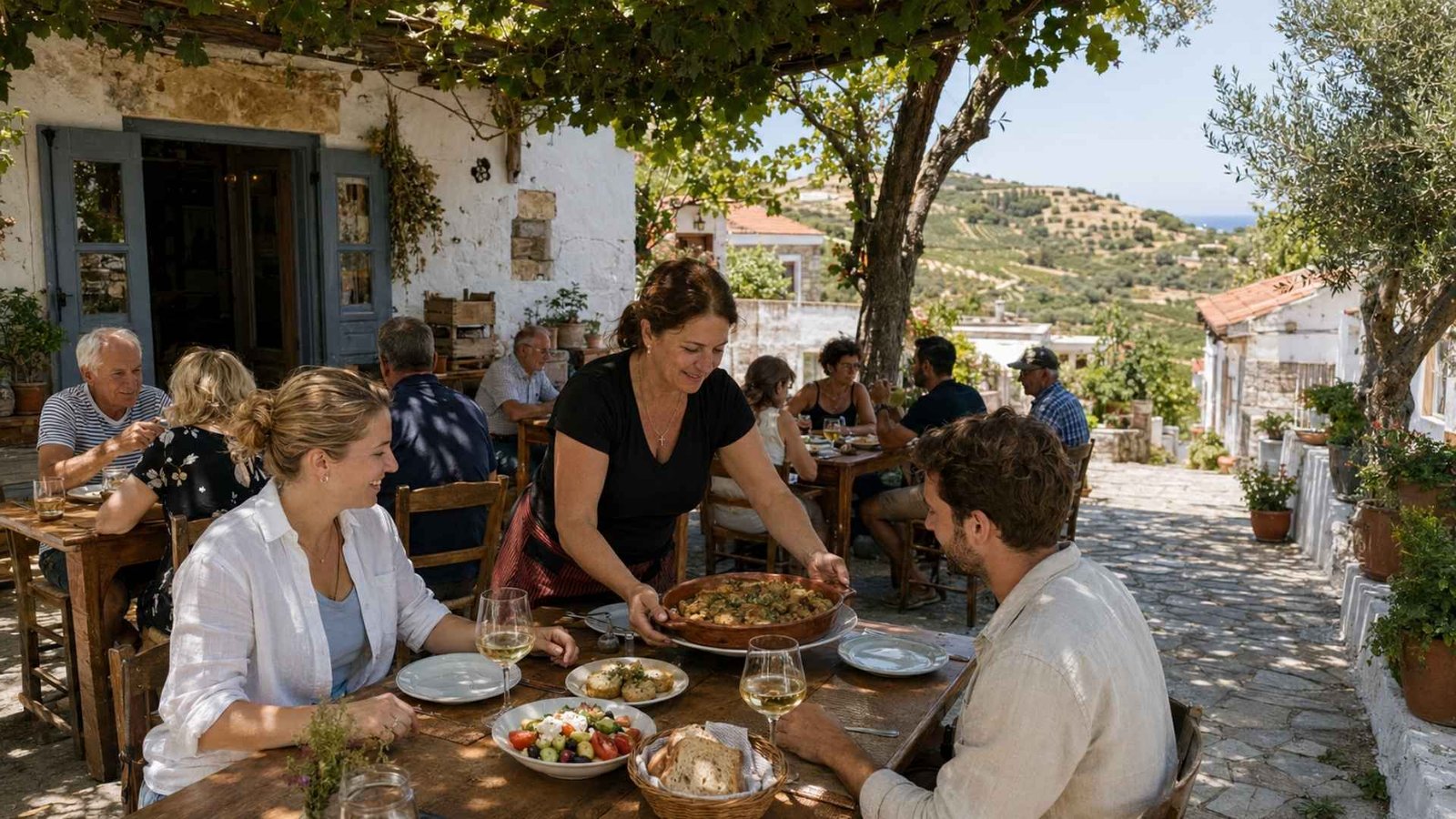
Where you stay can influence what to eat in Rhodes, because several dishes remain closely associated with particular villages.
| Area | Foods and Experiences to Prioritize |
|---|---|
| Rhodes Town | Meze, bakeries, seafood, and Rhodian wine |
| Lindos | Giaprakia, village dishes, and terrace dining |
| Archangelos | Rifiki and traditional meat dishes |
| Stegna | Local fish, rouzetia, and seafood tavernas |
| Embonas | Rhodian wine, mountain food, meat, cheese, and honey |
| Siana | Souma, honey, wine, and village products |
| Messanagros | Koulouria and rural food traditions |
| Psinthos | Goat and slow-cooked village dishes |
Rhodes Town is the most convenient base, but spending every meal inside the Old Town limits your view of the island’s cuisine.
At least one village or coastal meal can add a more regional experience.
Isabella’s Pick
Plan one lunch away from Rhodes Town and ask what was cooked that morning.
Instead of arriving with a fixed order, build the meal around one local specialty—such as pitaroudia, lakani, rifiki, or handmade pasta—then add seasonal vegetables, salad, and a Rhodian wine.
Daily dishes often provide a more authentic meal than a long menu of familiar Greek standards.
Vegetarian and Vegan Food in Rhodes
Rhodes is relatively easy for vegetarians, particularly if you enjoy pulses, vegetables, bread, rice, and shared meze.
Vegetarian choices may include:
- Pitaroudia
- Fakoryzo
- Greens-filled pouggia
- Stuffed vegetables without meat
- Beans and lentils
- Seasonal salads
- Grilled vegetables
- Bread, rusks, and olive-based dishes
- Vegetable-based giaprakia
- Fruit preserves
Vegans should confirm recipes individually. Fritters can contain egg, pies may contain cheese, pasta can be finished with butter, and rice or vegetable dishes may use meat broth.
Melekouni contains honey, so it is not suitable for vegans who avoid honey.
Other dietary requirements also need some care. Travelers avoiding gluten should be particularly cautious with pitaroudia, koulouria, matsi, breads, pies, and fried foods, which commonly contain wheat or may be prepared in shared oil. Fakoryzo, grilled fish, vegetables, and simple salads may be naturally gluten-free, but ingredients and cross-contact should always be confirmed with the restaurant.
Dietary preferences influence what you order, while location and restaurant style usually have the greatest effect on what you pay.
How Much Does Food Cost in Rhodes?
Prices vary by location, season, restaurant style, and wine selection. Use these amounts as planning estimates rather than fixed menu prices.
| Food or Dining Style | Approximate Cost |
|---|---|
| Bakery breakfast | €4–€9 per person |
| Gyros or simple takeaway | €4–€8 |
| Shared meze lunch | €18–€30 per person |
| Traditional taverna dinner | €25–€45 per person |
| Seafood dinner | €35–€70+ per person |
| Refined or special-occasion dinner | €60–€120+ per person |
Whole fish, lobster, premium meat, and wine can increase the final bill considerably. When seafood is priced by weight, ask for the price per kilogram and estimated total before it is cooked.
Restaurants in Rhodes Old Town, Lindos, and prominent waterfront locations can cost more than village tavernas.
Not every Rhodian flavor needs to be experienced at a restaurant. Several local products are practical to buy from bakeries, wineries, cooperatives, and specialty food shops.
Food Markets and What to Buy in Rhodes
Products that are relatively easy to take home include:
- Packaged melekouni
- Local thyme honey
- Rhodian olive oil
- Wine from Rhodes
- Herbs and herbal teas
- Barley rusks
- Olives and olive products
- Sesame sweets
- Fruit preserves
- Souma from a licensed producer
Traditional bakeries, village cooperatives, wineries, and specialty food shops are generally more useful than generic souvenir stores.
Check the customs rules of your destination before purchasing alcohol, honey, cheese, or other regulated products. Sealed packaging with a clear ingredient label is more practical for international travel.
Frequently Asked Questions About Rhodian Food
What food is Rhodes most famous for?
Rhodes is particularly known for pitaroudia, lakani, giaprakia, handmade pasta, melekouni, local honey, Rhodian wine, and souma.
Is Rhodian food different from other Greek food?
Rhodian cuisine is part of Greek cuisine but has a distinct regional identity. Wheat, pulses, handmade pasta, clay-pot meat, honey, sesame, local wine, and village-specific recipes play especially important roles.
Is Rhodes good for vegetarian travelers?
Yes. Pitaroudia, fakoryzo, beans, vegetable dishes, salads, bread, and greens-filled pies provide several choices. Vegans should confirm whether recipes contain cheese, egg, butter, honey, or meat broth.
What dessert should I try in Rhodes?
Start with melekouni, a soft sesame-and-honey sweet with almonds, orange zest, and cinnamon. Talagoutes and ritseli are also worthwhile when available.
What should I drink in Rhodes?
Try a local wine made from Athiri, Muscat, or Mandilaria/Amorgiano grapes. Souma is the island’s traditional grape-pomace spirit and should be consumed slowly.
Final Thoughts
Deciding what to eat in Rhodes is less about completing a list and more about discovering how the island’s villages, farmland, vineyards, and coastline shape its food.
Begin with pitaroudia and giaprakia, try one slow-cooked meat or handmade pasta dish, order local seafood when the catch is clear, and leave room for melekouni.
Most importantly, ask what was prepared that day—the answer may lead to a Rhodian specialty that never appears on a generic tourist menu.
Continue Exploring Greek Food
What to Eat in Athens — Discover classic Greek dishes, Athens street food, bakery breakfasts, desserts, and local dining habits.
What to Eat in Santorini — Explore fava, tomato fritters, white eggplant, Assyrtiko, and other volcanic-island specialties.
What to Eat in Crete — Compare Cretan dishes including dakos, kalitsounia, antikristo, local cheeses, and tsikoudia.
Best Restaurants in Athens — Find traditional tavernas, seafood restaurants, rooftop dining, and affordable local favorites.