

Traveling to Amsterdam or another Dutch destination is usually straightforward, but the documents you need depend on your nationality, passport and length of stay.
These Netherlands entry requirements cover short tourist and business visits, including passport validity, Schengen visa rules, the 90/180-day limit, EES registration and the expected introduction of ETIAS.
Important: This guide covers travel to the European Netherlands. Different entry rules may apply to Aruba, Curaçao, Sint Maarten and the Caribbean Netherlands.
Quick Answer: What Do You Need to Enter the Netherlands?
| Traveler | Main requirements |
|---|---|
| EU, EEA or Swiss citizen | Valid passport or national identity card |
| Visa-exempt non-EU traveler | Valid passport, supporting travel documents and compliance with the 90/180-day rule |
| Visa-required traveler | Valid passport and short-stay Schengen visa |
| Schengen resident | Valid passport and qualifying residence permit or long-stay visa |
| Visitor staying longer than 90 days | Appropriate long-stay visa or residence permit |
| Eligible traveler after ETIAS launches | Approved ETIAS linked to the passport |
| Most non-EU short-stay travelers | Electronic entry and exit registration through EES |
For most non-EU visitors, the passport must:
- Have been issued within the previous 10 years
- Remain valid for at least three months after leaving the Schengen Area
- Be valid and undamaged on the date of travel
- Match the details on the visa or future ETIAS authorization
A valid passport or visa does not automatically guarantee admission. Border officers may also ask for proof of accommodation, sufficient funds, travel insurance and return or onward travel.
Understanding the Netherlands Entry Requirements
The Netherlands is part of the European Union and the Schengen Area. Short-stay visitors are therefore subject to common Schengen border and visa rules.
Travelers generally fall into three groups:
- EU, EEA and Swiss citizens
- Visa-exempt non-EU citizens
- Non-EU citizens who require a Schengen visa
The place where you complete passport control depends on where you first enter the Schengen Area.
For example, passengers flying directly from New York to Amsterdam complete immigration at Amsterdam Schiphol Airport. Passengers traveling from New York to Amsterdam through Paris normally enter the Schengen Area in Paris.
Clara’s Tip: Your final destination does not always determine where passport control takes place. On a journey such as Istanbul–Frankfurt–Amsterdam, Schengen entry formalities are normally completed in Frankfurt.
Entry Requirements for EU, EEA and Swiss Citizens
Citizens of EU countries, Iceland, Liechtenstein, Norway and Switzerland can normally enter the Netherlands with:
- A valid passport
- A valid national identity card
They do not need a visa for an ordinary short visit.
A driving licence, residence document or photocopy of an identity card is not normally a substitute for an accepted travel document. Children must also have their own valid passport or national identity card.
Travelers arriving from another Schengen country do not usually pass through routine immigration control in the Netherlands. However, temporary internal border checks and airline identity checks can still occur.
Those arriving directly from a non-Schengen country—including the United Kingdom, Ireland, Türkiye or the United States—must pass through border control even if they hold an EU passport.
Entry Requirements for Non-EU Travelers
Non-EU citizens must carry a valid passport and meet the conditions for a short stay.
Depending on nationality and residence status, a traveler may:
- Visit without a visa
- Need a short-stay Schengen visa
- Enter using a valid residence permit or long-stay visa issued by a Schengen country
The Dutch government provides an official tool to check whether you need a visa for the Netherlands.
Non-EU visitors may also need to demonstrate:
- The purpose of the visit
- Confirmed accommodation
- Sufficient financial means
- Travel medical insurance
- Return or onward travel
- Compliance with the 90/180-day rule
These supporting documents should remain accessible during the journey, even when the traveler does not require a visa.
Passport Validity for the Netherlands

Passport validity is one of the most important Netherlands entry requirements for non-EU visitors.
For a short Schengen visit, the passport must generally:
- Be valid for at least three months after the planned departure from the Schengen Area
- Have been issued no more than 10 years before the date of entry
- Be valid on the day of travel
- Be undamaged and readable
- Contain sufficient blank pages when a visa sticker is required
The issue-date rule and expiry-date rule are separate.
A passport can therefore have several months remaining before its printed expiry date but still be unacceptable if it was issued more than 10 years before arrival.
Passport Validity Example
Suppose you plan to leave the Schengen Area on 15 September 2026.
Your passport should normally remain valid until at least 15 December 2026. It must also have been issued within the 10 years before your arrival date.
Do You Need Six Months of Passport Validity?
The general Schengen requirement is three months beyond the intended departure date—not six months.
However, transit countries, airlines or later destinations may impose different rules. Travelers taking a multi-country journey should check every country on the itinerary.
Can You Travel With a Damaged Passport?
A passport may be rejected if it has:
- A torn identification page
- Serious water damage
- An unreadable machine-readable zone
- Missing pages
- A damaged biometric chip
- Altered or unclear personal information
Replacing a damaged passport before departure is safer than relying on the airline or border authorities to accept it.
Who Can Visit the Netherlands Without a Visa?
Citizens of many non-EU countries can visit the Netherlands without a Schengen visa for tourism, family visits or certain short business activities.
Eligible travelers include ordinary passport holders from countries such as:
- Australia
- Canada
- Japan
- New Zealand
- South Korea
- United Kingdom
- United States
Visa-free travel normally permits stays of up to 90 days within any rolling 180-day period across the entire Schengen Area.
It does not provide 90 days in every country. Time spent in France, Germany, Spain, Italy, Greece and other Schengen destinations counts toward the same allowance.
For example, a traveler who has already spent 30 days in France and 30 days in Germany will generally have only 30 days remaining for the Netherlands and the rest of the Schengen Area within the relevant period.
Visa-Free Does Not Mean Document-Free
Visa-exempt travelers may still be asked to show:
- Return or onward ticket
- Hotel booking or host invitation
- Proof of sufficient funds
- Travel insurance
- Basic travel itinerary
Visa-free status also does not authorize unrestricted employment or residence in the Netherlands.
Who Needs a Schengen Visa for the Netherlands?
Citizens of visa-required countries must obtain a short-stay Schengen visa before traveling.
This generally includes ordinary passport holders from countries such as:
- China
- India
- Indonesia
- Pakistan
- South Africa
- Türkiye
Turkish citizens holding ordinary burgundy passports generally need a Schengen visa for a short visit to the Netherlands. Different rules or exemptions may apply to some diplomatic, service or special passport holders.
Because nationality lists and individual exemptions can change, travelers should verify their position through the official Dutch visa checker rather than relying only on a general country list.
When Should You Apply Through the Netherlands?
You should normally apply for a Schengen visa through the Netherlands when:
- The Netherlands is your only Schengen destination
- The Netherlands is the main purpose of the trip
- You will spend more time in the Netherlands than in any other Schengen country
If you will spend an equal number of days in several Schengen countries, you generally apply through the country you will enter first.
| Itinerary | Country responsible for the application |
|---|---|
| Netherlands only | Netherlands |
| Netherlands 7 days, Belgium 3 days | Netherlands |
| France 8 days, Netherlands 4 days | France |
| Netherlands 5 days, Germany 5 days, entering through Amsterdam | Netherlands |
| Germany 5 days, Netherlands 5 days, entering through Frankfurt | Germany |
The first country of arrival is not automatically responsible when another country is clearly the main destination.
Applying to the country with the easiest appointment rather than the correct main destination can result in additional questions, delays or refusal.
Documents for a Netherlands Schengen Visa

Exact requirements depend on nationality, country of residence and purpose of travel. A tourist application generally includes:
- Completed visa application form
- Valid passport
- Recent passport photograph
- Proof of legal residence in the country of application
- Travel medical insurance
- Accommodation confirmation
- Flight reservation or travel itinerary
- Proof of sufficient financial means
- Employment, business or study documents
- Evidence of intention to return
Applicants staying with friends or family may also need invitation, accommodation or sponsorship documents.
The official Netherlands Schengen visa tourism checklist should be used to confirm the documents required in the country of application.
Travel Medical Insurance
Schengen visa applicants generally need insurance that:
- Covers the entire planned stay
- Is valid throughout the Schengen Area
- Provides at least €30,000 in medical coverage
- Covers emergency treatment, hospitalization and repatriation
Visa-exempt travelers may not always need to present the same insurance certificate, but travel medical insurance remains strongly recommended.
Proof of Sufficient Funds
Visitors should be able to show that they can cover their expenses during the trip.
Dutch guidance generally uses €55 per person per day as the reference amount. Travelers who cannot demonstrate this may need a qualifying sponsor in the Netherlands.
Proof can include:
- Recent bank statements
- Accessible account balances
- Credit cards
- Proof of prepaid accommodation
- Sponsorship documents
A sudden large deposit immediately before a visa application may require an explanation. A clear and consistent financial history is generally more persuasive.
How Early Can You Apply?
A Schengen visa application can normally be submitted up to six months before travel.
The standard processing period is often around 15 calendar days, but some applications may take up to 45 days or longer when additional checks or documents are required.
Applying early is particularly important during spring, summer and major holiday periods.
Clara’s Tip: Keep accommodation, insurance, return-ticket and sponsorship documents available after receiving the visa. Border officers may ask to see them again when you arrive.
Does a Schengen Visa Guarantee Entry?
No. A visa allows you to travel to the Schengen border and request admission, but it does not provide an unconditional right to enter.
At passport control, officers may still verify:
- Visa validity and permitted entries
- Purpose and duration of travel
- Accommodation
- Financial means
- Return or onward journey
- Previous Schengen stays
- Compliance with the conditions of the visa
The final admission decision is made by the border authorities at the first external Schengen border.
How the 90/180-Day Rule Works
Most non-EU visitors may spend no more than 90 days within any rolling 180-day period in the Schengen Area.
The rule applies to:
- Visa-exempt visitors
- Travelers holding short-stay Schengen visas
The calculation covers the entire Schengen Area—not only the Netherlands. Both the arrival day and departure day normally count as days of stay.
| Previous Schengen travel | Days generally remaining |
|---|---|
| No previous stay within the relevant period | 90 days |
| 20 days in France | 70 days |
| 30 days in Spain and 15 days in Italy | 45 days |
| 90 days across several Schengen countries | No days until earlier stays begin leaving the rolling window |
Leaving the Schengen Area for one day does not reset the allowance.
Travelers with several previous visits should use the European Commission’s official short-stay calculator.
Does a Multiple-Entry Visa Provide More Than 90 Days?
No. A multiple-entry visa allows repeated visits during the visa’s validity period, but the traveler must still comply with:
- The number of days stated on the visa sticker
- The overall 90/180-day limitation
A visa valid for several years does not permit continuous residence in the Netherlands.
What Happens If You Overstay?
Overstaying can result in:
- A fine
- A return decision
- Removal from the Netherlands
- An entry ban
- Problems with future visa applications
- Additional scrutiny during later trips
Travelers unable to leave because of hospitalization, force majeure or another serious emergency should contact the Dutch immigration authorities before their permitted stay expires.
EES Requirements for the Netherlands
The Entry/Exit System, known as EES, electronically records eligible non-EU travelers when they cross an external border of the Schengen Area.
Following a gradual rollout, EES became fully operational on 10 April 2026.
The system generally records:
- Passport information
- Full name, nationality and date of birth
- Facial image
- Fingerprints where required
- Date and place of entry
- Date and place of exit
- Any refusal of entry
EES replaces routine manual passport stamping for travelers registered in the system. It also helps border authorities calculate permitted stays and identify overstays.
There is no separate EES fee or online application. Registration takes place at the border.
Travelers can find current information on the official European Union Entry/Exit System website.
Who Must Register in EES?
EES generally applies if you:
- Are not an EU, EEA or Swiss citizen
- Are visiting for a short stay
- Are subject to the 90/180-day rule
- Do not hold a qualifying residence permit or long-stay visa
- Cross an external border of a country using EES
Both visa-required and visa-exempt travelers may be registered.
This means EES generally applies to short-stay visitors from countries including:
- Australia
- Canada
- India
- Japan
- Türkiye
- United Kingdom
- United States
Needing a Schengen visa does not create an exemption from EES.
Who Is Normally Exempt From EES?
EES does not normally apply to:
- EU, EEA and Swiss citizens
- Holders of qualifying residence permits
- Holders of long-stay visas
- Certain non-EU family members of EU citizens
- Nationals of Andorra, Monaco and San Marino
- Holders of passports issued by Vatican City or the Holy See
- Travelers covered by certain diplomatic or legal exemptions
Anyone relying on a residence permit, residence card or family-member exemption should carry the original valid document.
What Happens During EES Registration at Schiphol?
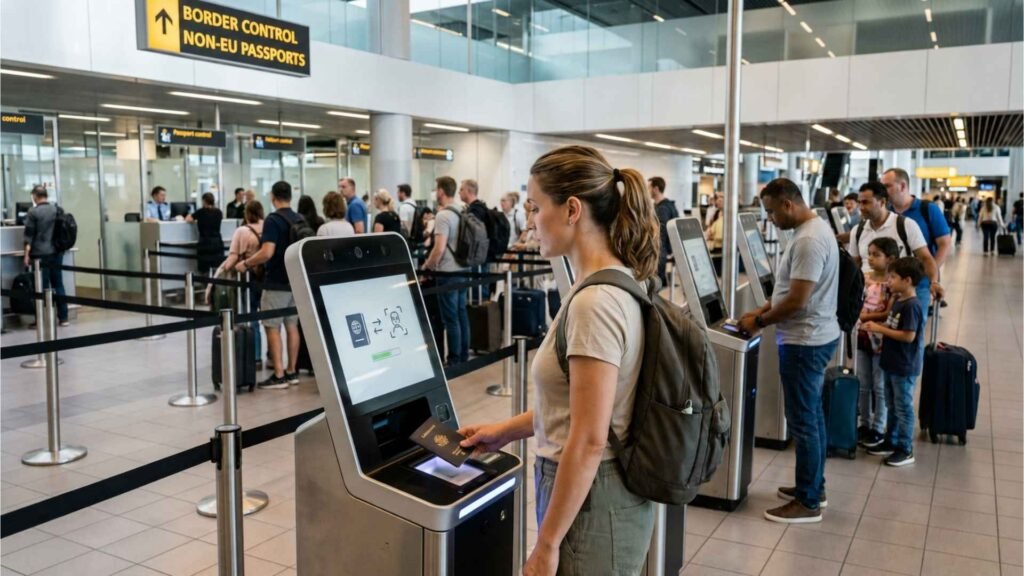
Eligible travelers arriving at Amsterdam Schiphol Airport from outside the Schengen Area may need to:
- Scan their passport
- Have a facial image taken
- Provide fingerprints
- Answer basic entry questions
- Complete verification with a border officer
Schiphol may use self-service registration machines for part of the process. Completing the kiosk steps does not guarantee admission or always eliminate the need to speak with the Royal Netherlands Marechaussee.
Children under 12 are generally exempt from fingerprint collection, although their passport details and facial image may still be registered.
Will EES Increase Waiting Times?
A traveler’s first EES registration may take longer because a biometric record must be created.
Later border crossings may be faster when the information can be verified against an existing record. Actual waiting times will still depend on passenger numbers, kiosk availability and whether additional checks are needed.
Passengers connecting at Schiphol should allow sufficient time for passport control, security and walking between gates.
Clara’s Tip: EES does not change where you enter Schengen. If Amsterdam is your first Schengen airport, registration normally takes place at Schiphol even when you are continuing to another European destination.
Can You Register for EES Before Traveling?
No advance EES application is required.
As of July 2026, travelers cannot pre-register for Dutch border checks through the proposed Travel to Europe mobile application. Avoid websites requesting payment to complete an EES application.
ETIAS Requirements for the Netherlands

ETIAS is an online travel authorization that will apply to eligible visa-exempt non-EU visitors traveling to the Netherlands and other participating European countries. It is not a Schengen visa.
As of July 2026, ETIAS is not operational and applications are not open. Its introduction is expected in the last quarter of 2026, although an exact launch date has not yet been announced.
Once the system becomes operational, eligible travelers will need to obtain an approved ETIAS before departure. Current information and future application access will be available through the European Union’s official ETIAS information portal.
Important: Do not submit personal information or pay a third-party website for an ETIAS application before the official system opens.
Who Will Need ETIAS?
ETIAS will generally apply to eligible visa-exempt travelers from countries such as:
- Australia
- Canada
- Japan
- New Zealand
- South Korea
- United Kingdom
- United States
Travelers who require a Schengen visa will not apply for ETIAS. Certain residents, qualifying family members and holders of European residence documents may also be exempt, depending on their status.
EES and ETIAS Are Different Systems
| EES | ETIAS |
|---|---|
| Records entry and exit at the border | Provides authorization before travel |
| Uses passport and biometric information | Uses an online application |
| Applies to many visa-required and visa-exempt travelers | Applies mainly to eligible visa-exempt travelers |
| Does not require an advance application | Requires an application before departure |
| Fully operational since 10 April 2026 | Expected in the last quarter of 2026 |
| Does not replace a visa | Does not apply to travelers who require a visa |
An eligible visa-exempt traveler may eventually be subject to both systems: ETIAS before departure and EES when crossing the external Schengen border.
How Much Will ETIAS Cost?
An ETIAS application will cost €20 once the system becomes operational.
Applicants who are under 18 or over 70 years of age at the time of application will be exempt from the fee. Certain qualifying family members of EU citizens and people who benefit from European free-movement rights may also qualify for a fee exemption.
Being exempt from the fee does not necessarily remove the application requirement. Eligible travelers in these groups will generally still need an approved ETIAS.
How Long Will ETIAS Be Valid?
An approved ETIAS is expected to remain valid for:
- Up to three years, or
- Until the linked passport expires,
whichever comes first.
It will generally permit multiple short visits. However, travelers must still comply with the 90/180-day rule.
ETIAS does not guarantee admission to the Netherlands. Border authorities will continue to make the final entry decision.
What If You Renew Your Passport?
ETIAS will be electronically linked to the passport used in the application. A new authorization will normally be required after:
- Passport renewal
- Replacement of a lost or stolen passport
- A legal name change reflected in a new passport
- Any change to the linked passport details
The passport presented to the airline and border authorities must match the passport linked to the ETIAS authorization.
What Happens When ETIAS Begins?
The introduction of ETIAS is expected to be followed by transitional and grace periods lasting at least 12 months in total.
The practical requirements during these periods will depend on the final implementation dates. Travelers should check the official ETIAS portal shortly before departure rather than relying on older guidance or unofficial application services.
Documents You May Need at Dutch Border Control
A valid passport and visa or ETIAS authorization are only part of the Netherlands entry requirements.
Border officers may also ask for:
- Return or onward ticket
- Hotel confirmation
- Host invitation
- Travel itinerary
- Travel medical insurance
- Proof of sufficient funds
- Sponsorship documents
- Residence permit or residence card
- Documents supporting a business or family visit
Not every traveler will be asked to show every item. However, the documents should be consistent with the purpose and length of the trip.
Proof of Accommodation
A hotel reservation should ideally show:
- Traveler’s name
- Hotel name and address
- Check-in and check-out dates
- Booking confirmation
Travelers staying with friends or family may need proof of private accommodation and details about their host.
The Dutch government explains how to arrange official proof of private accommodation.
Proof of Sufficient Funds
Dutch guidance generally uses €55 per person per day as the reference amount for a short visit.
| Length of stay | Reference amount per person |
|---|---|
| 3 days | €165 |
| 5 days | €275 |
| 7 days | €385 |
| 10 days | €550 |
| 14 days | €770 |
This is an entry reference rather than a realistic total travel budget. Accommodation, transportation and activities may require considerably more.
Travelers with insufficient personal funds may need official proof of sponsorship.
Questions Asked at Passport Control
A border officer may ask:
- Why are you visiting the Netherlands?
- How long will you stay?
- Where are you staying?
- Which other countries will you visit?
- How will you pay for the trip?
- When will you leave the Schengen Area?
- Are you visiting anyone in the Netherlands?
Answers should be brief, truthful and consistent with the supporting documents.
Where Do You Complete Passport Control?
Passport control takes place at the first external Schengen border.
| Route | Passport control location |
|---|---|
| New York–Amsterdam | Amsterdam |
| Istanbul–Amsterdam | Amsterdam |
| London–Amsterdam | Amsterdam |
| New York–Paris–Amsterdam | Paris |
| Istanbul–Frankfurt–Amsterdam | Frankfurt |
| Amsterdam–Copenhagen after arriving from New York | Amsterdam |
Flights arriving in Amsterdam from France, Germany, Spain, Italy or another Schengen country do not normally involve routine immigration control.
Temporary identity checks can still occur, so travelers should keep their passport or accepted identity document accessible.
Transit Visa Rules at Amsterdam Schiphol
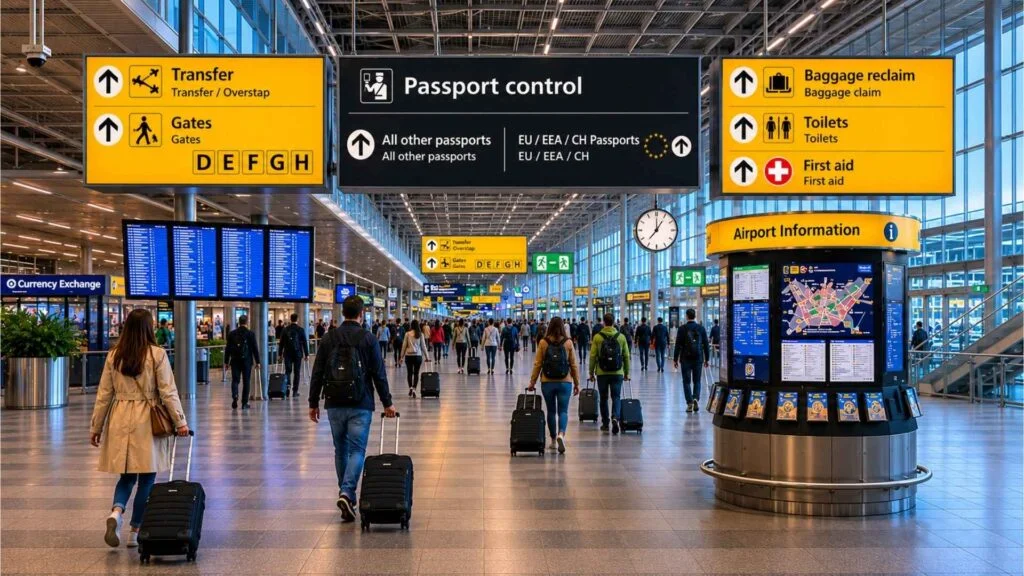
Transit requirements depend on nationality, final destination and whether you must enter the Netherlands during the connection.
Some travelers remaining in Schiphol’s international transit zone may need an airport transit visa. Others may need a full short-stay Schengen visa because their connection requires passport control.
An airport transit visa:
- Allows transit through the international zone
- Does not permit entry into the Netherlands
- Does not allow a visit to Amsterdam
- Cannot normally be used to collect baggage landside
- Does not permit transfer to a flight within the Schengen Area
Travelers should use the official Dutch tool to check whether a visa is required for transit in the Netherlands.
When Does a Connection Require Entry?
You will normally need permission to enter the Netherlands if:
- Your next flight is to a Schengen country
- You want to leave Schiphol Airport
- You must collect and recheck baggage
- Your separate tickets require landside check-in
- Your overnight connection requires leaving the transit zone
For example, Istanbul–Amsterdam–Paris requires Schengen entry at Amsterdam because the second flight operates within the Schengen Area.
Istanbul–Amsterdam–New York may remain airside if baggage is transferred, boarding passes are available and the itinerary does not require passport control.
Clara’s Tip: Separate tickets can turn an airside connection into a self-transfer requiring entry into the Netherlands. Confirm baggage and check-in arrangements with both airlines before booking.
Staying for More Than 90 Days
The short-stay Netherlands entry requirements do not cover residence, long-term study or employment.
Anyone planning to remain for more than 90 days may need:
- An authorization for temporary stay, known as an MVV
- A Dutch residence permit
- A work authorization
- A student residence permit
- A family-reunification permit
The correct process depends on nationality and purpose of stay. In some cases, a Dutch employer, educational institution or family member starts the application.
The Dutch Immigration and Naturalisation Service provides official information about residence permits and long-term stays.
A tourist stay cannot normally be extended simply because a visitor wants more time in the Netherlands. Extensions are generally limited to exceptional humanitarian, medical or force-majeure circumstances.
Can You Work During a Short Visit?
Visa-free entry or a tourist Schengen visa does not automatically authorize employment.
Additional permission may be required for:
- Paid employment
- Freelance assignments
- Internships
- Performances
- Certain on-site services
- Work carried out for a Dutch company
Limited business activities, such as meetings, conferences or trade fairs, may be permitted during a short stay. However, the exact rules depend on the activity and nationality.
Travelers should arrange the appropriate authorization when the main purpose of the trip is work rather than tourism.
Entry Requirements for Children
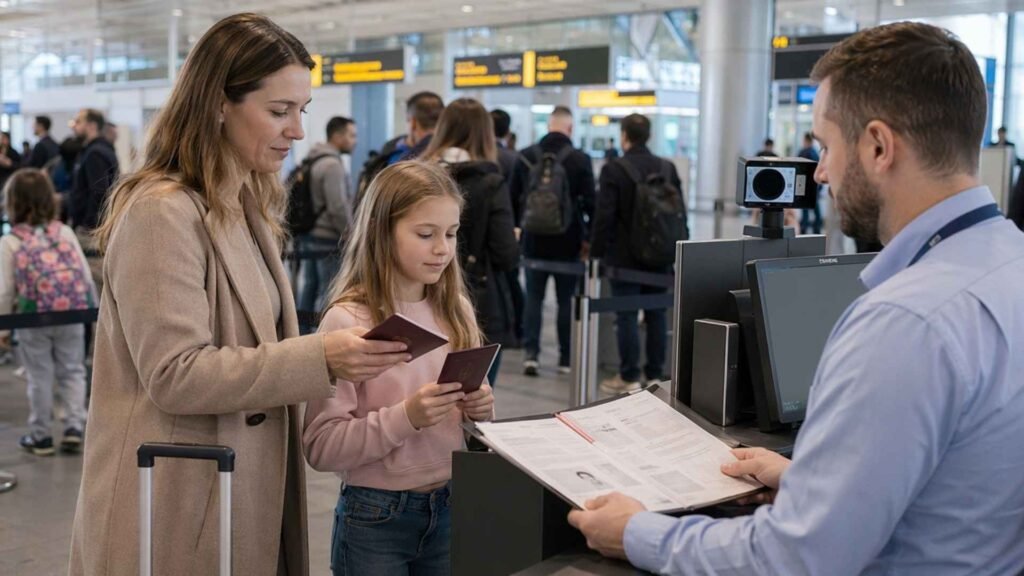
Every child must have their own valid passport or accepted national identity card.
Additional documents are advisable when a child:
- Travels with only one parent
- Travels without either parent
- Travels with an adult who is not a legal guardian
- Has a different surname from the accompanying parent
- Is subject to a custody agreement
Supporting documents may include:
- Birth certificate
- Written parental consent
- Copies of the parents’ passports
- Custody documents
- Proof of relationship
- Contact details for the absent parent
Non-EU children making short visits may also be registered in EES. Children under 12 are generally exempt from fingerprint collection, although their passport information and facial image may still be recorded.
Traveling With Medication
Most ordinary medication can be brought into the Netherlands in reasonable quantities for personal use.
Travelers should carry medication:
- In its original packaging
- With the prescription label attached
- In an amount appropriate for the trip
- With a prescription or doctor’s letter when necessary
Stricter rules apply to medicines containing controlled substances, including certain:
- Strong painkillers
- Sleeping medications
- Anti-anxiety drugs
- ADHD medications
- Medicinal cannabis products
An official medical certificate may be required. A medication passport can provide useful medical information, but it does not replace a legally required certificate.
Travelers should verify the rules for their active ingredient using the Dutch government’s guidance on bringing medication into the Netherlands.
Customs Rules on Arrival
Passport control determines whether you can enter the Netherlands. Customs checks what you are carrying into the country.
Travelers arriving from outside the EU should verify restrictions and allowances for:
- Alcohol
- Tobacco
- Food
- Plants
- Medicines
- High-value purchases
- Commercial goods
- Protected animal products
Goods above the relevant allowance should be declared. Commercial packaging does not automatically make meat, dairy, plants or other restricted food products acceptable.
Carrying €10,000 or More
Anyone entering or leaving the European Union with €10,000 or more in cash, or its equivalent in another currency, must normally make a declaration.
The legal definition may include certain negotiable instruments in addition to banknotes and coins. Declaring the money does not automatically mean that tax is due, but authorities may ask about its origin and intended use.
Traveling With a Pet
Dogs, cats and ferrets entering the Netherlands normally need:
- An approved microchip
- Valid rabies vaccination
- An EU pet passport or animal health certificate
- Entry through an approved point
- Additional documents based on the country of origin
A first rabies vaccination generally becomes valid for travel after a waiting period of at least 21 days. Animals arriving from or traveling through certain higher-risk countries may also need a rabies antibody blood test.
Travelers coming from Türkiye should begin preparation well in advance because additional rabies-related requirements can apply.
The Netherlands Food and Consumer Product Safety Authority provides the official requirements for traveling to the Netherlands with a pet from outside the EU.
Common Netherlands Entry Mistakes
Assuming Visa-Free Means Document-Free
Visa-exempt visitors can still be asked for accommodation, financial evidence and return travel.
Misunderstanding the 90/180-Day Rule
The allowance covers the entire Schengen Area and does not restart with each entry.
Ignoring the Passport Issue Date
A passport may fail the 10-year rule even when its printed expiry date appears acceptable.
Confusing EES With ETIAS
EES records border crossings. ETIAS will be a separate pre-travel authorization for eligible visa-exempt travelers.
Paying an Unofficial ETIAS Website
ETIAS applications are not open as of July 2026. No website can currently issue a valid authorization.
Applying to the Wrong Schengen Country
Visa applications should normally be submitted through the main destination, not the country with the easiest appointment.
Assuming a Transit Visa Allows Entry
An airport transit visa does not permit a traveler to visit Amsterdam or pass through Schengen passport control.
Booking a Self-Transfer Without Checking Visa Rules
Collecting checked baggage and checking in again may require entry into the Netherlands.
Forgetting Previous Schengen Trips
Days spent in other Schengen countries count toward the same 90/180-day allowance.
Netherlands Entry Checklist
Before departure, confirm that you have:
☐ Checked whether you need a visa
☐ Verified the passport issue date
☐ Confirmed three months of validity after leaving Schengen
☐ Checked the visa dates and permitted entries
☐ Calculated previous Schengen stays
☐ Checked the current ETIAS status
☐ Prepared for EES registration
☐ Saved your accommodation confirmation
☐ Kept your return or onward booking accessible
☐ Prepared proof of sufficient funds
☐ Arranged travel medical insurance
☐ Collected host or sponsorship documents if needed
☐ Checked every transit country
☐ Prepared parental consent documents where appropriate
☐ Obtained certificates for controlled medication
☐ Reviewed customs and pet requirements where relevant
Frequently Asked Questions About Netherlands Entry Requirements
Do US citizens need a visa for the Netherlands?
US citizens generally do not need a Schengen visa for tourist or limited business visits of up to 90 days in any 180-day period. They must meet the passport requirements and will normally be registered in EES. ETIAS is expected to apply after it becomes operational.
Do British citizens need a visa for the Netherlands?
British citizens generally do not need a visa for short visits lasting up to 90 days in any 180-day period. They are treated as non-EU travelers at passport control and are normally subject to EES.
Do Turkish citizens need a visa for the Netherlands?
Turkish citizens holding ordinary burgundy passports generally need a short-stay Schengen visa. Different rules or exemptions may apply to certain special, service or diplomatic passport holders.
How long must a passport be valid?
For most non-EU short-stay travelers, the passport must remain valid for at least three months after leaving the Schengen Area and must have been issued within the previous 10 years.
Is ETIAS required in July 2026?
No. ETIAS is not operational and applications are not open as of July 2026. Its introduction is expected in the last quarter of 2026.
Do I need to apply for EES online?
No. EES registration takes place at the external border. There is no separate online application or EES fee.
Can I enter with a Schengen visa issued by another country?
Yes, if the visa is valid and the itinerary remains consistent with the original application. The visa should normally have been issued by the main destination of the trip.
Does a valid Schengen visa guarantee entry?
No. Border officers can still verify the purpose of travel, accommodation, financial means, insurance and onward journey before making the final admission decision.
Final Thoughts
The Netherlands entry requirements mainly depend on your nationality, passport validity, visa status and previous time spent in the Schengen Area.
Check your documents early, keep accommodation and onward-travel evidence accessible, and verify the ETIAS status again before departure. Travelers connecting through Schiphol should also confirm whether their itinerary requires entry into the Netherlands.