

Traveling through Paris Charles de Gaulle Airport (CDG) for the first time can seem overwhelming. As France’s largest airport and one of Europe’s busiest international hubs, CDG handles millions of connecting passengers every year.
Fortunately, most connections are straightforward once you understand how the airport works. Whether you’re changing terminals, transferring between Schengen and non-Schengen flights, or connecting on separate tickets, knowing what to expect can make your journey much smoother.
This guide covers everything you need to know about Paris CDG Transit, including passport control, security screening, terminal transfers, baggage, transit visas, and recommended connection times.
Quick Answer
For most travelers, Paris CDG Transit is straightforward when both flights are booked under the same reservation.
After leaving your aircraft, follow the yellow Flight Connections signs instead of heading toward baggage claim or arrivals. Depending on your itinerary, you may need to pass through passport control, complete another security screening, or transfer to a different terminal before reaching your departure gate.
Before your connection, remember these key points:
- Follow the yellow Flight Connections signs throughout the airport.
- Passport control is only required if your journey enters or leaves the Schengen Area.
- Checked baggage is usually transferred automatically when both flights are on the same booking.
- Terminal changes may involve the free CDGVAL shuttle train or dedicated airport shuttle buses.
- Separate tickets require extra planning, as you may need to reclaim your baggage and check in again.
Understanding these basics before you travel can make your connection much less stressful.
Is Paris CDG Easy for Transit Passengers?
Yes—especially if your flights are booked on a single ticket.
Paris Charles de Gaulle Airport is designed to handle a large volume of connecting passengers and serves as the primary hub for Air France and one of the largest hubs within the SkyTeam alliance. Every day, travelers connect through CDG between Europe, North America, Asia, Africa, and the Middle East, making transit a routine part of the airport’s operation.
Although the airport is spread across multiple terminals, clear multilingual signage, dedicated transfer routes, and frequent terminal transportation help passengers move efficiently between flights. In many cases, you’ll remain inside the secure transit area without needing to exit the airport.
The complexity of your connection usually depends on four key factors:
- Whether both flights are booked on the same reservation.
- Whether your itinerary crosses the Schengen border.
- Whether you need to change terminals.
- Whether your checked baggage is transferred to your final destination.
Knowing the answers to these questions before you arrive will help you estimate how much time you’ll need and what procedures to expect during your connection.
Understanding Transit at Paris Charles de Gaulle Airport
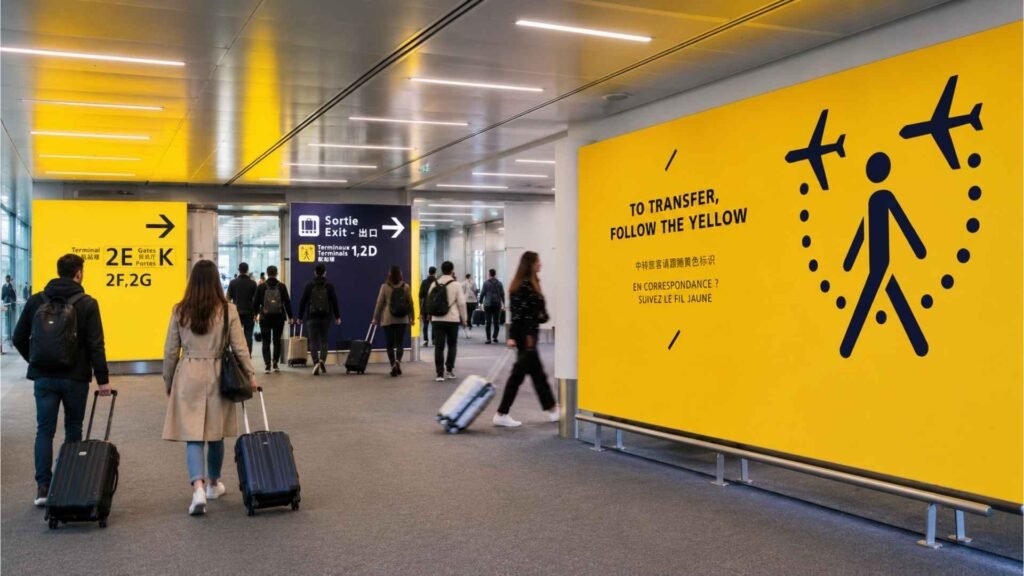
No two connections are exactly the same.
The procedures you’ll follow during Paris CDG Transit depend on where your journey begins, where you’re flying next, and how your flights are booked. While some passengers can walk directly to their next gate, others may need to complete immigration, security screening, or a terminal transfer.
Below are the most common transit scenarios at Charles de Gaulle Airport.
International (Non-Schengen) to International (Non-Schengen)
If you’re arriving from a country outside the Schengen Area and continuing to another non-Schengen destination, you’ll often remain inside the airport’s international transit zone.
In most cases, simply follow the Flight Connections signs after leaving your aircraft. Depending on your arrival terminal and departure gate, you may be directed through an additional security screening before continuing to your next flight.
Passport control is not usually required unless your transfer involves leaving the international transit area or crossing into the Schengen zone.
Non-Schengen to Schengen
Passengers arriving from outside the Schengen Area and connecting to a Schengen destination will normally pass through French passport control during their transfer.
Since the Entry/Exit System (EES) became operational across the Schengen Area in April 2026, eligible non-EU travelers entering the Schengen Area for the first time may also complete biometric registration, including facial image and fingerprint collection. During busy travel periods, this additional process can increase waiting times at border control. If you’re unfamiliar with the new system, our EES Explained guide covers how it works and what travelers should expect.
After immigration, you’ll continue toward your departure gate. Depending on your arrival terminal, another security screening may also be required.
This type of connection generally takes longer than an entirely airside international transfer, so allowing extra time is recommended.
Schengen to Non-Schengen
If you’re traveling from a Schengen country to a destination outside the Schengen Area, you’ll usually complete exit passport control at CDG before boarding your onward flight.
Depending on your routing and terminal, you may also pass through an additional security checkpoint before reaching your departure gate.
Schengen to Schengen
Connections between two Schengen destinations are generally the simplest.
Because you’re remaining within the same immigration area, passport control is not normally required. Most passengers simply follow the airport’s transfer signs directly to their next gate.
Additional security screening may still be necessary in some situations, depending on your arrival gate or operational procedures.
Domestic Connections Within France
Passengers connecting between domestic flights within France usually experience one of the quickest transfer processes at CDG.
If both flights are booked on the same reservation, checked baggage is normally transferred automatically, allowing you to remain inside the secure departure area.
However, travelers using separate tickets or changing airlines may need to collect their baggage, check in again, and pass through security before boarding their next flight.
What Determines Your Transit Experience?
While every itinerary is different, most transfers at Charles de Gaulle Airport are influenced by the same factors.
Before you travel, confirm:
- Whether your flights are booked on one ticket or separate reservations.
- Whether your journey crosses the Schengen border.
- Whether your arrival and departure flights use the same terminal.
- Whether your baggage is checked through to your final destination.
- Whether your airline has advised you of any additional transfer procedures.
Taking a few minutes to review these details before departure can help you avoid unnecessary stress and ensure a smoother connection at one of Europe’s busiest airports.
Do You Need to Go Through Immigration During Transit?
Whether you’ll pass through immigration during Paris CDG Transit depends on your itinerary rather than the length of your layover.
The most important factor is whether your connection crosses the Schengen border. If you’re traveling between two flights that remain within the same immigration zone, you can often stay inside the secure transit area. However, if your onward flight enters or leaves the Schengen Area, you’ll normally complete French passport control during your connection.
The table below shows what most travelers can expect.
| Connection Type | Immigration Required? |
|---|---|
| Non-Schengen → Non-Schengen | Usually No* |
| Non-Schengen → Schengen | Yes |
| Schengen → Non-Schengen | Yes |
| Schengen → Schengen | No |
| Domestic France → Domestic France | No |
*Some non-Schengen to non-Schengen transfers may still require additional checks depending on the terminals used, airline procedures, or operational requirements.
Eligible travelers may be able to use automated eGates, helping reduce waiting times at passport control. Availability depends on your nationality, passport type, and current border procedures.
During summer holidays, weekends, and the morning arrival peak, immigration queues can become significantly longer. If your connection includes passport control, building extra time into your itinerary is always a good idea.
Will You Need to Go Through Security Again?
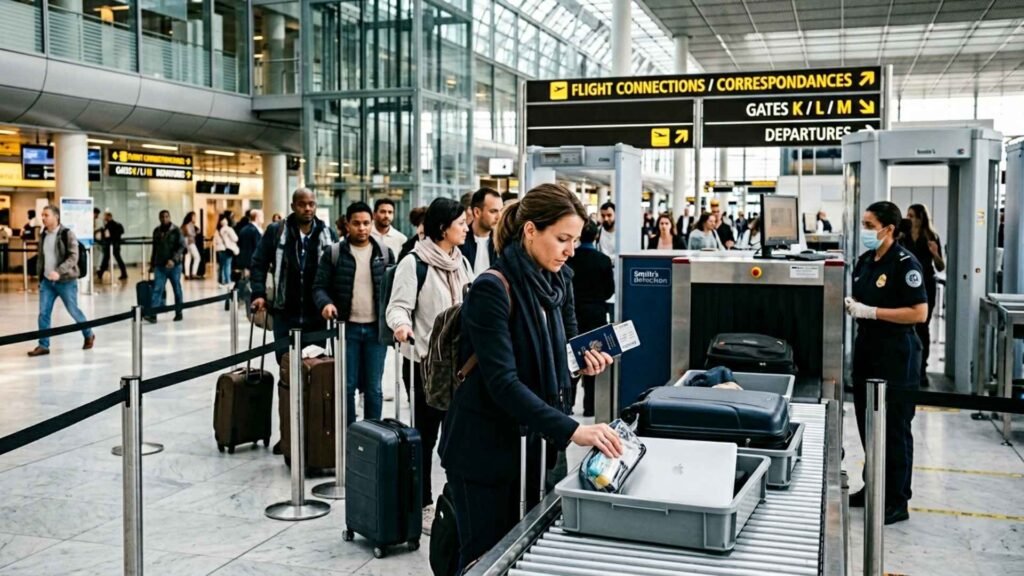
Possibly.
Even if you’ve already passed through security at your departure airport, you may be directed to another security screening before boarding your next flight at CDG.
Whether this happens depends on several factors, including:
- Your arrival country.
- Your arrival terminal.
- Your departure destination.
- Airline security agreements.
- Current airport security procedures.
If an additional screening is required, simply follow the yellow Flight Connections signs. Airport staff will direct you to the appropriate checkpoint before you continue to your departure gate.
To make the process as smooth as possible:
- Keep your passport and boarding pass easily accessible.
- Pack liquids according to current aviation security rules.
- Be prepared to remove laptops or larger electronic devices if requested.
- Empty your pockets before reaching the screening area.
A second security check during transit is completely normal at major international airports and shouldn’t be viewed as a sign that something is wrong with your connection.
Understanding the CDG Terminal Layout
One of the biggest reasons travelers find Charles de Gaulle Airport confusing is its terminal structure.
Unlike many airports with a single main terminal, CDG is divided into three terminal complexes, with Terminal 2 further split into several independent sections. Knowing which terminal your flights use before you travel can save both time and unnecessary stress.
| Terminal | Primarily Used By |
|---|---|
| Terminal 1 | International airlines outside the Air France network |
| Terminal 2A–2D | International and European airlines |
| Terminal 2E | Air France long-haul and many SkyTeam international flights |
| Terminal 2F | Air France and SkyTeam Schengen flights |
| Terminal 2G | Regional flights, mainly operated by Air France Hop |
| Terminal 3 | Low-cost and selected charter airlines |
For many international travelers, the most common connection is between Terminal 2E and Terminal 2F. Long-haul Air France flights frequently arrive at Terminal 2E, while onward flights to Schengen destinations often depart from Terminal 2F.
If you’re unsure which terminal you’ll use, check your boarding pass or airline’s mobile app before arriving at the airport. Gate and terminal assignments can occasionally change.
Changing Terminals at Paris CDG
Not every connection requires a terminal change, but if yours does, the process is usually well organized.
Charles de Gaulle Airport provides dedicated transfer routes, clear multilingual signage, and free transportation between terminal complexes. In many cases, you can remain inside the secure transit area without exiting the airport.
The time required depends on the terminals involved, whether you need to pass through immigration, and how busy the airport is when you arrive.
Connections Within Terminal 2
Terminal 2 is the airport’s largest complex and consists of multiple interconnected buildings rather than one continuous terminal.
Some sections are linked by indoor walkways, while others require a dedicated shuttle bus.
Common transfers include:
- Terminal 2E ↔ Terminal 2F
- Terminal 2E ↔ Terminal 2G
- Terminal 2A ↔ Terminal 2C
- Terminal 2B ↔ Terminal 2D
If you’re flying with Air France or another SkyTeam airline, there’s a good chance your connection will take place within the Terminal 2 complex.
Terminal 1 to Terminal 2
Passengers transferring between Terminal 1 and Terminal 2 normally use the free CDGVAL automated shuttle train.
The journey itself is relatively quick, but your total transfer time will also include walking between platforms, following airport signs, and any immigration or security procedures required for your itinerary.
Terminal 2 to Terminal 3
Transfers between Terminal 2 and Terminal 3 are also handled by the CDGVAL shuttle train.
Although the train ride is short, remember to allow additional time for walking between stations and locating your departure gate.
CDGVAL and Airport Shuttle Services
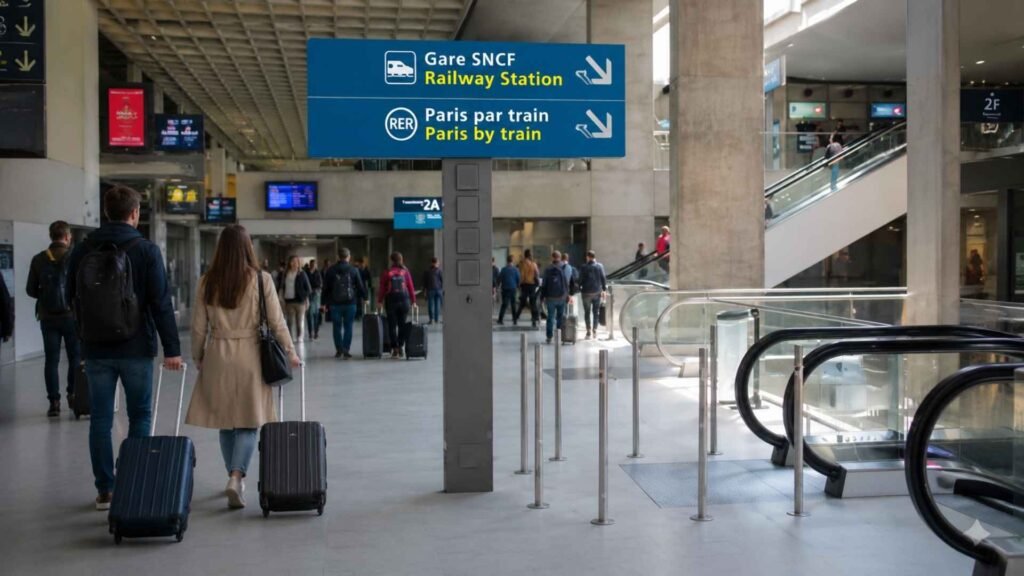
Charles de Gaulle Airport offers several free transportation options to help connecting passengers move between terminals.
Understanding which service to use can save valuable time during your connection.
CDGVAL Automated Shuttle Train
The CDGVAL is a free, fully automated train connecting the airport’s main terminal areas.
It serves:
- Terminal 1
- Terminal 2
- Terminal 3
- The TGV and RER railway station
- Airport parking facilities
The service operates frequently throughout the day, and no ticket is required.
For most passengers transferring between the airport’s main terminals, the CDGVAL is the fastest and most convenient option.
For the latest terminal maps and connection routes, visit the official Paris Aéroport Connecting Flights page.
Shuttle Buses
Some parts of the airport—particularly Terminal 2G and certain remote boarding areas—are served by dedicated airport shuttle buses.
If your connection requires one of these buses, simply follow the yellow Flight Connections signs. Staff are available throughout the terminal if you need assistance.
How Long Does It Take to Change Terminals?
The amount of time required depends on your arrival gate, departure gate, passenger volumes, and whether immigration or additional security screening is required.
The estimates below reflect typical transfer times under normal operating conditions.
| Transfer | Typical Time |
|---|---|
| Within the same terminal | 10–20 minutes |
| Between nearby Terminal 2 sections | 15–30 minutes |
| Terminal 2E ↔ Terminal 2F | 15–25 minutes |
| Terminal 2E ↔ Terminal 2G | 20–35 minutes |
| Terminal 1 ↔ Terminal 2 | 20–35 minutes |
| Terminal 2 ↔ Terminal 3 | 20–30 minutes |
These times are intended as a general guide rather than a guarantee.
During peak travel periods, passport control, security screening, long walking distances, or temporary operational changes may increase your overall transfer time. If your itinerary includes multiple transfer steps, aim to reach your departure gate well before boarding begins rather than relying on the minimum connection time.
How Much Time Do You Need for a Connection at CDG?
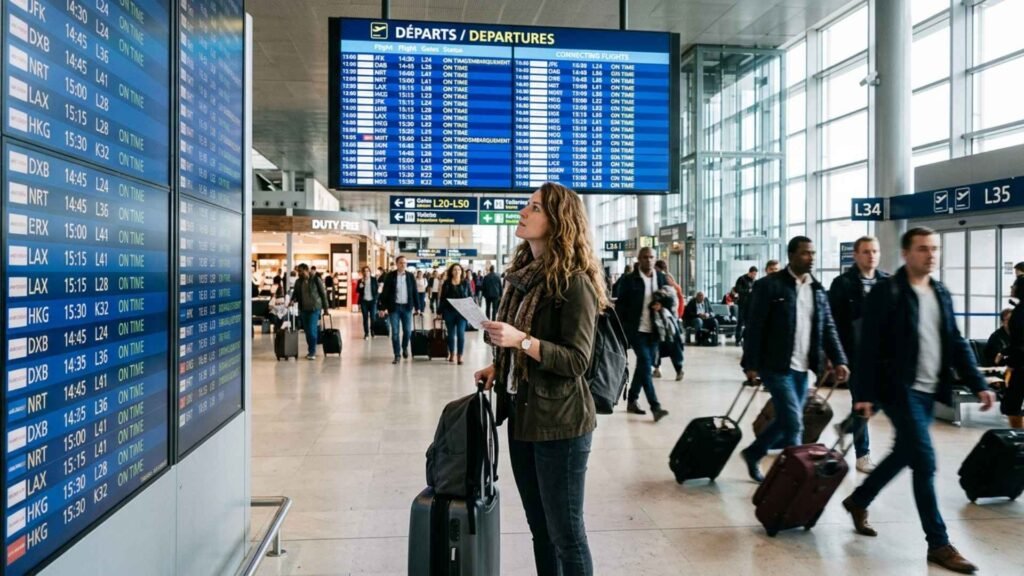
One of the most common questions about Paris CDG Transit is whether a connection is long enough.
The answer depends on far more than the number of minutes between your flights. Your terminals, immigration requirements, baggage arrangements, airline, and booking type all influence how much time you’ll actually need.
If your itinerary is booked on a single reservation, the connection already meets the airline’s published Minimum Connection Time (MCT). However, the minimum isn’t always the most comfortable option—particularly during busy travel periods or when your connection includes passport control and a terminal transfer.
For most travelers, allowing a little extra time makes the journey considerably less stressful.
Clara’s Tip: If you’re booking separate tickets, don’t rely on the airline’s official minimum connection time. Giving yourself an extra hour or two can make a significant difference if your first flight is delayed or immigration queues are longer than expected.
Recommended Connection Times
| Connection Type | Recommended Time |
|---|---|
| Same terminal (Schengen) | 60–90 minutes |
| Same terminal (International) | 90–120 minutes |
| Different terminals | 2–3 hours |
| Separate tickets (carry-on only) | At least 4 hours |
| Separate tickets with checked baggage | 5 hours or more |
These recommendations allow for normal walking times, possible security screening, passport control, and moderate airport congestion.
If you’re unfamiliar with Charles de Gaulle Airport, traveling with children, or flying during the summer holiday season, choosing a longer connection is usually the safer option.
Factors That Can Increase Your Transfer Time
Every connection is different, and several factors can make the transfer take longer than expected.
Your connection may require additional time if:
- You need to pass through passport control.
- Your flights depart from different terminals.
- Another security screening is required.
- You’re traveling during peak morning or afternoon departure periods.
- Your arriving flight is delayed.
- You’re flying on separate tickets.
- You need to reclaim and recheck checked baggage.
Even a relatively short delay at one stage of the journey can affect the time available for the next.
One Ticket vs Separate Tickets
How your flights are booked is one of the most important factors affecting Paris CDG Transit.
Two itineraries may look identical on paper, yet involve completely different transfer procedures depending on whether they’re booked on one reservation or two separate tickets.
Connecting on One Ticket
A single-ticket itinerary offers the simplest and most reliable connection.
In most cases:
- Your checked baggage is tagged through to your final destination.
- You won’t need to check in again during your connection.
- If your incoming flight is delayed, the airline is generally responsible for rebooking you on the next available flight.
- Airline transfer desks are available if you need assistance after landing.
For international journeys involving multiple flights, this is usually the lowest-risk option.
If you’re flying with Air France, you can also use the official Air France Connection Guide to check transfer routes, estimated walking times, and terminal information before you travel.
Connecting on Separate Tickets
Separate bookings require much more planning.
Because each ticket is treated as an independent journey, the second airline is generally not responsible if your first flight arrives late.
Depending on your itinerary, you may need to:
- Pass through immigration.
- Collect your checked baggage.
- Leave the secure transit area.
- Check in again.
- Drop off your baggage.
- Pass through security.
- Proceed to your departure gate.
For this reason, experienced travelers usually allow a significantly longer layover when booking separate tickets.
What Happens to Your Checked Baggage?
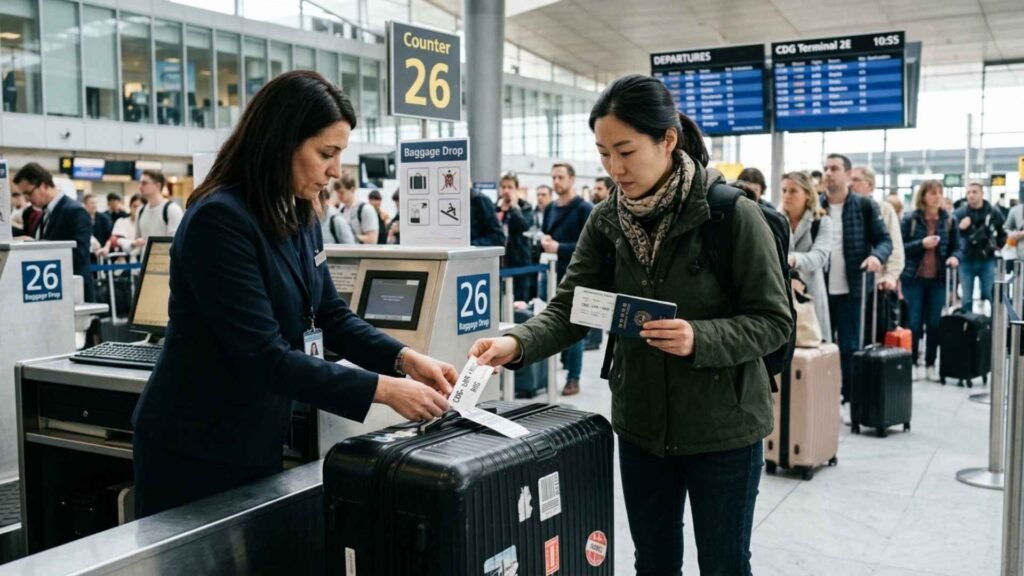
Whether you need to collect your luggage during transit depends almost entirely on how your flights are booked.
Flights on the Same Reservation
If both flights are included on the same booking, your checked baggage is usually tagged directly to your final destination.
In most cases, you won’t need to collect your luggage during your connection at Charles de Gaulle Airport—even if you’re changing terminals.
Before leaving the check-in counter, it’s always worth confirming the destination printed on your baggage tag. A quick check can prevent unnecessary confusion later in your journey.
Flights on Separate Tickets
If your flights are booked separately, you’ll often need to collect your baggage after landing at CDG.
Once you’ve reclaimed your luggage, you’ll normally need to:
- Exit the arrivals area.
- Check in with your next airline.
- Drop off your baggage again.
- Pass through security.
- Continue to your departure gate.
This additional process can easily add an hour or more to your transfer, particularly during busy travel periods.
What Happens If You Miss Your Connection?
Even carefully planned itineraries can be affected by weather, air traffic delays, or operational issues.
What happens next depends on how your flights were booked.
If You’re Traveling on One Ticket
If your incoming flight is delayed and causes you to miss your onward flight, your airline will normally arrange an alternative itinerary at no additional cost.
Depending on the situation, the airline may also provide assistance such as:
- Meal vouchers.
- Hotel accommodation for overnight delays.
- Transportation between the hotel and airport.
After landing, follow the signs to your airline’s transfer desk or customer service counter for further assistance.
If You’re Traveling on Separate Tickets
Passengers traveling on separate reservations usually have much less protection.
If your first flight arrives late and you miss the second one, you’ll generally be responsible for purchasing a new ticket or paying any fare difference yourself.
To reduce the risk, consider:
- Booking a longer layover.
- Choosing flexible fares where available.
- Purchasing travel insurance that includes missed connection coverage.
These precautions can save both time and money if unexpected delays occur.
Do You Need a Transit Visa at Paris CDG?
Not every traveler connecting through Charles de Gaulle Airport needs a transit visa.
The requirements depend on several factors, including:
- Your nationality.
- Your passport.
- Whether you remain inside the international transit area.
- Whether you need to enter France during your connection.
- Your final destination.
Many passengers can complete Paris CDG Transit without a visa as long as they remain airside and meet the applicable entry requirements.
However, some nationalities require an Airport Transit Visa (ATV) even when they don’t leave the international transit area.
If your itinerary requires passing through French immigration—for example, because you’re entering the Schengen Area, collecting baggage on separate tickets, or leaving the airport during a long layover—you may instead require a Schengen visa, depending on your nationality.
Because visa policies can change, always check the latest requirements before traveling on the France-Visas official website.
Can You Leave the Airport During a Layover?

Yes—but only if your schedule allows enough time and you’re eligible to enter France.
Whether it’s worth leaving the airport depends largely on the length of your layover.
Layovers Under 4 Hours
Leaving the airport is generally not recommended.
By the time you’ve completed immigration, traveled into the city, returned to the airport, and passed through security again, very little time remains for sightseeing.
Staying inside the terminal is usually the safer choice.
Layovers Between 5 and 7 Hours
A medium-length layover may provide enough time to leave the airport, but careful planning is essential.
If you decide to visit Paris, choose locations with convenient rail access and allow plenty of time for your return journey.
Unexpected delays on public transport or longer-than-expected security queues can quickly reduce your available time.
Layovers of 8 Hours or More
Longer layovers offer a much better opportunity to explore the city.
Many travelers use this time to visit central Paris before returning to Charles de Gaulle Airport for their onward flight.
Before leaving the airport, make sure you:
- Meet France’s entry requirements.
- Know how you’ll return to the airport.
- Monitor your flight status throughout the day.
- Arrive back at CDG well before boarding begins.
A comfortable time buffer is always preferable to rushing back for your flight.
Common Transit Mistakes at Paris Charles de Gaulle Airport
Most connections at Paris Charles de Gaulle Airport go smoothly, but a few common mistakes can make an otherwise straightforward transfer much more stressful.
Avoiding the following issues will help you navigate Paris CDG Transit with greater confidence.
Booking a Tight Connection on Separate Tickets
Separate tickets are one of the biggest causes of missed connections.
Unlike a single-ticket itinerary, each booking is treated independently. If your first flight is delayed, the second airline is generally not responsible for rebooking you.
If you’re flying on separate tickets, allow a generous layover—especially if you need to collect and recheck your baggage.
Underestimating the Size of CDG
Charles de Gaulle Airport is much larger than many travelers expect.
Even if the shuttle train journey is short, walking between gates, changing terminals, passing through immigration, and clearing security can take considerably longer than anticipated.
Always allow enough time to reach your departure gate comfortably.
Assuming Checked Baggage Transfers Automatically
Many travelers assume their luggage will always be transferred to the next flight.
In reality, this usually happens only when both flights are booked on the same reservation.
If you’re traveling on separate tickets, verify your baggage arrangements before leaving the check-in counter at your departure airport.
Following Arrivals Instead of Flight Connections
After leaving your aircraft, pay close attention to airport signage.
If you’re connecting to another flight, follow the yellow Flight Connections signs rather than the signs for Arrivals or Baggage Claim, unless your itinerary specifically requires you to leave the secure transit area.
Taking the wrong route may result in unnecessary delays or additional procedures.
Forgetting About Boarding Time
Your flight’s departure time is not the same as its boarding time.
For international flights, boarding often begins 30 to 60 minutes before departure, and boarding gates usually close well before the scheduled departure time.
Plan to arrive at your gate early rather than at the last minute.
Leaving the Airport Without Enough Time
A long layover can be a great opportunity to visit Paris, but only if your schedule allows.
Before leaving the airport, consider immigration queues, travel time to and from the city, security screening, and your boarding time.
If your layover is short, staying inside the terminal is usually the safer choice.
Clara’s Tip: Even with a long layover, always work backwards from your boarding time—not your departure time. This gives you a much more comfortable safety margin if trains are delayed or airport queues are longer than expected.
Not Checking Flight Updates
Departure gates can change, particularly on busy travel days.
Monitor the airport information screens or your airline’s mobile app throughout your connection so you don’t miss important updates.
Frequently Asked Questions About Paris CDG Transit
Is Paris CDG easy for connecting flights?
Yes. Although Charles de Gaulle Airport is one of Europe’s largest airports, it is designed to accommodate connecting passengers. Clear signage, dedicated transfer routes, and free terminal transportation make most connections straightforward, particularly when both flights are booked on the same reservation.
Is one hour enough for a connection at CDG?
It depends on your itinerary.
A one-hour connection may be sufficient for some same-terminal, single-ticket flights, but it leaves very little margin for delays. If your connection includes passport control, a terminal change, or another security screening, a longer layover is recommended.
Is 90 minutes enough for a connection?
For many protected connections booked on a single reservation, 90 minutes is generally sufficient.
However, if you’re traveling on separate tickets or need to collect checked baggage, allowing additional time is the safer option.
Do I need to collect my baggage during transit?
Usually not.
When both flights are booked on the same reservation, checked baggage is typically transferred to your final destination automatically.
If you’re traveling on separate tickets, you’ll often need to reclaim your baggage, check in again, and pass through security before your next flight.
Do I need to go through passport control?
Only if your connection enters or leaves the Schengen Area.
Passengers remaining within the same immigration zone can often stay inside the secure transit area without passing through passport control.
Do I need a transit visa?
Visa requirements depend on your nationality, passport, and itinerary.
Some travelers can transit through Charles de Gaulle Airport without a visa, while others may require an Airport Transit Visa (ATV) or a Schengen visa if they need to enter France.
Always check the latest requirements before traveling.
Can I leave the airport during a layover?
Yes, provided you meet France’s entry requirements and have enough time to return before your next flight.
Longer layovers generally offer the best opportunity to explore Paris without feeling rushed.
Can I walk between terminals?
Some parts of Terminal 2 are connected by indoor walkways.
However, transfers between the airport’s main terminal complexes usually require the free CDGVAL shuttle train or dedicated airport shuttle buses.
Is free Wi-Fi available at Paris CDG?
Yes.
Complimentary Wi-Fi is available throughout the airport, allowing you to check flight updates, stay connected, or work during your layover.
Are airport lounges available during transit?
Yes.
Charles de Gaulle Airport offers a wide range of airline lounges and independent lounges across several terminals. Depending on your airline, ticket type, lounge membership, or travel card, you may also be able to purchase a day pass.
Can I stay overnight at CDG?
Yes.
The airport operates 24 hours a day, and overnight stays are possible in designated public areas. If you prefer more comfort, several hotels are located within or close to the airport terminals.
Which terminal does Air France use?
Air France primarily operates from Terminal 2E, Terminal 2F, and Terminal 2G.
Long-haul international flights generally use Terminal 2E, while many Schengen and regional services depart from Terminals 2F and 2G. Always confirm your terminal before traveling, as operational changes are possible.
Final Thoughts
For most travelers, Paris CDG Transit is easier than it first appears. Understanding your connection type, terminal, baggage arrangements, and any immigration requirements before you travel can help you avoid unnecessary delays and make your transfer much smoother.
Whenever possible, book connecting flights on a single reservation, allow extra time during busy travel periods, and keep an eye on flight updates throughout your journey. With a little preparation, connecting through Paris Charles de Gaulle Airport can be a simple and stress-free part of your trip.
Continue Planning Your Paris CDG Journey
Planning more than just your connection? These guides will help you prepare for every stage of your trip through Charles de Gaulle Airport.
- Paris CDG Airport Guide — Terminals, services, transportation, and airport facilities
- Paris CDG Arrival Guide — Passport control, baggage claim, and customs.
- Paris CDG Self-Transfer Guide — Separate tickets and connection tips.
- Paris CDG Fast Track Guide — Fast-track options and shorter queues.
- Paris CDG Lounges Guide — The best lounges and access options.
- Hotels Near Paris CDG Airport — The best hotels for overnight stays and layovers.
- Paris CDG to Paris City Center — Train, taxi, bus, and transfer options.