

Booking separate tickets can save money, but it can also make your connection more complicated.
Depending on your itinerary, an Amsterdam Schiphol self-transfer may require you to collect checked baggage, pass through immigration, clear customs, and check in again before your next flight.
This guide explains how self-transfers work at Schiphol, when additional airport procedures apply, and how much connection time you should allow between flights.
Amsterdam Schiphol Self-Transfer Quick Answer
If you booked separate tickets through Amsterdam Schiphol Airport, you may need to:
✔ Pass through immigration
✔ Collect checked baggage
✔ Clear customs
✔ Check in again
✔ Drop baggage again
✔ Pass through security screening
Passengers traveling with carry-on luggage only may avoid some of these steps, depending on the airlines and destinations involved.
For most travelers, an Amsterdam Schiphol self-transfer is safest with at least 4–6 hours between flights, while first-time Entry/Exit System (EES) registration may require even more time.
What Is a Self-Transfer?
A self-transfer occurs when two or more flights are booked separately rather than under a single airline reservation.
For example:
- New York → Amsterdam on Airline A
- Amsterdam → Athens on Airline B
Although Schiphol acts as your connection airport, the airlines may not coordinate baggage handling or missed connection protection.
This differs from a standard connecting itinerary where all flights are booked under one reservation.
With a traditional connection:
- Baggage is often transferred automatically
- Airlines coordinate the transfer process
- Missed connection protection may apply
With a self-transfer:
- You are usually responsible for the transfer process
- Airlines may treat flights independently
- Additional airport procedures may be required
How Amsterdam Schiphol Self-Transfer Works
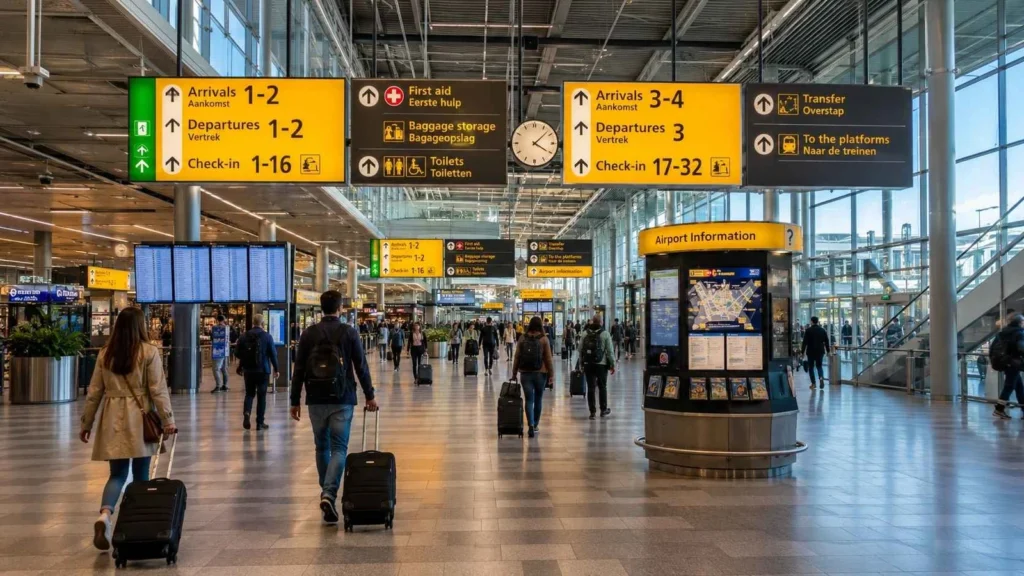
The exact process depends on:
- Whether you have checked baggage
- Whether flights are on separate tickets
- Whether airlines have an interline agreement
- Whether your journey involves Schengen or non-Schengen destinations
A typical Schiphol self-transfer may look like this:
Arrival
↓
Immigration (if required)
↓
Baggage claim
↓
Customs
↓
Departure check-in
↓
Baggage drop
↓
Security screening
↓
Departure gate
Although Schiphol operates within a single integrated terminal, many self-transfer passengers must temporarily leave the arrival flow and re-enter the departure process.
Separate Tickets vs Single Ticket Connections
Many travelers assume that all airport connections operate the same way.
They do not.
Single Ticket Connections
When flights are booked under a single reservation:
- Baggage is often checked through to the final destination
- Airlines coordinate transfers
- Missed connections may be protected
Passengers typically remain inside the transit system and follow transfer signs.
Separate Ticket Connections
With separate reservations:
- Baggage may not be transferred automatically
- Check-in may be required again
- Missed flights become your responsibility
- Immigration and customs procedures may apply
This is why separate-ticket travel usually requires more planning and longer connection times.
Same Airline vs Different Airline
A self-transfer can occur even when both flights are operated by the same airline.
For example, you may book:
- Flight 1 separately
- Flight 2 separately
Even though the carrier is identical, baggage handling and connection protection may differ from a single-ticket itinerary.
The situation becomes even more complicated when different airlines are involved because reservation systems and baggage agreements may not be linked.
Always verify transfer arrangements directly with your airline before departure.
Understanding Interline Agreements
Some airlines participate in interline agreements.
These agreements may allow:
- Through-checking baggage
- Coordinated baggage transfers
- Simplified transfer procedures
However, an interline agreement does not automatically guarantee baggage transfer on separately booked tickets.
Policies vary significantly between airlines.
Before departure, review your airline’s baggage policy and transfer arrangements or consult the official Amsterdam Schiphol Airport website for current airport information.
Do You Need to Collect Checked Baggage?
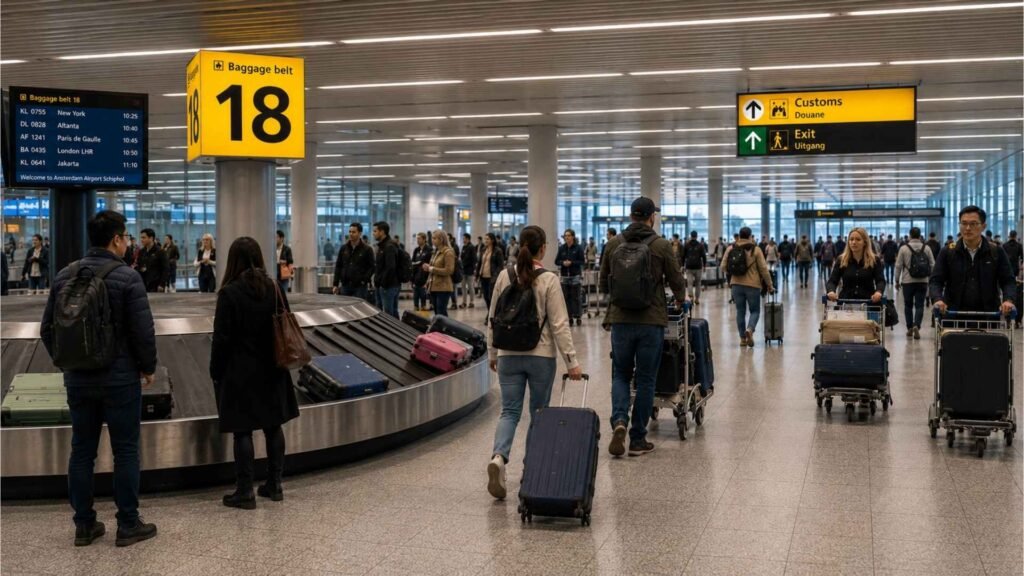
For most self-transfer passengers, this is the most important question.
In many cases, the answer is yes.
When flights are booked separately, airlines often require passengers to collect baggage at Schiphol and check it in again for the next flight.
A typical process looks like this:
Arrival
↓
Baggage claim
↓
Customs
↓
Check-in desk
↓
Baggage drop
↓
Security
Even when both flights depart on the same day, baggage is not always transferred automatically.
Situations Where Baggage Collection Is Often Required
- Separate tickets
- Different airlines
- No interline agreement
- Low-cost carrier combinations
- Independent bookings through online travel agencies
Situations Where Baggage May Be Transferred
- Single-ticket itineraries
- Certain partner airlines
- Confirmed through-check arrangements
Never assume baggage transfer is automatic.
Always verify baggage arrangements before departure.
Clara’s Tip
If your self-transfer includes separate tickets and checked baggage, avoid booking the shortest connection available.
A slightly longer layover is often far less expensive than purchasing a new ticket after a missed connection.
Can You Self-Transfer With Carry-On Luggage Only?
Yes.
Traveling with carry-on luggage only can significantly simplify a self-transfer at Schiphol.
In some situations, passengers may avoid:
- Baggage claim
- Customs processing
- Departure check-in counters
However, this depends on:
- Airline policies
- Boarding pass availability
- Immigration requirements
- Destination regulations
Even passengers with carry-on luggage only may still need to pass through immigration or security depending on their itinerary.
Do You Need to Pass Through Immigration?
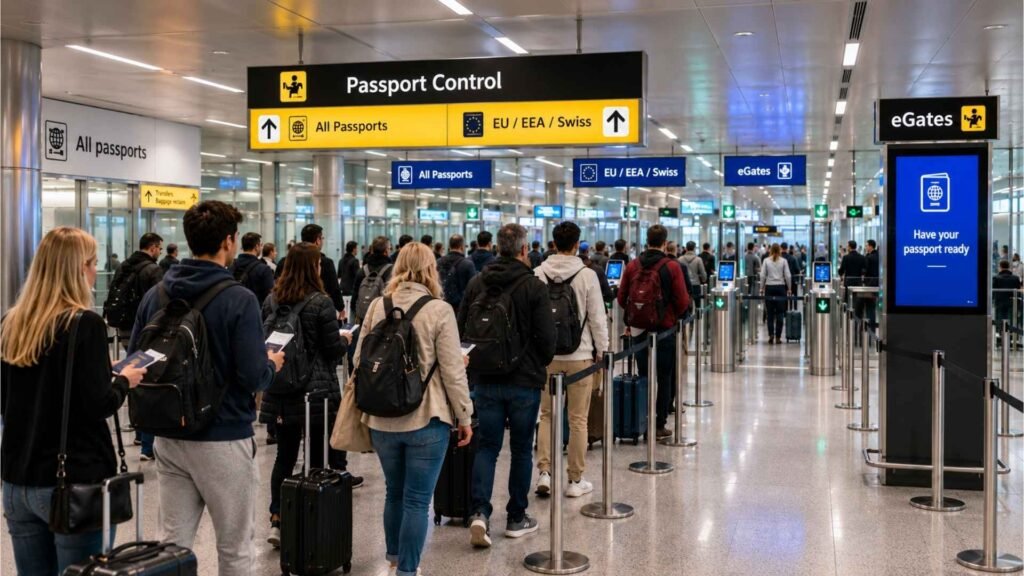
Immigration requirements depend primarily on whether your journey crosses the Schengen border.
Non-Schengen to Schengen
Example:
- New York → Amsterdam
- Amsterdam → Rome
Passengers normally enter the Schengen Area in Amsterdam.
Immigration is usually required.
Schengen to Non-Schengen
Example:
- Athens → Amsterdam
- Amsterdam → Dubai
Passengers normally complete exit immigration procedures before departure.
Passport control is usually required.
Non-Schengen to Non-Schengen
Example:
- Istanbul → Amsterdam
- Amsterdam → Toronto
Some passengers may remain airside.
However, self-transfer arrangements can still require entering the terminal depending on baggage and check-in requirements.
Schengen to Schengen
Example:
- Madrid → Amsterdam
- Amsterdam → Vienna
Immigration is generally not required because both flights remain within the Schengen Area.
Do You Need to Clear Customs?
Customs procedures are usually linked to baggage collection.
If you collect checked baggage, you will normally pass through customs before entering the public arrivals area.
Passengers who remain entirely airside may not encounter customs during the transfer process.
For current regulations, consult the official Dutch Customs guidance.
Recommended Self-Transfer Connection Times at Schiphol
When planning an Amsterdam Schiphol self-transfer, connection time is one of the most important factors.
Unlike traditional airline connections, self-transfer passengers may need to complete immigration procedures, collect baggage, clear customs, check in again, drop baggage, and pass through security screening before reaching their departure gate.
For this reason, connection times that may be acceptable on a single-ticket itinerary can become risky on separate tickets.
Recommended Self-Transfer Connection Times
| Situation | Recommended Time |
|---|---|
| Carry-on only | 3 – 4 hours |
| Checked baggage | 4 – 6 hours |
| Schengen → Non-Schengen | 4 – 5 hours |
| Non-Schengen → Schengen | 5 – 7 hours |
| First-time EES registration | 6 – 7+ hours |
| Peak travel periods | 6 + hours |
These recommendations are intentionally conservative.
A missed connection during a self-transfer can be significantly more expensive than spending a few additional hours at the airport.
Entry/Exit System (EES) Registration
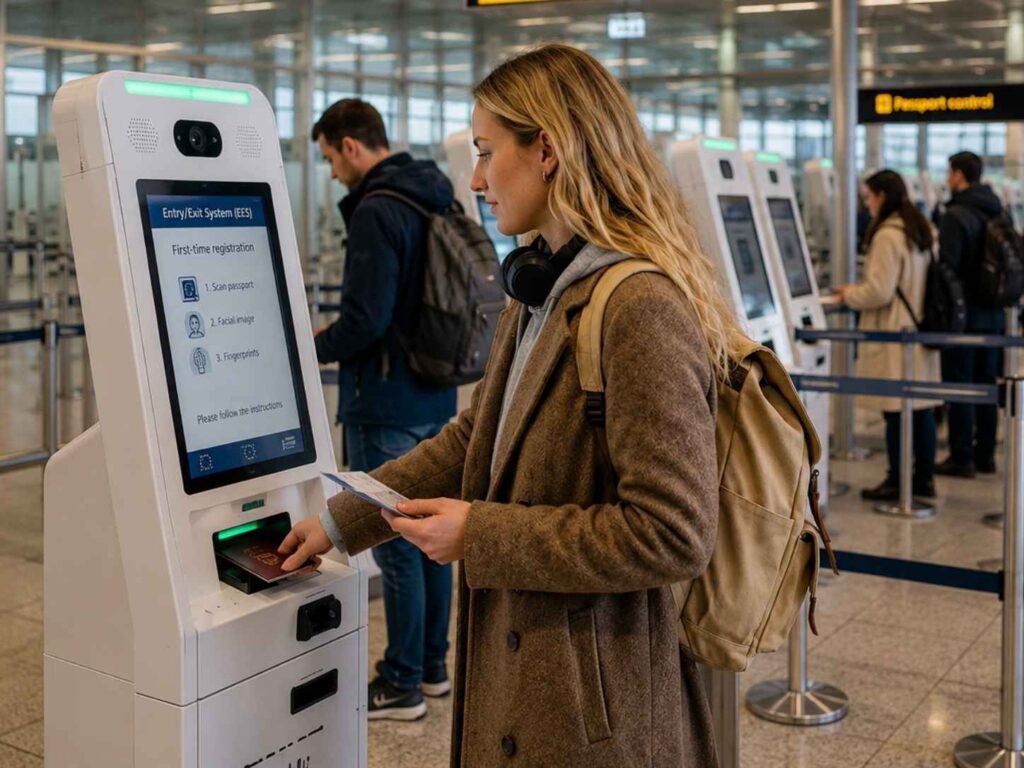
Since April 2026, many non-EU travelers entering the Schengen Area for the first time must complete registration under the Entry/Exit System (EES).
The process may include:
- Biometric data collection
- Facial image capture
- Passport verification
- Identity checks
For passengers arriving from outside the Schengen Area and continuing to a Schengen destination, EES can affect immigration processing times.
While waiting times vary depending on passenger volumes and staffing levels, first-time registration may increase passport control processing times during busy travel periods.
Travelers making a self-transfer through Amsterdam Schiphol Airport should factor this into their connection planning.
For a detailed explanation of the new system, see our ETIAS and EES Explained guide.
Clara’s Tip
If you are entering the Schengen Area for the first time since the introduction of EES, allow extra time for immigration procedures.
Even efficient airports such as Amsterdam Schiphol can experience longer passport control queues during busy travel periods.
Are Self-Transfers Protected Against Delays?
One of the biggest risks of a self-transfer is missed connection protection.
When flights are booked under a single reservation, airlines may assist passengers if delays cause a missed connection.
With separate tickets, the situation is often very different.
In most cases, airlines treat each booking as an independent journey.
If your first flight arrives late and you miss your onward flight, the airline operating the second flight is usually not responsible for providing a replacement ticket.
For this reason, many experienced travelers choose longer connection times when booking self-transfers through Schiphol.
Some travelers also purchase travel insurance that includes missed connection coverage, although policies and coverage limits vary significantly between providers.
Always review policy terms carefully before departure.
Factors That Can Increase Transfer Time
Even when everything goes smoothly, several factors can increase the time required for a self-transfer.
These include:
- Immigration queues
- First-time EES registration
- Security screening delays
- Checked baggage delivery times
- Airline check-in deadlines
- Long walking distances
- Peak-season passenger volumes
Amsterdam Schiphol Airport is generally efficient, but delays can occur during busy periods such as summer holidays, Christmas, and major travel weekends.
Building additional time into your itinerary provides a valuable safety margin.
Common Self-Transfer Mistakes
Many missed flights occur because travelers underestimate the complexity of separate-ticket connections.
Booking Extremely Short Connections
A connection that looks comfortable on paper may become risky once immigration, baggage claim, customs, and security are factored in.
Self-transfer passengers should generally avoid tight schedules.
Assuming Baggage Transfers Automatically
One of the most common mistakes is assuming checked baggage will automatically continue to the next flight.
Unless your airline explicitly confirms through-checking, always assume baggage collection may be required.
Ignoring Check-In Deadlines
Many airlines close baggage drop and check-in counters well before departure.
Arriving at the airport is not enough if check-in has already closed.
Always verify airline-specific deadlines.
Forgetting Visa and Entry Requirements
Some self-transfer itineraries require passengers to formally enter the Netherlands before continuing their journey.
Failing to verify entry requirements can create significant problems at the airport.
Booking During Peak Travel Periods
Summer holidays, Christmas, Easter, and major European vacation periods can increase waiting times throughout the airport.
Additional connection time is highly recommended during these periods.
Example Self-Transfer Scenarios at Schiphol
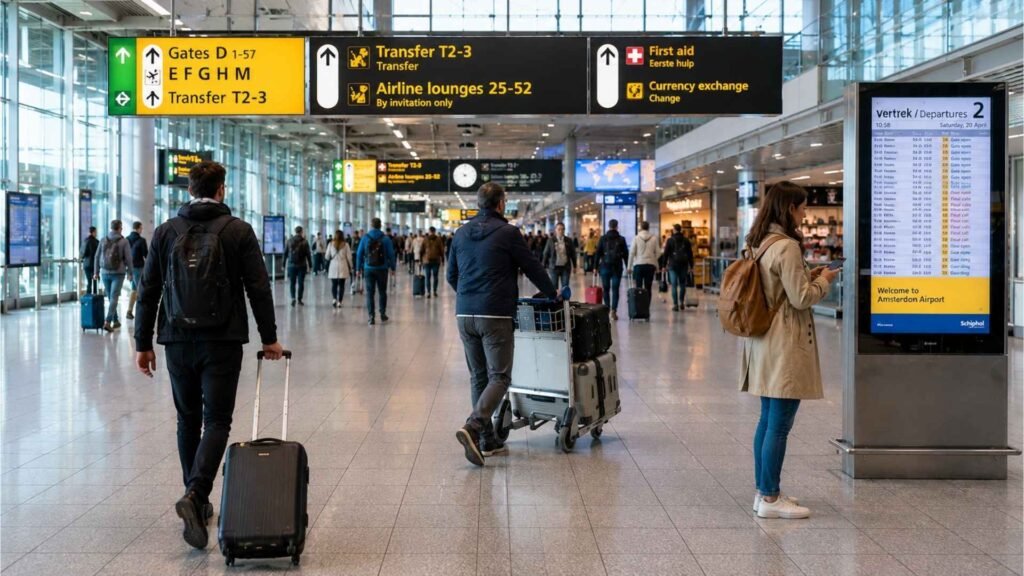
The exact transfer process depends on your route, airline, baggage arrangements, and ticket type.
The following examples illustrate common self-transfer situations at Amsterdam Schiphol Airport.
Scenario 1: Carry-On Luggage Only
New York → Amsterdam
Amsterdam → Rome
If you already have your boarding pass and are traveling with carry-on luggage only, your transfer may be relatively straightforward.
Depending on your itinerary, you may avoid baggage claim and proceed toward your departure gate after completing any required immigration procedures.
Typical transfer time: approximately 3–4 hours.
Scenario 2: Checked Baggage
Toronto → Amsterdam
Amsterdam → Athens
Most passengers in this situation will need to collect checked baggage, clear customs, check in again, drop baggage for the next flight, and pass through security screening before continuing their journey.
Typical transfer time: approximately 4–6 hours.
Scenario 3: Separate Low-Cost Airlines
Istanbul → Amsterdam
Amsterdam → Barcelona
Low-cost carriers frequently require passengers to complete the full arrival and departure process during a self-transfer.
This may include immigration, baggage collection, customs, check-in, baggage drop, and security screening.
Typical transfer time: approximately 5–7 hours.
Is Schiphol a Good Airport for Self-Transfers?
Generally, yes.
Amsterdam Schiphol Airport is considered one of Europe’s more self-transfer-friendly airports because:
- It operates within a single terminal complex
- Walking distances are generally manageable
- Signage is clear and multilingual
- International flight options are extensive
- Transfer facilities are well organized
However, even a well-designed airport cannot eliminate the risks associated with separate-ticket travel.
Adequate connection time remains the most important factor.
Before Booking a Self-Transfer at Schiphol
Before purchasing separate tickets, review the following checklist.
✔ Verify whether checked baggage can be transferred
✔ Confirm visa and entry requirements
✔ Check whether immigration procedures apply
✔ Allow realistic connection times
✔ Consider possible EES-related delays
✔ Review airline check-in deadlines
✔ Consider travel insurance options
Self-transfers can offer lower fares and greater flexibility, but they also place more responsibility on the traveler.
A few minutes of planning can help avoid costly disruptions later.
Frequently Asked Questions
What is a self-transfer at Amsterdam Schiphol Airport?
A self-transfer means you booked separate flight tickets and may be responsible for collecting baggage, checking in again, and completing airport formalities yourself.
Do I need to collect my baggage during a self-transfer at Schiphol?
Often yes. Separate tickets frequently require baggage collection and re-checking, although exceptions may exist with certain airline partnerships.
How much time do I need for an Amsterdam Schiphol self-transfer?
Most travelers should allow at least 4–6 hours if checked baggage is involved. First-time EES registration may require additional time.
Can I stay airside during a self-transfer?
Possibly. This depends on your itinerary, baggage arrangements, boarding passes, and airline policies.
Is Amsterdam Schiphol Airport good for self-transfers?
Yes. Schiphol’s single-terminal layout, clear signage, and efficient design make it one of the easier major European airports for self-transfer passengers.
What happens if I miss my second flight during a self-transfer?
With separate tickets, airlines generally do not provide missed-connection protection. You may need to purchase a new ticket at your own expense.
Is carry-on luggage better for a self-transfer?
Yes. Traveling with carry-on luggage only can simplify the transfer process and may reduce the amount of time required between flights.
Final Thoughts
An Amsterdam Schiphol self-transfer can be straightforward when planned correctly.
The most important considerations are baggage handling, immigration procedures, customs requirements, and realistic connection times.
If your flights are booked separately, always assume additional airport procedures may be necessary unless your airline explicitly confirms otherwise.
Allowing extra time is usually far less expensive than missing an onward flight.
Continue Planning Your Schiphol Trip
→ Amsterdam Schiphol Airport Guide
→ Amsterdam Schiphol Arrival Guide
→ Amsterdam Schiphol Transit Guide
→ Amsterdam Schiphol Fast Track Guide (Coming Soon)
→ Amsterdam Schiphol Lounges Guide (Coming Soon)