
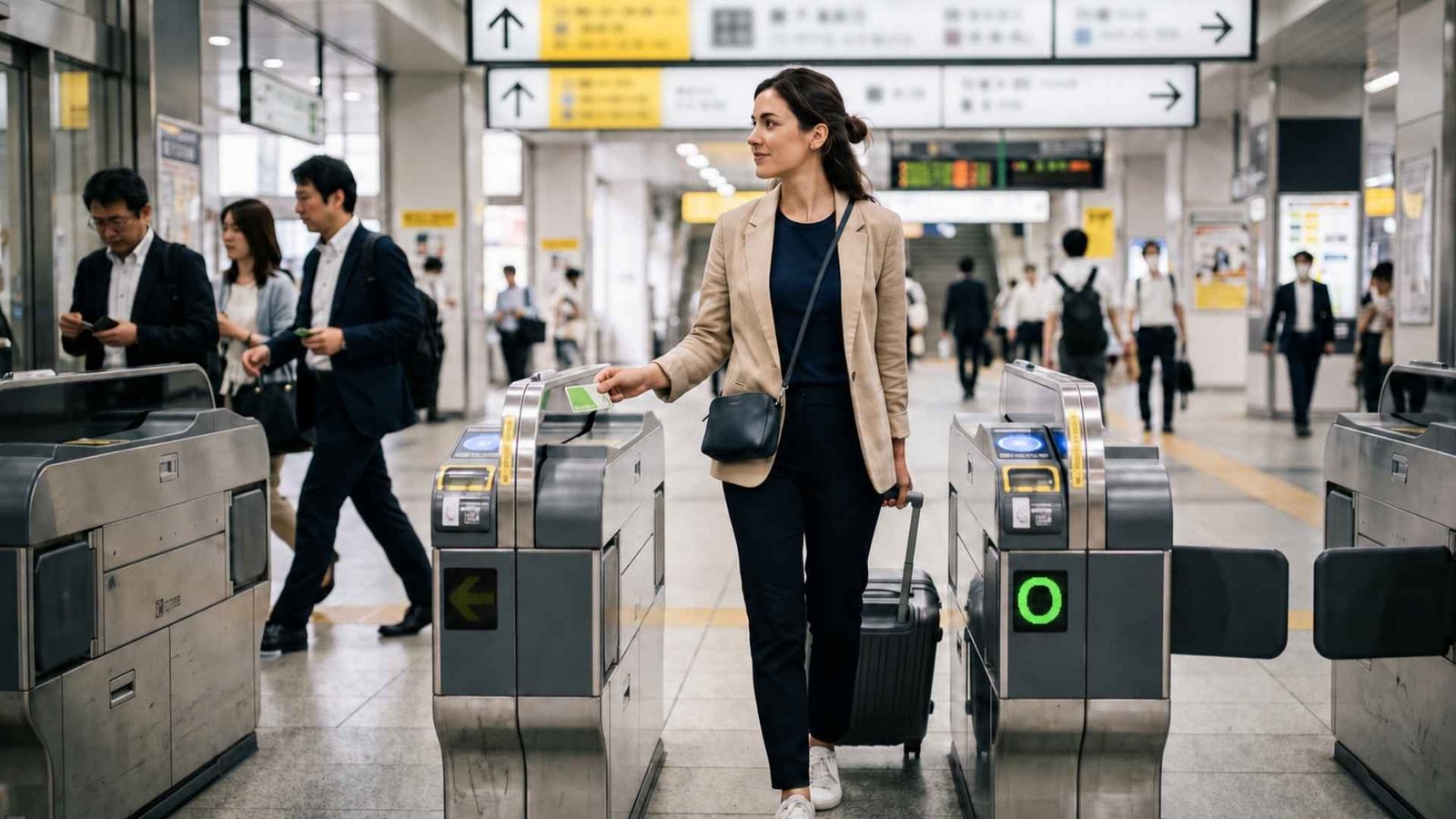
A Japan IC Card makes local travel easier by letting you tap in and out of trains, subways, and buses instead of buying a separate ticket for every journey.
Suica, PASMO, and ICOCA work across most major participating networks, so the easiest card to obtain is usually the best choice. This Japan IC Card guide compares standard, tourist, and digital options and explains where to buy them, how much to load, where they work, and when you need a separate ticket.
Quick Answer: Which Japan IC Card Should You Get?
For most travelers, the best Japan IC Card is the one most convenient to buy where the trip begins.
| Starting Point or Situation | Best Practical Choice |
|---|---|
| Tokyo, Narita Airport, or Haneda Airport | Suica, PASMO, Welcome Suica, or TOURIST PASMO |
| Osaka, Kyoto, or Kansai International Airport | ICOCA |
| Compatible iPhone or Apple Watch | Digital Suica, PASMO, or ICOCA |
| Visitor-focused iPhone option | Welcome Suica Mobile |
| Overseas Android phone | A physical IC card is usually safest |
| Trip shorter than 28 days | Regular or tourist card |
| Trip longer than 28 days | Regular physical card or compatible digital card |
| Returning to Japan in the future | Regular card |
| Traveling with children | Separate physical child card for each child |
Suica, PASMO, and ICOCA provide almost the same everyday experience for an international visitor. They can be used on most major participating trains, subways, buses, and electronic-payment terminals across Japan.
However, a Japan IC Card does not automatically cover Shinkansen journeys, reserved seats, limited-express supplements, or every rural transport operator. Separate tickets may still be required.
What Is a Japan IC Card?
A Japan IC Card is a rechargeable contactless smart card used to pay for everyday transportation and selected purchases in Japan.
Instead of buying a separate paper ticket for each local journey, you tap the card at the entry gate and tap again when leaving. The appropriate fare is automatically deducted from the stored balance.
Major cards include Suica, PASMO, and ICOCA, along with several regional alternatives. Most leading cards participate in Japan’s nationwide mutual-use system, allowing visitors to use one card across many compatible networks outside the card’s original region.
An IC card simplifies payment, but it does not replace every ticket. Certain journeys—including Shinkansen travel, limited-express services, and routes outside participating IC areas—may require an additional ticket, reservation, or different payment method.
Suica vs PASMO vs ICOCA at a Glance
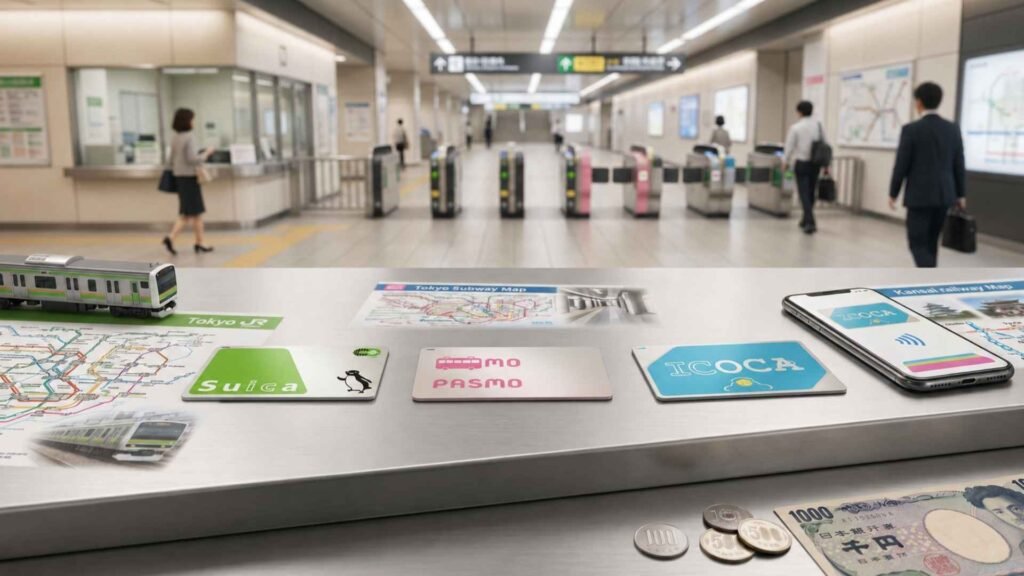
Suica, PASMO, and ICOCA are issued by different transport organizations, but they belong to Japan’s nationwide mutual-use network.
| Feature | Suica | PASMO | ICOCA |
|---|---|---|---|
| Main region | Tokyo and eastern Japan | Tokyo and surrounding areas | Osaka, Kyoto, and western Japan |
| Main issuer | JR East | PASMO member operators | JR West |
| Regular physical card deposit | ¥500 | ¥500 | ¥500 |
| Digital option | Yes | Yes | Yes |
| Typical starting point | Tokyo | Tokyo | Kansai |
| Nationwide mutual use | Yes, on participating networks | Yes, on participating networks | Yes, on participating networks |
| Local trains, subways, and buses | Yes | Yes | Yes |
| Shopping and vending machines | Yes | Yes | Yes |
| Ordinary Shinkansen fare included | No | No | No |
The biggest practical difference is usually where the card is issued, purchased, returned, replaced, or serviced—not where you can use it during an ordinary multi-city trip.
Suica
Suica is issued by JR East and is most closely associated with Tokyo and eastern Japan.
It is widely used on JR East trains, Tokyo Metro, Toei Subway, private railway lines, buses, shops, and other compatible services. Regular physical Suica cards normally include a ¥500 deposit, while digital Suica can be added to compatible Apple devices.
Visitors may also encounter Welcome Suica, the deposit-free tourist version, and Welcome Suica Mobile, the visitor-focused iOS product.
Suica is a natural choice if you begin in Tokyo, Yokohama, Narita, or Haneda, but it is not inherently better than PASMO for ordinary urban travel.
PASMO
PASMO is associated with Tokyo’s private railway, subway, and bus operators.
For a visitor, it works much like Suica. It can be used on participating JR lines, subways, private railways, buses, and electronic-payment terminals.
Regular PASMO cards normally include a ¥500 deposit. TOURIST PASMO, introduced for international visitors in May 2026, is a separate deposit-free product available at selected sales points at Haneda and Narita airports.
PASMO is convenient if the first railway counter or machine you encounter belongs to a Tokyo subway or private railway operator.
ICOCA
ICOCA is issued by JR West and is the natural choice for travelers beginning in Osaka, Kyoto, Kobe, or elsewhere in the JR West region.
It works on participating JR West services, Osaka Metro, Kyoto-area transport, private railways, buses, and electronic-payment terminals.
Regular ICOCA cards normally include a ¥500 deposit. Digital ICOCA is also available through Apple Wallet on compatible devices.
If you already have a usable Suica or PASMO when you reach Kansai, you do not need to buy ICOCA merely because you have entered its home region.
Which Japan IC Card Should You Choose?
Because nationwide mutual-use coverage is broad, the brand matters mainly when purchasing, returning, replacing, or troubleshooting the card. These procedures are usually handled through the issuer and its home region.
For that reason, choosing the card available where your journey begins is normally the simplest approach.
| Additional Consideration | Best Approach |
|---|---|
| You already own a valid Suica, PASMO, or ICOCA | Continue using it; another regional card is unnecessary |
| Your preferred tourist card is unavailable | Buy another conveniently available interoperable card |
| You want to recover the ¥500 deposit | Choose a regular card and return it in the issuer’s region |
| Your trip ends outside the issuer’s region | Keep the regular card or spend down the balance instead of relying on a refund |
| You expect to return to Japan | Choose a regular physical or compatible digital card |
| You may need card servicing | Choose a card issued in the region where your journey begins |
There is no practical reason to collect several cards during one ordinary trip. Use the same interoperable card across compatible regions and buy a separate ticket only when the journey falls outside the IC system.
If your route is not yet final, start with our Japan Itinerary for First-Time Visitors before deciding which airports, rail products, and local transportation options fit your trip.
Digital Japan IC Cards: Apple Wallet and Android
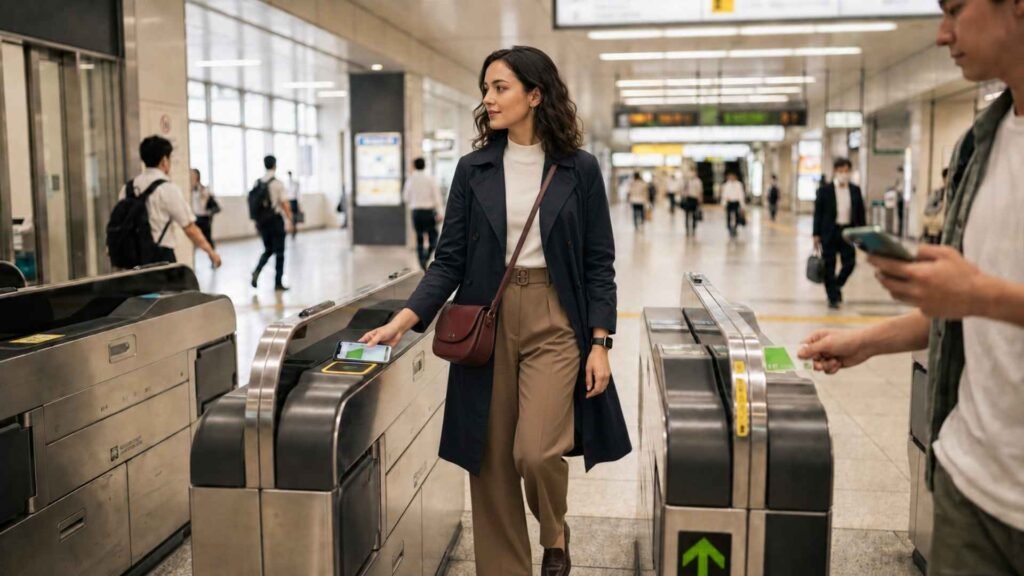
A digital Japan IC Card turns a compatible phone or watch into the card itself. You can tap the device at ticket gates, see the remaining balance, and often add money without using a ticket machine.
Digital cards are especially convenient for visitors who already use Apple Pay. Android compatibility remains more restrictive for phones purchased outside Japan.
Suica, PASMO, ICOCA, and TOICA in Apple Wallet
Apple Wallet supports Suica, PASMO, ICOCA, and TOICA on compatible devices. TOICA is the physical IC card issued by JR Central for central Japan, but its mobile implementation works differently.
According to Apple’s official instructions, you generally need:
- An Apple Account with two-factor authentication
- A compatible iPhone or Apple Watch using supported current software
- An eligible payment card in Apple Wallet
The usual setup process is:
- Open Apple Wallet.
- Tap the plus button.
- Select Transit Card.
- Choose Suica, PASMO, ICOCA, or TOICA.
- Select the initial amount.
- Complete the payment and add the card.
Express Mode is normally activated for the first transit card added. This allows you to tap at compatible gates without opening Wallet or authenticating every journey.
An iPhone 8 or later and Apple Watch Series 3 or later generally meet Apple’s current international-device requirements. Earlier supported models have additional Japan-purchase conditions, so travelers using older devices should check Apple’s compatibility notes.
When a physical TOICA is transferred to Apple Wallet—or TOICA is selected when adding a new card—the device creates an ICOCA (TOICA Model) issued by JR West. If an existing physical TOICA is transferred, its remaining balance and ¥500 deposit move to the newly issued mobile card, and the physical card can no longer be used.
This is a technical arrangement between the two railway companies rather than a change to the physical card. Physical TOICA remains a JR Central product, while ICOCA (TOICA Model) uses JR West’s mobile ICOCA infrastructure.
Even when the device is compatible, the bank may decline the initial payment or a later top-up. Set up and test the card before depending on it, and keep some Japanese yen as a backup.
Welcome Suica Mobile
Welcome Suica Mobile is a separate visitor-focused product from JR East. As of 2026, it is an iOS app that allows eligible users to issue and top up Suica.
Unlike the physical Welcome Suica, which lasts 28 days, Welcome Suica Mobile is valid for 180 days from issue. It requires no deposit and can be used for participating transportation and electronic-money purchases.
The app can be downloaded before travel. However, JR East notes that issuing or topping up the card may be restricted in some countries. If setup does not work at home, try again after arriving in Japan.
As of 2026, travelers should treat Welcome Suica Mobile as an iOS-only option. As detailed in JR East’s Samsung partnership announcement, JR East plans to expand the service during the first half of 2027 to eligible Samsung Galaxy smartphones sold overseas from 2027 onward. Supported models and regions have not yet been announced, so international Android travelers visiting Japan in 2026 should still plan to use a physical IC card.
Can You Use an IC Card on an Overseas Android Phone?
Some Android devices can support Japanese transit cards, but the phone must provide the necessary Japanese FeliCa or Osaifu-Keitai functionality.
Many Android phones sold outside Japan do not include this compatibility, even when they support normal NFC contactless payments and Google Wallet.
Do not assume your phone will work simply because it supports contactless bank cards. Check the exact device model and sales region before travel.
For most international Android users visiting Japan in 2026, a physical Suica, PASMO, ICOCA, Welcome Suica, or TOURIST PASMO remains the dependable option.
Physical or Digital: Which Is Better?
Choose digital if:
- Your device is compatible
- Your payment card can complete top-ups
- You want to see the balance on your phone
- You prefer not to visit ticket machines for every recharge
- You are comfortable depending on your device
Choose physical if:
- You use an incompatible Android phone
- You are traveling with children
- You prefer a platform-independent card
- You do not want transport access tied to battery power
- Your overseas bank card fails during digital setup
A digital card is not automatically cheaper. Its main advantages are convenience, visible balance information, and remote top-ups.
Tourist IC Cards in Japan
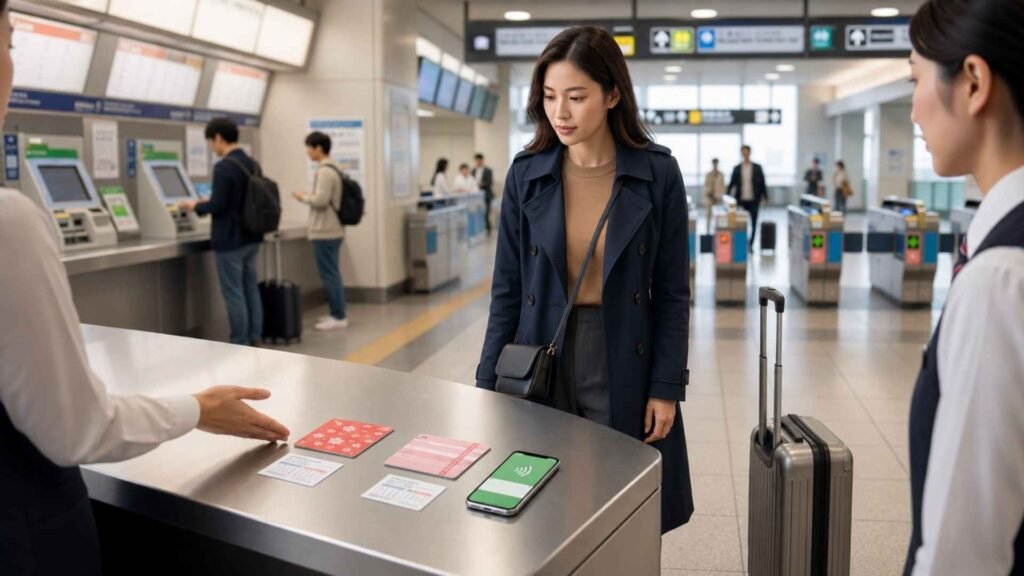
Tourist IC cards remove the standard ¥500 deposit. Physical versions can be kept as souvenirs, while all three options have fixed validity periods and do not refund ordinary unused stored value.
| Tourist Card | Format | Validity | Deposit | Balance Refund | Main Purchase or Setup Option |
|---|---|---|---|---|---|
| Welcome Suica | Physical | 28 days from purchase | None | No | Selected JR East centers and machines |
| TOURIST PASMO | Physical | 28 days from purchase | None | No | Selected Haneda and Narita locations |
| Welcome Suica Mobile | iOS app | 180 days from issue | None | No | Compatible iPhone through the visitor app |
Welcome Suica
Welcome Suica is designed for temporary visitors and works like an ordinary stored-value card during its validity period.
The entire purchase amount becomes usable stored value because there is no deposit. JR East currently lists selected travel service centers and vending machines at airports and major stations.
Check the official Welcome Suica purchase page before depending on a specific counter because availability and sales locations can change.
The 28-day validity period includes the purchase date and begins immediately—not with the first journey. The card becomes invalid on the 29th day.
Keep the reference paper issued with the card. It shows the expiration date and other important information and may be requested by station staff.
TOURIST PASMO
TOURIST PASMO became available on May 20, 2026, for international visitors. It lasts 28 days from the date of purchase, requires no deposit, and can be topped up during its validity period.
According to the official TOURIST PASMO information, the initial sales network includes selected locations operated by Keikyu at Haneda Airport and Keisei at Narita Airport.
At Narita, the announced purchase price is ¥2,000. Haneda offers multiple values between ¥1,000 and ¥10,000, depending on the sales point. The full purchase amount becomes available as stored value.
Keep the reference paper because it confirms the card’s expiration date, adult or child category, and other product information.
What Happened to PASMO PASSPORT?
PASMO PASSPORT was the previous tourist version of PASMO, but sales ended in 2024.
Travelers researching IC cards may still find older articles recommending it. For a current short-term visitor product in 2026, look for TOURIST PASMO instead.
Where to Buy a Japan IC Card
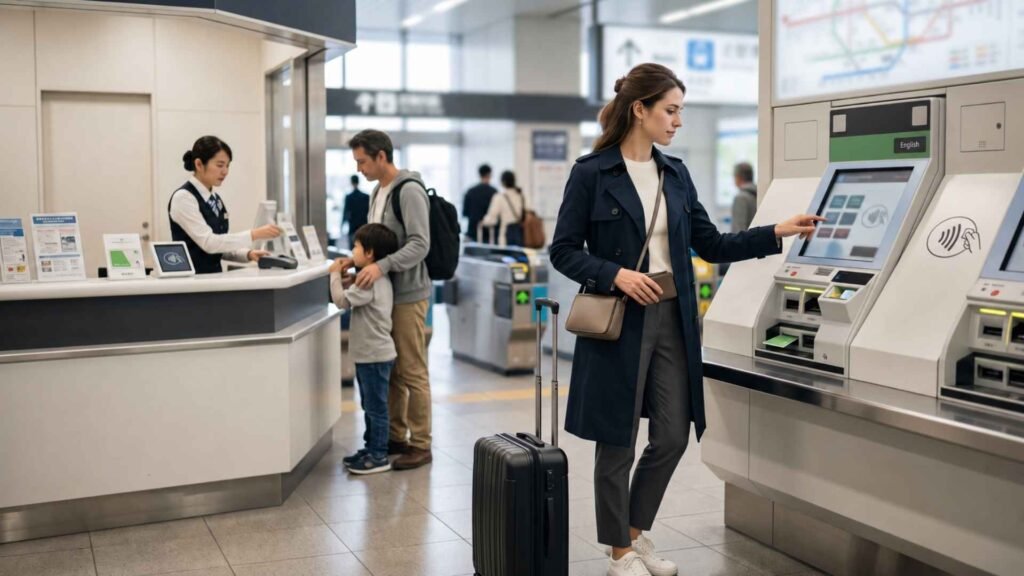
Purchase options depend on the card, station, operator, and region. English-language menus are common at major airport and city stations.
Narita Airport
Welcome Suica is available through selected JR East facilities and dedicated machines at Narita Airport Terminal 1 Station and Narita Airport Terminal 2・3 Station.
TOURIST PASMO is sold through selected airport sales points associated with participating PASMO operators.
Availability can vary by terminal and machine. Use a staffed counter if you need a child card or cannot find the product you intended to purchase.
Haneda Airport
Welcome Suica is available at specified JR East and Tokyo Monorail facilities in Haneda Airport Terminal 3.
TOURIST PASMO is sold through selected Keikyu ticket machines and sales points at Haneda’s passenger terminals.
If you are tired after a long flight or cannot find the card you want, buy a single airport ticket and obtain a regular Suica or PASMO later at a major station in Tokyo.
Tokyo Stations
Standard Suica cards are associated with JR East stations, while standard PASMO cards are issued through participating subway and private railway operators.
Major ticket machines usually provide English menus, but the exact cards available from each machine can vary.
Use a staffed counter when purchasing a child card, registering a personalized card, or resolving an availability problem.
Kansai International Airport, Osaka, and Kyoto
ICOCA is the natural option for travelers beginning in the JR West region. It is available from eligible ticket machines and JR ticket offices at major stations and gateways serving Osaka and Kyoto.
If you already have a functioning Suica, PASMO, or another interoperable card, you can continue using it on participating Kansai transportation instead of purchasing ICOCA.
Other Regions
Other regional cards include:
- Kitaca in Hokkaido
- TOICA, the JR Central IC card used primarily in central Japan
- manaca in the Nagoya area
- SUGOCA in parts of Kyushu
- nimoca in western Japan and Kyushu
- Hayakaken in Fukuoka
- Several smaller regional cards
Many participate in the nationwide mutual-use network. Purchase the interoperable card offered at your starting station, but check individual coverage when using rural railways, local buses, or smaller transport operators.
How to Use a Japan IC Card
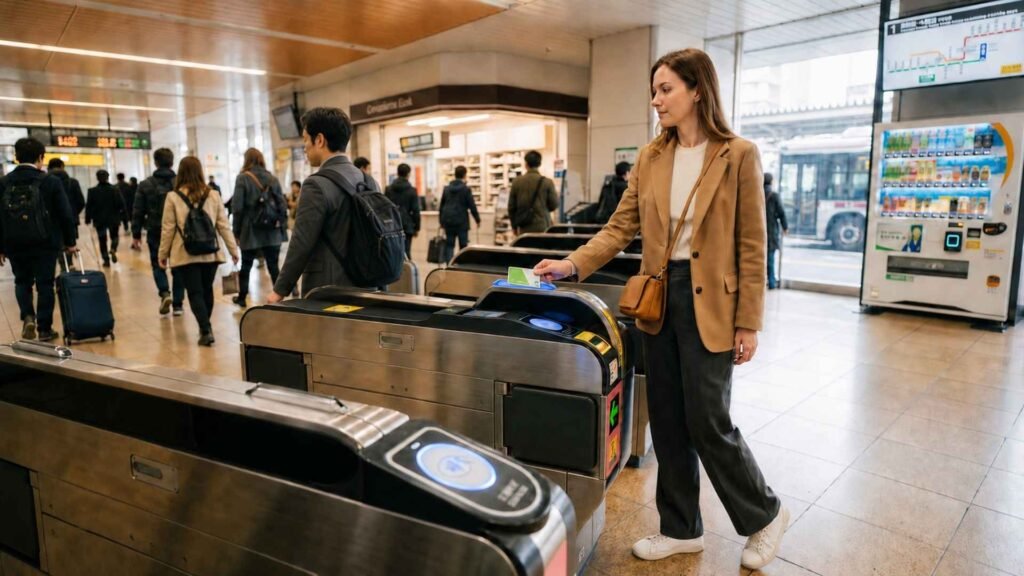
Using a Japan IC Card is straightforward, but a few basic habits prevent most gate problems.
On Trains and Subways
Touch the physical card or the top of your phone to the illuminated IC reader at the ticket gate.
Wait for the confirmation sound and screen response before walking through.
At the destination, tap the same card or device again. The system calculates the fare and deducts it from the stored balance. The gate display usually shows the fare charged and the remaining balance.
Always enter and exit with the same card. If you enter using a physical Suica and attempt to exit with a digital PASMO, the system will record two incomplete journeys.
On Buses and Trams
The procedure varies by operator.
Some buses require you to tap when boarding and again when leaving. Others charge a flat fare and require only one tap.
Watch the signs near the reader and follow the behavior of local passengers. When unsure, show the card to the driver before tapping.
In Shops, Restaurants, and Vending Machines
Look for the nationwide IC symbol or a Suica, PASMO, ICOCA, or compatible electronic-money logo.
At a staffed counter, tell the employee you want to pay by IC card, then tap when the terminal is ready.
At a vending machine, select the item and touch the card to the reader when prompted.
Some businesses do not permit split payment between the IC balance and cash or another card. Make sure the stored value covers the full purchase or ask before tapping.
Where Can You Use a Japan IC Card?
A Japan IC Card is most useful for short and medium local journeys within participating IC areas.
Common uses include:
- JR local and rapid trains
- Tokyo Metro and Toei Subway
- Osaka Metro and participating Kansai railways
- Private railway lines displaying the IC symbol
- Local buses and trams
- Airport urban rail services accepting ordinary IC fares
- Convenience stores and station kiosks
- Vending machines
- Selected coin lockers
- Some restaurants, cafés, supermarkets, pharmacies, taxis, and attractions
Acceptance is extensive in Tokyo, Yokohama, Osaka, Kyoto, Kobe, Nagoya, Fukuoka, Sapporo, and many other urban destinations.
The safest rule is visual: look for the nationwide mutual-use IC logo or a familiar card logo. Do not assume every rural station, transport company, or business accepts it.
Where Can’t You Use a Japan IC Card?
The nationwide mutual-use system connects many local networks, but it is not one continuous fare zone covering every railway line in Japan.
Shinkansen Without the Required Ticket or Setup
Stored value on an ordinary IC card does not automatically replace a standard Shinkansen ticket.
You normally need to purchase the required fare and limited-express product or complete a supported ticketless reservation.
For example, the official SmartEX service allows eligible Tokaido, Sanyo, and Kyushu Shinkansen reservations to be linked to a registered IC card. The card then works as the gate credential; the Shinkansen journey is covered by the reservation rather than being treated as an ordinary local IC fare.
Some JR East services also support limited forms of IC or app-based Shinkansen boarding on eligible routes. These are specific ticketless systems with their own registration, train, and route conditions—not universal stored-value access to every Shinkansen.
Limited Express and Premium Services
On many limited-express trains, airport express services, reserved-seat trains, and Green Car journeys, the IC card may cover only the ordinary base fare.
You must also buy the required limited-express, reserved-seat, or premium ticket.
The fact that a ticket gate accepts your card does not automatically give you the right to occupy a reserved or premium seat.
Continuous Travel Between Separate IC Areas
You generally cannot begin a conventional-line journey in one IC area and cross into a separate area as one uninterrupted stored-value trip, even when both ends independently accept the same card.
For long interregional travel, buy the correct paper or digital ticket in advance.
A card working for local transportation in both Tokyo and Sendai does not necessarily mean it can pay for one continuous conventional-line journey between the two cities.
Rural Railways and Buses Without IC Readers
Some rural railways, remote buses, community transport services, and unstaffed stations accept only:
- Cash
- Paper tickets
- Local transport cards
- Advance bookings
- Operator-specific mobile tickets
Carry some Japanese yen when traveling outside major urban areas. An IC card reduces the need for cash but should not eliminate your backup.
Purchases Above the Stored Balance
The maximum stored balance is generally ¥20,000.
A Japan IC Card is therefore unsuitable for expensive purchases. In addition, many merchants cannot combine a partial IC payment with another payment method.
How Much Money Should You Load?
The ideal starting balance depends on how frequently you plan to use local transportation and whether you will also use the card for small purchases.
| Travel Situation | Suggested Starting Balance |
|---|---|
| Airport arrival and a few local journeys | ¥2,000–¥3,000 |
| Several days of regular city transportation | Approximately ¥5,000 |
| Longer or multi-city trip | Start with ¥5,000 and recharge as needed |
These figures are starting points rather than complete transportation budgets. Intercity trains, Shinkansen journeys, airport express services, and reserved-seat trains may require separate tickets or supplementary fares.
Loading smaller amounts also makes it easier to avoid leaving Japan with a large unused balance—especially when using a tourist card that does not refund ordinary stored value.
Clara’s Tip
Check your balance when passing through a ticket gate and recharge before it becomes too low for your next journey. Smaller, occasional top-ups make the remaining balance easier to manage near the end of the trip.
How to Top Up and Check the Balance
Physical cards can be recharged at compatible ticket machines and fare-adjustment machines. Many convenience stores and Seven Bank ATMs also support cash top-ups for major IC cards.
The usual ticket-machine process is:
- Select the English-language option.
- Choose Charge or Top Up.
- Insert or place the card as shown.
- Select the amount.
- Insert Japanese yen.
- Take the card and receipt.
Physical Suica, PASMO, ICOCA, and visitor cards are commonly recharged with cash. Do not assume every machine will accept an overseas credit card for a physical-card top-up.
Digital cards in Apple Wallet can be topped up with an eligible credit, debit, or prepaid card already stored in Wallet. Compatibility depends on the issuing bank and card network, so individual transactions can still fail.
You can normally check the balance:
- On the ticket-gate display
- At a compatible ticket machine
- Through Apple Wallet for a digital card
- Through the relevant card app
- On some transaction receipts
If the balance is too low when you try to leave a station, use a fare-adjustment machine or ask station staff for help. Add enough money to complete the journey, then exit using the same card used when entering.
Japan IC Card vs Japan Rail Pass
A Japan IC Card and the Japan Rail Pass solve different transportation problems. Some travelers benefit from having both.
| Feature | Japan IC Card | Japan Rail Pass |
|---|---|---|
| Payment model | Pay as you go | Fixed price for a validity period |
| Main purpose | Local transportation and small purchases | Eligible JR trains and selected Shinkansen |
| Private railways and city subways | Often accepted | Usually not covered |
| Seat reservations | Not included with ordinary stored value | Available on eligible covered trains |
| Shopping | Often accepted | Not a payment card |
| Best for | Everyday local movement | Routes with enough covered long-distance JR travel |
If you have a Japan Rail Pass, use it for eligible JR journeys and your IC card for subways, buses, private railways, and other transportation outside the pass.
Do not automatically tap your IC card when a journey is covered by the rail pass. Use the correct pass gate or ticket so that an unnecessary local fare is not deducted.
The nationwide pass is not automatically good value for every Tokyo–Kyoto–Osaka itinerary. Our Japan Rail Pass guide explains current prices, eligible trains, seat reservations, and the routes where the pass may still make financial sense.
Japan IC Card vs Tokyo Subway Ticket
A Japan IC Card offers flexible pay-as-you-go travel across different operators.
The Tokyo Subway Ticket provides unlimited rides for a fixed period but only covers Tokyo Metro and Toei Subway lines.
The official tourist product is available for 24, 48, or 72 hours. It does not cover JR lines such as the Yamanote Line or every private railway serving Tokyo.
Choose an IC card when your day combines JR, subway, private railway, bus, and walking journeys.
Consider the official Tokyo Subway Ticket when you expect to make many Metro and Toei journeys during a concentrated sightseeing period.
You can use both products during the same trip: the subway ticket for covered journeys and the IC card for everything outside its network.
IC Cards for Children and Families
Every fare-paying traveler needs a separate card.
Passing one physical card between family members will not work because the card holds an open entry record until that passenger exits.
Child IC cards automatically deduct eligible child fares. Because they are age-verified, a passport or another accepted form of official identification is normally required during purchase.
Welcome Suica and TOURIST PASMO both offer child-card provisions. The purchase method may differ between ticket machines and staffed counters.
For many families, physical cards are easier than setting up digital cards across several devices.
Keep each person’s card separate so everyone consistently uses the correct one. Card sleeves can be labeled discreetly, but avoid covering the card number or damaging the surface.
Refunds, Expiration, and Lost Cards
Refund and replacement rules depend on the card type and issuer.
Regular Physical Cards
Standard Suica, PASMO, and ICOCA cards normally include a ¥500 deposit.
When the card is returned to the correct issuer in its home region, the deposit can usually be refunded. If stored value remains, an administrative fee of up to ¥220 may be deducted according to the issuer’s rules.
One practical approach is to spend down the balance at a convenience store and then return the nearly empty card if recovering the ¥500 deposit matters to you.
Return the card before leaving its issuing region:
- Suica through JR East
- PASMO through an eligible PASMO operator
- ICOCA through JR West
If you plan to return to Japan, keeping a regular card is often more convenient than processing a small deposit refund.
Tourist Cards
Welcome Suica, TOURIST PASMO, and Welcome Suica Mobile have no deposit to recover.
Their ordinary remaining balance is non-refundable and expires with the product. Use the final amount for transportation, a convenience-store purchase, or a vending machine before the validity period ends.
Some retailers do not accept split payments, so choose an item costing no more than the remaining balance or ask about payment options first.
Lost Cards
Anonymous physical cards are generally not replaceable when lost.
Personalized cards may offer reissue procedures, but these can require identification, fees, and waiting periods that are impractical for a short visit.
Tourist cards such as Welcome Suica and TOURIST PASMO also cannot normally be reissued when lost. Treat the card like cash and keep it in a secure wallet.
Digital cards may provide account-based recovery or device-transfer options, depending on the product, device, and account. Protect the phone with a passcode and make sure you can access the associated Apple Account.
Common Japan IC Card Mistakes to Avoid
Using Different Cards to Enter and Exit
If you enter with one card but try to exit with another, the gate will not be able to complete the journey correctly.
Do not continue tapping different cards. Visit the staffed gate, show the attendant the cards or devices involved, and explain where you entered. The attendant can correct the journey record and collect any outstanding fare.
Keeping Several Contactless Cards Against the Reader
A wallet containing multiple transport or payment cards can produce a read error or charge the wrong card.
Remove the Japan IC Card you want to use or keep only one active contactless card close to the reader.
Relying Only on a Phone
Digital cards are extremely convenient, but a lost, damaged, or uncharged phone can complicate the journey.
Express Mode may continue working with power reserve on some iPhone models, but you should still carry backup cash and know which transit card is currently active.
Assuming an IC Card Replaces Route Planning
The card simplifies payment, not navigation.
You still need to choose the correct operator, station, platform, train type, and destination. Check whether the route requires a limited-express ticket, reservation, or another supplementary product before boarding.
Best Japan IC Card Strategy for a First Trip
For most first-time visitors, the best strategy is straightforward:
- Obtain one card for each traveler.
- Choose the card easiest to purchase at your arrival airport or first major station.
- Add a modest starting balance and recharge when needed.
- Use the card for ordinary local trains, subways, buses, and small purchases.
- Check whether premium or long-distance journeys require an additional ticket or reservation.
- Carry some Japanese yen for rural transportation and unexpected payment problems.
- Spend down the remaining value on a non-refundable tourist card before it expires.
Travelers following a two-week route through Tokyo, Kyoto, Osaka, Nara, and Hiroshima can use the same interoperable card for a large share of their local transportation.
Our Japan Itinerary for 14 Days shows how local IC payments, individual intercity tickets, and rail passes can fit into one complete route.
FAQ About Japan IC Cards
Do Tourists Need a Japan IC Card?
A Japan IC Card is not mandatory, but it is highly recommended for most independent travelers.
It saves time on local trains, subways, buses, and small purchases by reducing the need to calculate individual fares or buy a separate paper ticket for every journey.
Which IC Card Is Best for Japan?
There is no single best card for every visitor.
Suica or PASMO is the most practical choice when starting in Tokyo, while ICOCA is convenient for travelers beginning in Osaka, Kyoto, or elsewhere in the JR West region. Because the major cards are widely interoperable, the simplest option is usually the card available at your arrival airport or first major station.
Can I Use Suica, PASMO, or ICOCA Across Japan?
Yes, these cards can be used across many participating transportation networks throughout Japan.
For example, you can use ICOCA on compatible transport in Tokyo and Suica or PASMO on compatible networks in Osaka and Kyoto. However, nationwide interoperability does not mean every rural operator is covered or that you can make one continuous conventional-line journey across separate IC areas.
Can One IC Card Be Used by Two People?
No. Each traveler needs a separate card.
An entry record remains open on the card until that passenger exits, so one card cannot be used to process two simultaneous journeys through a ticket gate. Children who qualify for reduced fares should have their own age-verified child card.
Can I Use an IC Card on the Shinkansen?
An ordinary IC card balance does not automatically cover Shinkansen travel.
You need the appropriate Shinkansen ticket or a supported ticketless reservation. Services such as SmartEX allow eligible reservations to be linked to a registered IC card, but the card then acts as the gate credential rather than paying the Shinkansen fare from its ordinary stored balance.
How Much Should I Put on My IC Card?
A starting balance of approximately ¥2,000–¥5,000 is suitable for most visitors.
Around ¥2,000–¥3,000 may cover an airport arrival and the first local journeys, while ¥5,000 is more convenient for several days of regular city transportation. Recharge as needed instead of loading your entire transportation budget at once.
Can I Top Up a Physical IC Card With a Credit Card?
Physical IC cards are generally recharged with Japanese yen at compatible ticket machines, convenience stores, and supported ATMs.
Some machines may accept a credit card for the initial purchase of a particular card, but this does not mean credit cards will be accepted for later top-ups. Credit-card recharging is more widely available for digital cards, although compatibility depends on the device, bank, and card network.
Does a Japan IC Card Save Money?
The main advantage of a Japan IC Card is convenience rather than a significant fare discount.
It deducts the applicable pay-as-you-go fare for each journey. A subway ticket, day pass, regional pass, or Japan Rail Pass may offer better value when your planned journeys fit its coverage and break-even point.
Do Japan IC Cards Expire?
Physical Welcome Suica and TOURIST PASMO expire 28 days after purchase, while Welcome Suica Mobile is valid for 180 days from issue.
Regular Suica, PASMO, and ICOCA cards are intended for longer-term reuse and do not have the short validity period applied to tourist cards. However, they remain subject to the inactivity and validity rules of their respective issuers.
Can I Use an IC Card From a Previous Japan Trip?
Often, yes. A regular Suica, PASMO, or ICOCA can usually be used again if it remains valid and undamaged.
Check the remaining balance at a compatible ticket machine after arriving. Expired tourist cards, including Welcome Suica and TOURIST PASMO, cannot be reactivated for a future trip.
Can I Use a Japan IC Card Without Internet?
A physical Japan IC Card does not require internet access.
A digital card can also normally be tapped at compatible gates and payment terminals without an active data connection. However, initial setup, top-ups, account recovery, reservations, and certain app features may require internet access.
Is Welcome Suica or TOURIST PASMO Better?
The two physical tourist cards are very similar for an ordinary short visit.
Both are valid for 28 days, require no deposit, work across participating nationwide transportation networks, and do not provide refunds for unused stored value. Choose whichever is easier to purchase when you arrive, as neither offers a major advantage for everyday tourist travel.
Final Thoughts
For most visitors, the best Japan IC Card is the one that is easy to obtain and works reliably throughout their everyday travel.
Choose one card per traveler, maintain a manageable balance, and check separately whether premium or long-distance journeys require another ticket. This simple approach removes much of the friction from using transportation across Japan.