
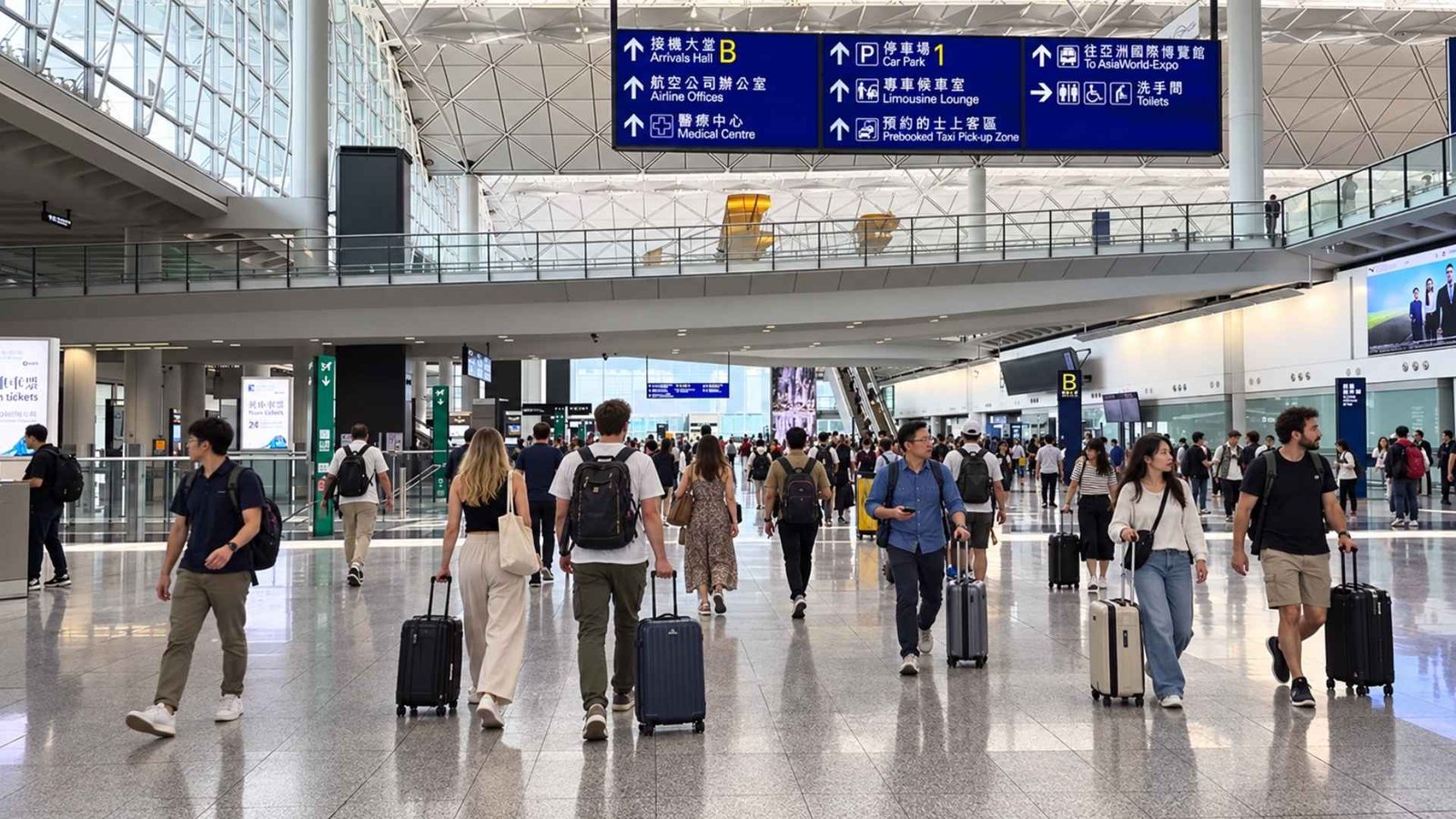
Your Hong Kong airport arrival starts with one important decision: are you entering Hong Kong, connecting to another flight, or taking an airside SkyPier transfer? For travellers heading into the city, the route is straightforward: follow the arrival signs to Terminal 1 immigration, collect your bags and pass through customs.
This guide walks you through those steps, then helps you organise mobile data, payment and transport to your accommodation. It also explains the details that can cause confusion, including Terminal 2, arrival cards and the different Octopus cards sold at the airport.
Hong Kong Airport Arrival: Quick Answer
Use this table to choose the right route before leaving your arrival gate.
| Your situation | What to do next | Key detail |
|---|---|---|
| You are entering Hong Kong | Follow Arrivals and Immigration signs. | Passenger arrival processing remains in Terminal 1 as of October 2026. |
| You have an onward flight | Follow your airline’s transfer instructions. | Collecting bags or checking in again may require entry into Hong Kong. |
| You have an eligible SkyPier ferry or transfer coach connection | Go to the relevant counter at Transfer Area E2. | Stay airside and follow the service’s baggage arrangements. |
| You have only cabin baggage | Clear immigration, then continue towards customs. | You can skip the carousel, but customs rules still apply. |
| You leave arrivals after the last Airport Express | Use a suitable night bus, taxi or arranged transfer. | The train does not operate throughout the night. |
1. Follow the Arrival Route from Your Gate
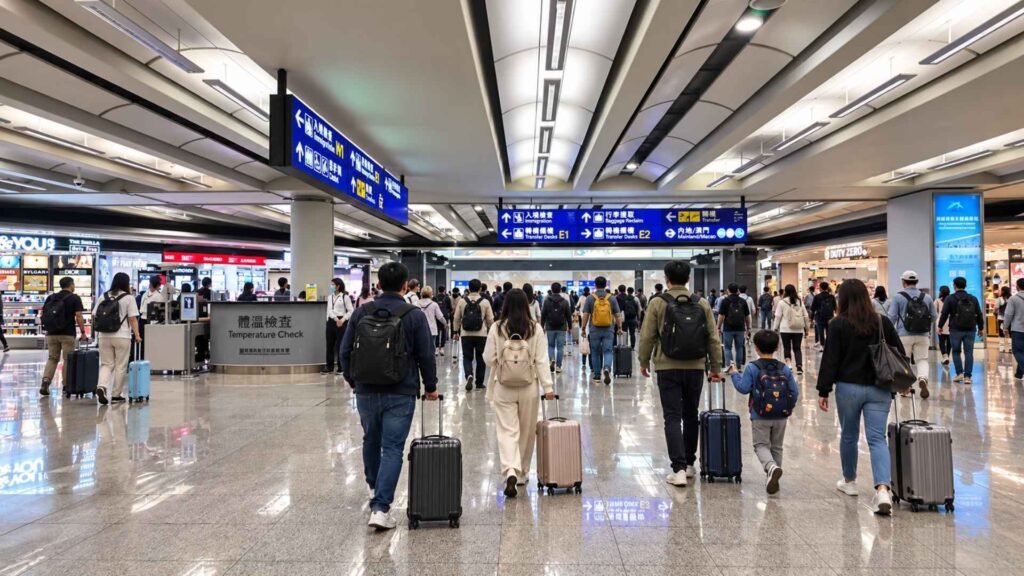
Once you leave the aircraft, keep your passport accessible and follow the overhead arrival signs. The distance to immigration depends on where your aircraft parks, so your route may include a longer walk or an internal airport connection.
Arrival immigration is on Level 5 of Terminal 1. Depending on your gate, signs may direct you towards the Automated People Mover, or APM. Follow the marked route to the APM platform and continue towards immigration after the ride.
The APM connects areas within the airport. It is separate from the Airport Express, which takes passengers towards the city after they have completed arrival formalities.
Does Terminal 2 Change Where You Arrive?
Terminal 2’s passenger departure facilities opened on 27 May 2026. However, as of October 2026, the normal passenger arrival process remains in T1.
Your airline may use T2 for departure check-in without changing where you clear immigration on arrival. Follow the arrival signs from your gate rather than heading towards a terminal listed for your return flight.
Taking a SkyPier Connection?
For an eligible SkyPier ferry or transfer coach connection to Macao or mainland China, go to the appropriate counter at Transfer Area E2 before immigration. Keep your onward booking and airline baggage-tag receipt ready, and follow the operator’s baggage instructions. Once you enter Hong Kong through immigration, you cannot return to the airside counter to use that service.
2. Clear Hong Kong Immigration
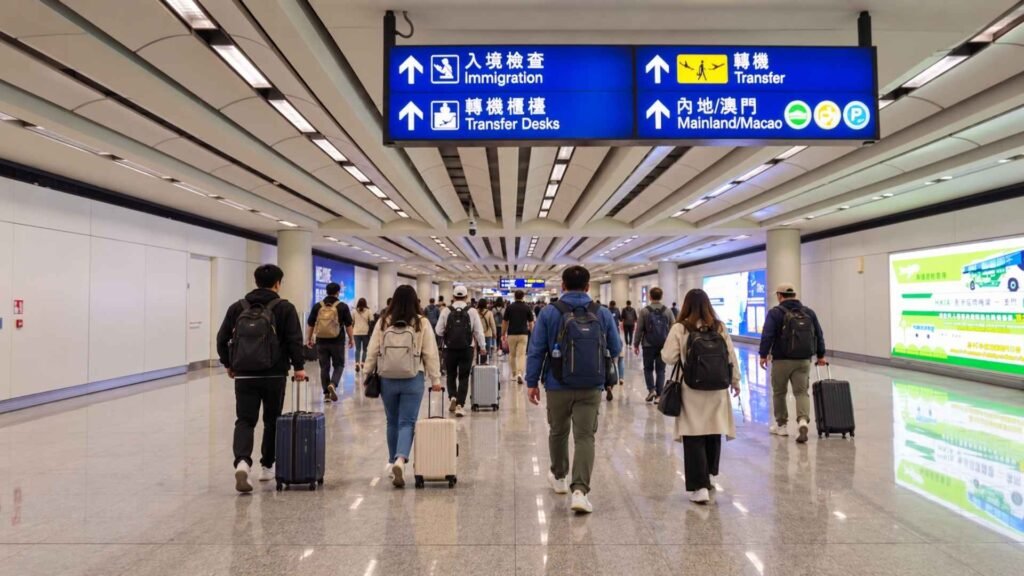
At immigration, join the lane appropriate to your travel document and eligibility. For a first visit, use the staffed visitor counters unless staff direct you to an automated channel.
Hong Kong has its own entry arrangements, separate from mainland China. Your nationality and travel document determine whether you need a visa, entry permit or pre-arrival registration. The Hong Kong Immigration Department’s entry requirements explain the conditions that apply to different visitors.
Have Your Documents Ready
Keep the following together in your cabin bag or in an offline folder on your phone:
- Your valid passport or other accepted travel document.
- Any visa, entry permit or pre-arrival registration required for your visit.
- Your accommodation name, address and booking details.
- Your return or onward travel itinerary, where required.
- Information showing how you will cover the cost of your stay, if requested.
Visitors generally need adequate funds and onward or return tickets. An exception to the ticket requirement applies to travellers in transit to mainland China or Macao.
Saving these details before your flight makes the counter conversation easier. You can show your hotel address or itinerary immediately, without depending on a mobile connection.
Do You Need an Arrival Card?
Visitors no longer need to complete arrival or departure cards for Hong Kong immigration.
Older instructions about filling in a paper arrival card are therefore outdated.
Can Visitors Use e-Channels?
Visitor e-Channels have specific eligibility and enrolment requirements. Carrying a biometric passport alone does not mean you can use them.
If you are already enrolled, follow the signs for the appropriate channel. Otherwise, the staffed visitor counters provide the normal route through immigration.
Keep Your Landing Slip
Hong Kong normally issues visitors a landing slip instead of a passport stamp. This records your permitted stay and conditions of entry.
Read the details before putting it away, especially the date by which you must leave. Keep the original with your passport during your visit; a photograph is a useful backup reference.
If your name, permitted stay or another detail seems unclear, ask an officer while you are still at immigration.
3. Collect and Check Your Baggage
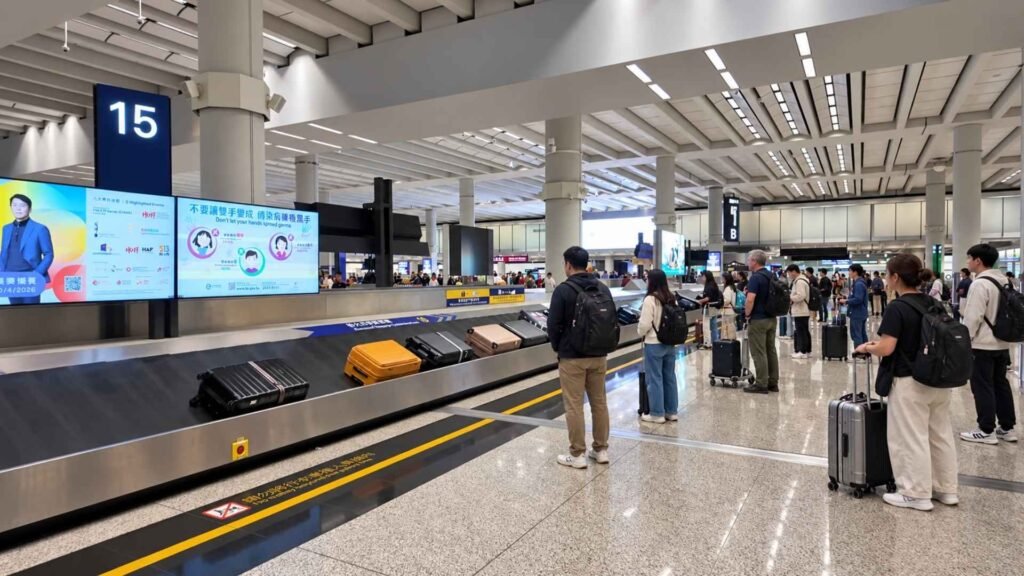
After passport control, look at the baggage information screens for your flight’s assigned carousel. Match the flight number as well as the departure city, particularly when several flights arrive from the same place.
Before lifting a suitcase onto your trolley, read its name tag. Similar bags are common, and a quick look at the label is easier than discovering a mix-up at your hotel.
Missing or Damaged Bags
If your suitcase has not arrived or is visibly damaged, speak to your airline’s baggage service staff or handling agent before leaving the reclaim area.
Have your boarding pass and baggage-tag receipt ready. These help staff identify the bag and open the appropriate report.
Before continuing through customs:
- Describe the bag’s colour, size and identifying features.
- Give staff a working contact number and your accommodation address.
- Obtain a report reference and follow-up instructions.
- Photograph any visible damage.
- Keep receipts for relevant expenses.
An airport report may be only the first step in a claim. Follow your airline’s instructions for any written submission, and retain the paperwork if you also plan to contact your travel insurer.
Pushchairs and Oversized Items
Pushchairs, sports equipment and other oversized items may be delivered separately from ordinary suitcases. If yours does not appear, ask staff for the designated collection point.
With cabin baggage only, you can continue towards customs without waiting at a carousel.
4. Pass Through Customs
After collecting your bags, choose the appropriate customs channel:
- Green channel: you have nothing to declare.
- Red channel: you have goods or currency requiring declaration.
If you are unsure about an item, speak to a customs officer before choosing your exit.
The official duty-free concessions for incoming passengers explain the alcohol and tobacco allowances. A purchase made in a departure airport’s duty-free shop still has to meet Hong Kong’s import rules.
Alcohol, Tobacco and Cash
The main limits to know are:
- Tobacco: passengers aged 18 or over may bring, for personal use, 19 cigarettes; one cigar, or up to 25 grams of cigars if carrying more than one; or 25 grams of other manufactured tobacco. These are alternative allowances.
- Strong alcohol: passengers aged 18 or over may bring one litre of liquor above 30% alcohol by volume for personal use under the concession. Hong Kong identity card holders must also have spent at least 24 hours outside Hong Kong.
- Currency: currency and bearer negotiable instruments with a combined value exceeding HK$120,000 must be declared through the red channel.
Vapes and Heated Tobacco Products
Hong Kong prohibits incoming travellers from importing alternative smoking products, including e-cigarettes and heated tobacco products.
These are prohibited items, not products that become acceptable simply by declaring them or paying duty. Review what is in your cabin and checked bags before leaving home.
Medicines and Prescriptions
Medicines carried in your accompanying personal baggage, in a reasonable quantity for your own use, may qualify for an import-licensing exemption. Keep them in their labelled packaging and carry the relevant prescription.
Additional controls apply to certain medicines. In particular, the Drug Office states that visitors bringing medicines classified as dangerous drugs need prior written approval. A prescription alone should not be treated as permission to bring every controlled medicine into Hong Kong. Consult the Drug Office’s guidance on bringing medicines into Hong Kong before travelling with a controlled medication.
5. Get Connected and Organise Payment
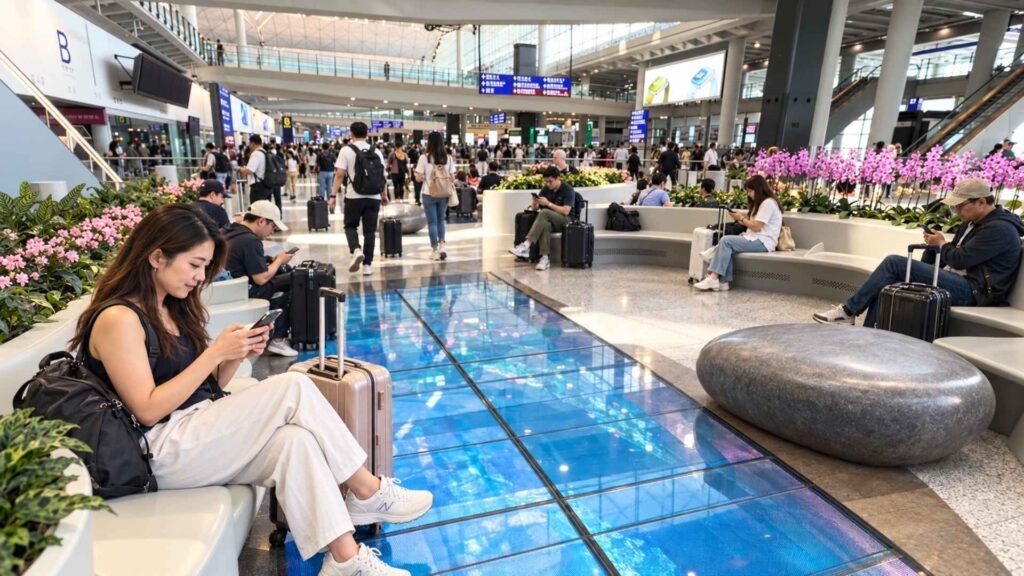
Once you pass customs, you enter the public arrivals area. Take a moment here to contact your driver or accommodation, arrange mobile data and prepare for the journey into town.
If someone is meeting you, send your exact location. T1 has Arrivals Halls A and B, so agree on a hall and a recognisable meeting point rather than simply saying “outside arrivals”.
Connect to Airport Wi-Fi
HKIA provides free Wi-Fi in most public and seating areas without registration. Advertised networks include:
- #HKAirport Free WiFi
- #HKAirport Hi-Speed WiFi
Follow the connection screen to get online. If it does not load, airport customer service staff can help.
Use the connection to send your arrival message, open your hotel booking and load the route to your accommodation before moving towards the transport area.
Activate an eSIM or Buy a Local SIM
If you bought a travel eSIM before departure, follow its activation instructions and select the intended line for mobile data. Your plan must cover Hong Kong, and the correct roaming settings depend on the provider.
Local SIM cards are available at airport shops and counters. SIMs issued by Hong Kong telecommunications providers for local use require real-name registration before activation, so keep your identity document available.
Before buying, compare the essentials: data allowance, validity, local calls and whether the plan suits the length of your stay.
Clara’s Tip
Save your hotel’s full address in English and Chinese, its map pin and your booking confirmation as screenshots. They remain easy to show a driver even if your mobile data is not working.
Buy the Right Octopus Card
Octopus is useful for public transport and everyday purchases. At the airport, one available option is the Tourist Octopus–China T-Union Card, which you buy outright rather than borrow against a deposit.
You can buy it at the arrivals 7-Eleven or an Airport Station customer service counter, except the counter on Platform 1.
The standard On-Loan Octopus is not available at Airport Station. It is a different product with different purchase and refund arrangements.
Before paying, ask how much of the price is usable travel credit. Tourist cards and packages can include different balances, and some require value to be added before use.
Keep a Little Hong Kong Cash
A modest cash reserve is useful for smaller purchases and as a backup payment method. Look at the displayed exchange rate or ATM fees before completing a transaction.
If you intend to pay for a taxi by card, confirm that the driver accepts your payment method before starting the journey.
6. Choose Transport to Your Accommodation
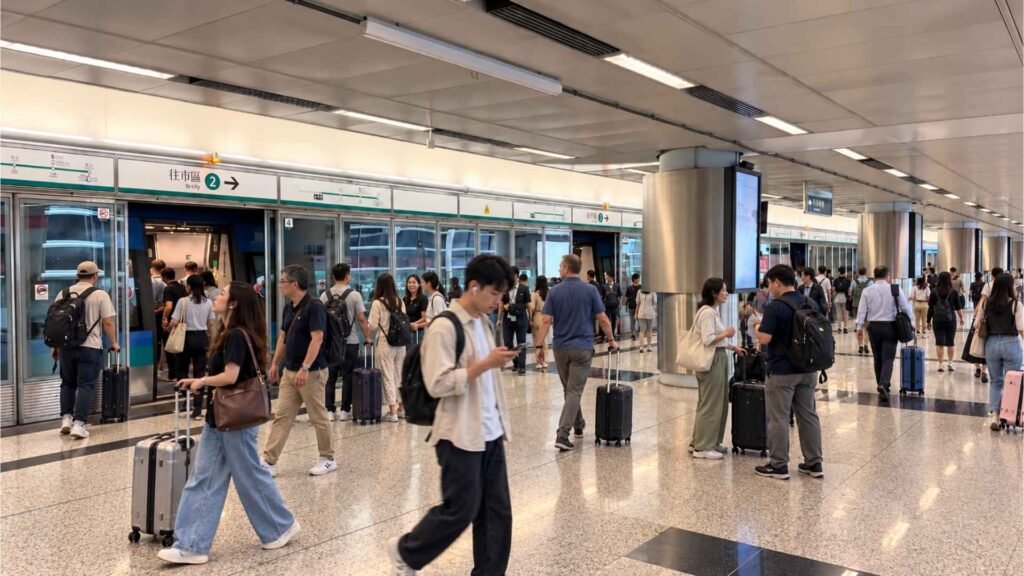
Start with your hotel’s exact location. The Airport Express is quick between stations, while a bus or taxi may leave you closer to the entrance.
Our Hong Kong International Airport guide covers the wider airport facilities and travel options. For your first journey after arrival, use this comparison.
| Transport | Best suited to | Main consideration |
|---|---|---|
| Airport Express | A predictable rail journey towards Tsing Yi, Kowloon or Hong Kong Station | The connection from the station to your hotel |
| Airport bus | Accommodation near a convenient stop | Route, operating hours and the walk from the stop |
| Taxi | A direct journey with luggage or companions | Metered fare and applicable extras |
| Pre-booked transfer | An arranged pickup with an agreed destination | Meeting point, waiting allowance and delayed-flight policy |
Airport Express: Compare Group Fares First
If two to four of you are travelling together, ask about Ride Together tickets before buying separate standard fares. These group tickets must be purchased together and used by passengers travelling together.
For two passengers, the current group fare is HK$170 to Hong Kong Station or HK$150 to Kowloon. Purchase the appropriate group tickets at the Airport Express Customer Service Centre.
For comparison, standard adult single fares are:
| Destination | Octopus or accepted contactless bank card | Smart Ticket |
|---|---|---|
| Hong Kong Station | HK$120 | HK$130 |
| Kowloon Station | HK$105 | HK$115 |
The journey to Hong Kong Station takes approximately 24 minutes. As of October 2026, the published city-bound service from Airport Station runs from 05:54 to 00:48.
These timings cover the train journey and service hours. Allow separately for reaching the platform and travelling from the city station to your accommodation.
Clara’s Tip
Four adults travelling together to Hong Kong Station currently pay HK$280 with a Ride Together group ticket—HK$70 each. Four standard HK$120 fares would total HK$480. Compare the group option before tapping through separately.
Airport Buses and Taxis
An airport bus can be convenient when its stop is close to your hotel. Look at the final walking route as well as the destination name, especially if you have heavy bags.
For a taxi, use the official rank and show the attendant your full address. Red urban taxis serve most destinations across Hong Kong, including the usual hotel areas in Kowloon and on Hong Kong Island. Green and blue taxis serve more limited areas. Request a receipt at the end of the journey.
Arriving After the Last Train
If the Airport Express has finished for the night, the main options are an operating night bus, an official taxi or your arranged transfer.
For buses, use the airport’s public transport information and bus operator links to find the service running towards your accommodation. Select the actual late-night travel time: a route available during the day may not operate overnight.
For a pre-booked pickup, keep the meeting instructions and operator’s contact details available. If you expect to arrive at your hotel after midnight, let reception know your approximate arrival time.
Hong Kong Airport Arrival FAQ
How Long Does It Take to Leave the Airport?
Your exit time depends on the gate location, immigration queue, baggage delivery and any customs checks. For a booked pickup, give the operator your flight number and choose a waiting policy that allows for arrival delays.
Do I Need to Fill In an Arrival Card?
No—visitors no longer need to complete arrival or departure cards for Hong Kong immigration.
Can I Use an e-Channel with a Biometric Passport?
A biometric passport alone is not enough; you must meet the visitor e-Channel eligibility and enrolment requirements.
Do I Collect My Bags Before Immigration?
For a normal arrival into Hong Kong, you clear immigration first, collect checked baggage and then pass through customs.
Where Should Someone Meet Me?
Arrange to meet in the public arrivals area after customs, specifying Arrivals Hall A or B and a clear meeting point.
Final Thoughts
A smooth Hong Kong airport arrival comes down to a few practical decisions: follow the correct route, keep your documents together and settle any baggage issue before leaving reclaim.
Once you reach the public hall, take a short pause to get connected and organise your journey. With your hotel address saved and transport chosen, you can leave the airport ready to enjoy the city.