

Arriving at Adolfo Suárez Madrid-Barajas Airport (MAD) is relatively straightforward once you know your terminal and whether you need to pass through passport control.
The main complication is Terminal 4 Satellite (T4S), where passengers may have an additional airport journey before reaching baggage reclaim and the public arrivals area in T4.
This Madrid Barajas Airport arrival guide explains what happens after landing in 2026, including passport control, EES, baggage reclaim, customs, T4S arrivals and the final walk into the arrivals hall.
Quick Answer: What Happens After You Land at Madrid Barajas?
If Madrid is your final destination, the usual arrival sequence is:
Aircraft → Passport Control if required → Baggage Reclaim → Customs if applicable → Arrivals Hall
| Your arrival | What to expect |
|---|---|
| From a Schengen country | Normally no external Schengen passport control |
| From outside Schengen | Passport control before continuing to baggage reclaim |
| EES-eligible traveller | Biometric border procedures may apply |
| Carry-on only | Continue toward the exit after required border formalities |
| Checked baggage | Check the airport screens for your baggage reclaim area |
| Arriving at T4S | Continue through the airport system toward T4 |
| Goods to declare | Follow the appropriate customs route |
| Connecting in Madrid | Check Flight Connections before following Arrivals |
Your exact route depends mainly on your arrival terminal, flight origin, immigration status and baggage arrangements.
If you need a broader overview of MAD before travelling, including terminals, transfers and airport facilities, start with our Madrid Barajas Airport Guide 2026.
Step 1: Check Your Madrid Barajas Arrival Terminal

Madrid Barajas has four numbered passenger terminals — T1, T2, T3 and T4 — plus Terminal 4 Satellite (T4S).
For arriving passengers, the most important distinction is whether you land in the T1–T3 complex, T4 itself or T4S.
Arriving at T1, T2 or T3
T1, T2 and T3 form the older terminal complex.
Your route after leaving the aircraft depends primarily on whether your flight arrived from inside or outside the Schengen Area. Follow the airport signs toward Arrivals (Llegadas), passport control when required and baggage reclaim.
Arriving at T4
T4 is the main Terminal 4 building and contains the public arrivals facilities for passengers using the T4 complex.
If your aircraft arrives directly at T4, follow the signs toward the appropriate arrivals route and baggage reclaim.
Arriving at T4S
T4S is Terminal 4’s separate satellite building.
If Madrid is your final destination, landing at T4S does not mean you can walk directly outside from the satellite building. You must continue through the airport system toward the main T4 terminal.
The Automatic People Mover (APM) connects T4S with T4, and passengers using the T4/T4S complex who need to collect checked baggage are directed to baggage reclaim hall 10 in T4.
This extra internal journey is one of the main reasons a T4S arrival can take longer than a simpler arrival elsewhere at Madrid Barajas.
Step 2: Follow Arrivals — Unless You Have Another Flight
Once you leave the aircraft, check the signs before automatically following other passengers.
If Madrid is your final destination, follow the signs for Llegadas / Arrivals and any border or baggage instructions that apply to your flight.
If Madrid is only your connection point, look for Flight Connections / Connecting Flights before exiting the secure area.
Your correct route can depend on your terminals, baggage arrangements, ticket type and whether you are crossing the Schengen border.
Protected connections and separate-ticket transfers involve different procedures and risks, so they are covered separately rather than turning this arrival article into a connection guide.
Step 3: Go Through Passport Control If Required
Passport control is one of the main variables in the Madrid Barajas Airport arrival process.
Whether you need it depends primarily on where your flight originated.
Arriving from the Schengen Area
Passengers arriving from another Schengen country normally do not pass through an external Schengen border check in Madrid.
A flight from cities such as Paris, Amsterdam, Frankfurt or Rome is international, but it normally operates within the Schengen travel area.
You should still keep your passport or other accepted travel document accessible.
Arriving from Outside the Schengen Area
If you arrive from outside Schengen and Madrid is your point of entry into the Schengen Area, you normally pass through passport control.
Keep your travel documents easy to reach. Depending on your nationality and immigration status, border authorities may check your passport, visa if required, purpose of travel and other entry conditions.
Passengers arriving from outside Schengen should also be aware of the Entry/Exit System (EES).
EES at Madrid Barajas Airport in 2026
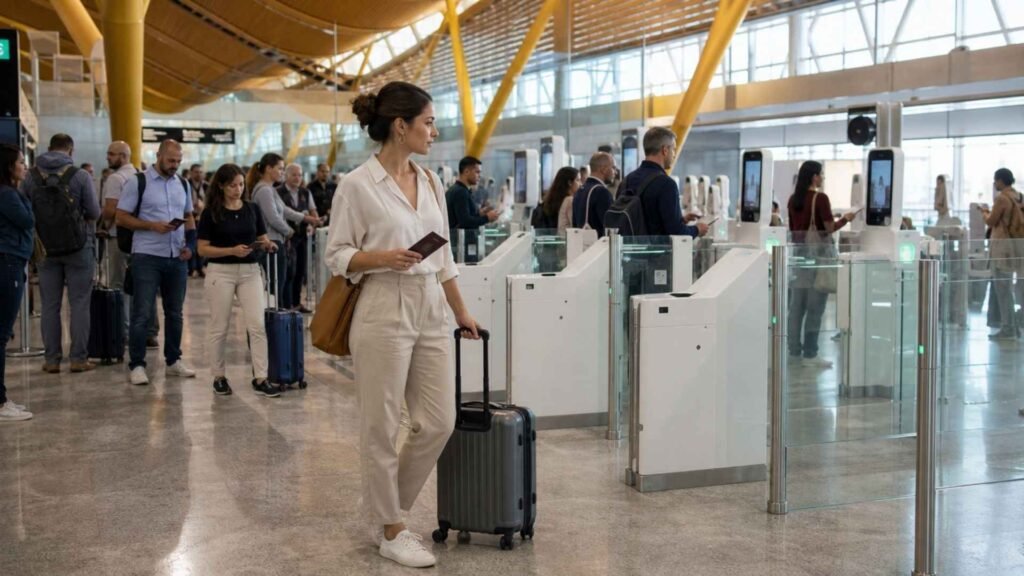
The Entry/Exit System (EES) became fully operational at Schengen external border crossing points on 10 April 2026.
It applies primarily to eligible non-EU nationals travelling for a short stay of up to 90 days in any 180-day period.
For travellers covered by EES, the system electronically records border crossings and can involve:
- Travel document data
- Facial image
- Fingerprints
- Electronic entry and exit records
A first EES registration can involve additional processing because biometric information may need to be collected.
For that reason, passengers arriving from outside Schengen should avoid building an overly tight schedule immediately after landing.
EU citizens and nationals of Iceland, Liechtenstein, Norway and Switzerland are not registered in EES. Certain other travellers, including some holders of qualifying residence permits or long-stay visas, are also outside the standard short-stay EES process.
For current eligibility, exemptions and border procedures, check the official EU Entry/Exit System information before travelling.
Can You Pre-Register for EES?
The EU also offers the Travel to Europe mobile app for travellers who are subject to EES registration.
Where the app is supported at a participating border crossing, eligible travellers can pre-register information such as passport data and a facial image before arrival.
Using the app does not replace the border check, and availability can depend on the country and border crossing. Do not assume that pre-registration will automatically shorten your Madrid arrival time; check the official Travel to Europe app information for current availability and instructions.
Is ETIAS Required in August 2026?
No. ETIAS is not operational as of August 2026, and applications are not currently being collected.
Do not confuse ETIAS with EES.
EES is an entry and exit registration system used at external borders.
ETIAS will be a pre-travel authorisation for eligible visa-exempt travellers once it becomes operational.
The EU has not announced a confirmed launch date on its current operational-status notice and says travellers will be informed before the system goes live. No ETIAS application is required at this time.
Because this is a changing requirement, check the official EU ETIAS status shortly before travelling rather than paying a third-party website for an application that is not yet required.
Step 4: Collect Your Checked Baggage

After passport control, when required, follow signs for Baggage Reclaim / Recogida de Equipajes.
Check the airport screens for your flight number and assigned baggage area rather than simply following other passengers.
Aena currently lists the principal arrival baggage areas as:
| Arrival | Baggage reclaim area |
|---|---|
| T1 non-Schengen | Hall 1 |
| T1 domestic and Schengen | Hall 2 |
| T2 domestic and Schengen | Hall 6 |
| T4 / T4S | Hall 10 |
Airport operations can change, so the screens and signs you see after landing should always take priority.
For current airport information, see Aena’s official Madrid Barajas arrivals page.
Check Your Bag Before Leaving
Compare the baggage tag before taking a suitcase from the carousel, particularly if you have a common bag design.
Keep your baggage receipt until you have confirmed that all checked luggage has arrived.
What If Your Baggage Does Not Arrive?
Do not leave the baggage reclaim area without reporting the problem.
For missing or damaged checked luggage, Aena directs passengers to their airline or handling agent’s desk.
Keep your boarding pass and baggage receipt ready and obtain a baggage irregularity reference when applicable.
Step 5: Pass Through Customs
Passport control and customs are different procedures.
Passport control concerns your entry into the country. Customs concerns the goods you are bringing with you.
If you arrive from outside the EU, check whether you are carrying anything that needs to be declared before leaving the baggage area.
Aena lists customs facilities in T1 and T4 and advises passengers who are unsure whether their goods require declaration to ask at Customs.
Examples can include certain food products, high-value goods and cash above the applicable threshold.
Using the Nothing to Declare route does not remove your obligation to comply with Spanish and EU customs rules.
Step 6: Enter the Public Arrivals Hall

After completing the procedures that apply to your journey, you enter the public arrivals area.
At this point, your Madrid Barajas Airport arrival process is essentially complete.
From here, follow signs for your next step, including:
- Metro
- Train
- Airport buses
- Taxi
- Car rental
- Pick-up and meeting points
- Airport information
If somebody is meeting you, send them your arrival terminal, not only your flight number.
Madrid Barajas is large enough that waiting at the wrong terminal can create a significant and unnecessary delay.
Detailed train, Metro, bus, taxi and private-transfer comparisons belong in our dedicated Madrid Barajas Airport to City Centre Guide rather than this arrival article.
Arriving at T4S: What Happens After Landing?
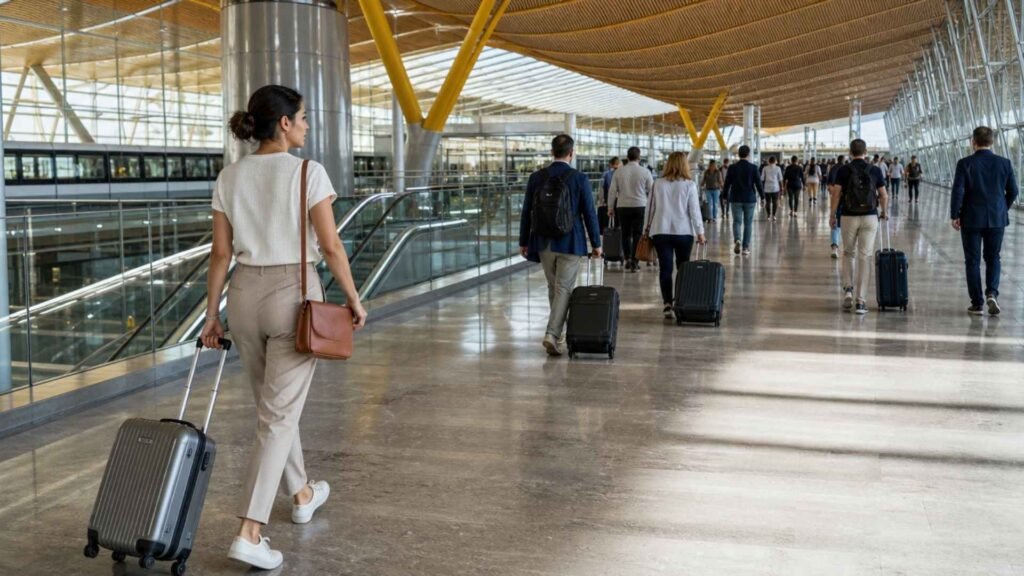
T4S is the part of Madrid Barajas most likely to confuse first-time visitors.
It is physically separated from the main T4 building and connected to it by the airport’s Automatic People Mover.
For a typical passenger arriving from outside Schengen at the S gates with Madrid as the final destination, the route broadly looks like:
T4S Arrival Gate → Passport Control → APM → T4 → Baggage Reclaim Hall 10 → Arrivals
Aena’s current T4/T4S instructions place passport control for this route in T4S before passengers take the APM toward T4.
Your exact route can vary according to your flight and passenger status, so airport signage and staff instructions always take priority.
You do not need to arrange a road transfer between T4S and T4 as part of the normal arrival process.
💡 Clara’s Tip:
Before your flight, take a screenshot showing your flight number, arrival terminal and accommodation address.
If you arrive tired, your phone has no immediate data connection or airport Wi-Fi takes time to connect, you will still have the three details most likely to help you navigate the airport and continue your journey.
How Long Does the Madrid Barajas Airport Arrival Process Take?
There is no guaranteed time between touchdown and reaching the arrivals hall.
The biggest variables are your terminal, passport-control queues, EES processing and baggage delivery.
For trip planning, these broad ranges are useful buffers rather than official airport processing times:
| Arrival situation | Planning range |
|---|---|
| Schengen + carry-on only | 20–45 minutes |
| Schengen + checked baggage | 30–60 minutes |
| Non-Schengen + carry-on only | 35–75 minutes |
| Non-Schengen + checked baggage | 45–90+ minutes |
| Busy non-Schengen T4S arrival | 60–120+ minutes |
A quiet arrival can be faster, while simultaneous long-haul flights, first-time EES registration, border queues or delayed baggage can extend the process.
Avoid booking a train, tour or other fixed-time activity too close to your scheduled landing time.
What If Madrid Is Not Your Final Destination?
If you have another flight, do not automatically follow the normal arrivals route.
Check whether your baggage is checked through and whether you should follow Flight Connections.
Passengers travelling on one protected booking may have a very different procedure from travellers using separate tickets.
Protected connections will be covered in our dedicated Madrid Barajas Airport Transit Guide, while separately booked flights belong in the Madrid Barajas Airport Self-Transfer Guide, including baggage collection, re-checking, terminal changes and missed-connection risk.
Arriving at Madrid Barajas Late at Night
The main concern with a late arrival is not the airport arrival procedure but what happens after you reach the public area.
Check the operating hours of your preferred transport before departure and leave enough margin for a delayed flight, passport-control queue or slow baggage delivery.
Late-night transport choices will be compared in our Madrid Barajas Airport to City Centre Guide, while practical overnight stays belong in the Hotels Near Madrid Barajas Airport Guide.
Arriving with Children
Families should keep passports, boarding passes and required travel documents together and easy to reach.
If you are travelling with a stroller or pushchair, check with your airline whether it will be returned at the aircraft or delivered through baggage reclaim, as procedures can vary.
Families arriving from outside Schengen should also allow additional time for border formalities rather than arranging a tight pickup immediately after landing.
Passengers Who Need Airport Assistance
Madrid Barajas is a large airport, and some arrival routes involve considerable walking distances.
Passengers with reduced mobility or other assistance needs should arrange the appropriate service in advance and follow the instructions provided by their airline and airport staff.
This can be particularly useful for journeys involving the large T4/T4S complex.
Common Madrid Barajas Arrival Mistakes
Confusing T4 with T4S
T4S is a separate satellite building. If you land there, the internal journey toward T4 can add time before you reach the public arrivals area.
Following Arrivals When You Have a Connection
If Madrid is not your final destination, check Flight Connections before leaving the secure area.
Assuming Every International Flight Requires Passport Control
The key distinction is normally Schengen versus non-Schengen, not simply domestic versus international.
Confusing EES with ETIAS
EES is operational. ETIAS is not operational as of August 2026 and no applications are currently being collected.
Leaving Before Reporting Missing Baggage
Report missing or damaged checked luggage to your airline or handling agent before leaving the baggage reclaim area whenever possible.
Planning Around Your Scheduled Landing Time
Landing time is not arrivals-hall time. Allow for taxiing, walking, border procedures and baggage delivery before committing to a fixed onward booking.
Madrid Barajas Airport Arrival Checklist
Before landing, make sure you know:
- Your arrival terminal: T1, T2, T3, T4 or T4S
- Whether Madrid is your final destination
- Whether you are arriving from inside or outside Schengen
- Whether passport control applies
- Whether EES applies to your trip
- Whether you need to collect checked baggage
- Whether you have anything to declare
- Where your pickup or onward transport begins
- Your accommodation name and address
Frequently Asked Questions
How long does it take to get through Madrid Airport arrivals?
Allow roughly 20–60 minutes for a straightforward Schengen arrival. Non-Schengen or busy T4S arrivals can take 60–120+ minutes, particularly when border queues or checked baggage are involved.
Do I go through passport control when arriving in Madrid?
Usually yes if Madrid is your entry point from outside Schengen. Arrivals from another Schengen country generally do not pass through an external Schengen border check.
Is Madrid Barajas Airport in the Schengen Area?
Yes. Spain is part of the Schengen Area, and Madrid Barajas handles both Schengen and non-Schengen passenger flows.
What is the difference between T4 and T4S?
T4 is the main terminal building; T4S is its satellite. The APM connects the two within the airport system.
How do I get from T4S to T4 after landing?
Follow the airport signs to the Automatic People Mover. Passengers collecting T4/T4S checked baggage continue to hall 10 in T4.
Do I need to collect my luggage in Madrid?
Yes if Madrid is your final destination and you checked baggage. Connecting passengers should confirm whether their bags are tagged through to their final destination.
Do I go through customs at Madrid Airport?
If customs applies to your arrival, it comes after baggage reclaim. Declare applicable goods or ask Customs if you are unsure.
Does EES apply at Madrid Barajas Airport?
EES applies to eligible non-EU short-stay travellers entering through an external Schengen border, subject to specific exemptions.
Is ETIAS required for Madrid in 2026?
Not as of August 2026. ETIAS is not operational and applications are not currently being collected. Check the official EU status before travelling because this will eventually change.
What should I do if my baggage is missing?
Report it to your airline or handling agent before leaving baggage reclaim and keep your boarding pass and baggage receipt available.
Final Thoughts
A Madrid Barajas Airport arrival is much easier when you know your terminal and whether border control applies. T4S requires the most attention because reaching T4 can still be part of your journey after landing.
Keep your documents accessible, follow the airport signs and leave a sensible buffer before any fixed onward booking. Once you reach the public arrivals hall, you can focus on the next stage of your trip.