
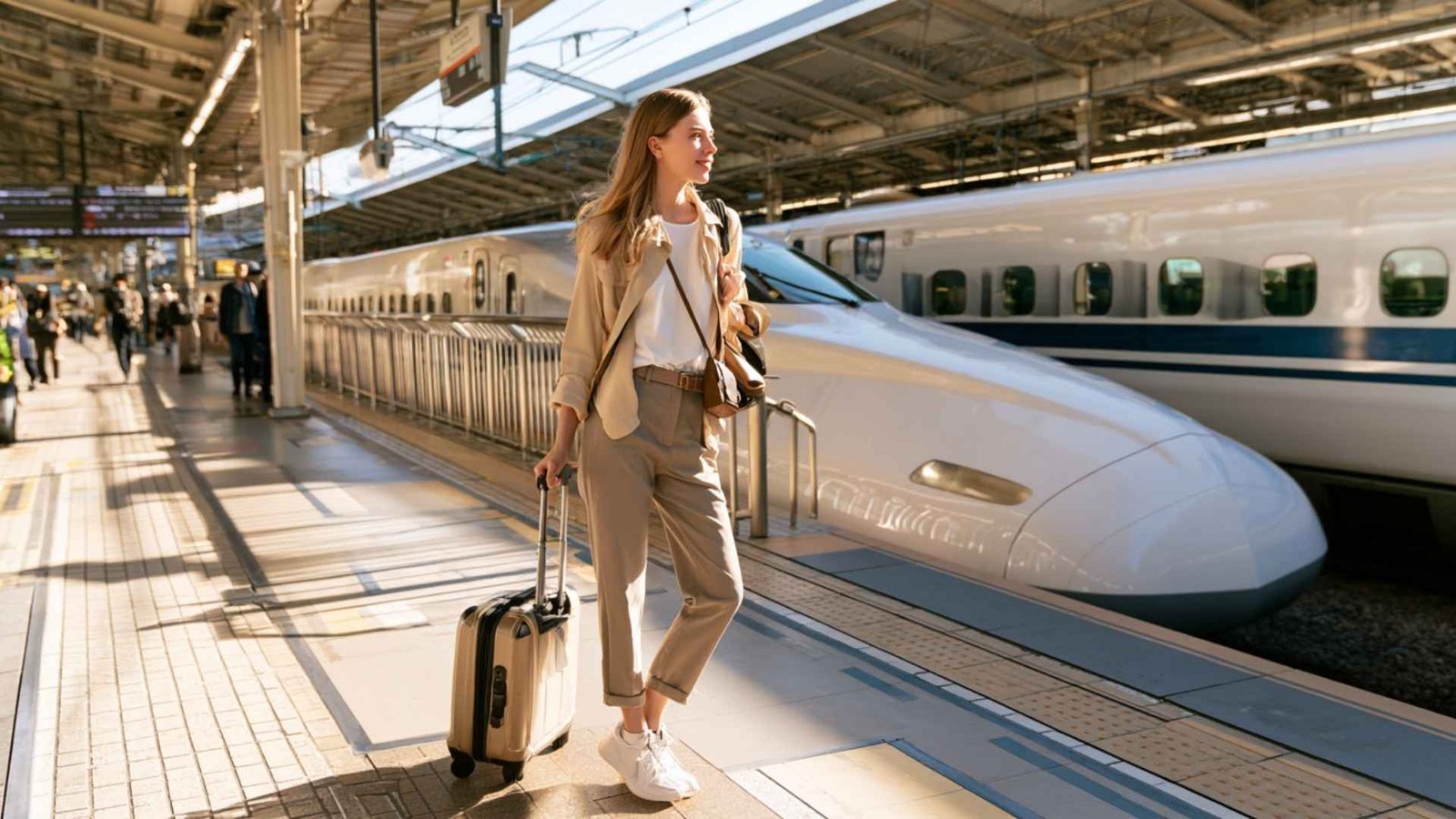
Learning how to use the Shinkansen in Japan may feel complicated before your first journey. You need to choose the correct train, understand the ticket options, find the right platform, manage your luggage, and board the correct carriage.
In practice, the system is remarkably organised. Once you understand the basic process, travelling between cities such as Tokyo, Kyoto, Osaka, Hiroshima, and Fukuoka becomes straightforward.
This guide explains the complete journey—from buying your ticket to leaving the station at your destination.
Quick Answer: How to Use the Shinkansen in Japan
To use the Shinkansen, choose your route, buy the correct ticket or make an eligible rail-pass reservation, confirm your train and seat, pass through the Shinkansen gate, find the platform and carriage number, and board at the marked position.
| Step | What to Do |
|---|---|
| 1 | Confirm the exact departure and arrival stations |
| 2 | Choose the Shinkansen train and departure time |
| 3 | Decide between reserved and non-reserved seating |
| 4 | Buy the ticket online, from a machine, or at a JR office |
| 5 | Reserve oversized-baggage space if required |
| 6 | Check whether you have one or several paper tickets |
| 7 | Arrive around 20–30 minutes before departure |
| 8 | Match the train name, number, time, and platform |
| 9 | Queue beside the floor marking for your carriage |
| 10 | Board promptly and store your luggage securely |
| 11 | Keep your ticket, pass, QR code, or linked IC card until you exit |
Do not rely only on the destination displayed on the departure board. Several trains may travel towards the same city within a few minutes, but a reserved seat is valid only for the specific train shown on your ticket.
What Is the Shinkansen?
The Shinkansen is Japan’s high-speed railway network, commonly known as the bullet train.
It connects Tokyo with many of the country’s most visited destinations, including Nagoya, Kyoto, Osaka, Hiroshima, Fukuoka, Kanazawa, Sendai, Aomori, and Hakodate.
The Shinkansen is not one continuous railway operated by a single company. It consists of several lines managed by different companies within the Japan Railways Group.
| Shinkansen Line | Main Route |
|---|---|
| Tokaido Shinkansen | Tokyo–Nagoya–Kyoto–Shin-Osaka |
| Sanyo Shinkansen | Shin-Osaka–Okayama–Hiroshima–Hakata |
| Kyushu Shinkansen | Hakata–Kumamoto–Kagoshima-Chuo |
| Nishi Kyushu Shinkansen | Takeo-Onsen–Nagasaki |
| Tohoku Shinkansen | Tokyo–Sendai–Morioka–Shin-Aomori |
| Hokkaido Shinkansen | Shin-Aomori–Shin-Hakodate-Hokuto |
| Joetsu Shinkansen | Tokyo–Niigata |
| Hokuriku Shinkansen | Tokyo–Nagano–Toyama–Kanazawa–Tsuruga |
Most first-time visitors begin with the Tokaido Shinkansen because it connects Tokyo, Kyoto, and Osaka—the central route in many first-time Japan itineraries.
The train names you see, such as Nozomi, Hikari, and Kodama, describe different stopping patterns on the same line.
Understanding Shinkansen Train Types
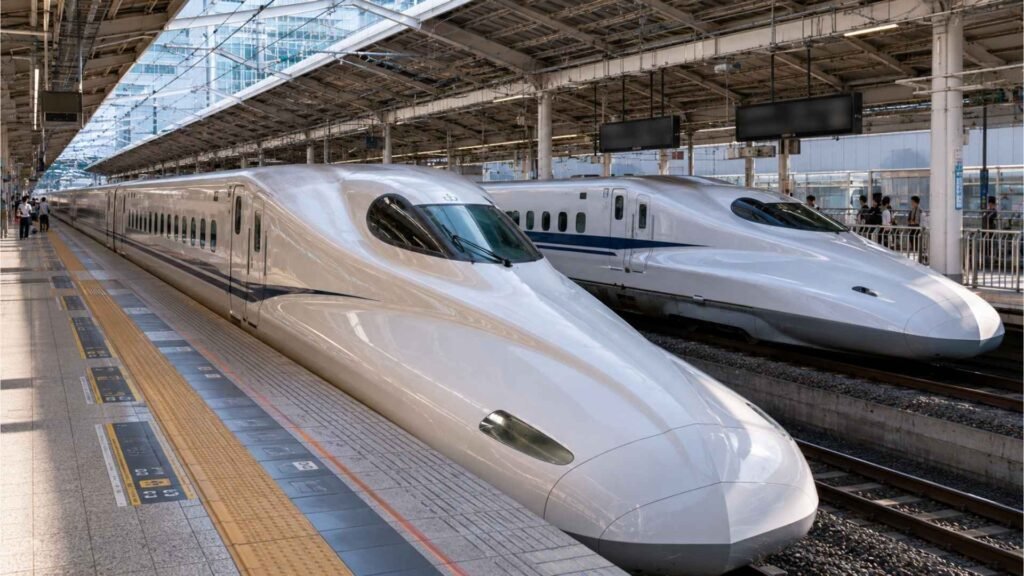
The fastest Shinkansen services stop only at major stations. Slower services call at more stations but may provide better availability or more suitable Japan Rail Pass coverage.
Tokaido, Sanyo, and Kyushu Train Types
| Train | General Stopping Pattern | Standard Japan Rail Pass |
|---|---|---|
| Nozomi | Fastest Tokaido–Sanyo service; major stations | Supplement required |
| Hikari | Fast, with more stops than Nozomi | Covered |
| Kodama | Stops at every station | Covered |
| Mizuho | Fastest Sanyo–Kyushu service | Supplement required |
| Sakura | Fast service with additional stops | Covered |
| Tsubame | Stops at most or all Kyushu stations | Covered |
If you are buying an ordinary point-to-point ticket between Tokyo and Kyoto, Nozomi is usually the fastest and most convenient option.
Japan Rail Pass holders can use Hikari and Kodama without paying an additional Shinkansen supplement. Sakura and Tsubame are also covered on eligible routes.
Nozomi and Mizuho require special attention because the standard nationwide pass does not cover them by itself.
Are Nozomi Trains Covered by the Japan Rail Pass?
Nozomi trains provide the fastest and most frequent services between Tokyo, Kyoto, Shin-Osaka, and other major stations along the Tokaido and Sanyo routes.
The standard Japan Rail Pass does not independently cover Nozomi or Mizuho. Pass holders must purchase a separate [ONLY WITH JAPAN RAIL PASS] NOZOMI MIZUHO Ticket before boarding.
This supplementary ticket:
- Must be used with a valid Japan Rail Pass
- Applies only to the route and class shown on the ticket
- Cannot be used as an independent Shinkansen ticket
- Must be purchased before boarding the train
Prices depend on the route and may change, so check the current supplement on the official Japan Rail Pass Nozomi and Mizuho page.
If you prefer not to pay the supplement, choose a Hikari service between Tokyo, Kyoto, and Shin-Osaka.
Hikari trains are less frequent and take slightly longer, but the difference is often reasonable when your journey is already covered by the pass.
Before purchasing the nationwide pass, compare its total price with the individual journeys in your itinerary using our Japan Rail Pass guide. The pass is convenient, but it is no longer automatically the cheapest choice for every visitor.
Reserved vs Non-Reserved Shinkansen Seats
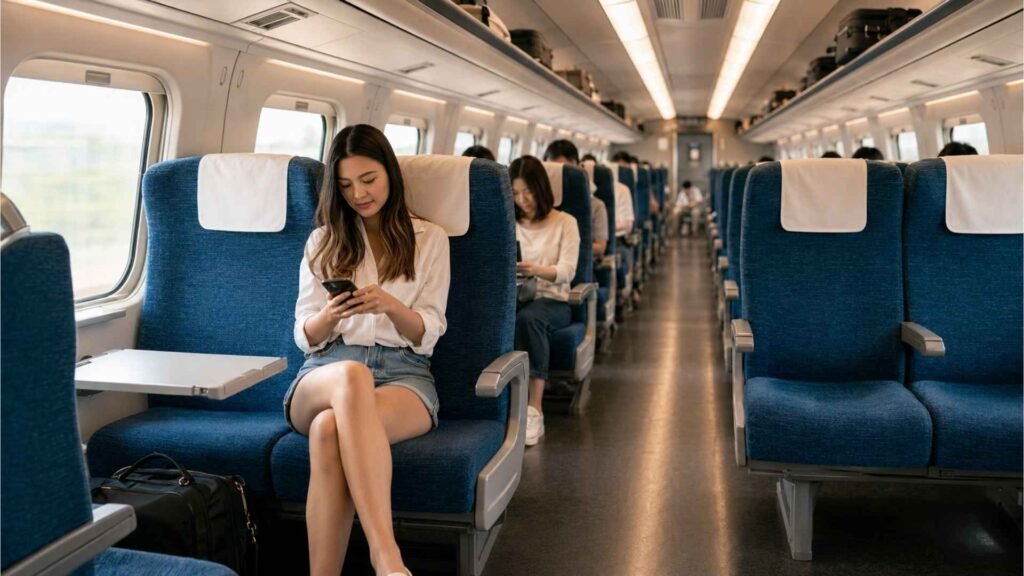
One of the most important decisions when learning how to use the Shinkansen in Japan is whether to reserve a specific seat.
Reserved Seats
A reserved-seat ticket assigns you a particular:
- Train and departure time
- Carriage
- Row and seat
- Travel date
- Route
A ticket might show information such as:
- Train: Nozomi 25
- Car: 8
- Seat: 12-E
- Departure: 10:30
- Route: Tokyo to Kyoto
Reserve a seat if:
- You are travelling during a busy period
- You need to sit with your companions
- You are travelling with children
- You want a window or Mount Fuji-side seat
- You have limited mobility
- You are carrying oversized baggage
- You must catch a specific connection
- You do not want to queue for an available seat
The main trade-off is flexibility: your reservation is tied to a specific departure unless your ticket conditions permit a change.
Non-Reserved Seats
A non-reserved ticket allows you to use a designated non-reserved carriage on an eligible train.
You do not receive a seat number. Instead, you queue at the relevant carriage marking and take any vacant seat after boarding.
This option can work well when:
- You are travelling outside peak periods
- Your schedule is flexible
- You are travelling alone
- Trains run frequently on your route
- You are willing to wait for the next train
A non-reserved ticket does not guarantee a seat. If the carriage is full, you may need to stand where permitted or wait for another service.
The number and position of non-reserved cars vary between trains, so always check the platform display before joining a queue.
When Should You Reserve in Advance?
Advance reservations are strongly recommended during:
- Golden Week
- Obon
- The New Year holiday period
- National holiday weekends
- Cherry blossom season
- Autumn foliage weekends
- Friday evenings
- Sunday afternoons and evenings
Nozomi trains on the Tokaido and Sanyo Shinkansen operate with reserved seating only during designated peak periods. Passengers holding only non-reserved tickets may be unable to sit on those services.
The dates change each year, so consult the official Nozomi peak-period calendar before travelling.
Our Best Time to Visit Japan guide can also help you identify the busiest travel seasons before finalising your itinerary.
Ordinary Car, Green Car, and Premium Classes
Most travellers choose between Ordinary Car and Green Car.
Ordinary Car
Ordinary Car is the standard Shinkansen class.
On the Tokaido Shinkansen, seats are generally arranged in a 2+3 layout. They offer good legroom, reclining backs, tray tables, and enough comfort for journeys between Tokyo, Kyoto, Osaka, and Hiroshima.
For most visitors, Ordinary Car provides everything needed for a comfortable trip.
Green Car
Green Car is the traditional first-class option.
Seats are normally arranged in a 2+2 layout and provide:
- Wider seats
- More legroom
- Additional personal space
- A quieter environment
- Fewer passengers per carriage
- More room for working or relaxing
Green Car can be worthwhile on a long journey, but it is not essential for enjoying the Shinkansen.
GranClass and Supreme Class
GranClass is available on selected JR East and JR Hokkaido services. It offers premium seating and may include enhanced onboard service, depending on the train.
JR Central is also introducing Supreme Class on 1 October 2026 as a new private premium experience on selected Tokaido Shinkansen services.
It is a specialist product rather than a standard alternative to Ordinary or Green Car, so most first-time visitors do not need to consider it when planning a regular journey.
How Much Do Shinkansen Tickets Cost?
A conventional Shinkansen fare normally consists of two main components:
- The basic fare for travelling between the stations
- The Shinkansen limited express charge
Additional costs may apply for:
- Reserved seating
- Green Car or another premium class
- Faster train categories
- Seasonal pricing
- Specific discounted products
This fare structure explains why a ticket machine may issue more than one piece of paper for a single journey.
The final price depends on your route, train, seating class, reservation type, season, and ticket product.
As a general planning estimate, an ordinary reserved ticket between Tokyo and Kyoto is usually around ¥14,000. Tokyo to Shin-Osaka costs slightly more. Check the live fare before travelling rather than treating an example price as fixed.
Remember that some Shinkansen stations are not the main central stations. A journey ending at Shin-Osaka, for example, may require an additional local train or metro ride to reach your hotel.
Include these connecting journeys when estimating your total transportation budget in our Japan trip cost guide.
Where to Buy Shinkansen Tickets
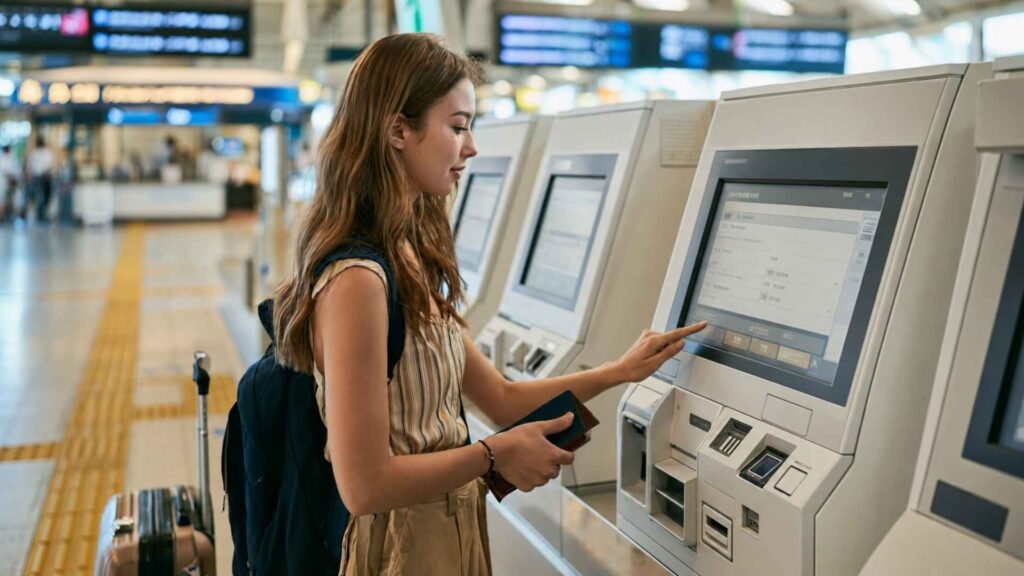
You can buy Shinkansen tickets through:
- SmartEX
- The relevant official JR online reservation platform
- Reserved-seat ticket machines
- Staffed JR ticket offices
- Japan Rail Pass reservation services
The best method depends on the route, ticket type, and whether you are using a rail pass.
Buying Shinkansen Tickets with SmartEX
SmartEX is the official online reservation service for the Tokaido, Sanyo, and Kyushu Shinkansen.
Its coverage includes the main corridor linking:
- Tokyo
- Shinagawa
- Shin-Yokohama
- Nagoya
- Kyoto
- Shin-Osaka
- Hiroshima
- Hakata
- Kumamoto
- Kagoshima-Chuo
SmartEX allows eligible users to:
- Book before arriving in Japan
- Choose a train and seating class
- Select seats from a carriage map
- Reserve seats for several passengers
- Purchase eligible advance fares
- Board with a QR ticket
- Link a compatible IC card
- Collect paper tickets when necessary
- Change eligible reservations before departure
Reservations for selected seats and products may be requested up to one year ahead. Bookings made more than one month in advance are initially based on a tentative service plan, with the train and seat confirmed closer to departure.
Registration requires a supported payment card. Some international cards may fail during registration or payment, even if they work elsewhere.
Use the official SmartEX website rather than an unfamiliar third-party booking platform.
How to Book Through SmartEX
The usual process is:
- Create a SmartEX account.
- Register a compatible payment card.
- Enter the departure and arrival stations.
- Select the date, approximate time, and passenger number.
- Compare the available trains.
- Choose the seating class and reservation type.
- Select seats from the carriage map when available.
- Indicate whether oversized baggage space is required.
- Complete the payment.
- Choose a QR ticket, linked IC card, or paper-ticket collection.
Each traveller needs a separate boarding credential. If you reserve several seats, SmartEX can issue individual QR tickets that you share with the other passengers.
The Shinkansen fare is charged to the payment card used for the reservation. Linking an IC card does not cause the Shinkansen fare to be deducted from its stored balance.
Important SmartEX Limitation
SmartEX is not a universal reservation platform for every Shinkansen line in Japan.
It covers the Tokaido, Sanyo, and Kyushu corridor. Travellers using many Tohoku, Joetsu, Hokuriku, or Hokkaido Shinkansen services should use the relevant JR operator’s official reservation system.
Confirm that your entire route is supported before registering or purchasing a ticket.
Buying Tickets from a Ticket Machine
Reserved-seat ticket machines are available at major JR stations, and many provide an English-language interface.
Depending on the machine, you can normally:
- Search by destination and departure time
- Choose a specific train
- Select reserved or non-reserved seating
- Choose Ordinary Car or Green Car
- Select a preferred seat
- Pay by cash or card
- Collect an existing reservation
The usual purchasing process is:
- Select English.
- Choose the Shinkansen or reserved-ticket option.
- Enter the departure station.
- Enter the destination.
- Choose the date and approximate time.
- Select a train.
- Select the class and seat type.
- Confirm the passenger number.
- Choose seats when a seat map is available.
- Pay and collect every ticket issued.
Do not walk away after the first ticket appears. The machine may issue a basic fare ticket and a separate Shinkansen limited express ticket.
Keep everything together until the journey is complete.
Buying Tickets at a JR Ticket Office
A staffed JR ticket office can be the easiest option if your route is complicated or you need help with luggage, seating, or transfers.
Major offices may be marked:
- JR Ticket Office
- Tickets
- Midori-no-madoguchi
- Reserved Seat Tickets
Prepare the following information before reaching the counter:
- Departure station
- Destination
- Travel date
- Preferred time
- Number of adults and children
- Reserved or non-reserved seat
- Ordinary Car or Green Car
- Oversized-baggage requirements
- Window, aisle, or grouped-seat preference
For example:
Tokyo to Kyoto, 10 October, around 9:00 a.m., two adults, reserved Ordinary Car seats together.
If your first choice is full, the staff can suggest an alternative departure.
Queues can become long at major stations. Buying the ticket one or two days before the journey can make departure morning much easier.
Can You Use an IC Card for the Shinkansen?
A normal IC card balance does not automatically function as a complete long-distance Shinkansen ticket.
You cannot simply tap a Suica, PASMO, or ICOCA at any Shinkansen gate and expect the intercity fare to be calculated like a local train journey.
However, a compatible IC card can act as your boarding credential when correctly linked to an eligible SmartEX or other supported reservation.
With a SmartEX-linked IC card:
- The Shinkansen ticket is purchased using your registered payment card.
- An eligible IC card is assigned to the reservation.
- You tap the assigned card at the Shinkansen gate.
- The gate issues a small seat-information slip.
- You keep that slip during the journey.
The Shinkansen fare is not deducted from the stored balance. Local connecting fares may still be charged to the card when applicable.
If you are unsure whether the card has been assigned correctly, use the QR ticket or collect paper tickets instead.
Our Japan IC Card guide explains how Suica, PASMO, ICOCA, and compatible regional cards work across Japan.
Understanding Paper Shinkansen Tickets
A traditional Shinkansen journey may involve:
- A basic fare ticket
- A Shinkansen limited express ticket
- Reserved-seat information
These elements may be combined into one ticket or printed separately.
When using an automatic gate, insert all tickets required for that stage together unless the printed instructions or station staff tell you otherwise.
The gate may retain one ticket and return another. Always collect everything that comes back.
When transferring from a conventional JR train to the Shinkansen, the transfer gate may require both the conventional ticket and the Shinkansen ticket.
If the combination is unclear, use the staffed gate. It is far better to ask than to force a ticket into the wrong machine.
Shinkansen Large Luggage Rules
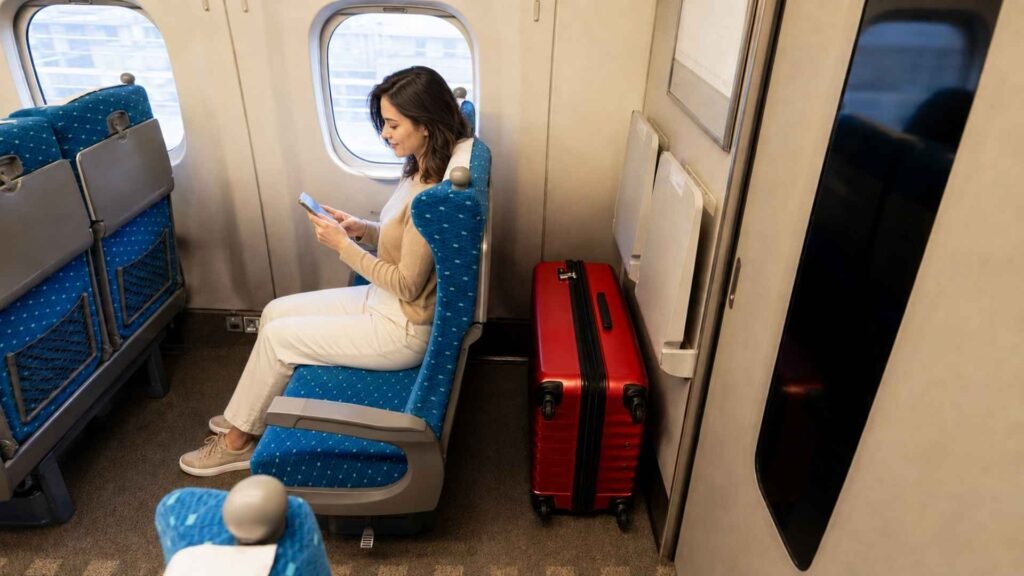
Large luggage is one of the few parts of Shinkansen travel that requires advance planning.
On the Tokaido, Sanyo, Kyushu, and Nishi Kyushu Shinkansen, special rules apply to bags with combined external dimensions exceeding 160 cm.
Calculate the measurement as:
Length + width + height
| Combined Dimensions | General Rule on Affected Lines |
|---|---|
| 160 cm or less | No special oversized-baggage reservation normally required |
| More than 160 cm and up to 250 cm | Oversized-baggage reservation required |
| More than 250 cm | Generally not permitted onboard |
Passengers are normally limited to two pieces of carry-on baggage, each weighing no more than 30 kg, subject to the railway’s additional size and safety conditions.
Airline cabin bags and many standard checked suitcases remain below 160 cm. Larger checked cases may exceed the limit, so measure your luggage before travelling.
How to Reserve Oversized Baggage Space
When booking your seat, select:
- A seat with an oversized baggage area, or
- An eligible baggage-storage option offered for your train
The traditional oversized baggage area is located behind the final row of seats in selected carriages. It is reserved for passengers who booked the corresponding seats.
Do not place a suitcase behind another passenger’s seat without the correct reservation.
Passengers boarding an affected service with oversized baggage but no reservation may be charged ¥1,000 and directed to a location chosen by the train crew. Storage space is not guaranteed.
The oversized-baggage reservation does not cost more than a standard reserved seat, but availability is limited.
Bags measuring 160 cm or less can generally be placed on the overhead rack or safely in front of your legs if they fit without obstructing other passengers.
Should You Use Luggage Delivery?
Japan’s luggage-forwarding services can make a multi-city itinerary considerably easier.
Sending a suitcase ahead may be worthwhile when:
- You have several transfers
- Your hotel is far from the station
- You are travelling with children
- You have more than one large suitcase
- Your accommodation has stairs
- You are stopping briefly between cities
- Oversized-baggage seats are unavailable
Carry medication, valuables, travel documents, and a small overnight bag with you. Same-day delivery should never be assumed.
Clara’s Tip: If you are spending one night in a smaller destination between Tokyo and Kyoto, forward your main suitcase directly to Kyoto and travel with a compact overnight bag. It makes station transfers noticeably calmer.
Choosing the Best Shinkansen Seat
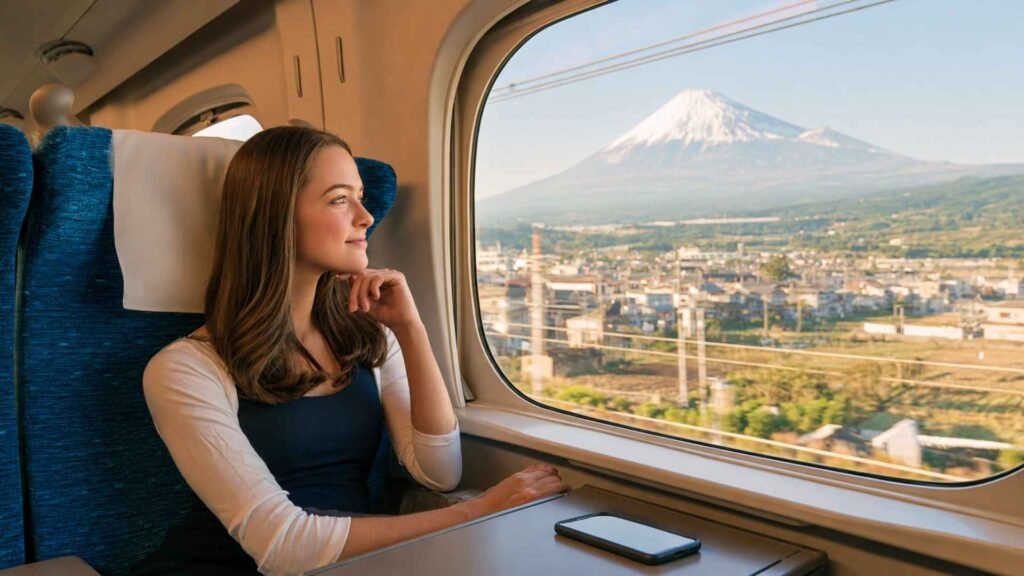
Choose your seat according to whether you value scenery, easy aisle access, luggage space, or sitting with companions.
Window or Aisle?
Choose a window seat if you want:
- Better scenery
- A wall to lean against
- Fewer interruptions
- A possible Mount Fuji view
Choose an aisle seat if you:
- Expect to use the toilet frequently
- Want easier access to the luggage rack
- Dislike feeling enclosed
- Need to leave quickly at your stop
Which Seat Has a View of Mount Fuji?
On the Tokaido Shinkansen, Mount Fuji is generally visible from the northern side of the train when the weather is clear.
For the best chance of seeing it, choose:
- Seat E in a typical Ordinary Car
- Seat D in a typical Green Car
This is normally the Mount Fuji side in both directions.
The mountain is generally visible between Shin-Yokohama and Shizuoka, with one of the closest views around Shin-Fuji. Cloud cover can obscure it completely, so even the correct seat cannot guarantee a view.
How Early Should You Arrive?
Arrive around 20–30 minutes before departure if you already have your ticket and understand the station layout.
Allow 30–45 minutes if:
- You need to buy or collect a ticket
- You are unfamiliar with the station
- You are departing from Tokyo or Shin-Osaka
- You want to buy food
- You have children or large luggage
- You are transferring from a metro or private railway
- You need assistance
Shinkansen trains depart punctually and will not wait for passengers running towards the platform.
Major stations can also involve long walks between local lines, metro platforms, and Shinkansen gates. Seeing “Tokyo Station” on a map does not mean every platform is only a few minutes apart.
How to Find the Correct Platform
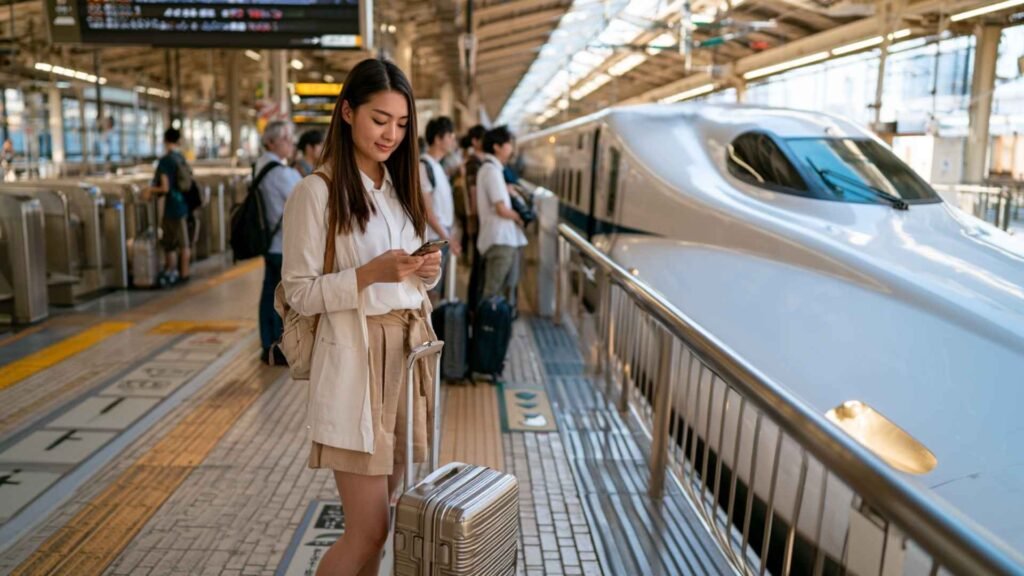
Follow signs displaying:
- Shinkansen
- Bullet Train
- Tokaido and Sanyo Shinkansen
- Tohoku Shinkansen
- The name of your relevant line
Shinkansen platforms are separated from conventional railway platforms by dedicated ticket gates.
After passing through the gate, check the electronic departure board for:
- Train name and number
- Departure time
- Destination
- Platform
- Carriage information
- Delay notices
Match the train number as well as the destination.
Several Nozomi trains may travel towards Hakata within minutes of one another. A reservation for Nozomi 21 is not valid as a reserved seat on Nozomi 23.
Be Careful with “Shin” Stations
Some Shinkansen stations are separate from the city’s principal conventional station.
| Shinkansen Station | Important Detail |
|---|---|
| Shin-Osaka | Different from Osaka Station |
| Shin-Kobe | Separate from central Kobe stations |
| Shin-Yokohama | Different from Yokohama Station |
| Shin-Aomori | Different from Aomori Station |
| Shin-Hakodate-Hokuto | Outside central Hakodate |
Always use the exact station name printed on your ticket when planning hotel transfers or searching a map.
Waiting in the Correct Place
Your ticket shows a carriage number such as Car 7 or Car 12.
Find that number on:
- Overhead signs
- Platform barriers
- Electronic displays
- Floor markings
Queue behind the line corresponding to your carriage.
Some platforms serve trains with different carriage arrangements, so more than one set of markings may appear on the floor. Check that the marking matches your train type.
Allow arriving passengers to leave before boarding.
Station stops can be brief. Keep your ticket, luggage, and companions ready before the doors open.
How to Board the Shinkansen
When the train arrives:
- Confirm the train name and number on the carriage display.
- Allow passengers to exit.
- Board through the door beside your queue.
- Move away from the entrance.
- Find the row and seat printed on your ticket.
- Store your luggage safely.
- Sit down promptly.
Ordinary Car seats commonly follow a 2+3 arrangement, while Green Car seating is usually 2+2.
If you have a non-reserved ticket, enter only a carriage marked for non-reserved seating.
Do not take an empty reserved seat simply because no one is sitting there. Its passenger may board at a later station.
Food and Drinks on the Shinkansen
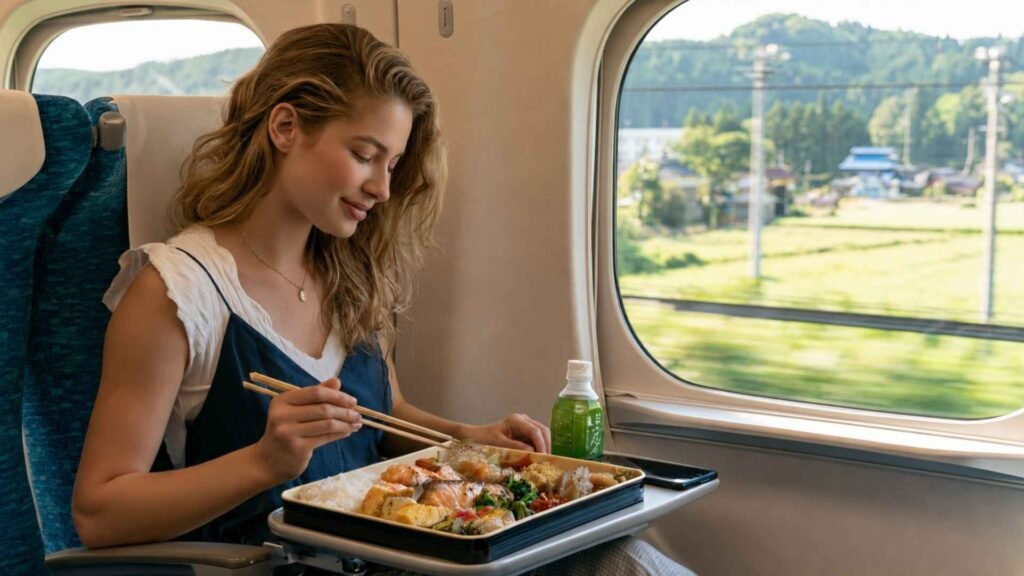
Eating and drinking are generally acceptable on the Shinkansen.
Many passengers buy an ekiben—a station bento box—before boarding. Major stations also sell sandwiches, snacks, sweets, tea, coffee, and bottled drinks.
Buy what you need before reaching the platform when possible. Trolley sales are limited or unavailable on many routes, so do not rely on purchasing a meal after departure.
Choose food with a mild aroma and dispose of rubbish in the appropriate onboard or station bins. If no bin is available, carry it with you.
Shinkansen Etiquette
Shinkansen journeys are typically calm and quiet. Visitors are not expected to understand every local custom, but a few habits make the experience more comfortable for everyone.
Keep Your Voice Low
Quiet conversation is acceptable. Avoid loud group discussions, speakerphone calls, and audible notifications.
Do Not Make Calls at Your Seat
Place your phone on silent mode. If you need to take a call, move to a permitted deck area between carriages.
Use Headphones
Music, videos, games, and other audio should not be audible to surrounding passengers.
Recline Considerately
Shinkansen seats are designed to recline, but lower the seat gradually and consider acknowledging the person behind you first.
Return it to the upright position before leaving.
Keep the Aisle Clear
Do not allow suitcases, coats, shopping bags, or children’s belongings to obstruct the aisle.
Prepare Before Your Stop
Collect your belongings shortly before arrival, but avoid standing in the aisle too early. Check the overhead rack and seat pocket before leaving.
Toilets and Onboard Facilities
Depending on the train and carriage, facilities may include:
- Toilets and washbasins
- Accessible toilets
- Reclining seats
- Tray tables
- Coat hooks
- Electrical outlets
- Free Wi-Fi
- Multipurpose rooms on selected services
Facilities vary by train model and route.
Do not assume that every seat has its own power outlet. Carrying a charged power bank remains sensible.
Wi-Fi may work well for messaging and basic browsing, but performance can decline in tunnels, rural areas, or crowded carriages.
Making Shinkansen Transfers
Some itineraries require a transfer between two Shinkansen services.
Common transfer stations include:
- Tokyo
- Omiya
- Takasaki
- Tsuruga
- Shin-Osaka
- Hakata
- Takeo-Onsen
Your reservation should list each train separately.
Before arrival, check:
- The incoming platform
- The next departure platform
- The next train’s name and number
- Your new carriage and seat
- The available transfer time
You may not need to leave the controlled Shinkansen area when both services use connected platforms.
Avoid following signs for the general station exit unless your itinerary requires leaving the Shinkansen gates.
When travelling with heavy luggage, avoid the shortest possible connection. A transfer that works on paper can still feel rushed in a large, unfamiliar station.
Transferring Between Local Trains and the Shinkansen
The gate procedure depends on whether you are using:
- Paper tickets
- A Japan Rail Pass
- A SmartEX-linked IC card
- A QR ticket
- Different tickets for the local and Shinkansen portions
With traditional paper tickets, the transfer gate may require the conventional-line ticket and the Shinkansen tickets to be inserted together.
If you have SmartEX paper tickets and use an IC card for the local journey, you may need to insert the Shinkansen tickets first and then tap the IC card.
A correctly linked SmartEX IC card can be used at supported transfer gates, provided the local card balance is sufficient where a connecting fare applies.
Ticket combinations vary. Use the staffed transfer gate whenever you are uncertain.
What Happens If You Miss the Train?
The result depends on your ticket.
With many standard reserved-seat tickets, you may be permitted to use a non-reserved carriage on a later eligible service on the same route and date. Your original reserved seat is lost once the train departs.
Obtaining another reserved seat may require an additional payment.
Discounted products can be stricter. Certain SmartEX Hayatoku fares are tied to a specific train and may not provide the same flexibility as a standard fare.
If you realise you will be late, change the reservation before departure whenever the product conditions allow it.
Do not assume that every ticket can simply be used on the next train. Speak to JR staff as soon as possible.
What If the Shinkansen Is Delayed or Cancelled?
Significant disruption is uncommon, but typhoons, heavy rain, snow, earthquakes, technical problems, and safety inspections can affect services.
If disruption occurs:
- Check the relevant JR operator’s official service information
- Follow station announcements
- Keep all tickets and receipts
- Ask whether the ticket can be changed or refunded
- Avoid leaving the controlled area until you understand your options
- Notify your accommodation if you will arrive late
- Allow additional time before flights or separately ticketed journeys
Refund and rebooking conditions depend on the delay, operator, route, and ticket product.
Avoid planning the final Shinkansen of the day immediately after an international flight. Immigration, baggage collection, and airport transportation can easily take longer than expected.
Using the Shinkansen with Children
The Shinkansen is comfortable for families, especially when seats are reserved together.
Under standard JR fare classifications:
- Adults are generally aged 12 and over.
- Children are generally aged 6–11 and usually pay half the adult basic and limited express fare.
- Children aged 1–5 are classified as infants.
- Babies are younger than one year.
A 12-year-old still attending elementary school may be treated as a child under JR rules, while a six-year-old who has not yet entered elementary school may be classified as an infant.
Infants and babies can travel free in certain circumstances, but a child fare is required if they occupy their own reserved seat. Charges can also apply when one accompanying adult or child travels with more than two infants.
For an easier journey:
- Reserve seats together
- Avoid the busiest departures
- Choose at least one aisle seat
- Buy food before boarding
- Keep entertainment and essentials accessible
- Use luggage forwarding for large suitcases
- Arrive at the platform early
Confirm the exact child-fare conditions when purchasing, particularly if younger children need separate seats.
Accessibility and Reduced Mobility
Shinkansen trains and major stations provide accessible facilities, but travellers needing assistance should arrange it in advance whenever possible.
Support may include:
- Step-free station routes
- Elevators
- Wheelchair-accessible seating
- Accessible toilets
- Boarding assistance
- Transfer guidance
- Multipurpose rooms on eligible trains
Wheelchair spaces and accessible seats are limited and may require reservations.
Contact the relevant JR operator or visit a staffed ticket office before travelling. Allow additional connection time because an accessible route through a large station may be longer than the standard route.
11 Essential Shinkansen Tips: A Quick Checklist
Before leaving for the station, use this quick checklist to make sure the most important details are covered.
- Search for the exact Shinkansen station, particularly when the name begins with “Shin.”
- Reserve seats during holidays, weekends, cherry blossom season, and autumn foliage season.
- Confirm that your Japan Rail Pass covers the train type before boarding.
- Use SmartEX only within its Tokaido, Sanyo, and Kyushu coverage area.
- Measure large bags by adding their length, width, and height.
- Arrive at least 20–30 minutes before departure.
- Match the train name, number, time, and platform.
- Queue beside the floor marking for your carriage.
- Buy food and drinks before boarding.
- Keep every ticket and boarding credential until you exit.
- Use the staffed gate whenever the ticket procedure is unclear.
Frequently Asked Questions About the Shinkansen
Do I Need to Book the Shinkansen in Advance?
Not for every journey. Advance booking is strongly recommended during busy periods, when travelling with companions, or when you need oversized-baggage space.
Outside peak periods, solo travellers can often buy a ticket on the day.
Can I Buy a Shinkansen Ticket on the Same Day?
Yes. Subject to availability, tickets can be purchased on the day from a reserved-seat machine, JR ticket office, or eligible online service.
Can I Use Suica on the Shinkansen?
Not as an ordinary stored-value journey in the same way as a local train. A compatible IC card can act as the boarding credential when correctly linked to an eligible service such as SmartEX.
Can I Bring a Suitcase onto the Shinkansen?
Yes. Standard suitcases are permitted. On affected lines, baggage measuring more than 160 cm and up to 250 cm in combined dimensions requires an oversized-baggage reservation.
Are All Shinkansen Seats Reserved?
No. Many trains provide both reserved and non-reserved carriages, although the arrangement varies.
Nozomi trains operate with reserved seats only during designated peak periods.
Can I Change My Reservation?
Many standard and SmartEX reservations can be changed before departure, subject to their conditions. Discounted fares may be restricted to a particular train.
What Happens If Someone Is Sitting in My Seat?
Politely show the seat number on your reservation. If the issue is not resolved immediately, ask the conductor for assistance.
Can I Eat on the Shinkansen?
Yes. Eating and drinking are generally acceptable. Ekiben and other station meals are popular choices, but avoid strongly scented food.
Is There Wi-Fi on the Shinkansen?
Free Wi-Fi is available on many services, although connection quality varies by train, route, and location.
Is the Shinkansen Covered by the Japan Rail Pass?
Most eligible Shinkansen services are covered. Nozomi and Mizuho require an additional ticket, while some routes or premium facilities may have other exclusions.
How Early Should I Arrive for the Shinkansen?
Arrive 20–30 minutes early when your ticket is ready, or allow 30–45 minutes if you need to buy tickets, navigate a large station, or travel with children or luggage.
Is the Shinkansen Easy for First-Time Visitors?
Yes. The ticket options may seem complicated before the first journey, but stations are well organised, major signs include English, and the carriage markings make boarding predictable.
Before stepping onto the train, check four details:
- Train name and number
- Departure time
- Platform
- Carriage and seat
If those details match your ticket, the rest is usually straightforward.
Once you have completed your first journey, the system quickly begins to feel familiar—and the Shinkansen often becomes one of the easiest and most enjoyable parts of travelling through Japan.