
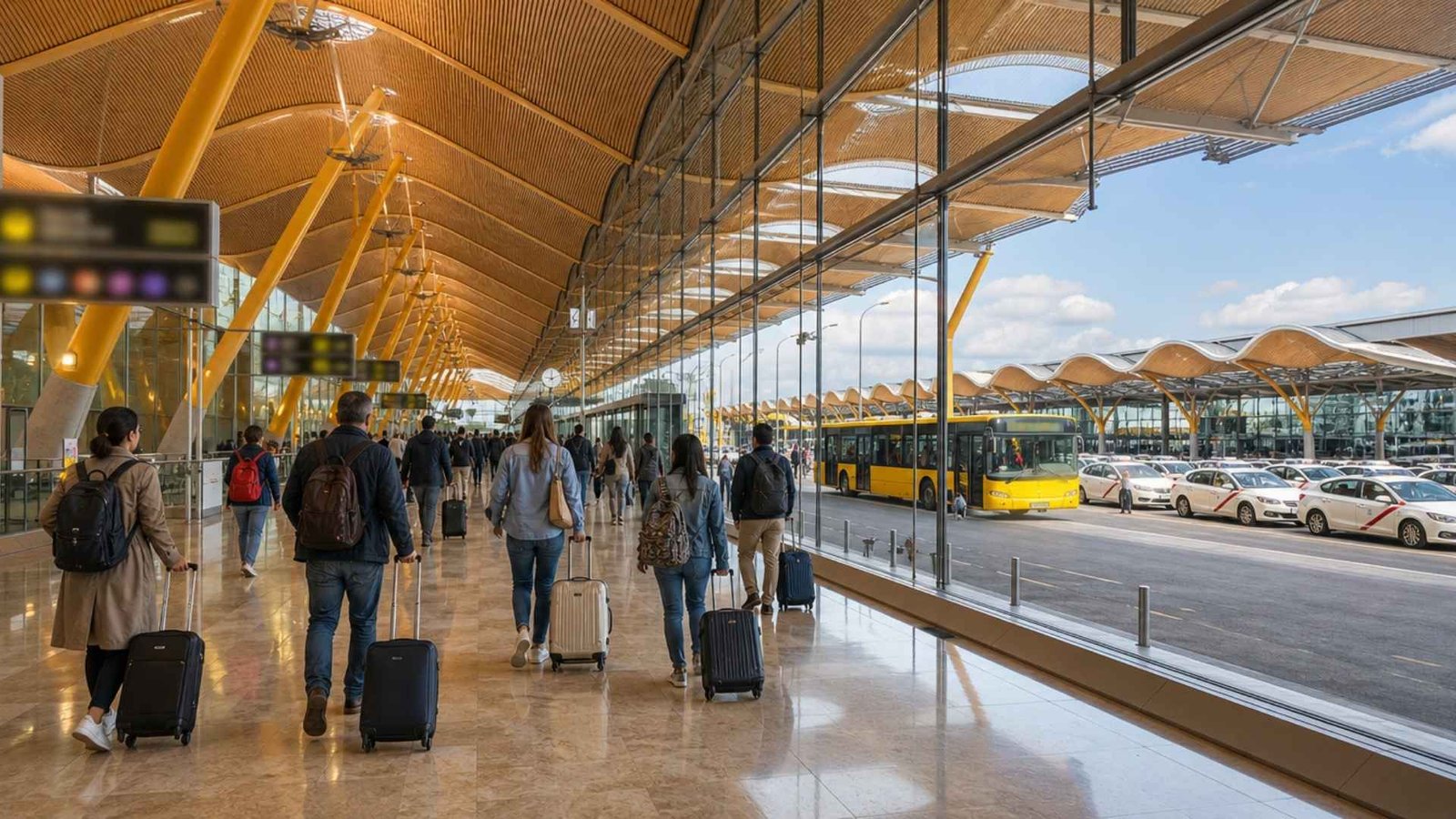
Travelling from Madrid Barajas Airport to city centre hotels is straightforward once you choose the option that matches your terminal, arrival time and final neighbourhood. Metro Line 8 is reliable for many daytime journeys, while Cercanías is especially convenient from Terminal 4. The Airport Express provides a simple 24-hour connection, and official taxis offer a fixed fare to addresses inside the M-30. This guide compares the five main options, current fares and realistic journey times for 2026.
Quick Answer: Madrid Barajas Airport to City Centre
| Transport | Best for | Typical fare | Typical time to central Madrid | Main limitation |
|---|---|---|---|---|
| Metro Line 8 | Solo travellers and light luggage | €4.50–€5, plus €2.50 for a new Multi card | 25–45 minutes | Usually requires at least one change |
| Cercanías C1 | T4 arrivals, Atocha, Recoletos and Chamartín | €1.70–€2.60 | 15–40 minutes | Airport station is only at T4 |
| Airport Express bus | Late arrivals, Cibeles and Atocha | €5 | 30–50 minutes | Journey time depends on traffic |
| Official taxi | Door-to-door travel inside the M-30 | €33 fixed fare | 20–35 minutes | Traffic can extend the journey |
| Private transfer or VTC | Families, groups and arranged pickups | Quote-based | 20–40 minutes | Usually costs more than public transport |
These are planning ranges from the airport stop or station. Add time for walking from your gate, waiting for the next service and completing the journey from the final stop to your hotel. Fares and operating hours were checked in September 2026 but can change.
How to Choose Your Airport Transport in 30 Seconds
There is no single best option for every traveller because your arrival terminal and hotel location matter more than small differences in price.
- Choose Cercanías C1 from T4 if you are staying near Chamartín, Recoletos, Atocha or Príncipe Pío.
- Choose Metro Line 8 if your destination connects conveniently from Nuevos Ministerios and you are comfortable changing lines.
- Choose the Airport Express for Cibeles, Atocha or a late-night arrival.
- Choose an official taxi when you have several bags, young children or a hotel away from a convenient station.
- Choose a private transfer when you need a larger vehicle, child seat, accessible transport or arranged pickup.
For most solo travellers making the Madrid Barajas Airport to city centre journey during the day, Metro or Cercanías offers the best balance of cost and reliability. The Airport Express is the strongest all-night public option, while taxis and private transfers provide the easiest door-to-door journey.
1. Metro Line 8: Best for Frequent and Predictable Service
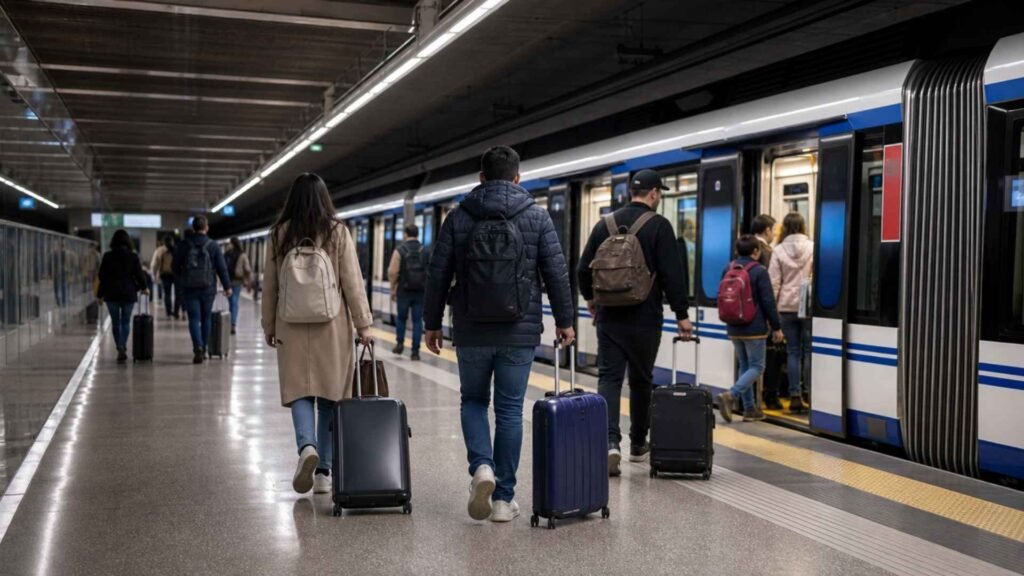
Metro Line 8 connects Madrid Barajas Airport with Nuevos Ministerios through two airport stations. Aeropuerto T1-T2-T3 serves Terminals 1, 2 and 3, while Aeropuerto T4 is located inside Terminal 4.
Line 8 does not travel directly to Puerta del Sol, Gran Vía or most central hotel districts. At Nuevos Ministerios, you normally need to change to another Metro line or continue by taxi. Some destinations are easier with a change at Colombia, so check the route to your hotel’s exact address rather than treating “city centre” as a single stop.
Madrid Airport Metro Fare in 2026
The airport journey combines a standard Zone A Metro fare of €1.50–€2 with the €3 airport supplement. If you do not already have a reusable Multi Public Transport Card, you must also pay €2.50 for the card.
This makes the first Metro journey from the airport approximately €7–€7.50. Later journeys loaded onto the same card do not require another card purchase.
The airport supplement is generally included in a valid Tourist Travel Pass. When using a ticket machine, select the correct airport journey or supplement and keep your ticket or card until you have passed through the exit gates.
Metro Operating Hours
Line 8 operates daily, including public holidays, from approximately 06:05 to 02:00. The system remains open until around 02:00, although the final trains leave each end of the line at 01:33. Maintenance or temporary service changes can affect individual journeys, so check the official Aena Metro information before relying on the first or last service of the day.
Who Should Use the Metro?
The Metro is a strong choice when you have manageable luggage and your accommodation is near a convenient interchange. It becomes less comfortable when the journey requires two changes, a lift is temporarily unavailable or you are travelling during a crowded weekday rush hour.
Clara’s Tip: Check your hotel’s nearest Metro station before buying your ticket. A route that appears faster on a network map may feel considerably longer when it includes several corridors, two changes and a final walk with luggage.
2. Cercanías C1 Train: Best from Terminal 4
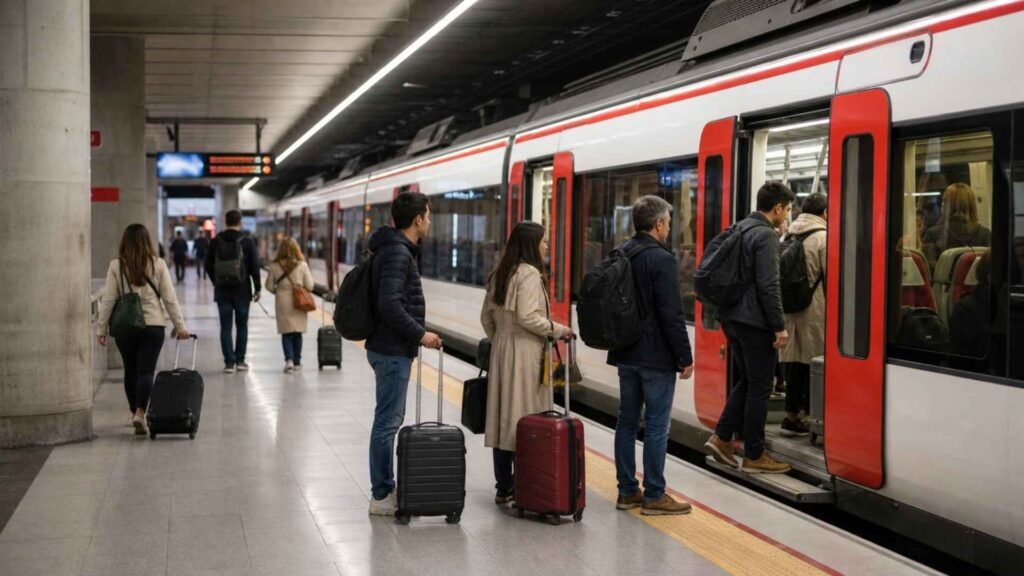
Cercanías C1 is often the fastest and cheapest public transport option from Terminal 4. It connects Aeropuerto T4 with several major stations across Madrid.
The line is particularly useful for:
- Chamartín: The main railway station and northern business district
- Nuevos Ministerios: Metro connections and the AZCA business area
- Recoletos: Parts of Salamanca, Chueca and the Paseo del Prado area
- Atocha: Onward trains, Lavapiés and the southern side of the historic centre
- Príncipe Pío: Western Madrid and onward Metro connections
Single fares currently range from €1.70 to €2.60, depending on the number of zones travelled. Tickets are available from Cercanías machines and ticket offices at the T4 station and must be used within the validity period shown on the ticket.
Important Terminal Limitation
The airport’s Cercanías station is located at T4 only. If you arrive at T1, T2 or T3, you must first take the free airport shuttle bus to T4, which can remove much of the train’s time advantage.
From T1–T3, Metro, Airport Express or taxi is normally simpler unless the C1 route is particularly convenient for your final destination.
Passengers arriving at T4S must first take the airport’s internal train to the main T4 building and complete the normal arrival process before following signs for Cercanías. For a clearer explanation of the terminal layout, see the Madrid Barajas Airport Guide.
How Long Does the C1 Train Take?
Allow approximately 15–20 minutes to Chamartín, 25–30 minutes to Recoletos and 30–40 minutes to Atocha. These are approximate onboard journey times, so add the wait for the next train, the walk to the platform and any onward connection.
Check the live departure board before boarding because engineering work and operational changes can affect platforms or service patterns. Older Madrid transport guides may also refer to different airport rail arrangements, so use the service shown on the current airport and Renfe information screens.
3. Airport Express Bus: Best 24-Hour Public Transport
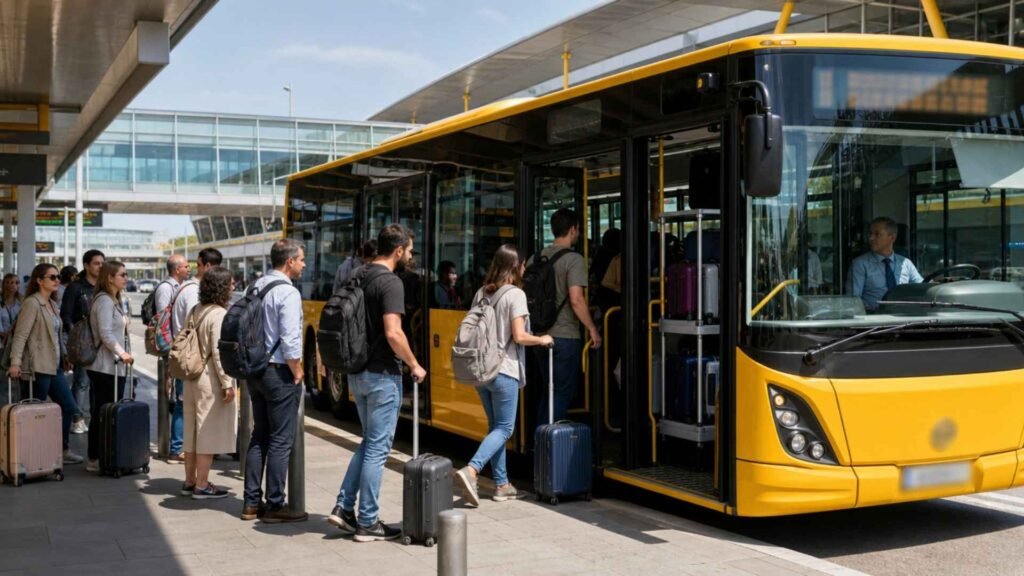
EMT Line 203, usually called the Airport Express or Exprés Aeropuerto, provides a straightforward Madrid Barajas Airport to city centre connection 24 hours a day. It serves T1, T2 and T4, while passengers arriving at T3 normally use the nearby T2 bus stop.
The central stops include O’Donnell, Plaza de Cibeles and Atocha. Overnight services use Cibeles as the principal central terminus, so do not assume that every late-night bus continues to Atocha.
The fare is €5 per passenger, regardless of journey length. Travel time is normally around 30–50 minutes, although traffic, major events and road closures can make the journey longer. The latest fare and operating information is available on the official Aena bus page.
When Is the Airport Express the Best Choice?
The Airport Express works particularly well if:
- You arrive after the Metro and Cercanías have stopped.
- Your hotel is near Cibeles, Retiro, the Prado area or Atocha.
- You want to avoid changing trains with luggage.
- You prefer an above-ground journey with clearly defined airport stops.
It is less convenient for accommodation around Sol or Gran Vía because you may still need to walk, take a local bus or use a short taxi journey from Cibeles. Unlike Metro and Cercanías services, the Airport Express shares the road with city traffic, so its travel time is less predictable.
4. Official Taxi: Best for Door-to-Door Convenience
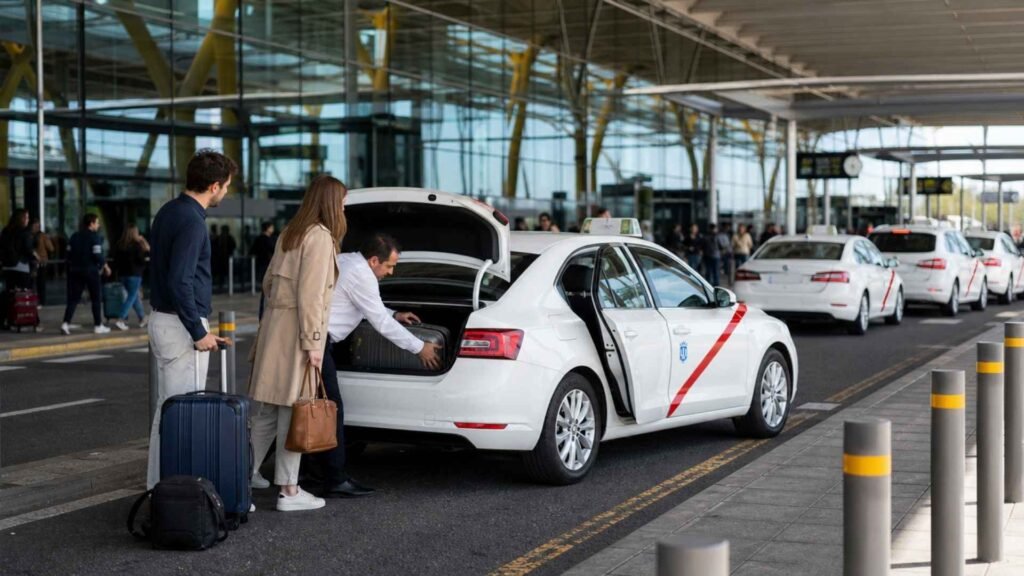
Official Madrid taxis wait at clearly signed ranks outside the arrivals area of every terminal. They are white with a red diagonal stripe and display the Madrid City Council emblem on their doors.
The fixed Fare 4 is €33 for eligible Madrid Barajas Airport to city centre journeys ending inside the M-30 ring road. It applies 24 hours a day, every day of the year, and no normal supplements can be added. Most central Madrid hotels are inside the M-30, but confirm the location if your accommodation is close to or beyond the boundary.
A taxi to central Madrid normally takes approximately 20–35 minutes. Heavy traffic can extend the journey, but the fixed fare still provides certainty about the final price for eligible addresses. Always use the official rank, ignore anyone offering taxi services inside the terminal and ask for a receipt at the end of the journey.
Is a Taxi Worth It?
For one passenger, public transport is considerably cheaper. For two to four people, however, the €33 fixed fare is divided across the group and can offer good value, particularly when everyone is travelling with luggage.
A taxi may also be the most practical option when your hotel is not close to a direct Metro, train or Airport Express stop. The time and effort saved by avoiding transfers and the final walk can be more valuable than choosing the lowest fare.
5. Private Transfer or VTC: Best for Arranged Pickup

A pre-booked private transfer provides a confirmed meeting procedure and can be arranged with a larger vehicle, child seat or additional luggage capacity when requested in advance. App-based VTC services may also operate from designated pickup areas at Madrid Barajas Airport.
Prices are quote-based and vary according to the vehicle, demand, booking time and destination. Unlike an official taxi, a VTC or private transfer does not automatically use the fixed M-30 airport fare. Before booking, review the total price, cancellation conditions, included waiting time, luggage allowance and exact airport meeting point.
A private transfer is most useful for:
- Families requiring a confirmed child seat
- Groups too large for one standard taxi
- Travellers carrying bulky or specialist luggage
- Passengers needing an accessible vehicle
- Travellers who prefer an arranged meeting point
If your flight is delayed, follow the operator’s instructions rather than leaving the agreed meeting area. For the steps before you reach the public arrivals hall, use the separate Madrid Barajas Airport Arrival Guide.
Which Option Is Best from Each Madrid Airport Terminal?
The most convenient Madrid Barajas Airport to city centre route can change according to where your flight arrives. T4 has direct access to both Metro and Cercanías, while passengers arriving at T1–T3 normally choose between Metro, Airport Express and taxi.
| Arrival terminal | Easiest low-cost option | Fastest practical option | What to remember |
|---|---|---|---|
| T1 | Metro or Airport Express | Taxi | There is no Cercanías station; use T1’s own Metro and bus access |
| T2 | Metro or Airport Express | Taxi | T2 has convenient access to the T1-T2-T3 Metro station |
| T3 | Metro or Airport Express via T2 | Taxi | Follow signs towards T2 for most public transport stops |
| T4 | Cercanías C1 or Metro | Taxi or C1 for rail-linked districts | T4 has both Metro and Cercanías stations |
| T4S | Cercanías or Metro after reaching T4 | Taxi from the main T4 arrivals area | Take the internal APM to T4 before using any landside transport |
Do not travel to another terminal simply because one transport option appears slightly cheaper. The airport shuttle, waiting time and additional walking can turn a small saving into a longer and more tiring journey.
Best Madrid Airport Transport by Destination
Choosing the most practical Madrid Barajas Airport to city centre connection also depends on the location of your accommodation. Selecting the stop closest to your hotel can remove an unnecessary transfer or a difficult final walk.
Puerta del Sol and the Historic Centre
The Airport Express to Cibeles followed by local transport or a short taxi journey is often the simplest public option. Metro is reliable but normally requires more than one line to reach Sol, while a taxi provides the easiest door-to-door journey after a long flight.
Gran Vía, Chueca and Malasaña
Cercanías from T4 to Recoletos can work well for the eastern side of this area, followed by a walk or short onward journey. From T1–T3, Metro may be more practical, although the number of changes depends on the exact hotel location.
These neighbourhoods contain many smaller streets, so check the distance from the final station rather than relying only on the district name. A taxi becomes more attractive when the final walk is long or difficult with luggage.
Atocha, Lavapiés and the Prado Area
Cercanías C1 is usually the strongest option from T4 because it provides a direct connection to Atocha. The Airport Express is generally simpler from T1–T3 and serves Atocha during its daytime operating pattern.
If you arrive late at night, check the bus’s current central terminus before boarding. Overnight services focus on Cibeles, which may require another connection to accommodation near Atocha or Lavapiés.
Salamanca and Retiro
The Airport Express stops at O’Donnell and Cibeles, both of which can be convenient depending on your hotel’s location. Cercanías to Recoletos is a good alternative from T4, particularly for accommodation on the western side of Salamanca.
These neighbourhoods cover a large area, so a stop that looks suitable on a city map may still leave a considerable walk. Check the exact address before deciding between public transport and taxi.
Chamartín
Cercanías C1 from T4 is the clearest public transport choice for Chamartín and its railway station. It offers a direct journey without the need to cross central Madrid.
From T1–T3, Metro Line 8 to Nuevos Ministerios followed by an onward connection may be easier than taking the airport shuttle to T4 solely to use Cercanías. Compare the complete journey rather than only the time spent on the train.
How to Travel from Madrid Barajas Airport to City Centre Late at Night
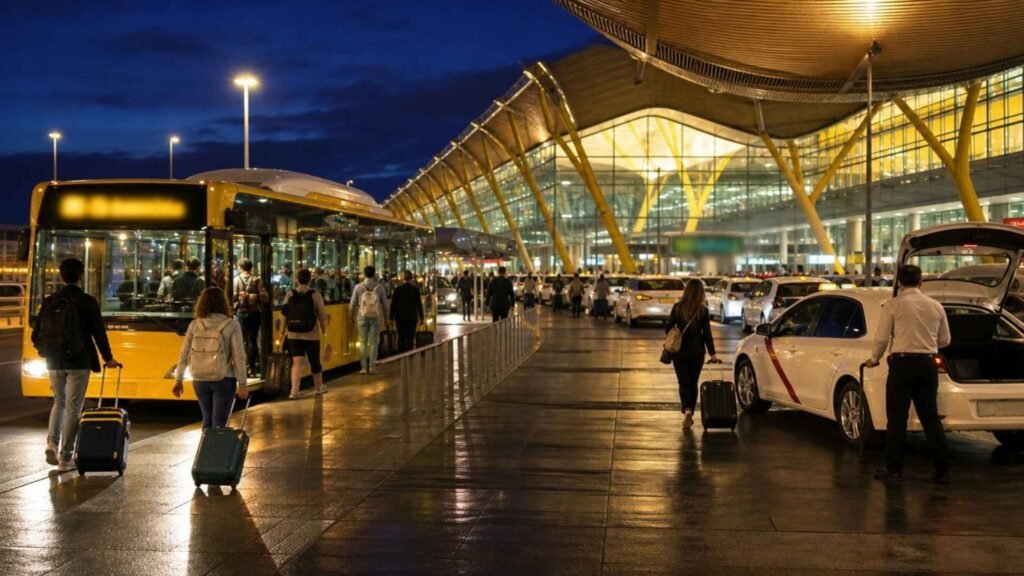
The Airport Express is the main 24-hour public transport option between Madrid Barajas Airport and central Madrid. Overnight services use Cibeles as their principal central stop, where you may need a night bus, taxi or walk to complete the journey to your hotel.
Metro does not operate throughout the night, and Cercanías services stop earlier. Remember that your flight’s scheduled arrival is not the time you will reach the station. Disembarking, passport control, baggage collection and walking through the terminal can push a late arrival beyond the final train.
An official taxi is the most straightforward late-night alternative, with the fixed airport fare continuing to apply to eligible addresses inside the M-30. If a severe delay would make the journey into Madrid impractical, compare the options in Hotels Near Madrid Barajas Airport rather than assuming you must continue into the centre immediately.
Travelling with Luggage, Children or Reduced Mobility
The lowest fare is not always the most practical choice when you have additional travel needs. Consider the number of changes, the final walking distance and whether your route depends on several lifts before selecting your transport.
Travelling with Heavy Luggage
Cercanías is comfortable from T4 when your hotel is close to one of its stations, while the Airport Express avoids underground interchanges. Metro can still work with luggage, but a route involving two changes and long station corridors may become tiring.
A taxi normally provides the easiest final approach to the hotel. This can be particularly valuable when your accommodation is on a smaller street or some distance from the nearest station.
Travelling with Children
A taxi or pre-booked transfer reduces stairs, corridors, crowded connections and the risk of becoming separated during a transfer. The convenience may justify the additional cost, especially when several passengers can share the fare.
If you require a particular child-restraint arrangement, request and confirm it before travelling. Do not assume that every taxi or private vehicle automatically carries the correct seat.
Travelling with Reduced Mobility
The airport’s Metro and rail stations have accessible infrastructure, but the complete journey also depends on lift availability and step-free access at the destination station. Check every interchange rather than confirming only that the airport station is accessible.
Travellers who need predictable door-to-door assistance may find an adapted taxi or pre-arranged accessible vehicle more suitable. Confirm the vehicle and assistance requirements in advance.
How to Buy Tickets Without Delaying Your Journey
- Metro: Buy your ticket from the machines at Aeropuerto T1-T2-T3 or Aeropuerto T4. Select the airport fare and purchase a Multi card if you do not already have one.
- Cercanías: Use the Renfe machines or ticket office at the T4 station. Keep your ticket because you may need it to pass through the exit gates.
- Airport Express: Pay the €5 fare onboard. If paying with cash, carry a smaller note because Aena states that the maximum change is €20.
- Official taxi: Join the signed rank outside arrivals and confirm that your destination is inside the M-30 for the fixed airport fare.
- Private transfer or VTC: Follow the operator’s exact terminal and pickup-zone instructions.
Save a screenshot of your hotel’s name and address before leaving the arrivals hall. It will be useful when checking the correct station exit or explaining your destination to a driver.
Common Mistakes to Avoid
Assuming Cercanías Serves Every Terminal
The airport’s Cercanías station is at T4 only. From T1–T3, changing terminals just to use C1 may take longer than travelling directly by Metro or Airport Express.
Treating Nuevos Ministerios as the Historic Centre
Metro Line 8 ends at Nuevos Ministerios, which is a major transport interchange but not Puerta del Sol. Include the onward Metro journey, taxi ride or walk in your total travel time.
Planning Around the Scheduled Landing Time
Your ground journey begins only after you reach the public arrivals area. Late flights need enough margin for disembarking, passport control, baggage collection and walking through the terminal.
Accepting an Unofficial Taxi Offer
Official taxis use clearly marked ranks outside the terminals. Do not accept unsolicited rides from people approaching passengers inside the airport building.
Comparing Only the Headline Fare
A cheap route involving two changes and a long final walk may not offer the best overall value. Compare the complete door-to-door time, group size, luggage effort and distance between the final stop and your hotel.
Forgetting the Metro Card Cost
First-time Metro users may need to purchase the €2.50 Multi card in addition to the standard Metro fare and €3 airport supplement. Include all three elements when comparing the Metro with other options.
Frequently Asked Questions About Madrid Barajas Airport to City Centre
How far is Madrid Barajas Airport from the city centre?
Madrid Barajas Airport is approximately 12–15 kilometres from central Madrid. The exact distance depends on your arrival terminal and which part of Madrid you use as the city centre.
What is the cheapest way from Madrid Barajas Airport to city centre?
Cercanías C1 is often the cheapest direct airport rail option from T4, with single fares ranging from €1.70 to €2.60. From T1–T3, compare Metro and bus routes without forgetting the Metro card cost and any required changes.
What is the fastest way to central Madrid?
Cercanías can be the fastest option from T4 when your destination is close to a station on the C1 route. A taxi is normally the fastest door-to-door choice when traffic is light and your hotel is not beside a direct public transport stop.
Does the Madrid Metro go directly to the city centre?
Metro Line 8 connects Madrid Barajas Airport with Nuevos Ministerios. Most visitors then need to change to another Metro line or use another form of transport to reach their hotel.
Is there a direct train from Madrid Airport to Atocha?
Yes. Cercanías C1 connects Aeropuerto T4 with Atocha, but there is no Cercanías station at T1, T2 or T3.
How much is a taxi from Madrid Airport to the centre?
The official fixed fare is €33 between Madrid Barajas Airport and eligible addresses inside the M-30. It applies 24 hours a day and does not accept normal supplements.
Does the Airport Express bus run all night?
Yes. Airport Express Line 203 operates 24 hours a day. However, overnight services use Cibeles as the principal central stop rather than continuing to every daytime stop.
Where do I catch the Airport Express at T3?
The Airport Express serves T1, T2 and T4. Passengers arriving at T3 should follow the airport signs towards the nearby T2 bus stop.
Is Metro or Cercanías better from Terminal 4?
Cercanías is normally better for Chamartín, Recoletos, Atocha and other stations directly served by C1. Metro is better when your destination connects more naturally from Line 8.
Should I book a private transfer in advance?
Advance booking can be worthwhile for a large group, bulky luggage, a required child seat or an accessible vehicle. Otherwise, official taxis and public transport are readily available at Madrid Barajas Airport.
Final Verdict: The Easiest Route into Madrid
The best route from Madrid Barajas Airport to city centre depends on where you land and where you are staying. Cercanías is excellent from T4, Metro offers dependable coverage, and the Airport Express remains the strongest all-night public option. For groups, heavy luggage or an awkward hotel location, an official taxi can provide the best overall value. Check live service information before leaving arrivals, especially late at night.