

The Greece Digital Nomad Visa allows eligible non-EU remote workers to live in Greece while working for employers, clients, or businesses located outside the country. Applicants generally need at least €3,500 per month after taxes, suitable health insurance, and proof that their work can be performed remotely.
This guide explains the updated 2026 requirements, including the new consular application rule, required documents, fees, family income thresholds, taxes, and cost of living.
Greece Digital Nomad Visa Quick Answer
| Requirement | 2026 Rule |
|---|---|
| Eligible applicants | Non-EU, non-EEA, and non-Swiss remote workers |
| Minimum monthly income | €3,500 net after taxes |
| Spouse or registered partner | Income requirement increases by 20% |
| Each dependent child | Income requirement increases by 15% |
| Permitted work | Remote work for employers or clients outside Greece |
| Greek employment | Not permitted |
| Initial visa validity | Up to 12 months |
| Residence permit | Up to two years, renewable |
| Application location | Greek consulate in the applicant’s country of residence |
| Health insurance | Required |
| Tax residency | Possible after more than 183 days or through other residency tests |
| Family members | Spouse or registered partner and dependent minor children |
Important 2026 change: A tourist or visa-exempt visitor can no longer enter Greece and then convert that stay directly into a Digital Nomad Residence Permit. The application route must normally begin at the competent Greek consulate before travel.
What Is the Greece Digital Nomad Visa?
The Greece Digital Nomad Visa is a long-stay national visa, commonly referred to as a Type D visa, created for third-country nationals who can perform their work remotely using digital technology.
It is intended for:
- Employees of companies established outside Greece
- Freelancers working with clients outside Greece
- Independent contractors providing services abroad
- Business owners whose companies are registered and operating outside Greece
The visa allows remote workers to reside in Greece without entering the Greek labor market.
This means you may continue working for a company in the United States, United Kingdom, Canada, Australia, Türkiye, or another foreign country while living in Greece. You cannot use the visa to accept a position with a Greek employer, invoice Greek clients, or establish a business activity in Greece.
A digital nomad visa is also different from a standard Schengen tourist visa. Short-stay permission is designed for temporary visits, while the digital nomad route provides a formal legal basis for longer residence and remote work.
Important Greece Digital Nomad Visa Change for 2026

Older online guides may state that eligible applicants can enter Greece as tourists or visa-exempt visitors and then apply locally for a two-year residence permit.
That route changed in February 2026.
According to the latest Greece Digital Nomad Visa application guidance, applicants can no longer apply for an initial Digital Nomad Residence Permit from inside Greece after entering under a tourist visa or visa waiver.
New applicants should now:
- Apply through the Greek consular authority responsible for their place of residence.
- Obtain the appropriate national Digital Nomad Visa before traveling.
- Enter Greece using that visa.
- Apply locally for a residence permit if they intend to remain beyond the initial visa period.
Anyone already holding a valid digital nomad national visa may still apply for the corresponding residence permit from within Greece before the visa expires.
This change is particularly important for applicants relying on older articles, relocation forums, or immigration advice published before February 2026.
Who Can Apply?
The Greece Digital Nomad Visa is available to nationals of countries outside the European Union, European Economic Area, and Switzerland.
You must work remotely and receive your professional income from outside Greece.
Remote Employees
Employees must normally provide an employment contract or employer certificate confirming:
- The employer is established outside Greece
- The employment relationship remains active
- The applicant is permitted to work remotely
- The contract covers the intended visa period
- The applicant meets the minimum income requirement
Obtaining a separate employer letter authorizing remote work from Greece can strengthen the application, even when remote work is already mentioned in the employment contract.
Freelancers and Independent Contractors
Freelancers may qualify when their clients are located outside Greece.
They should be prepared to provide:
- Active client contracts
- Recent invoices
- Bank statements
- Proof of regular payments
- Tax records where requested
- Information about the services they provide
Applicants with several clients should organize the documents clearly enough to show that the combined income is stable and sustainable.
Owners of Foreign Companies
Business owners may apply when their company is registered outside Greece and its activities can be managed remotely.
They may need to submit:
- Company registration documents
- Registered business address
- Description of business activity
- Proof of ownership or management position
- Company bank statements
- Evidence of personal income
The business must not be registered as a Greek company under this visa category.
EU, EEA, and Swiss Citizens
EU, EEA, and Swiss citizens do not need the Greece Digital Nomad Visa because they already benefit from freedom of movement.
They may still face registration, healthcare, tax residency, and administrative requirements when living in Greece for an extended period.
Greece Digital Nomad Visa Requirements
Applicants must satisfy several financial, professional, immigration, and health-related conditions.
The main requirements are:
- Citizenship outside the EU, EEA, and Switzerland
- Remote employment, freelance work, or business activity
- Employer, clients, or company located outside Greece
- Ability to work using information and communication technology
- Minimum net monthly income of €3,500
- Valid passport
- Suitable health and travel insurance
- Clean criminal record certificate
- Medical certificate
- Signed declaration confirming no work will be performed for Greek employers or clients
- Sufficient documentation supporting the application
Meeting the income requirement alone does not guarantee approval. The consulate must also be satisfied that the applicant’s work is genuine, stable, and compatible with the digital nomad category.
Minimum Income Requirement

The minimum income for a single applicant is €3,500 per month after taxes.
This is a net requirement. Applicants should not assume that a gross salary of €3,500 will be sufficient.
The amount increases by:
- 20% for a spouse or registered partner
- 15% for each dependent child
Income Requirements for Families
| Family Composition | Minimum Net Monthly Income |
|---|---|
| Single applicant | €3,500 |
| Applicant and spouse or partner | €4,200 |
| Applicant and one child | €4,025 |
| Applicant, spouse, and one child | €4,725 |
| Applicant, spouse, and two children | €5,250 |
The additional percentages are calculated from the main €3,500 threshold:
- 20% for a spouse or partner = €700
- 15% for each child = €525
Applicants earning in another currency should maintain a reasonable margin above the threshold. Exchange-rate fluctuations could otherwise push the documented income below the minimum during assessment or renewal.
How Can You Prove Your Income?
Depending on your employment structure, evidence may include:
- Employment contract
- Employer certificate
- Recent payslips
- Client agreements
- Independent service contracts
- Recent invoices
- Personal bank statements
- Business bank statements
- Tax returns or income certificates
- Proof of recurring payments
The Greece Digital Nomad Visa document checklist states that sufficient funds may be demonstrated through employment or service contracts, employment certificates, or bank account evidence.
Although savings can support an application, applicants should not assume that a large one-time bank balance will replace the requirement for stable professional income. Ask the responsible consulate how it assesses savings, irregular freelance revenue, dividends, or business-owner income.
Required Documents
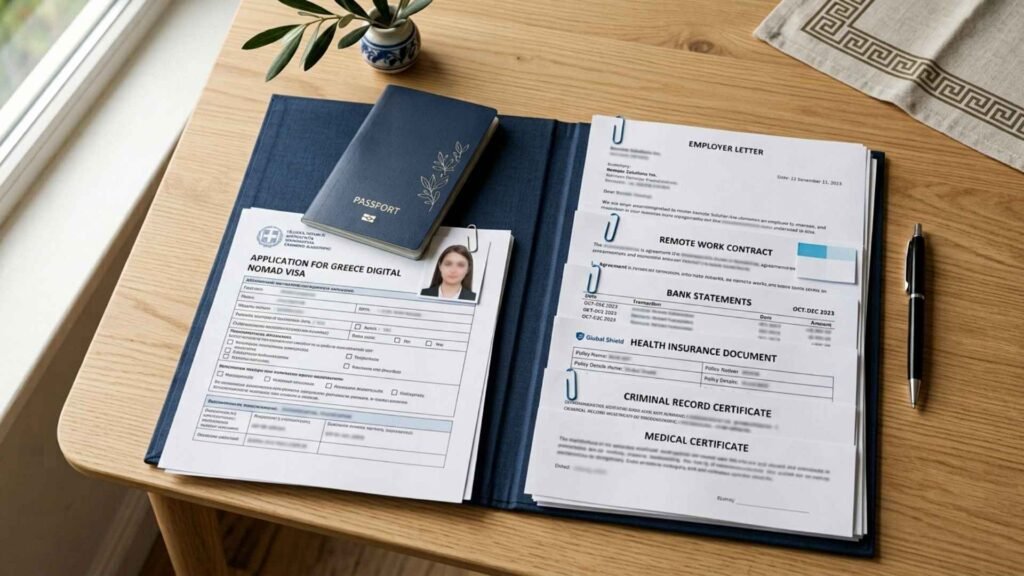
The exact checklist may vary according to nationality, country of residence, and consular practice.
Applicants should generally prepare:
Long-Stay Visa Application Form
The national Type D visa application form must be completed, signed, and submitted with a recent photograph meeting the required biometric standards.
Valid Passport
The passport should normally:
- Have been issued within the previous 10 years
- Remain valid for at least three months beyond the intended departure date
- Contain at least two blank pages
A consulate may request a longer remaining validity period for a long-stay application.
Declaration Letter
Applicants must declare that they intend to live in Greece while working remotely and will not provide employment or independent services to an employer or client established in Greece.
Proof of Remote Work
Employees can provide their contract, employer certificate, and remote-work authorization.
Freelancers can submit contracts, invoices, client information, and proof of payments.
Company owners may need corporate registration documents and details about the company’s registered office, activities, and ownership.
Proof of Income
Contracts, payslips, bank statements, tax records, or other financial evidence should demonstrate that the applicant meets the net monthly income threshold.
Criminal Record Certificate
Applicants normally need a criminal record certificate issued by the authorities of their country of residence.
The certificate may need an apostille or other legalization, along with an official translation. Document-age requirements vary, so avoid ordering it too early.
Medical Certificate
A medical certificate must generally confirm that the applicant does not have a condition considered a serious risk to public health.
The consulate may specify which doctors, hospitals, or medical institutions are authorized to issue the certificate.
Health and Travel Insurance
Insurance must normally remain valid for the relevant visa period and cover:
- Emergency medical care
- Emergency hospital treatment
- Medical repatriation
- Other coverage required by the consulate
Accompanying family members also need suitable coverage.
Family Documents
Applicants bringing family members may need:
- Marriage certificate
- Registered partnership certificate
- Birth certificates for children
- Custody or parental consent documents where applicable
- Apostilles or legalization
- Official translations
Each family member generally receives an individual visa or residence document.
Maya’s Tip: Ask the responsible consulate for its current written checklist before paying for translations, apostilles, medical certificates, or insurance. A document accepted by one Greek consulate may require a different format or validity period at another.
How to Apply for the Greece Digital Nomad Visa

The application process begins at the Greek consulate responsible for your legal place of residence. The steps are straightforward, but confirming the current document, translation, and appointment requirements in advance can prevent avoidable delays.
Step 1: Find the Responsible Greek Consulate
Identify the embassy or consulate responsible for your legal place of residence through the Greek Ministry of Foreign Affairs missions directory.
Applying through a consulate outside your normal country of residence may require proof explaining why that consulate has jurisdiction.
Step 2: Request the Current Checklist
Contact the consulate before gathering time-sensitive documents.
Confirm:
- Current application procedure
- Appointment availability
- Required translations
- Apostille or legalization rules
- Accepted insurance policies
- Required document validity
- Payment method
- Whether an interview is required
The initial request may be made by email or registered letter, but the consulate may still require an in-person appointment for document verification, biometrics, an interview, or passport submission.
Step 3: Gather Employment and Income Evidence
Organize contracts, bank statements, payslips, invoices, employer letters, and company records.
The documents should tell a consistent story about:
- What you do
- Who pays you
- Where the employer or clients are located
- Whether the work can be performed remotely
- How much you earn after taxes
Step 4: Arrange Criminal, Medical, and Insurance Documents
Some documents take several weeks to obtain and may then need legalization and translation.
Check their permitted age before requesting them.
Step 5: Submit the Application
Submit the completed application, supporting documents, passport, photograph, and required fees using the procedure specified by the consulate.
An interview may focus on your work, income, planned accommodation, intended length of stay, and reasons for choosing Greece.
Step 6: Wait for the Decision
Current guidance states that the consular authority should respond to the request within 10 days.
However, the 10-day period should not be treated as a guaranteed visa issuance date. Additional document checks, security procedures, appointment availability, and passport processing can extend the overall timeline.
Avoid booking non-refundable flights or long-term accommodation until the visa is issued.
Step 7: Travel to Greece
After approval, check the visa sticker carefully for:
- Name and passport number
- Validity dates
- Number of entries
- Authorized duration
- Visa category
Keep digital and paper copies of the documents used for the application. Several may be needed again for the residence permit.
Realistic Greece Digital Nomad Visa Timeline
Although the Greek consular authority is expected to respond to a complete digital nomad visa request within 10 days, the entire relocation process usually takes longer.
Applicants must also allow time for criminal record certificates, medical examinations, insurance, translations, apostilles, consular appointments, and passport return.
| Application Stage | Suggested Planning Time |
|---|---|
| Confirming eligibility and contacting the consulate | 2–5 business days |
| Collecting criminal, medical, employment, and financial documents | 2–4 weeks |
| Apostilles, legalization, and official translations | 1–3 weeks |
| Waiting for a consular appointment | Varies by consulate |
| Consular response after a complete request | Normally within 10 days |
| Additional checks and passport return | Several days to several weeks |
| Preparing accommodation and traveling to Greece | 1–3 weeks |
As a practical estimate, many applicants should allow approximately 6–10 weeks between beginning document preparation and being ready to relocate.
This is a planning estimate rather than an official processing guarantee. Applications involving missing documents, irregular freelance income, family members, or additional security checks may take longer.
Do not resign from employment, end an existing lease, or book non-refundable travel based only on the shortest published processing period.
Greece Digital Nomad Visa Fees
The current visa checklist lists the following standard charges:
| Application Stage | Current Listed Fee |
|---|---|
| National visa fee | €75 |
| Administrative fee | €150 |
| Standard total per visa applicant | €225 |
| Two-year residence permit for main applicant | €1,000 |
| Additional family member residence permit | €150 per person |
The €75 visa fee and €150 administrative fee are listed as applying separately to each accompanying family member.
Translation, apostille, medical examination, insurance, biometric card, legal assistance, courier, and external application-center charges may be additional.
Because government and consular charges can change, confirm the exact amount and payment method directly before submitting the application.
Bringing Your Family to Greece
The main applicant may generally include:
- A spouse
- A legally recognized or registered partner
- Dependent minor children
Each family member receives an individual visa or residence document that normally expires at the same time as the main applicant’s authorization.
The financial threshold increases by 20% for a spouse or partner and 15% for each child. Family members also need appropriate health insurance and proof of the family relationship.
A dependent family visa does not normally give the spouse, partner, or children the right to work or conduct professional activity in Greece.
If a partner wants to work for a Greek employer or operate a Greek business, they may need a different immigration status.
Applying for the Two-Year Residence Permit
The initial national visa can be valid for up to 12 months.
Applicants who want to remain in Greece longer may apply for a Digital Nomad Residence Permit before their national visa expires.
Applications are handled through the Greek Ministry of Migration and Asylum. Applicants can use the official electronic residence permit portal to begin an initial application or access renewal and other residence permit services.
The residence permit is generally valid for up to two years and may be renewed for further two-year periods when the applicant continues to meet the conditions.
You should normally be prepared to provide:
- Valid passport
- Current national digital nomad visa
- Continuing proof of foreign remote work
- Updated proof of sufficient income
- Valid health insurance
- Greek residential lease or property purchase contract
- Family documents where applicable
- Photographs and biometric data
- Proof of payment of the required fees
A residential lease or property ownership document is particularly important at the residence permit stage.
Extended absences from Greece may affect renewal eligibility. Applicants who expect to spend substantial periods outside Greece should obtain current immigration advice before planning their travel schedule.
Greece Digital Nomad Visa Taxes

Immigration status and tax residency are separate legal matters.
Receiving the Greece Digital Nomad Visa does not automatically make you tax-free. It also does not guarantee that you will remain a tax resident only in your previous country.
According to the Greek tax residency rules published by AADE, an individual who spends more than 183 days cumulatively in Greece during any 12-month period may be considered a Greek tax resident from the first day of presence.
Tax residence may also be affected by:
- Permanent or principal residence
- Habitual place of residence
- Center of vital interests
- Personal and family relationships
- Economic relationships
A person considered a Greek tax resident may become liable to declare worldwide income in Greece.
Double taxation agreements can determine which country has the primary right to tax particular income and may provide credits for tax paid elsewhere. They do not necessarily remove filing or registration obligations.
For a more complete explanation, read our guide to Taxes in Greece for Foreigners.
Is There a 50% Tax Exemption for Digital Nomads?
Greece has an Article 5C regime that can exempt 50% of qualifying employment or business income from income tax for up to seven tax years.
However, this is not an automatic digital nomad discount.
The AADE guidance on tax incentives for new residents states that Article 5C concerns qualifying income arising in Greece from salaried employment or business activity and imposes several eligibility conditions.
A standard digital nomad working only for a foreign employer or foreign clients should not assume that the exemption applies. There may also be tension between establishing a local Greek business activity and the immigration rule prohibiting work or business for the Greek market.
Obtain personalized tax advice before including the 50% exemption in your relocation budget.
Employer and Social Security Considerations
Employees should also discuss the move with their employer.
Long-term remote work from Greece can create questions involving:
- Employer payroll obligations
- Social security contributions
- Permanent establishment risk
- Local employment rules
- Workplace insurance
- Data protection and cybersecurity
- Tax withholding
A digital nomad visa gives the employee permission to reside and work remotely. It does not automatically remove the employer’s corporate or employment-law responsibilities.
Greece Digital Nomad Visa Cost of Living

The €3,500 income threshold is an immigration requirement, not an estimate of how much a single person must spend every month.
A remote worker can often live comfortably in Greece for less, particularly outside the most expensive central neighborhoods and summer island destinations.
Estimated Monthly Budget in Athens
| Lifestyle | Estimated Monthly Budget | Typical Situation |
|---|---|---|
| Budget-conscious | €1,000–€1,400 | Shared housing or outer neighborhood, limited discretionary spending |
| Comfortable | €1,700–€2,300 | Private apartment, regular dining out, coworking and local travel |
| High-comfort | €3,000+ | Central premium apartment, frequent travel and higher discretionary spending |
These are planning estimates rather than official visa figures.
Housing usually creates the largest difference between budgets. A small apartment outside central Athens may cost approximately €500–€900 per month, while central or recently renovated apartments can reach €800–€1,400 or more.
Seasonal destinations such as Mykonos, Santorini, Paros, and parts of Crete can become significantly more expensive during summer.
Our Cost of Living in Athens guide provides a more detailed breakdown of housing, food, transportation, and everyday expenses.
Practical Setup After Arriving
Finding Accommodation
Short-term accommodation is useful during the first weeks, but residence permit applicants will generally need a formal lease or proof of property ownership.
Before paying a deposit:
- Verify the owner or authorized agent
- Inspect the property in person or through a reliable representative
- Request a written rental agreement
- Confirm whether utilities are included
- Test the internet connection
- Check noise during working hours
- Avoid untraceable cash transfers
Our guide explaining how to rent an apartment in Athens covers leases, deposits, neighborhoods, and common rental scams.
Internet and Coworking
Athens and Thessaloniki offer the strongest combination of home broadband, 5G coverage, coworking spaces, cafés, and professional services.
Internet quality can vary by building, even within the same neighborhood. Ask the landlord which connection is physically installed rather than relying on a general claim that fiber is available in the area.
A coworking membership or reliable mobile-data connection provides a useful backup during outages.
Banking and Greek Tax Number
A Greek bank account is not a standard requirement for the initial visa application.
However, longer-term residents may find one useful for rent, utilities, local payments, and government transactions. Banks may request a passport, residence document, proof of address, proof of income, foreign tax number, and Greek Tax Identification Number known as an AFM.
Requirements vary between banks and branches.
Healthcare
Private health insurance is required for the visa, but the policy should also be practical for daily life.
Check:
- Hospital network
- Outpatient appointments
- Prescription coverage
- Emergency care
- Pre-existing condition exclusions
- Deductibles
- Direct billing
- Medical evacuation and repatriation
Do not assume that holding the visa automatically provides unrestricted access to Greece’s public healthcare system.
Best Places to Live as a Digital Nomad in Greece

Athens
Athens offers the widest selection of apartments, coworking spaces, international flights, private healthcare, professional services, and year-round networking.
It is the most practical choice for first-time residents who want reliable infrastructure and do not mind traffic, summer heat, and higher central rents.
Our Athens Digital Nomad Guide explains neighborhoods, transportation, coworking, internet, and daily life in greater detail.
Thessaloniki
Thessaloniki combines an active student atmosphere, strong food culture, a walkable center, and generally lower housing costs than central Athens.
The international flight network is smaller, but it remains one of the most practical year-round alternatives.
Crete
Heraklion and Chania provide established cities, airports, healthcare, and a large international community.
Crete can work well for remote workers who want island life without relying entirely on a small seasonal destination. However, summer rental prices and availability can become difficult in popular coastal areas.
Smaller Islands
Smaller Greek islands can be attractive during spring and autumn, but they require more planning.
Potential limitations include:
- Seasonal housing
- Reduced winter ferry schedules
- Limited healthcare
- Fewer coworking options
- Variable internet by property
- Higher summer prices
Anyone working with strict meeting schedules should verify the exact apartment connection and keep a mobile backup.
Greece Digital Nomad Visa Pros and Cons
| Pros | Cons |
|---|---|
| Legal residence while working remotely | €3,500 net income threshold |
| Initial 12-month visa | No work for Greek employers or clients |
| Renewable two-year residence permit | Significant residence permit fee |
| Family members can accompany the applicant | Dependents cannot work locally under this status |
| Access to major Greek cities and islands | Tax residency may arise after extended presence |
| Travel within the Schengen Area | Administrative procedures and translations |
| Strong lifestyle and climate appeal | Seasonal housing pressure in popular destinations |
| Good time-zone overlap with Europe | Employer compliance issues may require advice |
A Greek long-stay visa or residence permit may allow short visits to other Schengen countries for up to 90 days in any 180-day period. It does not authorize residence or employment in another Schengen country.
Common Greece Digital Nomad Visa Mistakes
Following Outdated Application Advice
Articles published before February 2026 may still suggest entering Greece as a tourist and applying locally for a residence permit. New applicants should normally begin the process through the responsible Greek consulate before traveling.
Proving Gross Instead of Net Income
The €3,500 requirement refers to monthly income after taxes. Applicants earning close to the threshold should maintain a financial buffer for exchange-rate movements and income fluctuations.
Using an Incompatible Work Arrangement
Applicants cannot work for Greek employers or provide freelance services to Greek clients. Contracts, invoices, company records, and bank deposits should consistently show that professional income comes from outside Greece.
Treating the 10-Day Response as Guaranteed Visa Issuance
The 10-day period does not necessarily include appointment waiting times, additional checks, passport processing, or document corrections. Build flexibility into your relocation schedule.
Leaving Compliance Checks Until After Approval
Health insurance, document legalization, employer authorization, tax residency, payroll, and social security questions should be reviewed before relocating—not after arriving in Greece.
Is the Greece Digital Nomad Visa Worth It?
The Greece Digital Nomad Visa is a strong option for remote professionals who earn comfortably above the income threshold and want a legal base in Southern Europe.
It works particularly well for applicants who:
- Work exclusively with foreign employers or clients
- Want to stay longer than the normal tourist limit
- Prefer a European time zone
- Can manage Greek tax and administrative requirements
- Want a mix of city life, coastline, and island travel
- Do not need access to the Greek labor market
It may be less suitable for applicants whose income fluctuates around €3,500, whose spouse needs local employment, or whose employer does not allow long-term international remote work.
The visa is also not a simple tax-avoidance route. Anyone planning to spend most of the year in Greece should evaluate taxation before relocating.
FAQ About the Greece Digital Nomad Visa
Can I apply for the Greece Digital Nomad Visa from inside Greece?
Generally, no. Since the February 2026 change, tourists and visa-exempt visitors can no longer enter Greece and directly apply for the initial Digital Nomad Residence Permit.
New applicants should normally obtain the national visa through the responsible Greek consulate before traveling.
How much income do I need?
A single applicant needs at least €3,500 per month after taxes.
The threshold increases by 20% for a spouse or registered partner and 15% for each dependent child.
Can freelancers apply?
Yes. Freelancers can apply when they work remotely for clients established outside Greece and can demonstrate stable income through contracts, invoices, bank statements, and other supporting records.
Can I work for a Greek company?
No. The visa does not give access to Greek employment or locally based independent business activity.
If you want to accept a Greek job or provide services to Greek clients, you may need a different immigration status.
Can my spouse work in Greece?
A spouse or registered partner accompanying the main applicant does not normally receive the right to work or conduct business in Greece under the dependent digital nomad status.
They would need a separate status permitting employment.
How long is the visa valid?
The national visa may be valid for up to 12 months.
Eligible applicants can then apply for a two-year residence permit, which may be renewed in additional two-year periods while the conditions continue to be met.
Do I need a Greek bank account?
A Greek bank account is not generally required for the national visa.
It may become useful for rent, utilities, tax payments, and other administrative transactions after relocation.
Do digital nomads pay tax in Greece?
Potentially. Spending more than 183 days in Greece or establishing your permanent residence, habitual residence, or center of vital interests there can create Greek tax residency.
Your nationality, employment structure, home-country rules, and applicable double taxation agreement will affect the final position.
Can I travel around Europe with the visa?
A valid Greek long-stay visa or residence permit generally allows short visits to other Schengen countries for up to 90 days in any 180-day period.
It does not grant the right to live or work in another European country.
Does the visa lead automatically to permanent residence or citizenship?
No. It is not a direct permanent residence or citizenship program.
Long-term eligibility may depend on continuous legal residence, absence periods, integration requirements, and the immigration rules in force when the application is made.
Final Thoughts
The Greece Digital Nomad Visa offers eligible remote professionals a legal way to live in Greece while continuing to work for foreign employers or clients.
Before applying, confirm the latest consular checklist, income evidence, insurance requirements, and tax position. Preparing these elements together can make both the application and the move significantly smoother.
This article provides general information and does not constitute immigration, legal, tax, or financial advice. Visa rules, fees, consular procedures, and tax requirements may change. Confirm your position with the responsible Greek authorities and qualified professionals before applying.