
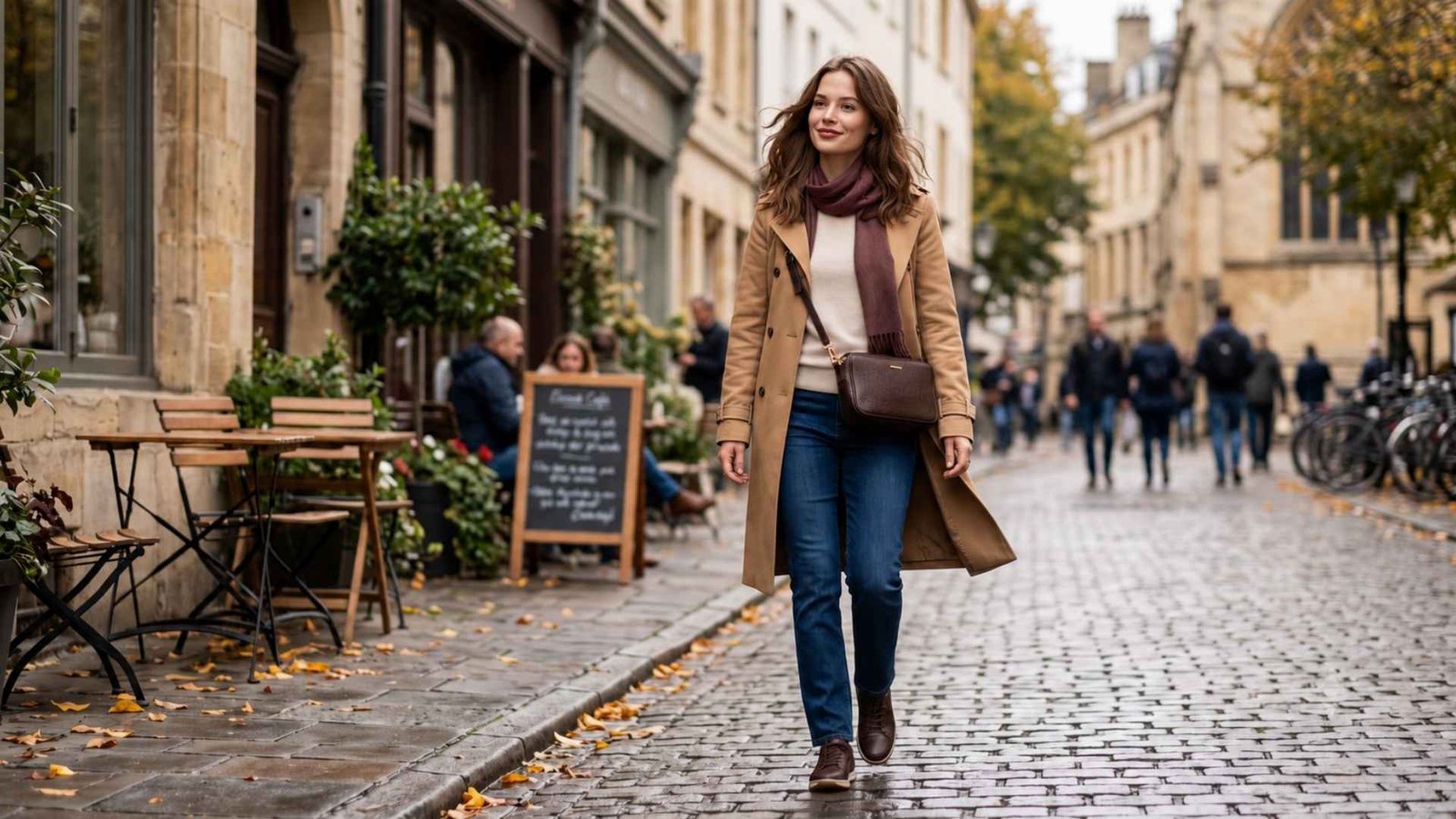
Packing for Europe in fall means preparing for cool mornings, mild afternoons, sudden rain, and colder evenings. The answer is not a larger suitcase, but clothing that can adapt throughout the day.
This fall travel capsule wardrobe for Europe uses 15 coordinated pieces to create comfortable, polished outfits for sightseeing, train journeys, museums, cafés, and relaxed dinners—without packing a separate look for every occasion.
Quick Answer: What Should You Pack for Europe in Fall?
A practical 15-piece fall capsule includes:
- 2 outerwear options
- 2 knit layers
- 3 everyday tops
- 3 bottoms
- 1 versatile midi dress
- 2 pairs of shoes
- 1 large scarf
- 1 secure crossbody bag
These pieces can create more than 20 combinations, although 10 reliable outfit formulas are usually enough for a one- or two-week trip.
Your destination matters. Southern Europe may remain warm in September and early October, while Northern Europe, mountain regions, and late-autumn itineraries can require thermal layers, insulated outerwear, and weather-resistant footwear.
Lina’s Tip: Choose your main coat and two pairs of shoes first. When these three pieces coordinate, building the rest of the capsule becomes much easier.
Why Fall Packing Requires a Flexible Wardrobe
Europe does not experience one consistent autumn climate.
A September afternoon in Rome, Seville, or Athens may still feel summery. At the same time, Amsterdam, Copenhagen, or Edinburgh can be cool, windy, and wet.
Temperatures can also change within the same day. You may need a cardigan and coat at breakfast, remove both inside a museum, and put them on again after sunset.
Instead of packing for every possible condition, choose clothing that can be layered and reworn. Each visible piece should:
- Coordinate with several other items
- Fit beneath your outerwear
- Work with at least one pair of shoes
- Suit more than one activity
- Remain comfortable during long walking days
Apply the three-outfit rule before packing: if you cannot create at least three realistic looks with an item, it probably does not belong in the capsule.
Choose a Coordinated Fall Color Palette
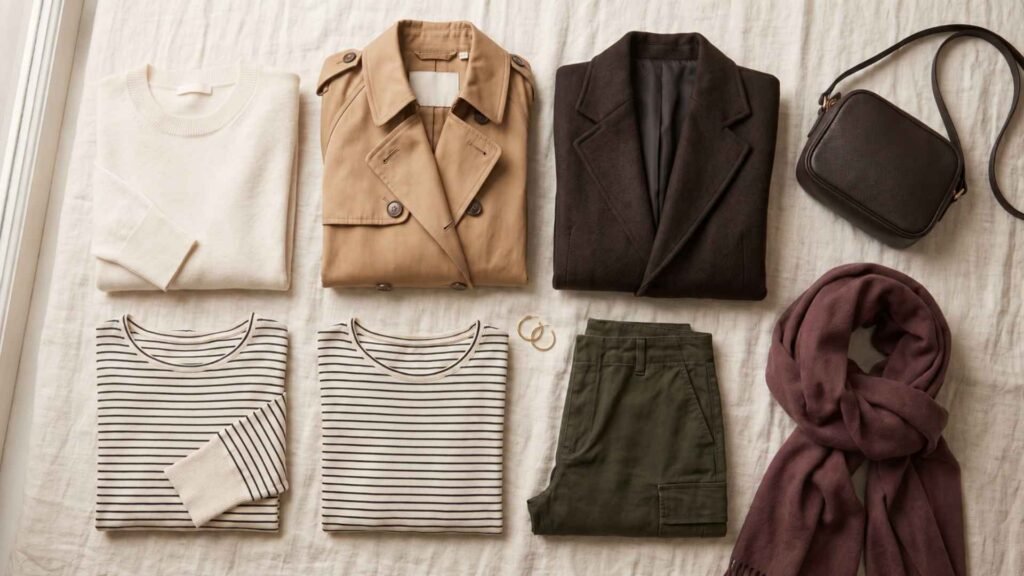
A controlled color palette allows more pieces to work together and makes repeated outfits feel intentional.
Start with two or three neutrals such as:
- Cream
- Camel
- Black
- Navy
- Charcoal
- Chocolate brown
- Taupe
- Dark olive
Add one muted accent such as burgundy, plum, rust, forest green, or deep red.
A warm palette could combine cream, camel, chocolate brown, and burgundy. For a cooler alternative, try black, grey, navy, and dark red.
I personally find an entirely beige wardrobe a little flat in autumn. Burgundy or dark olive adds depth without making the capsule difficult to coordinate.
Texture provides additional variety. Denim, fine knitwear, cotton, wool blends, and leather can make similar colors feel distinct. One subtle stripe, check, or print is enough; several competing patterns often create pieces that work in only one outfit.
The 15 Essential Pieces for a Fall Travel Capsule Wardrobe for Europe
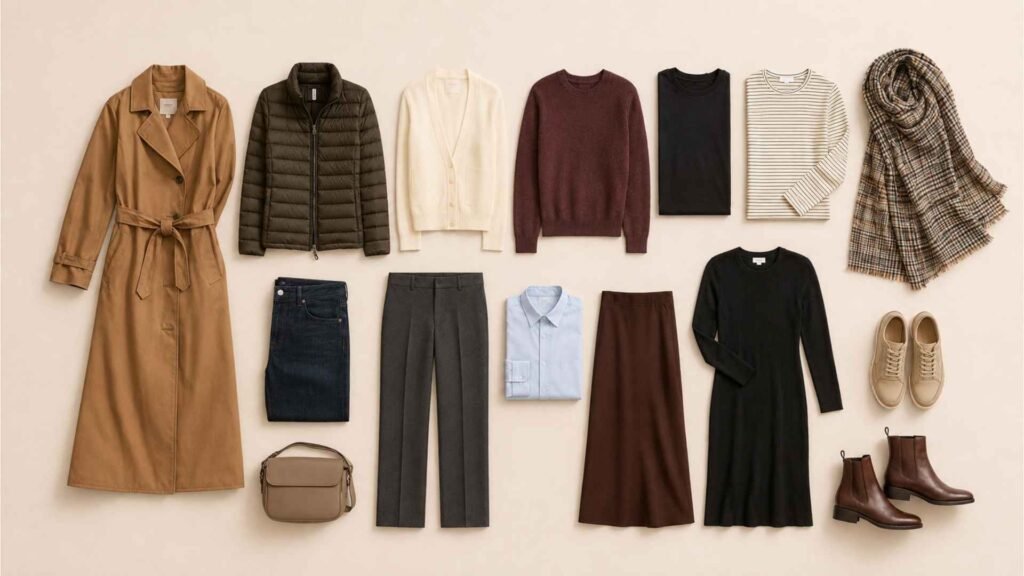
This capsule is designed for a seven- to fourteen-day trip focused primarily on cities, cultural attractions, restaurants, and rail travel.
Underwear, socks, sleepwear, tights, thermal base layers, and specialist outdoor clothing are not included in the 15-piece count.
1. A Lightweight Trench Coat
A trench coat protects against wind and passing showers without the bulk of winter outerwear.
Choose a slightly relaxed fit that closes comfortably over knitwear. Mid-thigh or knee length provides useful coverage, while secure pockets and a water-resistant finish make the coat more practical for sightseeing.
Camel is classic, but navy, taupe, black, and dark olive are equally versatile. The coat should work with both casual jeans and more polished trousers or dresses.
For a relaxed silhouette, I prefer leaving the belt open or loosely knotting it behind the coat. Remember that a water-resistant trench can handle light rain, but it is not a substitute for a genuinely waterproof jacket during prolonged downpours.
2. A Warmer Jacket or Regional Alternative
Your second outerwear piece should serve a different purpose.
For Northern Europe, mountain destinations, or November travel, choose a lightweight insulated jacket, quilted coat, or warm wool-blend style. For southern destinations in early fall, a blazer or lighter structured jacket may be more useful.
A slim insulated layer that fits beneath the trench is particularly effective on routes crossing different climates. Avoid packing two coats that provide the same level of warmth.
3. A Lightweight Cardigan
A fine- or medium-knit cardigan works during cool mornings, train journeys, and outdoor dinners but is easier to carry than a bulky sweater.
Merino wool, cotton blends, and smooth synthetic blends usually fold well and fit comfortably beneath outerwear. Choose a neutral shade or use the cardigan to introduce your capsule’s accent color.
4. A Medium-Weight Sweater
Your second knit should provide genuine warmth without occupying half the suitcase.
A crew neck, V-neck, or modest mock neck is generally easier to layer than a thick roll neck. Burgundy, forest green, rust, muted blue, or plum can bring character to an otherwise neutral wardrobe.
For colder conditions, wear a thin merino or thermal base underneath rather than packing another heavy sweater.
5–6. Two Long-Sleeve Base Tops
Two lightweight long-sleeve tops form the foundation of the capsule. They can be worn alone during mild afternoons or beneath knitwear when temperatures fall.
Useful combinations include:
- One black and one cream
- One plain and one subtly striped
- One cotton and one fine merino
- One neutral and one muted accent
A fitted or semi-fitted shape usually layers more cleanly than an oversized cut. For colder destinations, replace one ordinary top with a temperature-regulating merino or thermal base.
7. A Polished Everyday Shirt
A shirt adds structure and prevents the wardrobe from becoming a repetitive collection of basics and knitwear.
Soft white, cream, pale blue, chambray, fine stripes, and lightweight denim work well. Wear it buttoned with tailored trousers, open over a base top, or beneath a sweater with the collar visible.
Tencel, soft denim, and cotton blends are often more forgiving in a suitcase than very crisp cotton.
8. Straight-Leg Jeans
Straight-leg jeans work for sightseeing, casual meals, flights, and rail journeys. Dark or medium-blue denim coordinates especially well with autumn colors.
Test comfort before departure by sitting, climbing stairs, and walking for an extended period. Also check the hem with both pairs of shoes. Denim that drags across wet pavements quickly becomes cold and difficult to rewear.
9. Tailored Trousers
Tailored trousers create a polished outfit without feeling overly formal.
Look for a comfortable waistband, freedom through the hips and thighs, and fabric that resists excessive creasing. Black, charcoal, navy, chocolate brown, and dark olive are practical choices.
I avoid floor-skimming hems for travel. They may look elegant indoors but become inconvenient on wet streets, station stairs, and uneven pavements.
10. A Third Bottom Suited to Your Itinerary
The third bottom should fill a genuine gap between your jeans and tailored trousers.
Consider:
- A midi skirt for museums and dinners
- Ponte trousers for comfort
- Corduroy trousers for cooler weather
- Soft trousers for frequent rail journeys
- Water-resistant trousers for outdoor itineraries
There is no universal choice. Pack the option that reflects how you will actually spend your time.
11. A Versatile Midi Dress
A midi dress creates a complete outfit with little effort and provides a welcome change from separates.
Long or three-quarter sleeves are easiest to adapt for fall. Knit, wrap, and softly tailored styles can move from daytime sightseeing to dinner.
Choose a silhouette that allows you to walk, sit, and layer comfortably. Wear it with sneakers and a cardigan during the day, then add boots, tights, and structured outerwear in colder conditions.
12. Comfortable Walking Sneakers
European city trips often involve cobbled streets, station stairs, long museum corridors, and more walking than expected.
Choose sneakers based on fit, cushioning, support, and traction—not appearance alone. A weather-resistant upper is useful in changeable conditions, and the shoes should be broken in before departure.
I would always choose a supportive sole over a delicate style that becomes painful after an hour. For more detailed footwear guidance, see Best Shoes for Europe Travel.
13. Ankle Boots or Weather-Resistant Loafers
The second pair should feel slightly more polished while remaining comfortable enough for real walking.
Ankle boots are preferable for cold or wet destinations. Look for a low heel, dependable traction, a weather-resistant upper, and room for comfortable socks.
Loafers are a lighter option for southern and some central European cities during September or early October. Avoid thin or slippery soles, however stylish they appear.
14. A Large Scarf
A lightweight scarf provides warmth without adding another full garment.
Wear it around your neck, over your shoulders during dinner, or as a light blanket on a train. A muted check, stripe, or accent color can also connect the capsule’s neutral shades.
15. A Secure Crossbody Bag
A compact crossbody bag keeps your hands free while navigating stations, carrying an umbrella, or checking directions.
Choose a secure zip closure, adjustable strap, and enough room for your phone, wallet, portable charger, and small essentials. Pack a foldable tote separately if you expect to shop.
How to Layer Clothes for Europe in Fall
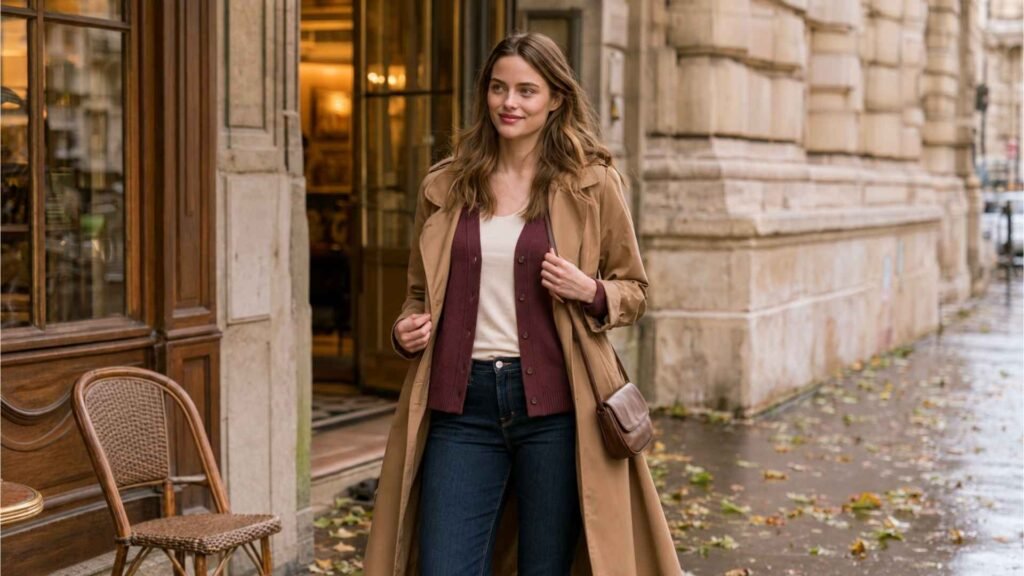
A simple three-layer system is more adaptable than one very heavy garment:
- A breathable base
- A removable knit layer
- A wind- or rain-resistant outer layer
For a mild but changeable day:
Long-sleeve top + cardigan + trench coat
For colder conditions:
Long-sleeve base + sweater + insulated jacket
Keep the base layer relatively streamlined and allow more room through your knitwear and coat. Three oversized garments worn together create bulk and restrict movement.
Try on your thickest planned combination before packing. Your coat should close comfortably without pulling across the shoulders.
Lina’s Tip: Your outfit should reduce to a presentable base when you enter a heated museum or restaurant. Avoid layers that are awkward to remove, carry, and put on again.
10 Easy Outfit Formulas
Use these combinations as a starting point rather than a fixed daily schedule.
- Classic sightseeing: Long-sleeve top + jeans + sneakers + trench
- Cool morning: Base top + cardigan + jeans + sneakers + scarf
- Museum day: Shirt + tailored trousers + boots or loafers + trench
- Train journey: Base top + comfortable third bottom + cardigan + sneakers
- Cold city walk: Base top + sweater + jeans + boots + warmer jacket
- Relaxed dinner: Midi dress + ankle boots + structured outerwear
- Day to evening: Base top + tailored trousers + boots + scarf
- Layered look: Shirt + sweater + jeans or trousers + boots
- Mild southern day: Shirt + third bottom + sneakers or loafers
- Rainy sightseeing: Base top + practical trousers + weather-resistant shoes + trench
Switch the shoes, scarf, bottom, or outerwear according to the forecast and your plans.
How to Adapt the Capsule for Different Parts of Europe
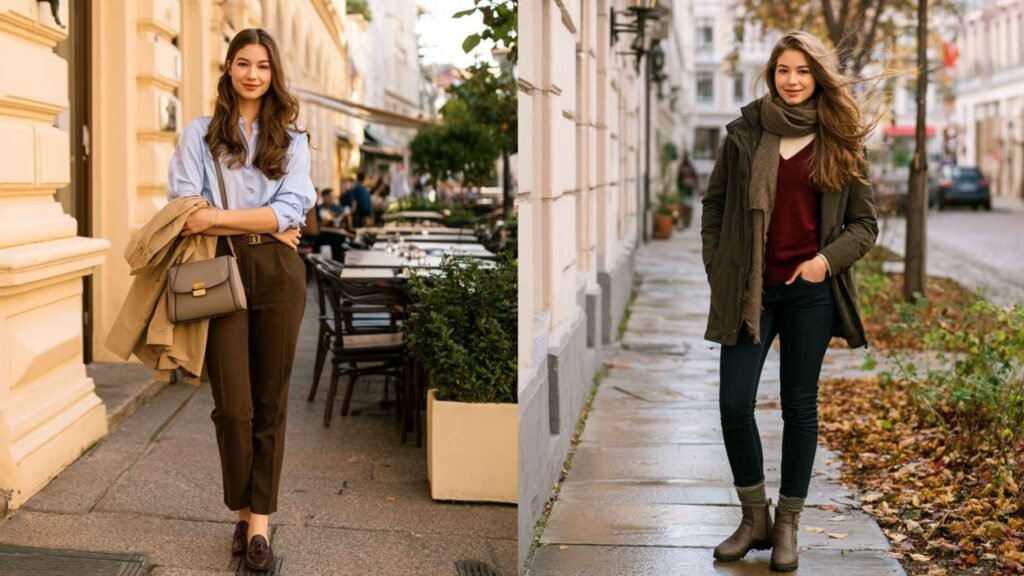
“Europe in fall” covers several climates. Your destination, month, altitude, and planned activities should determine any changes.
Southern Europe
Portugal, Greece, southern Spain, southern Italy, Mediterranean islands, and coastal Croatia may remain warm during September and early October.
Consider:
- Replacing the insulated coat with a blazer
- Choosing loafers instead of substantial boots
- Exchanging one long-sleeve top for a short-sleeve style
- Selecting a lighter dress
- Prioritizing breathable fabrics
Keep at least one warm layer for coastal wind and cooler evenings.
Central and Western Europe
The original capsule suits many fall trips to Paris, Amsterdam, Brussels, Berlin, Vienna, Prague, and Munich.
Closed shoes, two knit layers, a scarf, and adaptable outerwear create a strong foundation. If persistent rain is forecast, add a packable waterproof shell rather than relying entirely on the trench.
Northern Europe
Copenhagen, Stockholm, Oslo, Helsinki, Edinburgh, Iceland, and northern parts of the United Kingdom generally require better protection from cold, wind, and rain.
Choose insulated outerwear, a thermal or merino base, warm socks, weather-resistant boots, gloves, and a hat—especially later in the season.
Alpine and Mountain Destinations
Higher altitudes can be substantially colder than nearby cities.
Add appropriate base layers, insulated outerwear, warm accessories, and footwear with dependable traction. If your plans involve hiking, snow, or prolonged outdoor exposure, use specialist equipment rather than relying on a city capsule wardrobe.
What to Wear in September, October, and November
| Month | Main Priority | Useful Adjustment |
|---|---|---|
| September | Breathable clothing and light layers | Consider a short-sleeve top or loafers; carry light outerwear for evenings |
| October | Flexible layers and rain protection | Use knitwear, closed shoes, a scarf, and adaptable outerwear |
| November | Warmth and weather protection | Add thermal layers, warm accessories, and insulated outerwear where needed |
These are general guidelines, not guaranteed conditions. Check the forecast for every destination shortly before departure, particularly when crossing regions or changing altitude. For severe conditions, consult the official Meteoalarm European weather warnings.
Where to Invest and Where to Save
A capsule wardrobe does not require buying 15 new pieces. Begin with clothing you already wear comfortably, then fill only the gaps affecting warmth, walking comfort, or coordination.
If you are allocating a budget, invest first in:
- Supportive walking shoes
- Weather-appropriate outerwear
- A secure, durable crossbody bag
Spend moderately on trousers and knitwear, where fabric and fit matter more than a designer label. Basic tops, scarves, and occasional accessories are sensible places to save.
Second-hand platforms can be useful for coats, leather bags, and quality knitwear. Footwear should only be purchased when you can assess its fit and condition properly.
The best investment is not necessarily the most expensive garment. It is the piece you will continue wearing after the trip.
Complete Fall Packing Checklist
Before closing your suitcase, use this checklist to confirm that you have the core capsule, everyday essentials, and only the weather-dependent extras your itinerary genuinely requires.
The 15-Piece Capsule
- Lightweight trench coat
- Warmer jacket, blazer, or regional alternative
- Lightweight cardigan
- Medium-weight sweater
- Two long-sleeve tops
- Everyday shirt
- Straight-leg jeans
- Tailored trousers
- Third bottom
- Midi dress
- Walking sneakers
- Ankle boots or loafers
- Large scarf
- Crossbody bag
Base Essentials
- Underwear and bras
- Socks
- Sleepwear
- Tights
- Optional thermal base layer
Forecast-Dependent Extras
- Compact umbrella
- Packable waterproof shell
- Gloves and warm hat
- Thermal tights or wool socks
- Water-resistant shoe treatment
Optional Accessories
- Simple jewelry
- Belt
- Silk scarf
- Foldable tote
How to Pack and Rewear Your Capsule
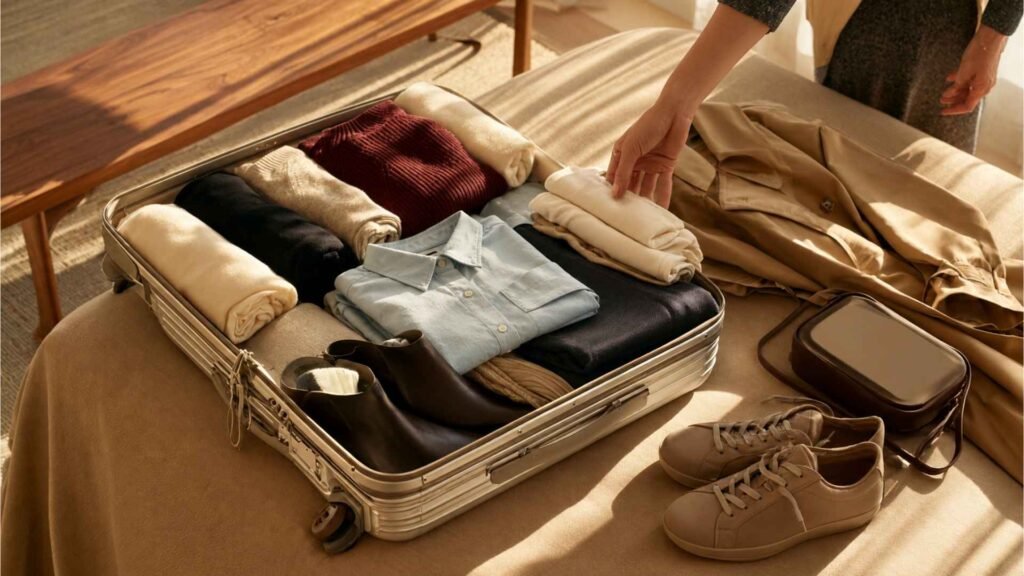
Wear your bulkiest practical items during the journey. A long-sleeve top, cardigan, jeans or soft trousers, sneakers, trench, and scarf make a comfortable travel-day outfit.
Fold tailored trousers along their natural creases, roll soft base layers, and place socks inside your boots. Packing cubes help with organization, although they cannot reduce the physical weight of thick clothing.
Plan to rewear pieces realistically:
- Rewear jeans and trousers
- Air knitwear between uses
- Wash base tops during the trip
- Alternate shoes so each pair can dry
- Wear the shirt both buttoned and open
With laundry access, you can pack for five to seven days even if the journey lasts two weeks.
For a broader method of choosing colors, planning combinations, and removing unnecessary pieces, see 7 Proven Steps to Build the Perfect Travel Capsule Wardrobe.
Common Fall Packing Mistakes
Packing Too Many Bulky Layers
Several heavy sweaters occupy valuable space and become uncomfortable inside heated buildings. One cardigan, one sweater, and lightweight base layers offer greater flexibility.
Treating Europe as One Climate
An outfit suitable for Lisbon in September may not work in Stockholm in November. Review every destination on your route, especially when travelling north or visiting higher altitudes.
Sacrificing Comfort for Style
Uncomfortable shoes are not travel shoes, regardless of how polished they look. Test both pairs during long walks before departure.
Bringing Too Many Coats and Shoes
Two complementary outerwear options and two pairs of shoes are generally enough for a city-focused trip. Each should perform a distinct role.
Packing Single-Outfit Pieces
A difficult skirt, delicate shoe, or statement blouse weakens the capsule when it works in only one look. Apply the three-outfit rule and replace anything that cannot be reworn easily.
Can You Travel Carry-On Only in Europe During Fall?
Carry-on-only travel is possible in autumn, although closed shoes, coats, and knitwear make it more challenging than summer packing.
It works best when:
- You wear bulky items in transit
- The palette remains coordinated
- Footwear is limited to two pairs
- Laundry is available
- Knitwear and base layers are lightweight
- Unnecessary “just in case” outfits are removed
A checked suitcase may be more practical when crossing sharply different climates or carrying formalwear, mountain equipment, or specialist clothing.
Packing light should make the journey easier, not leave you unprepared.
Fall Travel Capsule Wardrobe for Europe: Frequently Asked Questions
How many outfits can a 15-piece fall capsule create?
A coordinated 15-piece wardrobe can create more than 20 combinations by rotating tops, bottoms, layers, shoes, and outerwear. Ten dependable formulas usually provide enough variety for a one- or two-week trip.
How many sweaters should I pack for Europe in fall?
One cardigan and one medium-weight sweater are sufficient for many city trips. For Northern Europe or late-autumn travel, add a thin thermal or merino base instead of packing another bulky sweater.
Do I need a winter coat in Europe during fall?
It depends on the destination, month, altitude, and activities. A winter coat is often unnecessary in southern Europe during early fall but may be appropriate in Northern Europe, mountain regions, or colder destinations during November.
Can I wear sneakers in Europe in autumn?
Yes. Supportive sneakers suit sightseeing, train travel, museums, and casual restaurants. Choose dependable traction and some resistance to light rain, and alternate them with your second pair if they become wet.
Is a carry-on enough for a fall trip to Europe?
A carry-on can be sufficient when you limit footwear, coordinate the wardrobe, wear bulky pieces in transit, and have access to laundry. A larger suitcase may be more practical for colder routes or specialist activities.
Final Thoughts
A successful fall travel capsule wardrobe for Europe should respond to changing temperatures without filling your suitcase with clothing that serves only one occasion.
With 15 coordinated pieces, two comfortable pairs of shoes, and layers chosen for your route, you can dress confidently throughout the trip while keeping your luggage manageable.