
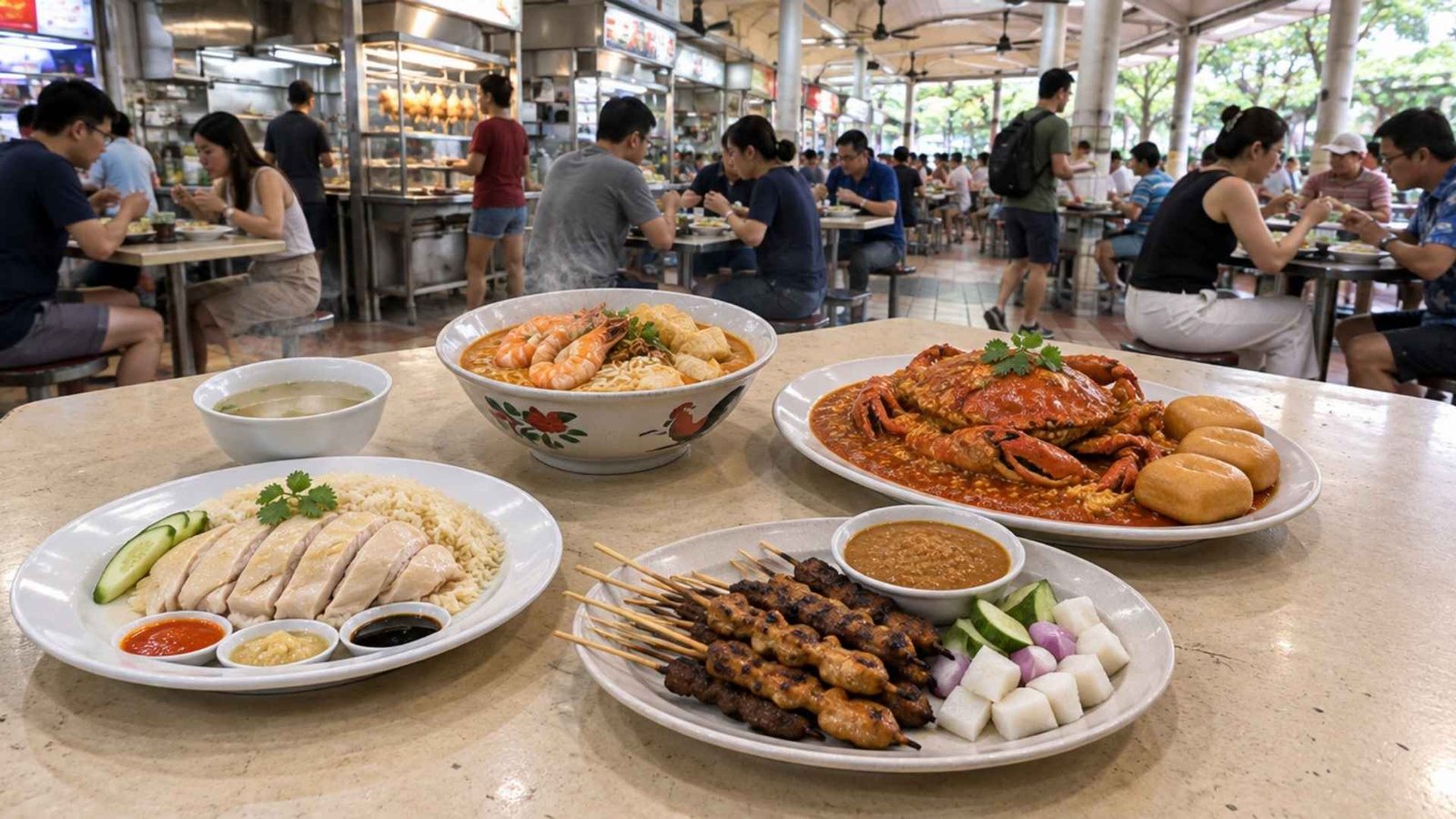
Singapore’s food culture is one of the best reasons to explore beyond Marina Bay and Changi Airport. Chinese, Malay, Indian, Peranakan and other culinary traditions meet in hawker centres, coffee shops and neighbourhood restaurants, giving the city an exceptional variety of flavours within a compact area.
If you are wondering what to eat in Singapore, begin with fragrant chicken rice, coconut-rich laksa, smoky noodles, crisp roti prata and a cold chendol. This guide covers 12 iconic Singapore dishes, what they taste like, when to order them and the details first-time visitors should know.
Quick Answer: What to Eat in Singapore
The essential foods to try in Singapore are Hainanese chicken rice, chilli crab, laksa, char kway teow, Hokkien mee, satay, kaya toast, bak kut teh, nasi lemak, roti prata, chai tow kway and chendol.
If you have time for only five dishes, prioritise Hainanese chicken rice, laksa, char kway teow, kaya toast and chilli crab.
| Dish | What It Is | Best Time to Try It |
|---|---|---|
| Hainanese chicken rice | Poached or roasted chicken with fragrant rice and sauces | Lunch or dinner |
| Chilli crab | Crab in a sweet, savoury and mildly spicy tomato-chilli sauce | Shared dinner |
| Laksa | Rice noodles in a spicy coconut-based broth | Lunch |
| Char kway teow | Flat rice noodles stir-fried with egg and savoury seasonings | Lunch or dinner |
| Hokkien mee | Yellow noodles and rice vermicelli cooked in prawn stock | Lunch or dinner |
| Satay | Grilled meat skewers with peanut sauce and rice cakes | Evening snack or dinner |
| Kaya toast | Toast filled with coconut-egg jam and butter | Breakfast |
| Bak kut teh | Peppery pork-rib soup served with rice and tea | Breakfast or lunch |
| Nasi lemak | Coconut rice with sambal and different accompaniments | Breakfast or lunch |
| Roti prata | Crisp, flaky flatbread served with curry | Breakfast or supper |
| Chai tow kway | Radish-and-rice cakes fried with egg and preserved radish | Breakfast or snack |
| Chendol | Shaved ice with coconut milk, palm sugar and green jelly | Afternoon dessert |
Isabella’s Pick
Do not attempt all 12 dishes in one food crawl. Plan one breakfast, one hawker lunch and one shared evening meal. Start with kaya toast in the morning, compare two noodle or rice dishes at lunch and save chilli crab or satay for dinner.
Why Is Singapore’s Hawker Culture So Special?
Understanding what to eat in Singapore starts at its hawker centres, where independent stalls serve Chinese, Malay, Indian and Peranakan dishes around shared tables.
These centres are not simply affordable places to eat; they are social spaces shaped by generations of cooks and diners. In 2020, Singapore’s hawker culture was added to UNESCO’s Representative List of the Intangible Cultural Heritage of Humanity.
Many hawkers spend decades perfecting a single recipe, so look for steady turnover and food cooked to order. The iconic dishes in this guide reflect Singapore’s multicultural identity, even when their roots extend beyond the country.
1. Hainanese Chicken Rice — Singapore’s Essential First Dish
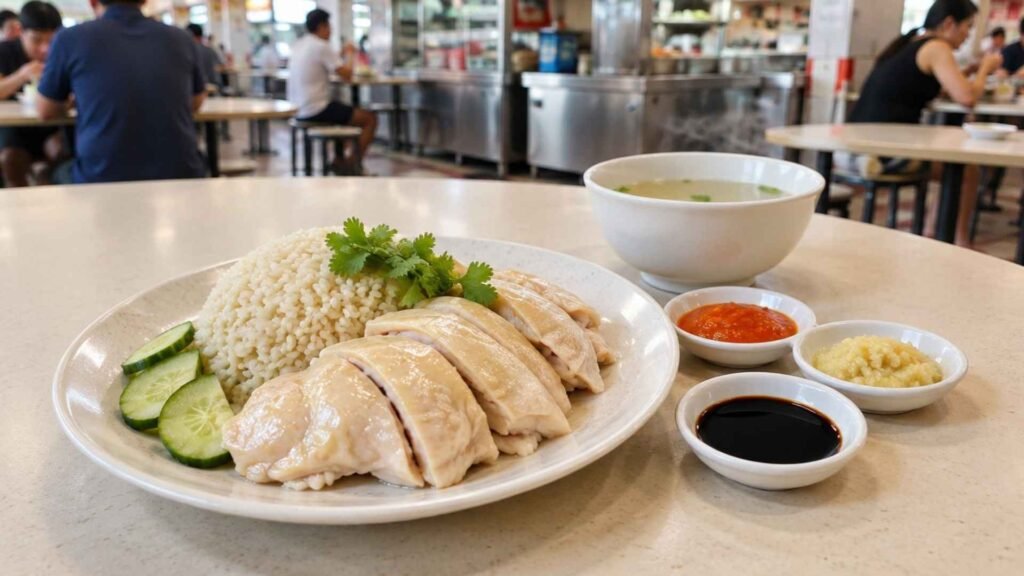
For many visitors deciding what to eat in Singapore first, Hainanese chicken rice is the clearest answer.
The plate appears simple: tender poached or roasted chicken, sliced cucumber and rice. Its quality, however, depends on careful technique. The rice is cooked with chicken stock and aromatics, giving it a savoury fragrance that makes it just as important as the meat.
The poached version should be succulent, with smooth skin and delicately seasoned flesh. Roasted chicken offers deeper colour and a slightly richer flavour. Chilli sauce, ginger paste and dark soy sauce are commonly served alongside, while a light bowl of broth may complete the set.
Chicken rice developed from recipes brought by Hainanese migrants and adapted in Southeast Asia. Today, it can be found across Singapore, from neighbourhood hawker centres to polished restaurants and hotels.
Try the poached version first so you can appreciate the tenderness of the chicken and fragrance of the rice. You can then compare it with roasted chicken at another stall.
Best for: An accessible first hawker meal
First-time tip: Taste the chicken and rice before adding all three sauces
2. Chilli Crab — Singapore’s Famous Shared Seafood Feast
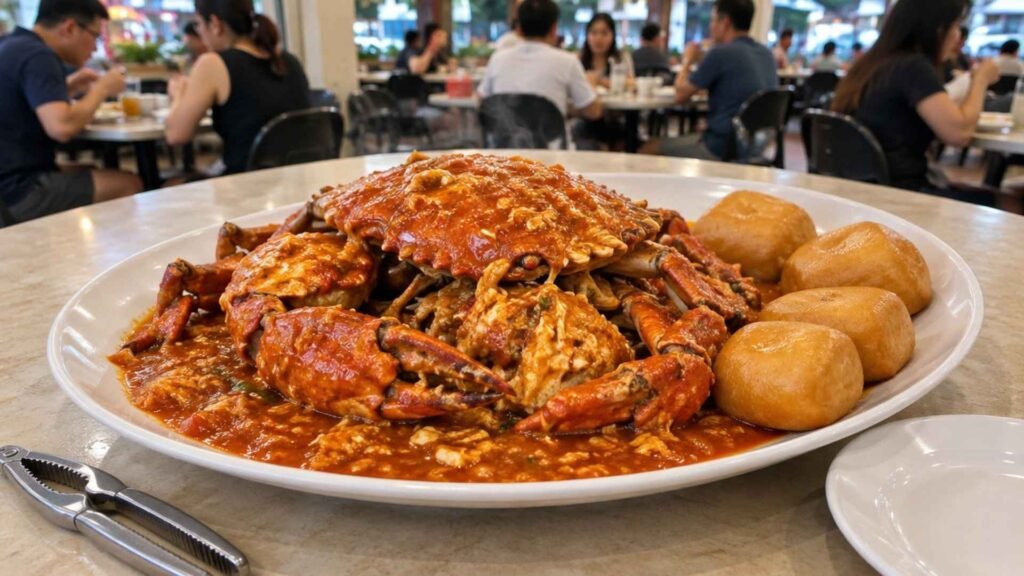
Despite its name, chilli crab is usually more sweet and savoury than aggressively hot. Whole crab is cooked in a glossy sauce built around tomato, chilli and egg. The sauce is rich, tangy and mildly spicy.
Fried or steamed mantou buns are the ideal accompaniment. Tear open a bun and use it to collect the sauce that remains after the crab has been eaten.
Unlike most everyday dishes in this guide, chilli crab is normally ordered at a seafood restaurant rather than as a quick solo hawker meal. It can also be expensive. Crab is frequently sold by weight, so confirm the price, approximate weight and preparation before placing your order.
One crab is generally intended for sharing, and eating it is a hands-on experience. Restaurants often provide shell crackers, gloves or wet towels, but wearing clothes that can survive a splash of sauce is still sensible.
Black pepper crab is Singapore’s other famous crab preparation. Its dry, aromatic pepper coating provides a sharper flavour, but chilli crab is the better first choice if you want the most recognisable local version.
Best for: A celebratory dinner shared by two or more people
First-time tip: Confirm the estimated total price before ordering and add mantou for the sauce
3. Laksa — Spicy, Coconut-Rich Noodle Soup
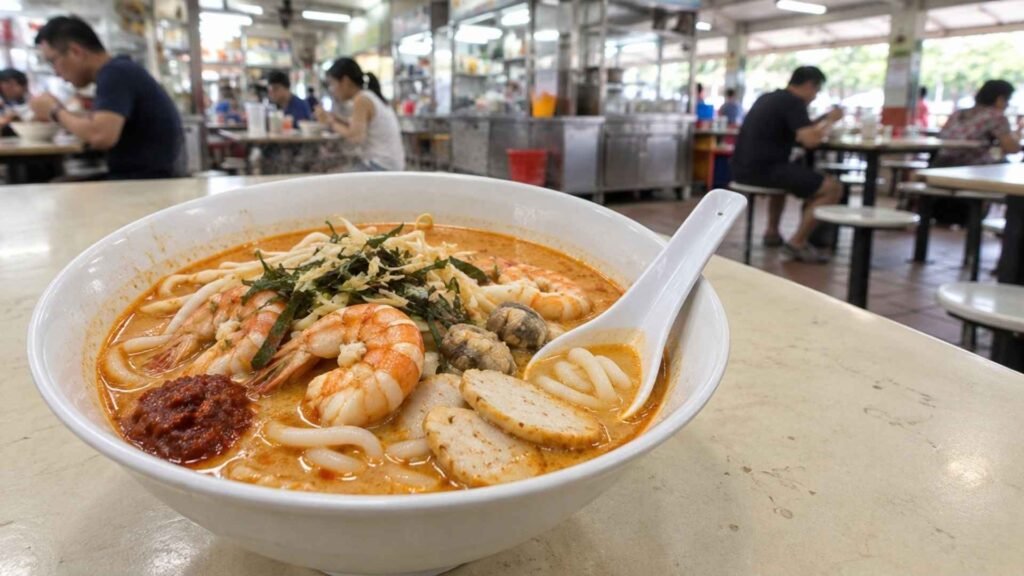
Singapore-style laksa combines rice noodles with a fragrant broth commonly made from coconut milk, spices and seafood.
Prawns, fishcake, tofu puffs, cockles, egg and fresh herbs may appear depending on the stall. The result is creamy, savoury and spicy, with enough depth to feel like a complete meal rather than a light soup.
Katong laksa is the version most closely associated with Singapore. Its noodles are traditionally cut into shorter pieces, allowing the dish to be eaten with a spoon. Recipes and serving styles vary, so not every bowl labelled laksa will look or taste identical.
The tofu puffs absorb the broth particularly well, while cockles add a stronger seafood flavour. If you are uncertain about cockles, ask whether they can be omitted.
Request less sambal if you are sensitive to heat, but remember that the broth itself is already seasoned. Laksa commonly contains shellfish and dried shrimp, so confirm the ingredients if you have dietary restrictions.
Best for: A flavourful lunch in Katong or at a hawker centre
First-time tip: Taste the broth before mixing in additional sambal
4. Char Kway Teow — Smoky Wok-Fried Flat Noodles
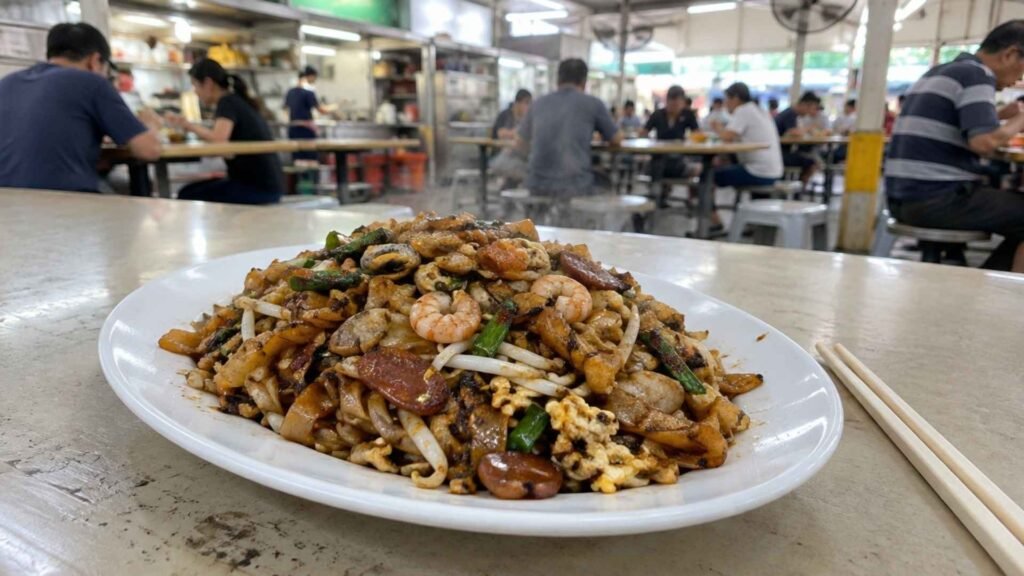
Char kway teow is a plate of flat rice noodles fried over high heat with dark soy sauce, egg, bean sprouts and chives.
Traditional versions may also include prawns, cockles, fishcake, Chinese sausage and crisp pieces of pork fat. The best plates balance sweetness, salt and smoke without leaving the noodles excessively greasy.
The prized flavour is wok hei, the smoky aroma produced when ingredients meet an extremely hot wok. Because portions are often cooked individually, a busy specialist stall may have a queue. Eat the noodles immediately while the edges remain lightly charred and the bean sprouts retain some texture.
Char kway teow is richer than many visitors expect and works best as a full meal or a shared dish. Traditional versions commonly contain Chinese sausage or lard, so the dish is not automatically pork-free.
Best for: Travellers who enjoy rich, smoky noodle dishes
First-time tip: Request less chilli rather than skipping the dish if heat is your concern
5. Hokkien Mee — Noodles Saturated With Prawn Stock
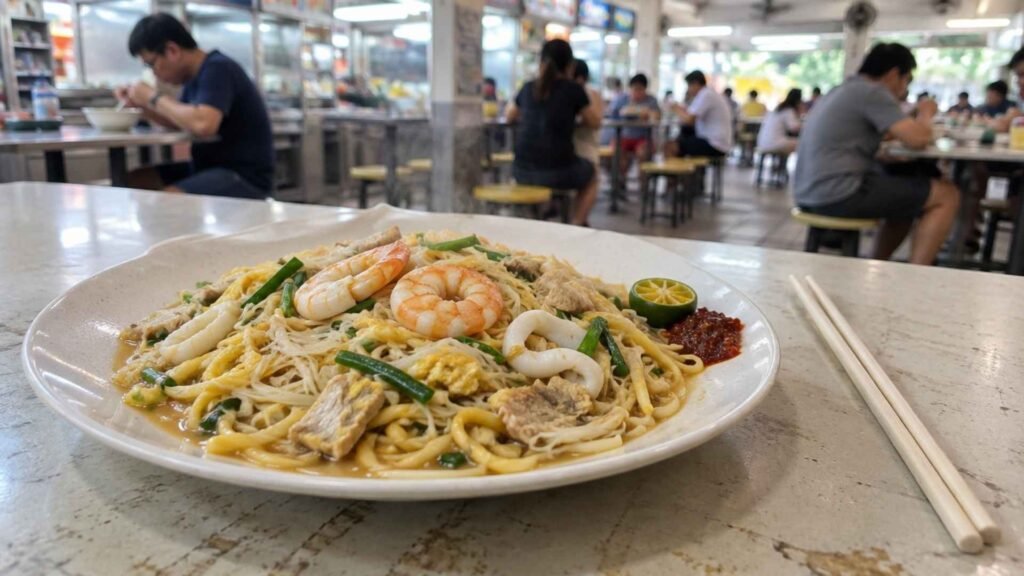
Singapore Hokkien mee usually combines yellow egg noodles with thin rice vermicelli. The noodles are cooked in a concentrated stock commonly made with prawns and pork.
Prawns, squid, egg and pieces of pork belly may be included. Sambal and calamansi lime are usually served on the side to add heat and brightness.
Do not confuse this pale, seafood-led Singapore dish with the dark-soy Hokkien mee associated with Kuala Lumpur. Even within Singapore, the texture varies between stalls. Some serve a wetter, almost brothy plate, while others reduce the stock until the noodles become drier and more intensely flavoured.
Start without lime or sambal so you can appreciate the stock. Then add calamansi and sambal gradually. The stock commonly contains shellfish and pork, even when every ingredient is not visible on the plate.
Best for: Seafood lovers who want a deeply savoury noodle dish
First-time tip: Choose between wet and dry styles according to your preferred texture
6. Satay — Charred Skewers With Peanut Sauce
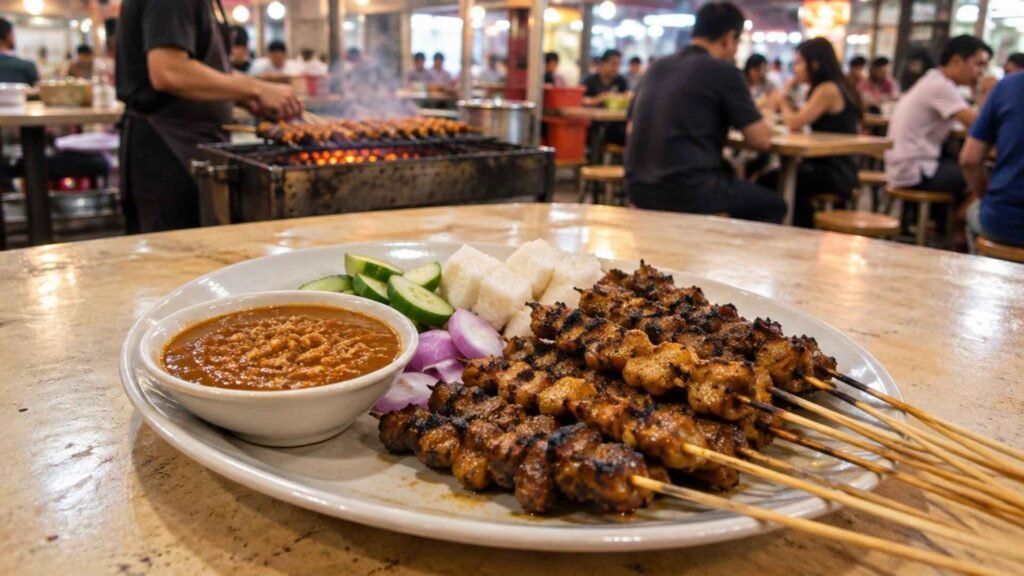
Satay consists of small pieces of marinated meat threaded onto skewers and grilled over charcoal.
Chicken, beef and mutton are common choices, while some non-halal stalls also serve pork. The skewers are accompanied by a thick peanut sauce, cucumber, raw onion and pieces of compressed rice cake known as ketupat.
Smoke and caramelised edges are essential to good satay. The meat should remain tender inside rather than becoming dry from the grill.
Stalls usually impose a minimum order, so satay is particularly suitable for sharing. Order several types of meat when possible and compare how each responds to the marinade and charcoal.
Lau Pa Sat’s outdoor Satay Street offers a convenient and atmospheric introduction, especially in the evening. Hawker centres elsewhere in Singapore provide alternatives that may feel less visitor-focused.
Travellers with peanut allergies should avoid satay unless a vendor can safely accommodate them. The sauce is peanut-based, and cross-contact at a specialist stall is highly likely.
Best for: A sociable evening meal or shared snack
First-time tip: Add ketupat and dip the rice cake as well as the meat into the peanut sauce
7. Kaya Toast — The Classic Singapore Breakfast Set
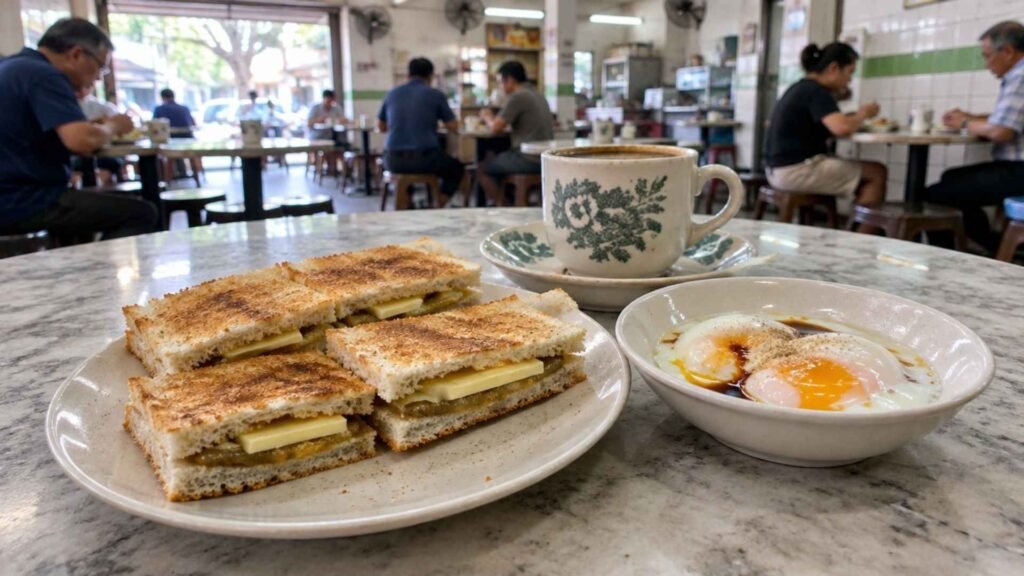
For breakfast, one of the easiest answers to what to eat in Singapore is kaya toast.
Thin slices of toast are spread with kaya, a jam made from coconut milk, egg, sugar and pandan. Slabs of cold butter are added between the warm slices. The contrast between crisp bread, sweet aromatic jam and salty butter makes the combination more distinctive than its simple appearance suggests.
A traditional breakfast set includes kaya toast, two soft-boiled eggs and coffee or tea. Crack the eggs into a small dish and season them with dark soy sauce and white pepper. You can then eat them separately or dip the toast into the mixture.
Order kopi for coffee with condensed milk or teh for tea. Singapore’s drink vocabulary allows you to adjust the amount of sugar and milk, although the terminology can be confusing during a first visit.
Kaya toast is available at traditional kopitiams and modern local chains. The portions are relatively small, leaving room for another dish later in the morning.
Best for: A quick and distinctly Singaporean breakfast
First-time tip: Order the full set and try the toast with the seasoned soft-boiled eggs
8. Bak Kut Teh — Peppery Pork-Rib Soup
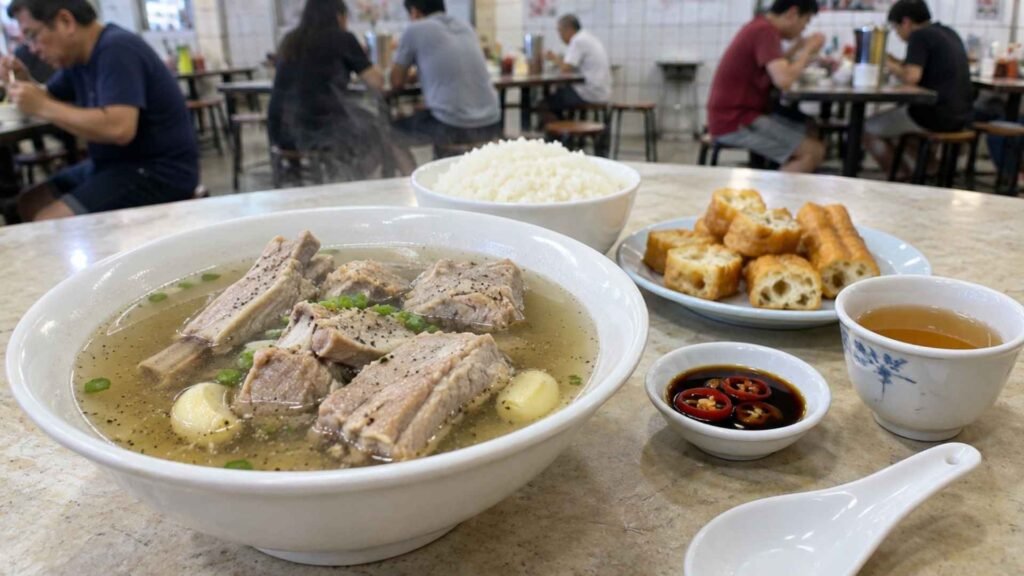
The name bak kut teh translates approximately as “meat bone tea”, but tea is not normally an ingredient in the soup.
Singapore’s best-known Teochew-style version is a clear pork-rib broth powered by white pepper and garlic. It tastes warming, savoury and noticeably peppery rather than dark and herbal.
Pork ribs form the centre of the meal. Rice, fried dough sticks, braised tofu, preserved vegetables and other side dishes are generally ordered separately.
Chinese tea is traditionally served alongside the food, which helps explain the “tea” in the dish’s name. Add a piece of fried dough, known as you tiao, to the broth just before eating. It should soften while retaining a little of its original texture.
Bak kut teh is not halal and cannot be made suitable simply by removing the visible meat because the broth itself is pork-based.
Visitors familiar with Malaysia’s darker Klang-style bak kut teh should expect something different. Singapore’s Teochew interpretation places much greater emphasis on pepper and garlic.
Best for: A comforting breakfast, lunch or late meal
First-time tip: Expect a strong pepper flavour and order rice with you tiao to complete the meal
9. Nasi Lemak — Fragrant Coconut Rice With Sambal
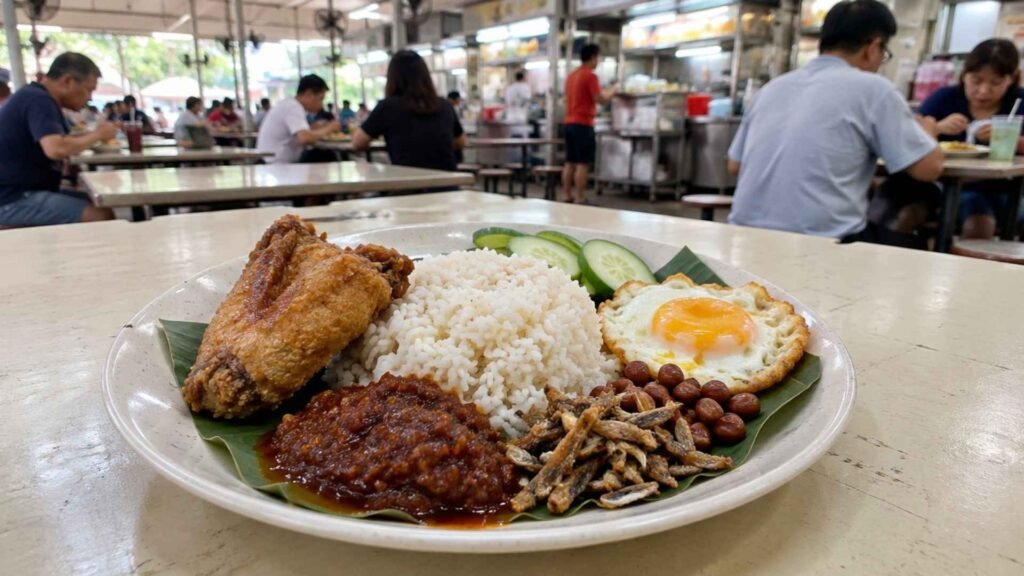
Nasi lemak centres on rice cooked with coconut milk and pandan leaves.
The rice is traditionally accompanied by sambal, cucumber, peanuts, fried anchovies and egg. Fried chicken, fish, otah and other additions may be available depending on the stall.
Its appeal comes from contrast: fragrant rice, sweet-hot sambal, crisp anchovies, crunchy peanuts and cooling cucumber appear in the same meal.
Nasi lemak is associated with Malay cuisine but is eaten by communities across Singapore. It ranges from compact breakfast packets to generous plates with multiple accompaniments.
A small wrapped portion is useful when you want a quick taste without committing to a large meal. A stall displaying several side dishes allows you to create a more substantial lunch.
Sambal varies considerably in sweetness and heat. Not every nasi lemak stall is halal, so look for official certification when this matters.
Best for: Breakfast or a customisable lunch
First-time tip: Start with the core combination, then add fried chicken or otah if you are hungry
10. Roti Prata — Crisp, Flaky Flatbread With Curry
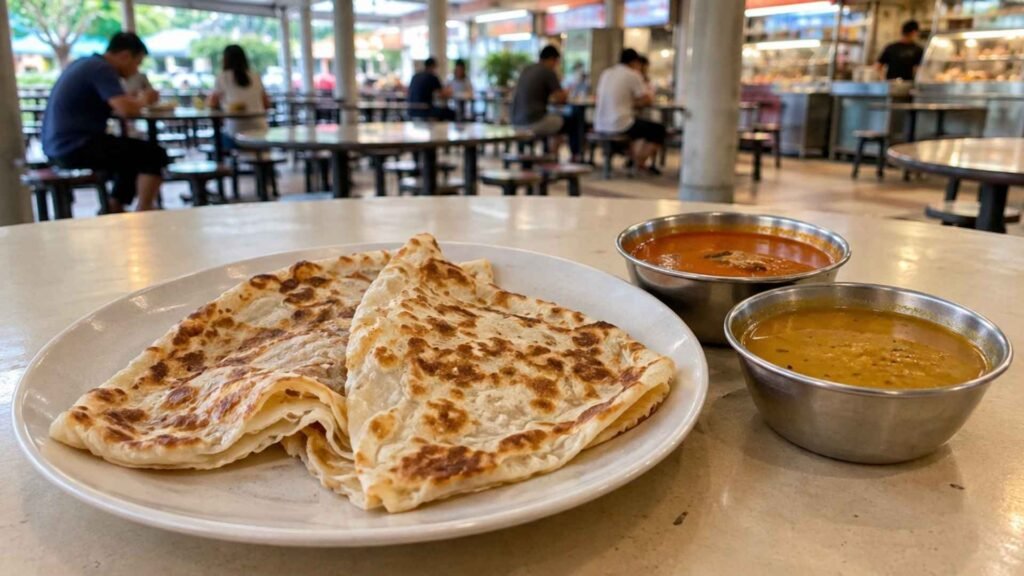
Roti prata is a South Indian-influenced flatbread stretched, folded and cooked on a hot griddle until crisp outside and chewy within.
It is usually served with fish, chicken, mutton or vegetable curry and is popular for breakfast, supper or a late-night snack.
Order prata kosong for plain prata or prata telur for one filled with egg. Onion, cheese and sweet fillings are also widely available, but the plain version provides the clearest test of the cook’s technique.
Tear off a piece and use it to scoop up the curry, preserving the bread’s crisp edges. The cooking fat, curry and shared griddle may affect its suitability for vegetarian or halal diets.
Best for: Breakfast, a casual supper or a late-night snack
First-time tip: Order one plain prata and one egg prata to compare their textures
11. Chai Tow Kway — Singapore’s Savoury “Carrot Cake”
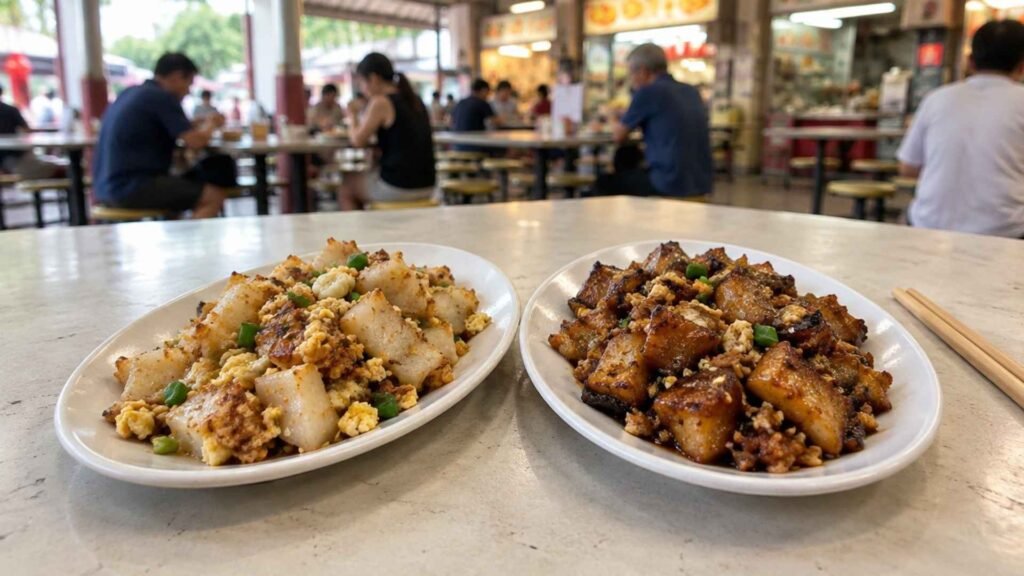
Do not expect a slice of Western cake when you order chai tow kway.
Singapore’s fried “carrot cake” is made from cubes of steamed radish-and-rice-flour cake cooked with egg, garlic, preserved radish and seasonings. The name refers to white radish rather than orange carrot, and the finished dish is entirely savoury.
There are two main styles. White chai tow kway is fried into a paler, egg-bound layer with crisp edges. Black chai tow kway is tossed with sweet dark soy sauce, producing softer and more caramelised cubes.
Neither version is universally better, so order one of each if you are sharing. Traditional recipes may contain lard or fish-based seasonings, meaning the dish is not automatically vegetarian.
Best for: Breakfast, brunch or a savoury hawker snack
First-time tip: Try both the white and black versions before choosing a favourite
12. Chendol — A Cooling Coconut and Palm-Sugar Dessert
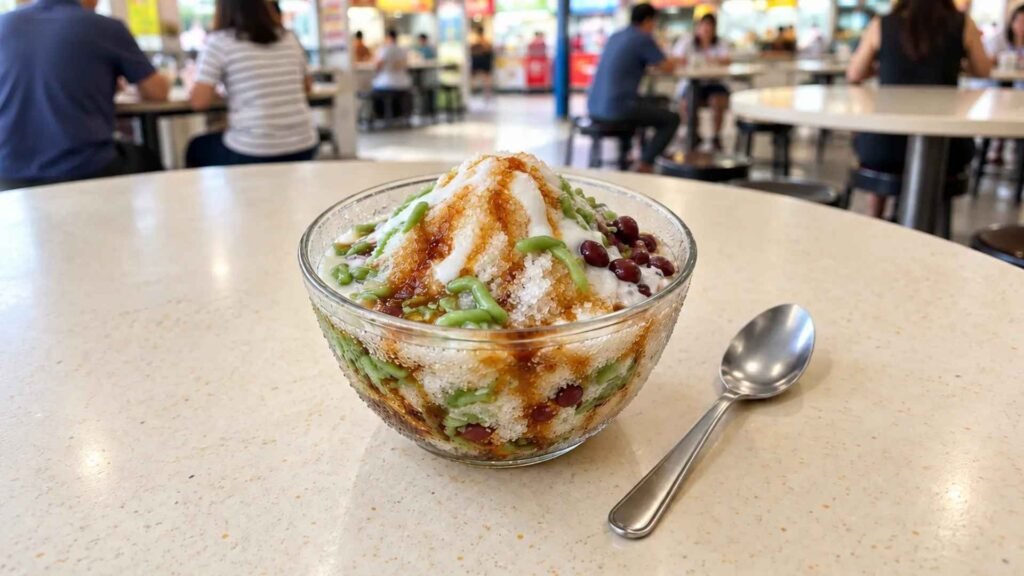
End your introduction to what to eat in Singapore with chendol, also written as cendol.
The dessert combines shaved ice, coconut milk, dark palm-sugar syrup and short green rice-flour jelly strands. Red beans and other additions may appear, but gula melaka and coconut should remain the dominant flavours.
Chendol is sweet and rich, yet the melting ice makes it refreshing in Singapore’s humid climate. Taste the layers separately first, then mix them enough to distribute the palm sugar throughout the bowl.
If you want to try another cold dessert, choose ice kacang. It usually features a taller mound of shaved ice covered with colourful syrups and ingredients such as red beans, sweet corn, grass jelly or attap chee.
Chendol provides a more focused combination of coconut and palm sugar, while ice kacang is the more colourful and playful alternative.
Best for: A cooling afternoon dessert
First-time tip: Share one after a large hawker meal if you have already ordered several dishes
How to Order at a Singapore Hawker Centre
Ordering at a hawker centre is straightforward once you understand the basic routine.
- Walk around the centre before ordering. Note the specialities, displayed prices and queues rather than choosing the first stall you see.
- Make sure that you have joined the correct queue, as neighbouring stalls may serve similar-looking dishes.
- State the name of the dish, portion size and any simple choice such as poached or roasted chicken, white or black carrot cake, or your preferred level of chilli.
- Ask whether you should wait at the stall or provide your table number for delivery.
- Carry some Singapore dollars. Digital payments are common, but an overseas visitor’s card or payment application may not work at every stall.
- Return your tray and used crockery to the designated station after eating. Halal and non-halal trays may have separate return areas.
Sharing tables during busy periods is normal. A tissue packet placed on a table may indicate that someone has reserved, or “choped”, the seat. Respect the reservation and choose another place.
Do not leave your phone, wallet or passport unattended to reserve a table.
Where to Find Traditional Food in Singapore
There is no single best hawker centre for every dish. The speciality and opening schedule of an individual stall matter more than the fame of the building itself.
| Area or Hawker Centre | Foods and Experiences to Prioritise |
|---|---|
| Maxwell Food Centre | Chicken rice and a broad first-time selection |
| Chinatown Complex Food Centre | Chinese-Singaporean dishes, snacks and desserts |
| Lau Pa Sat | Central location and an evening satay experience |
| Old Airport Road Food Centre | Extensive local choice outside the main tourist core |
| Tekka Centre | Indian and Malay food near Little India |
| East Coast and Katong | Laksa, seafood and neighbourhood food |
| Tiong Bahru Market | Breakfast, snacks and a neighbourhood visit |
Do not plan an entire journey around one stall without checking its current schedule. Hawkers may close on a particular weekday, take an extended break or sell out early. Identify one preferred stall and one nearby alternative for any dish you consider essential.
Vegetarian, Halal and Allergy Advice
Singapore offers excellent options for different diets, but a dish’s name does not reveal every ingredient.
Noodle stocks can contain pork bones or prawns. Vegetables may be fried in lard. Sambal frequently includes shrimp paste, while shared woks, grills and fryers create a risk of cross-contact.
Vegetarians should seek dedicated vegetarian stalls when possible and confirm whether the stock, sauces and cooking fat contain meat or seafood. Vegans also need to ask about egg, which appears in kaya, fried noodles, prata fillings and chai tow kway.
Muslim travellers should look for official halal certification rather than judging by the meat displayed at a stall. The Islamic Religious Council of Singapore provides a searchable list of halal-certified eating establishments.
A mixed hawker centre may contain halal and non-halal stalls. Tray-return stations may also be separated.
Travellers with severe allergies should be particularly careful with peanuts, shellfish, egg, soy, wheat and coconut. A busy stall using shared equipment may not be able to guarantee protection from cross-contact.
Planning Your Singapore Food Stops From Changi Airport
Most travellers will find a broader and more rewarding food selection after leaving the airport.
Use the Singapore Changi Airport Guide to understand the terminals, Jewel and transport before planning your first meal.
Jewel is in the public landside area, so passengers remaining in transit cannot visit it without clearing immigration. If you have only a short connection, eat within your departure area rather than risking a rushed journey into the city.
Frequently Asked Questions About What to Eat in Singapore
What Food Is Singapore Most Famous For?
Hainanese chicken rice and chilli crab are Singapore’s most internationally recognised dishes. Laksa, char kway teow, Hokkien mee, kaya toast and satay are equally important to a first food itinerary.
What Should I Eat First in Singapore?
Start with Hainanese chicken rice if you want a gentle introduction. Choose laksa or char kway teow if you prefer stronger spice and wok flavour, then try kaya toast for breakfast the following morning.
Is Hawker Food in Singapore Spicy?
Some dishes are spicy, but not everything is hot. Chicken rice and kaya toast are mild, while laksa and sambal-based dishes bring more heat. Chilli sauce is often served separately, allowing you to control the intensity.
What Is the Best Singapore Breakfast?
A kaya toast set with soft-boiled eggs and kopi is the classic first choice. Nasi lemak, roti prata, chai tow kway and bak kut teh are more substantial breakfast alternatives.
What Is the Difference Between Chendol and Ice Kacang?
Chendol focuses on coconut milk, gula melaka and green rice-flour jelly. Ice kacang usually combines a larger mound of shaved ice with colourful syrups and a wider assortment of beans, jellies, sweet corn and fruit-based toppings.
Can Vegetarians Eat Easily in Singapore?
Yes, particularly at dedicated vegetarian Indian, Chinese or Buddhist stalls. However, ask about pork or seafood stock, lard, shrimp paste, fish sauce and egg when a dish is not explicitly labelled vegetarian.
Final Thoughts
The best approach to what to eat in Singapore is to spread these dishes across several meals rather than treat them as a one-day checklist. Begin with kaya toast, explore a hawker centre at lunch and save chilli crab or satay for a shared evening meal.
Together, these 12 dishes reveal the multicultural traditions and everyday dining culture that make Singapore one of the world’s most rewarding food destinations.