

Japan entry requirements in 2026 are relatively straightforward for most tourists, but the exact rules depend on your nationality, passport type, intended length of stay and what you carry into the country.
Many travelers can visit Japan without obtaining a tourist visa in advance. However, every visitor still needs a valid travel document, must qualify for their intended status of stay and must complete Japan’s immigration and customs procedures.
This guide explains the passport, visa, Visit Japan Web, immigration, medication and customs rules you should check before travelling.
Quick Answer: Japan Entry Requirements 2026 at a Glance
Most tourists need a passport valid throughout their stay, the correct visa status and completed immigration and customs information. Depending on the trip, travelers may also be asked for evidence of onward travel, accommodation details, sufficient funds or advance approval for certain medicines.
| Requirement | What Travelers Should Know |
|---|---|
| Passport | Must remain valid throughout the trip; there is no general six-month validity rule for ordinary passports |
| Tourist visa | Not required for eligible visa-exempt travelers visiting Japan for a short stay |
| Visa-free stay | Usually 90 days, although some eligible nationalities receive 15 or 30 days |
| Visit Japan Web | Recommended for preparing immigration and customs information, but it is not a visa or guarantee of entry |
| Return or onward ticket | May be requested as evidence that you plan to leave within your permitted stay |
| Accommodation information | Keep the name, address and telephone number of your first accommodation available |
| Proof of funds | Immigration officers may ask how you will support yourself during the trip |
| COVID-19 documents | Vaccination certificates and pre-departure tests are not currently required |
| Customs declaration | Required for every passenger entering Japan |
| Medication | Some medicines and quantities require Import Confirmation or separate advance permission |
| JESTA | The establishing legislation was enacted in May 2026, but the system is not operational and is currently planned for FY2028 |
Clara’s Tip:
Save your passport details, return booking, first hotel address and Visit Japan Web codes in an offline folder on your phone. Airport Wi-Fi is usually available, but access to essential arrival information should not depend entirely on an internet connection.
Passport Requirements for Japan

Your passport is the most important of the Japan entry requirements. It must be valid when you arrive and remain valid throughout your intended stay.
Does Japan Require Six Months of Passport Validity?
Japan does not have a general six-month passport-validity requirement for visitors travelling on ordinary passports.
Japanese diplomatic missions state that an ordinary passport should remain valid during the traveler’s stay. Therefore, a tourist whose passport expires shortly after the planned departure date may not automatically need six additional months of validity.
However, renewing the passport before travelling may still be sensible if it expires soon after your return. Airlines, transit countries and countries visited before or after Japan may apply different validity requirements.
Different conditions may also apply to:
- Emergency or temporary passports
- Refugee travel documents
- Re-entry permits
- Certificates of identity
- Other non-standard travel documents
Travelers using one of these documents should contact the Japanese embassy or consulate responsible for their place of residence before booking.
The Embassy of Japan’s current passport guidance confirms that an ordinary passport does not generally need six months of remaining validity, provided it remains valid throughout the visit.
Do You Need a Blank Passport Page?
Leave at least one blank passport page available for immigration endorsements or a visa sticker if you need a physical visa.
Although immigration processes are increasingly digital, arriving with a damaged or completely full passport can create unnecessary difficulties at airline check-in or border control.
Can You Enter Japan With a Damaged Passport?
A passport with a torn identity page, water damage, an unreadable machine-readable zone, a detached cover or a damaged electronic chip may be rejected by an airline or immigration authority.
Replace a materially damaged passport before departure. Do not assume that a document accepted on a previous journey will be accepted again.
Your flight booking should also match the name shown in your passport. Contact the airline before departure if there is a spelling error or significant difference.
Do You Need a Visa to Visit Japan?

Whether you need a visa is determined primarily by your nationality, passport type, purpose of travel and intended length of stay.
It is not determined simply by where you live.
For example, holding permanent residence in a visa-exempt country does not automatically give a traveler that country’s visa-free privileges. Immigration authorities normally apply the rules associated with the passport presented for travel.
Japan currently maintains short-stay visa exemption arrangements with 74 countries and regions. Eligible ordinary-passport holders can normally enter as Temporary Visitors for tourism, short business visits, conferences or unpaid visits to relatives and friends.
Check the current Ministry of Foreign Affairs visa-exemption list before booking because passport conditions and country eligibility can change.
Passport Conditions Within the Visa-Exemption Program
Being a national of a listed country does not always provide automatic visa-free entry with every passport.
Some exemptions apply only to:
- ICAO-compliant electronic passports
- Machine-readable passports
- Passports registered in advance with a Japanese diplomatic mission
- Specific passport types issued by the listed country or territory
- Passports containing a required personal identification number
The Ministry of Foreign Affairs list contains individual notes for affected nationalities. Read the note beside your country rather than relying only on the country name.
When Is a Tourist Visa Required?
You will generally need a visa before departure if:
- Your nationality is not covered by Japan’s visa-exemption arrangements
- Your passport does not meet the conditions attached to the exemption
- You intend to work or receive payment in Japan
- You plan to study or remain longer than the short-stay period allowed
- You are travelling for a purpose not covered by Temporary Visitor status
- Your travel document requires advance visa approval
- Your itinerary requires entry into Japan during a transit and you do not qualify for visa-free entry
Japan does not normally issue tourist visas at the airport. If a visa is required, obtain it before boarding your flight.
Is JAPAN eVISA the Same as Visit Japan Web?
No. They are separate systems with different purposes.
JAPAN eVISA is an official system through which eligible travelers residing in certain countries can apply for a single-entry short-term tourism visa online.
Visit Japan Web helps travelers prepare arrival procedures, including immigration and customs information.
Receiving a Visit Japan Web code does not mean that a visa has been issued.
Travelers with an electronic visa may be required to display the official visa issuance notice on a connected device during airline check-in or arrival procedures. Follow the instructions attached to the eVISA rather than relying only on a printed copy or screenshot.
The official JAPAN eVISA FAQ explains current eligibility and how electronic visa proof must be presented.
How Long Can You Stay in Japan Without a Visa?
Most eligible visa-exempt tourists receive permission to stay for up to 90 days. However, this is not universal.
Under the current arrangements:
| Nationality Group | Standard Period Granted |
|---|---|
| Indonesia and Thailand | 15 days |
| Brunei and Qatar | 30 days |
| Most other visa-exempt countries and regions | 90 days |
Certain bilateral arrangements technically permit stays of up to six months for nationals of selected countries. These travelers are normally granted 90 days on arrival and must apply for an extension in Japan before that period expires if they qualify and intend to stay longer.
Do not assume that a visa-free arrangement allows you to remain for 90 days. Confirm the period attached to your nationality and inspect the landing permission recorded at immigration.
Is a Visa-Free Stay Automatically Granted?
No. Visa exemption allows an eligible traveler to arrive without obtaining a visa in advance. It does not create an unconditional right to enter Japan.
The final decision is made during the landing examination. Immigration officers may ask for evidence that your visit is temporary and consistent with Temporary Visitor status, including your itinerary, accommodation, available funds and return or onward travel arrangements.
The period granted by immigration controls how long you may stay, even if your airline ticket or original travel plan covers a different number of days.
Can You Work During a Visa-Free Visit?
Temporary Visitor status does not permit ordinary paid work in Japan.
Tourism, meetings, conferences, market research and certain unpaid business activities may be possible, but accepting local employment or performing revenue-generating activities in Japan can require an appropriate visa and status of residence.
Travelers planning remote work, long-term study, employment or a stay longer than the permitted tourist period should check the relevant visa category before departure.
Documents You May Be Asked to Show
There is no single universal folder of supporting documents that every tourist must present. Many visitors are admitted after showing their passport and completing the standard arrival process.
Nevertheless, airline staff or immigration officers may request evidence that supports the purpose and duration of your trip.
Keep the following readily available:
- Return or onward flight confirmation
- First accommodation booking
- Address and telephone number of the accommodation
- A basic trip itinerary
- Evidence of sufficient funds if relevant
- Travel insurance details
- Visa or electronic visa evidence, if required
- Contact details for a host, friend or family member in Japan
- Medication approvals and prescriptions, where applicable
A return ticket is not a substitute for landing permission, but it can help demonstrate that you intend to leave within your authorized stay. A one-way ticket may result in additional questions from the airline or immigration authorities.
Accommodation does not have to be a traditional hotel. A legitimate rental property, hostel or private residence may be acceptable, but you should be able to provide an accurate address and explain where you will stay.
Avoid entering placeholder or invented information in arrival forms.
Is Visit Japan Web Required?

Visit Japan Web is the Japanese government’s online arrival service. It allows travelers to register information used for immigration and customs procedures before reaching Japan.
Using Visit Japan Web is strongly recommended, but it is not a visa, travel authorisation or guarantee of entry. Immigration officers still decide whether each traveler meets Japan’s landing requirements.
Travelers who cannot use the service can generally complete the relevant arrival information through the available alternative procedures. However, completing it in advance can reduce form-filling after a long flight and make it easier to present consistent information.
The service can be used to prepare:
- Immigration information
- Customs declaration information
- Arrival codes
- Accompanying family-member records
- Tax-free shopping information, if the traveler chooses to use that function
Use only the official Visit Japan Web service. The Japanese government does not charge a fee for creating an account or submitting an electronic customs declaration.
Fake websites and private assistance services may imitate the official platform and request unnecessary payments. Japan Customs issued a specific warning in 2026 confirming that Visit Japan Web and electronic customs declarations are free.
For the complete registration process, follow our Visit Japan Web Guide 2026 rather than repeating every step here.
Should You Screenshot the Codes?
Keeping an offline copy of your Visit Japan Web codes is useful in case the internet connection is slow or unavailable. However, follow any on-screen instruction requiring the current code or a live system display.
Check that each code belongs to the correct traveler, especially when several family members are registered through the same account.
Clara’s Tip:
Reopen Visit Japan Web a few days before departure and compare the registered flight, passport and accommodation details with your latest bookings. Correcting a changed flight number or hotel address before arrival is easier than explaining inconsistent information at the airport.
What Happens at Japanese Immigration?

After leaving the aircraft, follow the signs for Immigration, Passport Control or Arrivals unless you are remaining airside for an eligible international connection.
At the immigration checkpoint, most foreign visitors will:
- Present their passport
- Present their visa evidence if a visa was required
- Submit or display their arrival information
- Provide fingerprints and a facial photograph where required
- Answer any questions from the immigration officer
- Receive landing permission showing their status and permitted stay
Most foreign visitors aged 16 or older are required to provide fingerprints and a facial photograph during the landing examination. Children under 16 are generally exempt from this biometric requirement, as are certain other legally exempt categories.
The officer may ask simple questions such as:
- Why are you visiting Japan?
- How long will you stay?
- Where are you staying?
- When are you leaving?
- Are you travelling alone?
- Have you visited Japan before?
Answer accurately and keep your explanation consistent with your bookings and declared purpose.
Check Your Permitted Stay
Before leaving the immigration area, check the landing permission in your passport or electronic record.
Confirm:
- Status: normally Temporary Visitor for tourists
- Date of entry
- Permitted period of stay
Do not calculate your departure deadline only from what you expected to receive. The authorization granted by immigration is the relevant record.
Customs Declaration Requirements

Every passenger entering Japan must declare their belongings to Customs.
Japan Customs recommends completing the declaration electronically through Visit Japan Web. Paper declaration forms may also be available during the journey or in the customs area when an alternative is needed.
After collecting checked baggage, travelers proceed toward the appropriate customs channel or electronic declaration gate.
You must answer the declaration questions truthfully, including questions about:
- Prohibited or restricted goods
- Commercial merchandise
- Goods exceeding duty-free allowances
- Meat, animal products, plants, fruits and vegetables
- Large amounts of cash or equivalent means of payment
- Unaccompanied baggage
- Items carried for another person
If you are uncertain about an item, declare it and ask a customs officer. Declaring an item does not automatically mean it will be confiscated or taxed; failing to declare a controlled item can create a much more serious problem.
Japan’s Main Duty-Free Allowances
For an adult traveler, the standard allowances currently include:
| Item | Allowance |
|---|---|
| Alcohol | 3 bottles of approximately 760 ml each |
| Cigarettes | 200 cigarettes |
| Cigars | 50 cigars |
| Other tobacco | 250 grams |
| Perfume | 2 ounces, approximately 56 ml |
| Other goods | Total overseas market value below ¥200,000 |
Special calculation rules apply when carrying multiple types of tobacco. There is also no standard duty-free allowance for an individual item or set worth more than ¥200,000.
Allowances for children are more limited and do not include alcohol or tobacco.
These limits concern customs duty and tax. They do not make an otherwise prohibited product legal to import.
Current allowances and passenger procedures are available from Japan Customs.
Bringing Medication into Japan
Medication rules are one of the most important Japan entry requirements to check in advance. A medicine legally prescribed or sold in another country may be controlled, restricted or prohibited in Japan.
Do not check only the brand name. The same brand can contain different active ingredients in different countries.
How Much Medication Can You Bring?
As a general rule, travelers can bring limited quantities of medicines for personal use without applying for Import Confirmation.
The standard exemption commonly covers:
- Up to one month’s supply of prescription medicine
- Up to two months’ supply of many non-prescription medicines
- Limited quantities of medical devices and cosmetics
The exact rule depends on the product, active ingredient, dosage, classification and quantity.
If the amount exceeds the applicable personal-use limit, you may need to obtain an Import Confirmation, previously widely known as a Yakkan Shoumei, before travelling.
The official Ministry of Health medication guidance explains the quantity limits and application process.
Controlled and Prohibited Medicines
Some narcotics, psychotropics, stimulants, stimulant raw materials and cannabis-related products are subject to separate rules.
Depending on the substance:
- Advance permission may be required
- A quantity limit may apply
- Import may be prohibited even with a foreign prescription
- Permission may be needed both when entering and leaving Japan
Products containing certain stimulant ingredients can create particular difficulties. This may include some medicines used for attention disorders, pain management, sleep disorders or nasal congestion.
CBD or cannabis-derived products also require careful checking. Do not assume a product is allowed simply because it contains no intoxicating dose or is sold legally in your home country.
Check the active ingredients with Japan’s Narcotics Control Department well before departure.
How Should You Carry Medication?
Keep medicine:
- In its original labeled packaging
- In your hand luggage where practical
- With a copy of the prescription
- With a doctor’s letter explaining the medical need
- In a quantity consistent with your trip
- With any required Import Confirmation or controlled-drug permission
The doctor’s letter should ideally identify the generic names, dosages and intended use.
A prescription or medical letter supports your explanation but does not replace advance permission when Japanese law requires it.
Clara’s Tip:
Check medication rules before finalising the flight, not the night before departure. Import Confirmation and controlled-substance applications require supporting documents and time for official review.
Food, Plants and Prohibited Items
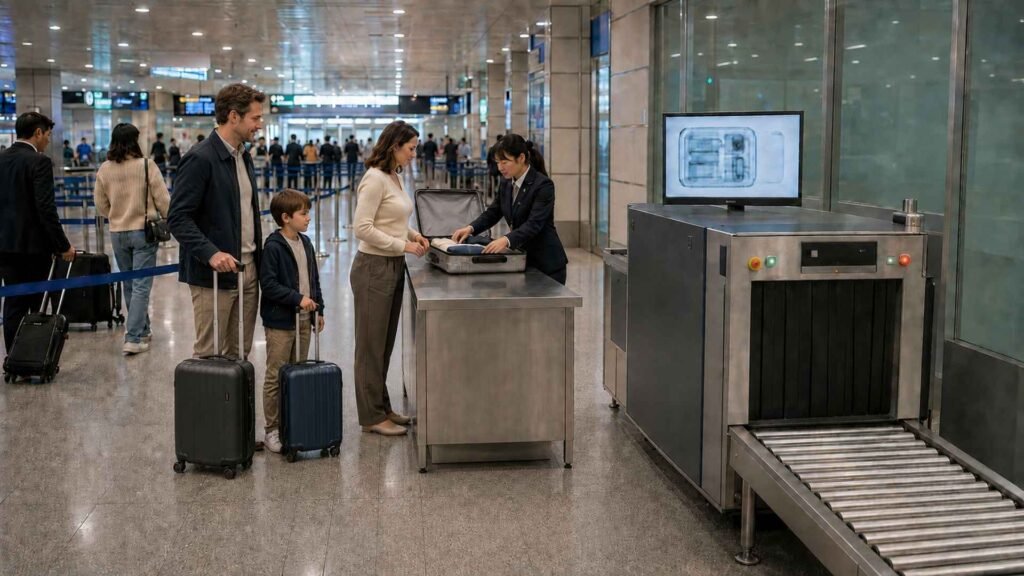
Japan applies strict quarantine rules to protect domestic agriculture and livestock.
Many travelers are surprised that packaged, cooked, vacuum-sealed or duty-free food can still be restricted.
Meat and Animal Products
Do not bring meat or meat products into Japan unless you have confirmed that the product qualifies and carries the necessary inspection certificate.
Restrictions can cover:
- Fresh or frozen meat
- Sausages and salami
- Ham and bacon
- Jerky
- Meat-filled snacks
- Meat-containing instant foods
- Homemade meat products
- Products purchased at an overseas duty-free shop
Commercial packaging does not automatically make a product acceptable.
Japan’s Animal Quarantine Service warns that illegally importing meat or animal products can lead to confiscation and severe penalties.
Fruits, Vegetables, Seeds and Plants
Fresh fruit, vegetables, plants, seeds, cuttings and soil may be prohibited or require phytosanitary documentation and inspection.
Rules vary by product and origin. An item allowed from one country may be restricted from another because of plant pests or disease risks.
If you are carrying any plant material, proceed to the plant quarantine counter before customs clearance.
Other Prohibited or Restricted Goods
Items prohibited or tightly controlled by Japanese law include:
- Illegal narcotics and stimulants
- Cannabis and certain cannabis-derived products
- Firearms, ammunition and weapon parts
- Explosives
- Counterfeit currency
- Certain obscene materials
- Goods infringing intellectual property rights
- Protected wildlife products
- Some knives and weapons
Never carry a package for another person unless you know exactly what it contains.
COVID-19 and Vaccination Requirements
Japan does not currently require ordinary tourists to present:
- A COVID-19 vaccination certificate
- A pre-departure COVID-19 test
- A quarantine booking
- A COVID-specific health declaration
Japan removed its general COVID-19 vaccination and pre-departure testing requirements on April 29, 2023.
Routine vaccinations are also not generally required as a condition of entry for ordinary tourists. However, travelers should seek individual medical advice based on their health, itinerary and planned activities.
Border-health measures can change if a new public-health risk emerges, so check Japan’s official cross-border travel guidance shortly before departure.
Japan Entry Requirements for Children and Families
Children need their own valid passport and, when applicable, their own visa. Being included in a parent’s booking or Visit Japan Web account does not replace the child’s individual travel document.
Parents should check:
- The child’s passport validity
- Visa requirements based on the child’s nationality
- Return or onward booking
- Accommodation information
- Medication carried for the child
- Consent documentation when the child travels with one parent or another adult
Japan does not apply a universal tourist-entry rule requiring every single-parent family to present a consent letter. However, airlines, departure countries, transit countries or border officials may request evidence of parental authority.
A consent letter is particularly sensible when:
- The child is travelling without either parent
- The child travels with only one parent
- The parent and child have different surnames
- Custody arrangements could raise questions
- The itinerary passes through a country with specific consent rules
Carry a copy of the child’s birth certificate or other relationship evidence when appropriate.
Children under 16 are generally exempt from providing fingerprints and a facial photograph during Japan’s standard foreign-visitor biometric procedure.
Visit Japan Web allows accompanying family members to be registered together for convenience. Nevertheless, select the correct traveler and use that person’s information at each stage.
Japan Entry Requirements for Transit Passengers
Whether a transit passenger must meet Japan’s full entry requirements depends on whether they remain inside the international transit area.
Remaining Airside
A traveler who:
- Has a confirmed onward international flight
- Does not collect checked baggage
- Does not change to an airport requiring entry into Japan
- Can remain inside the secure international transit area
- Does not need to pass immigration
may not need to enter Japan.
However, not every airport, terminal or overnight itinerary supports airside transit. Airline staff should confirm whether the baggage is checked through and whether the connection can be completed without immigration.
Passing Through Immigration
You must satisfy Japan’s entry and visa rules if your connection requires you to:
- Collect and recheck baggage
- Transfer between Haneda and Narita
- Leave the international transit area
- Change terminals through a landside route
- Stay overnight where the terminal closes or airside transit is unavailable
- Continue on a domestic flight
- Use a separate ticket that requires landside check-in
A passenger who needs a visa cannot rely on receiving one at the airport. Confirm the transfer procedure with both airlines and check visa requirements before departure.
Do not assume that the word “transit” on the booking means you will remain airside.
What Is JESTA and Is It Required in 2026?
JESTA is the informal name commonly used for Japan’s electronic travel-authorisation system for eligible visa-exempt visitors.
The legislation establishing JESTA was enacted in May 2026, but the system is not yet operational. The Japanese government currently plans to introduce it during fiscal year 2028.
Therefore, JESTA is not part of the Japan entry requirements for travelers arriving in 2026.
Once introduced, the system is expected to screen eligible visa-exempt visitors before they travel, broadly resembling electronic travel-authorisation systems used by several other countries.
However, the final:
- Launch date
- Application process
- Fee
- Validity period
- Eligibility rules
- Exemptions
- Official application website
should not be treated as confirmed until the Japanese government publishes the operational details.
Travelers should be cautious of websites offering paid JESTA applications before the official launch. Visit Japan Web is not JESTA, and completing it does not provide a current or future electronic travel authorisation.
The Japanese government’s current planning documents identify FY2028 as the implementation target.
Final Pre-Departure Checklist
Complete this check shortly before travelling:
- Confirm that your passport remains valid throughout the trip
- Check visa rules for your nationality and exact passport type
- Obtain the correct visa before departure if required
- Confirm your permitted visa-free stay
- Check whether every transit can be completed airside
- Keep your return or onward booking available
- Save your first accommodation’s full address and telephone number
- Complete Visit Japan Web or prepare to use the available alternative forms
- Save arrival codes for offline access
- Check all medication by active ingredient
- Obtain Import Confirmation or controlled-drug permission if required
- Remove restricted meat, plant and animal products from your luggage
- Declare goods honestly at Customs
- Carry supporting documents for children when relevant
- Recheck official rules shortly before departure
Frequently Asked Questions About Japan Entry Requirements
Do I need six months on my passport to enter Japan?
Not as a general rule for ordinary passports. Your passport should remain valid throughout your stay. Emergency passports, refugee travel documents and other non-standard documents may have different requirements.
Do tourists need a visa to enter Japan in 2026?
It depends on nationality, passport type, purpose and duration. Japan currently grants short-stay visa exemptions to eligible travelers from 74 countries and regions.
Can I get a tourist visa when I arrive in Japan?
Normally, no. If your nationality or travel document requires a visa, obtain it before departure.
How long can I stay in Japan without a visa?
Most eligible visa-exempt visitors receive up to 90 days. Eligible nationals of Indonesia and Thailand generally receive 15 days, while Brunei and Qatar receive 30 days.
Is Visit Japan Web mandatory in 2026?
It is strongly recommended but is not a visa or electronic travel authorisation. Alternative arrival procedures are generally available for travelers who cannot use it.
Does Visit Japan Web cost money?
No. The official government service is free. Avoid unofficial sites that charge an application or customs-processing fee.
Do I need a return ticket to enter Japan?
A return or onward ticket is not an unconditional guarantee of entry, but the airline or immigration authorities may request evidence that you plan to leave within your permitted stay.
Do I need proof of accommodation?
You should be able to provide the name, address and contact details of your first accommodation. Immigration officers may ask where you will stay.
Do I need to show proof of funds?
Not every tourist is asked to show financial evidence. Immigration officers may nevertheless ask how you will support yourself during the visit, particularly if the itinerary or length of stay raises questions.
Are COVID-19 vaccination certificates required?
No. Japan does not currently require ordinary travelers to submit a COVID-19 vaccination certificate or pre-departure test.
Can I bring prescription medicine into Japan?
Usually, limited quantities for personal use are permitted, but the rule depends on the active ingredient and amount. Some medicines require Import Confirmation or separate advance permission, while others are prohibited.
Can I bring packaged meat into Japan?
Do not assume packaged, cooked or duty-free meat is permitted. Japan strictly controls meat and animal products, and many items require official inspection certification.
Do children complete the same entry procedures?
Children need their own passports and visas where applicable. Children under 16 are generally exempt from fingerprinting and facial photography, but they remain subject to immigration and customs requirements.
Do I need a visa to transit through Japan?
Not necessarily if you remain airside on a confirmed international connection. You must meet Japan’s entry requirements if you collect baggage, transfer airports, continue domestically or otherwise pass immigration.
Is JESTA required for Japan in 2026?
No. JESTA is planned for a future launch, currently targeted for FY2028. It is not required in 2026, and Visit Japan Web is not a substitute version of JESTA.
Final Thoughts
The most important Japan entry requirements are a valid passport, the correct visa status, accurate arrival information and compliance with medication and customs restrictions.
For most eligible tourists, the process is simple once these details have been checked. Complete Visit Japan Web before departure, keep essential documents accessible offline and verify any medication or food item that could be restricted.
Rules can change, so make one final check with the relevant Japanese government authority before you travel.