
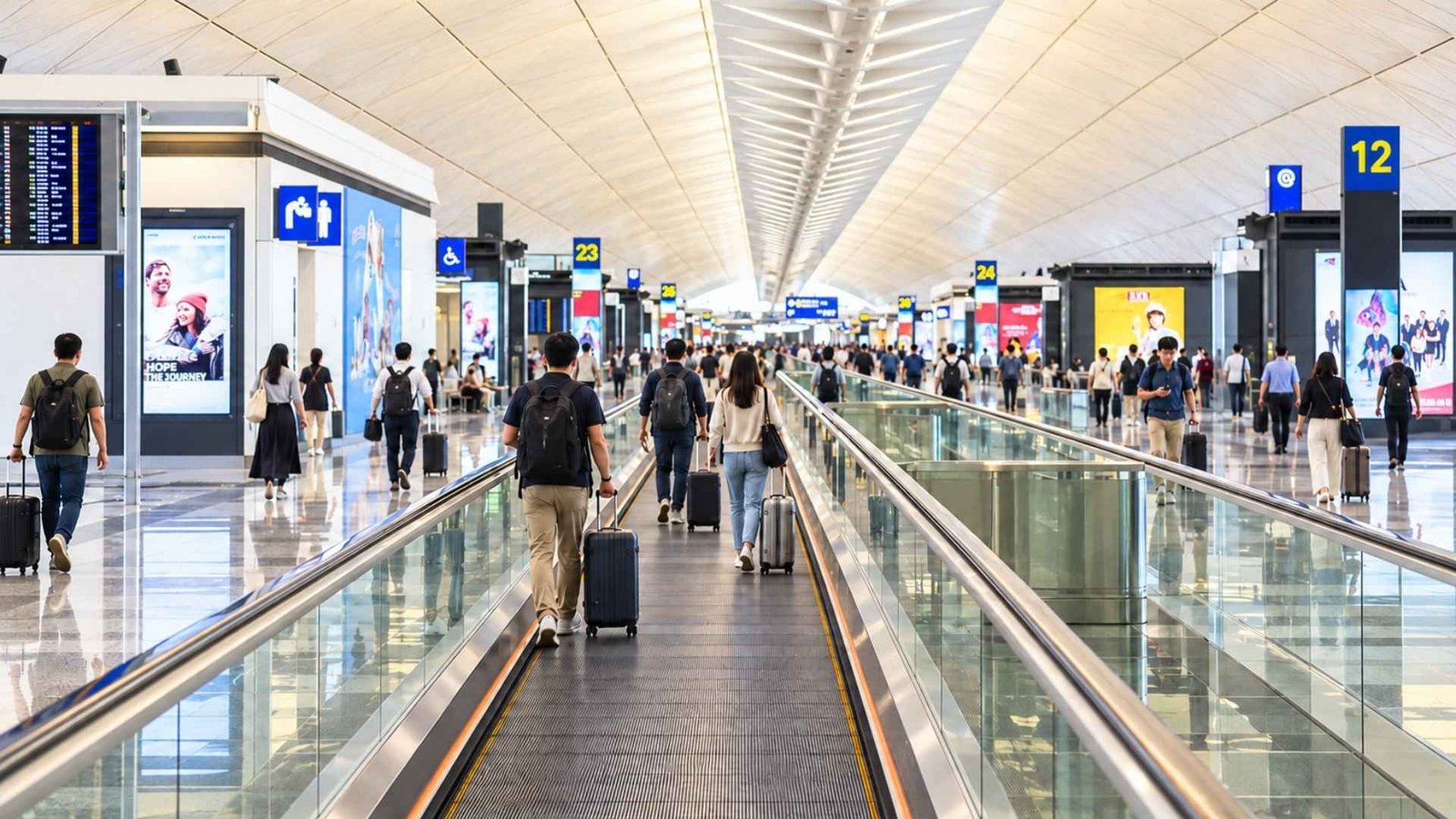
Hong Kong International Airport can be the start of a city break, a connection between long-haul flights or the gateway to Macau and mainland China. Those journeys begin at the same airport, but each follows a different route through it.
This Hong Kong International Airport guide helps you choose that route, understand the terminal layout and plan what comes next, from a train into Central to an overnight stay or onward cross-border transfer.
Hong Kong International Airport Guide: Quick Answer
Start with what you intend to do after landing. Your onward journey determines which signs to follow.
| Your journey | Where to go | First priority |
|---|---|---|
| Staying in Hong Kong | Arrivals and immigration, then baggage reclaim and customs | Choose transport around your hotel’s exact address |
| Connecting to another flight | Flight-transfer signs and your airline’s transfer desk if needed | Establish your boarding-pass and baggage arrangements |
| Continuing to Macau or mainland China through SkyPier | The relevant transfer counter before Hong Kong immigration | Confirm the service’s eligibility and departure deadline |
For departures, check your airline’s terminal before setting off: T2’s passenger departure facilities opened on 27 May 2026, so older instructions sending every passenger to T1 are outdated.
Terminal 1 and Terminal 2: Where Your Journey Starts
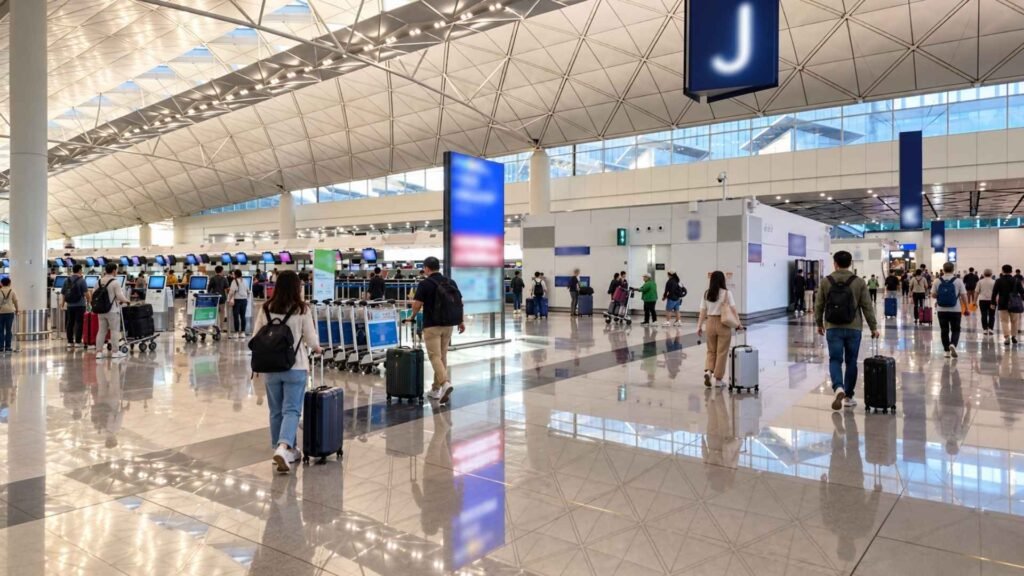
HKG is the airport code, HKIA is its common abbreviation, and Chek Lap Kok is another name you may encounter. Within the airport, your check-in terminal and boarding concourse can be different.
Terminal 1: Arrivals and Boarding
Under the current operating arrangement, passenger arrival formalities are handled in Terminal 1. Its main public arrivals level is L5, while the departure check-in hall is on L7.
If a suitcase is missing or damaged, report it to the relevant baggage-service staff before leaving baggage reclaim. For a driver pickup, agree on the meeting point and how flight delays affect the waiting allowance.
After departure formalities, follow the signs to your boarding gate. Your route can involve walking, moving walkways and the Automated People Mover, or APM. Reaching the train platform and walking from its arrival station to your gate also take time.
Use the live gate information and airport directions rather than allowing one fixed walking time for every flight. Find your gate area before choosing somewhere to eat.
Terminal 2: Check-In and Departure Formalities
T2 handles departures for selected airlines, including HK Express, Hong Kong Airlines and Greater Bay Airlines. Follow your operating airline’s current terminal instructions, especially for codeshare bookings.
The T2 process is check-in and bag drop, security screening and departure immigration, followed by the APM to T1’s boarding facilities. The new T2 Concourse is a separate development phase, so T2 check-in currently leads to boarding elsewhere in the airport.
Clara’s Tip
Save your departure terminal alongside your flight number before leaving the hotel. Give that terminal to your driver and follow its signs from Airport Express, even if the gate later shown on your boarding pass is in T1’s boarding area.
Before You Fly: Documents and Cabin Essentials
A little preparation is particularly useful at HKG because an airside connection, a Hong Kong visit and a cross-border transfer can have different requirements.
Hong Kong Entry and Transit Requirements
Passport holders from many countries and territories can visit Hong Kong without a visa for a limited stay. The permitted duration and any advance-registration requirements depend on the travel document.
Use the Hong Kong Immigration Department’s entry requirements to find your nationality and read the accompanying remarks. Airside transit exemptions have exceptions, so match the rules to your actual itinerary.
Hong Kong, mainland China and Macau have separate immigration arrangements. Check each destination included in your trip, including any entry required to collect luggage between flights.
Power Banks and Vapes
For flights departing HKG, the current limit is two power banks per passenger. Carry them in cabin baggage and protect them against short circuits; they must not go in checked luggage.
Recharging a power bank during the flight is prohibited. Your airline may additionally prohibit using a power bank to charge another device and storing it in an overhead compartment. Battery-capacity restrictions also apply.
Hong Kong prohibits bringing in alternative smoking products, including e-cigarettes and heated tobacco products, even in small quantities for personal use. An exemption applies to qualifying air transit passengers who remain before immigration, but it does not cover entering Hong Kong for a hotel stay or sightseeing. For a visit involving entry, leave these products at home.
Keep Your Journey Details Accessible
Save the documents needed for your particular route before flying:
- Passport and any required entry or transit permissions.
- Boarding passes and onward bookings, with offline copies.
- Hotel address or transfer meeting instructions.
- Baggage receipts, retained until your luggage reaches its final destination.
Free airport Wi-Fi is available in most terminal seating and public areas. Look for “#HKAirport Free WiFi” or “Wi-Fi.HK via HKAirport”.
Request mobility assistance through your airline before travel if you need support between gates or through arrivals.
Connecting Flights and Self-Transfers
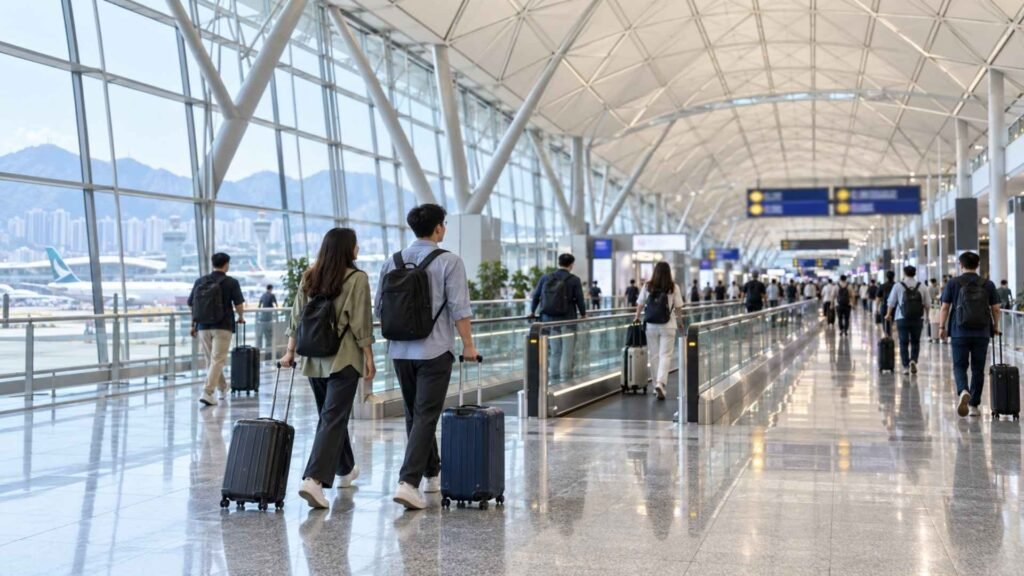
The important distinction is whether your airline has arranged a through connection or you are responsible for joining separate bookings.
Through Connections
When your bags are checked through and you have the next boarding pass, follow the transfer signs, complete transfer security and continue towards the departure gate. If you need a boarding pass, visit the operating airline’s designated transfer desk first.
The minimum connection time is an airline and itinerary-specific booking threshold. It tells you whether a connection meets the applicable booking requirements, rather than how much spare time you will have.
When choosing between similar through-ticket itineraries, we suggest allowing around two to three hours for a more comfortable connection. Follow your airline’s requirements for the actual flights you book.
Separate Tickets
Before booking a self-transfer, establish what you will need to do between flights:
- Boarding pass: Can the next airline issue or accept it airside?
- Checked baggage: Will it reach the final destination, or must you collect and recheck it?
- Entry permission: Can you enter Hong Kong if the transfer requires landside access?
- Deadlines: When do the next flight’s check-in, bag drop and boarding close?
- Missed-flight costs: Who pays for a replacement ticket if the first flight arrives late?
Collecting and rechecking a bag adds arrival procedures, check-in and departure screening to the journey. Cabin baggage simplifies the process only when the next airline can accept you through the airside transfer route.
A generous gap or overnight stop is worth considering when the next ticket would be expensive to replace. Measure the gap against the airline’s deadlines, rather than the scheduled departure time alone.
If you are also joining separate flights in Singapore on the same trip, our Singapore Changi Airport Self-Transfer Guide explains the arrangements for that airport.
Hong Kong Airport to City Centre
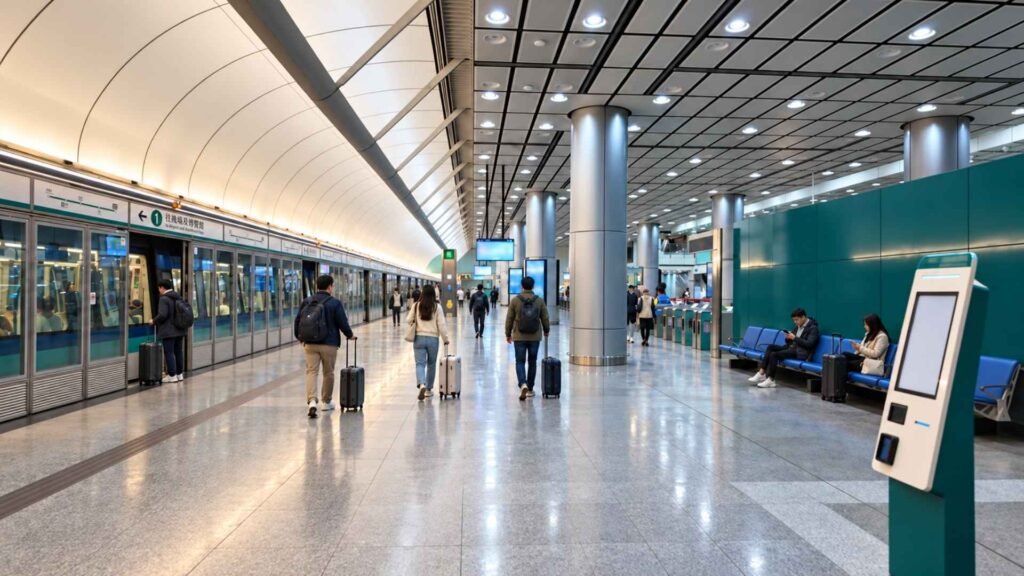
Choose transport by your hotel’s location and the number of people travelling. Airport Express offers a predictable rail journey; a convenient bus stop or a shared taxi may make the complete hotel transfer easier.
| Option | Journey time | Adult fare or planning budget | Best fit |
|---|---|---|---|
| Airport Express to Hong Kong Station | 24 minutes on the train | HK$120 with Octopus or eligible contactless/QR payment; HK$130 Smart Ticket | Central and useful onward rail connections |
| Airport Express to Kowloon | 22 minutes on the train | HK$105 with Octopus or eligible contactless/QR payment; HK$115 Smart Ticket | West Kowloon and hotels reached conveniently from the station |
| A11 airport bus | Allow roughly 50–90 minutes, depending on stop and traffic | HK$41.90 | Sheung Wan, Central, Wan Chai, Causeway Bay and North Point |
| A21 airport bus | Allow roughly 60–90 minutes, depending on stop and traffic | HK$34.60 | Mong Kok, Yau Ma Tei, Jordan and Tsim Sha Tsui |
| Red taxi to Central | Allow roughly 35–60 minutes in ordinary traffic | Budget around HK$375–450 per vehicle | Direct hotel arrival, groups and substantial luggage |
| Red taxi to Tsim Sha Tsui | Allow roughly 30–60 minutes in ordinary traffic | Budget around HK$290–350 per vehicle | Direct arrival in southern Kowloon |
Bus and taxi times are planning estimates, excluding the wait to board; congestion can make them longer. Taxi ranges are budgeting allowances, not fixed fares. The Transport Department’s reference estimates are HK$375 to Central/Admiralty and HK$290 to Tsim Sha Tsui, including relevant tolls but excluding other taxi charges.
Airport Express: Choose the Right Station
The train also serves Tsing Yi, around 14 minutes from the airport. The adult fare there is HK$73 with Octopus or eligible contactless/QR payment, or HK$80 with a Smart Ticket.
From Airport Station towards the city, the first train is 05:54 and the last is 00:48. In the opposite direction, trains from Hong Kong Station run from 05:50 to 00:48. Use the Airport Express timetable when travelling close to those limits.
Hong Kong Station is in Central. Kowloon Station is in West Kowloon, so many Tsim Sha Tsui hotels require another ride. Add that final connection when comparing the train with A21 or a taxi.
Clara’s Tip
Three adults travelling to Hong Kong Station with Octopus pay HK$360. That is close to the HK$375 reference taxi estimate to Central, before additional taxi charges. For a group with luggage, compare a direct taxi first: it may cost little more overall while avoiding another transfer from the station.
Airport Buses and Late Arrivals
A11 and A21 are useful starting points, but the best route is the one with a convenient stop near your accommodation. Save the stop name and the final walking route before boarding.
Octopus is useful for paying bus fares without handling cash. Keep enough stored value for the journey, particularly when arriving late.
Overnight options include N11 to Central’s Macao Ferry area at HK$32.10 and N21 to Tsim Sha Tsui at HK$23.80. Their routes and journey times differ from the daytime services; allow for additional stops and consult the departure board for the next bus.
Citybound airport buses depart from the Ground Transportation Centre. For a late flight, choose a backup based on when you are likely to finish arrivals, rather than the scheduled touchdown time.
Taxis and Private Transfers
Use the official red urban taxi queue for Central and Tsim Sha Tsui. Have the hotel’s full address ready, preferably in Chinese as well as English, and request a receipt.
The final fare reflects the meter and applicable additions, including tolls and chargeable baggage. For a pre-booked vehicle, establish the total price, waiting allowance, luggage capacity and child-seat requirements before payment.
Do You Need an Octopus Card?
Octopus is useful for repeated journeys on the MTR, buses, trams and participating ferries, as well as purchases at many shops. It is a stored-value payment method, so load enough credit for your journeys; a basic card is not an unlimited transport pass.
You do not need one solely to ride Airport Express: eligible contactless bank cards and other ticket options are available. For several days of sightseeing, Octopus can make everyday payments simpler. Physical tourist cards and mobile options have different purchase and refund terms.
Hong Kong Airport to Macau and Mainland China
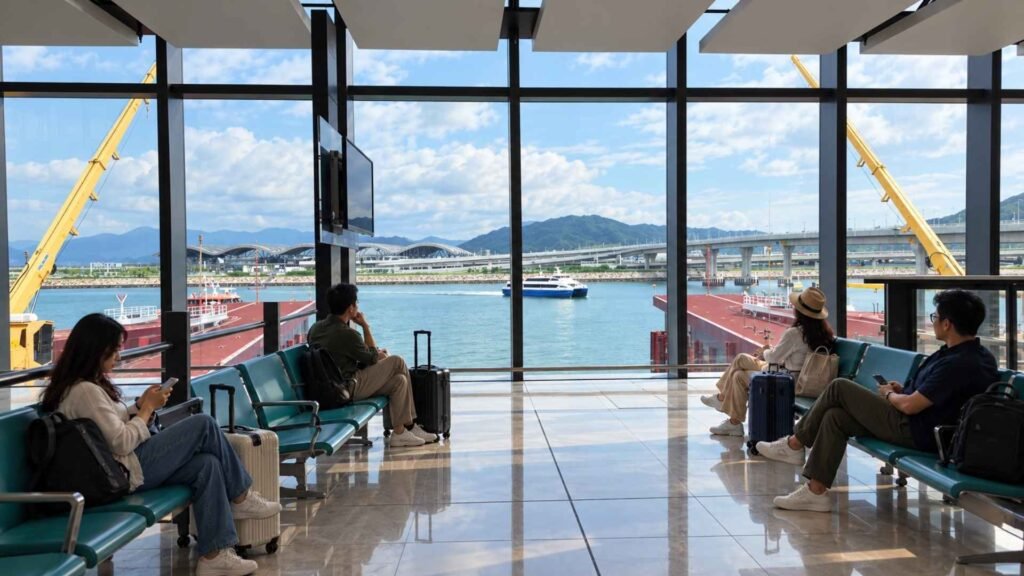
Choose between an eligible SkyPier transfer before entering Hong Kong and a landside journey after completing Hong Kong arrivals. This decision determines where you go inside the airport.
SkyPier Transfers
SkyPier transfer coaches connect eligible passengers to the Hong Kong–Zhuhai–Macao Bridge’s Macao and Zhuhai ports. Arriving passengers use the counter at Transfer Area E2 before immigration and present their baggage receipts for luggage-transfer arrangements.
For the airport-to-Macau or mainland coach direction, travel must continue on the same day. Reach the counter at least 60 minutes before departure with checked baggage, or 30 minutes without it, and carry the required flight evidence, coach ticket and destination documents.
Once you pass Hong Kong immigration, you cannot return to this counter to use the service.
SkyPier also has ferry connections to selected Greater Bay Area ports, including Shenzhen Shekou. Services vary by route and date, so establish that your intended sailing operates before booking the rest of the journey.
Travelling After Entering Hong Kong
A landside bridge journey begins with Hong Kong immigration and baggage collection, followed by transport to the Hong Kong Port and the relevant cross-border service.
Compare the arrival point and onward ride to your hotel, not just the crossing itself. For mainland destinations, establish entry eligibility separately; arriving at HKG does not automatically qualify you for a mainland visa-free transit scheme.
Lounges, Showers and Rest Between Flights
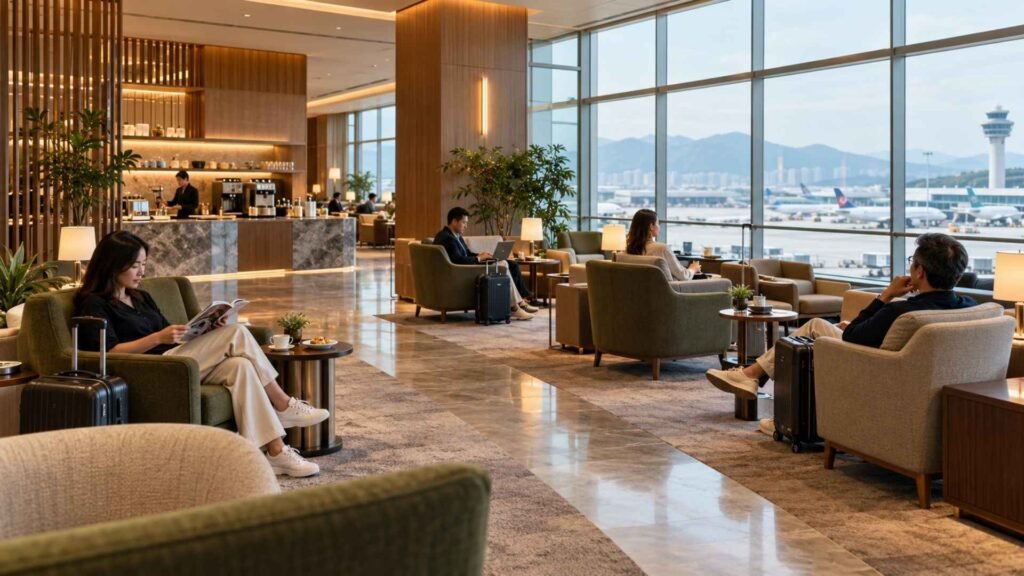
Choose a resting place around the gate area you can access and the time available before boarding.
Lounges
HKG has airline lounges, including Cathay Pacific facilities, alongside independent options such as Plaza Premium and Kyra. Airline-lounge access depends on the relevant cabin, status or programme rules.
The airport lists Kyra Lounge near Gate 23, with opening hours of 05:30–23:30, and Kyra | Taste by Priceless near Gate 40, operating 06:00–23:59.
Selected Plaza Premium locations, including the East Hall lounge near Gate 1 and West Hall lounge near Gate 60, are listed as operating 24 hours. Other branches have shorter hours, so choose the exact location when booking.
Compare the permitted stay, shower inclusion and access conditions with your available time. A lounge visit is most useful when it leaves a comfortable margin for reaching the gate.
Showers and Terminal Rest
HKG offers complimentary shower facilities and paid shower services; ask an information desk for the nearest option accessible from your current arrivals or departure area.
For a terminal rest, keep valuables secure and use an alarm that leaves time for boarding. A light layer and comfortable shoes help during long waits; our Airport Outfits for Women guide includes options for long flights and layovers.
Hotels Near Hong Kong Airport
Choose an airport hotel by the sleeping time it provides after transfers and before your next departure.
A Terminal-Connected Stay
Regal Airport Hotel is connected to the passenger terminal by a covered link bridge. It is landside, so you must be eligible to enter Hong Kong to reach the room.
This can be convenient for an overnight break, particularly when avoiding a road transfer matters. For a daytime arrival, book a confirmed day-use arrangement or early check-in if you need immediate room access.
A Hotel Reached by Shuttle or Taxi
For other airport-area hotels, assess the complete transfer before booking:
- Shuttle hours: The last departure after your arrival and the first service before your flight.
- Pickup point: Where to meet the shuttle and how to reach it with luggage.
- Journey and waiting time: Include both when calculating your sleeping time.
- Booking requirements: Whether you must reserve a seat in advance.
- Backup cost: The taxi allowance if the shuttle does not match your flights.
A room offering an extra hour of sleep can be better value than a cheaper property with a long wait for transport. For an early departure, work backwards from your airline’s check-in deadline.
Departing from Hong Kong Airport
As a planning recommendation, aim to reach the correct departure terminal around three hours before an international flight, adjusting for your airline’s instructions and any assistance needs.
Bag drop and boarding close before the scheduled departure. Save the deadlines for your flight and allow enough time to complete security, departure immigration and the journey to the gate.
In-town check-in is available at designated Airport Express stations for participating airlines, subject to their hours and eligibility rules. Confirm your flight qualifies before taking luggage to a city station for bag drop.
Hong Kong International Airport Guide: Frequently Asked Questions
Which Terminal Handles Arrivals?
Passenger arrival formalities currently take place in T1. Use the arrivals meeting point agreed with your driver, even if your airline uses T2 for departure check-in.
Is Hong Kong Airport Open Overnight?
HKG operates around the clock, but individual check-in desks, restaurants and lounges have their own hours. Access to restricted areas depends on your flight and travel documents.
How Much Is a Taxi from HKG to Central?
Budget roughly HK$375–450 per vehicle for planning purposes. The actual fare depends on the meter, traffic and applicable additional charges.
Can You Leave the Airport During a Layover?
Yes, if you meet Hong Kong’s entry requirements and have sufficient time. Allow for arrival procedures, both transport journeys and the return departure process before deciding how long to spend in the city.
Do You Need an Octopus Card for Airport Express?
No. Eligible contactless bank cards and other ticket options are available; Octopus is more useful when you also plan regular public-transport journeys during your stay.
Do You Need a Visa to Transit Through HKG?
The answer depends on your passport and whether you remain airside or enter Hong Kong. Use the immigration requirements linked above and read the transit exceptions for your nationality before booking.
Final Thoughts
A smooth HKG journey starts with choosing the route that fits your ticket and destination. Settle your transfer or hotel transport before flying, then leave enough time for the airport steps in between. With those decisions made, you can arrive ready for the next part of your trip.