

Mornings in Barcelona are not just beautiful — they are productive.
Soft Mediterranean light spills across the structured avenues of Eixample as the city gradually wakes. Cafés open quietly, laptops appear on marble tables, and conversations shift between Spanish, English, and the language of opportunity.
Somewhere between lifestyle and ambition, Barcelona creates something rare.
Starting a business in Barcelona is no longer just a relocation idea — it’s a strategic move toward building a location-independent, globally connected business within Europe.
But opportunity without structure leads to friction.
This guide gives you a clear, strategic, and execution-focused roadmap for starting a business in Barcelona as a foreign entrepreneur — especially if it’s your first time navigating the process.
Why Starting a Business in Barcelona Is a Smart Move in 2026

Barcelona is where lifestyle meets scalable global opportunity — but what makes it truly powerful is how these two elements reinforce each other.
Many international founders are now starting a business in Barcelona to take advantage of its unique balance between lifestyle and global business access.
Strategic Advantages
✔ Access to the EU Market (450M+ customers)
Operate within one of the world’s largest single markets while benefiting from EU trade and logistics infrastructure.
✔ Fast-Growing Startup Ecosystem
Barcelona is consistently ranked among Europe’s top startup hubs, attracting international founders, investors, and tech talent.
✔ Global Talent Pool
A steady flow of skilled professionals in tech, design, marketing, and remote services.
✔ Cost vs Value Advantage
Lower operational costs compared to cities like London or Paris — with comparable lifestyle quality.
✔ Remote-First Business Environment
Ideal for building businesses that serve global clients while operating locally.
💡 Strategic Insight
The most successful founders in Barcelona don’t rely on the local market alone.
They build location-independent income streams with global reach, while using Barcelona as a high-quality, cost-efficient base.
This is not just a place to start a business — it’s a place to scale it internationally.
Best Business Ideas for Starting a Business in Barcelona

Barcelona rewards the right business model — especially for those starting a business in Barcelona with a global and scalable mindset.
1. Remote Consulting & Freelance Services
- Marketing, design, development, coaching
- Low cost, high margin
- Fully location-independent
👉 Ideal if you want fast setup and access to global clients
2. E-commerce (EU-Focused)
- Sell physical or digital products across Europe
- Benefit from EU logistics & shipping networks
👉 Strong potential with the right niche and branding
3. Digital Marketing Agency
- High demand from local + international businesses
- Recurring revenue model
👉 One of the most scalable service businesses
4. Airbnb & Property Management Services
- Manage short-term rentals for property owners
- High demand in tourist-heavy areas
👉 Works well with local partnerships
5. Personal Brand / Content Business
- YouTube, blog, social media, education products
- Monetization via ads, affiliates, digital products
👉 Long-term scalable income stream
💡 Key Insight
Barcelona rewards businesses that are:
✔ Location-independent
✔ Digitally scalable
✔ Service or knowledge-based
What Doesn’t Work Well (Most People Get This Wrong)
❌ Small local retail shops (high rent, low margins)
❌ Tourist-only businesses (seasonal income risk)
❌ Traditional restaurants without strong differentiation
💡 Reality Check
If your business depends only on foot traffic, Barcelona becomes expensive.
If your business serves global clients, Barcelona becomes highly profitable.
Best Strategy for New Entrepreneurs
👉 Start with a low-cost, service-based model (Autónomo)
👉 Validate income
👉 Scale into a company (SL) + digital expansion
🔥 Power Closing Line (Highly Important)
Barcelona is not the place to open just another business.
It’s the place to build a business that works from anywhere — but earns globally.
Autónomo vs SL: Which Is Better for Starting a Business in Barcelona?
| Feature | Autónomo | SL (Limited Company) |
|---|---|---|
| Setup Time | 24–48 hours | 2–4 weeks |
| Min Capital | €0 | €3,000 |
| Liability | Unlimited | Limited |
| Taxes | 19–47% | ~25% |
| Best For | Freelancers | Startups |
Choosing the right structure is one of the most important decisions when starting a business in Barcelona.
Step-by-Step Guide to Starting a Business in Barcelona
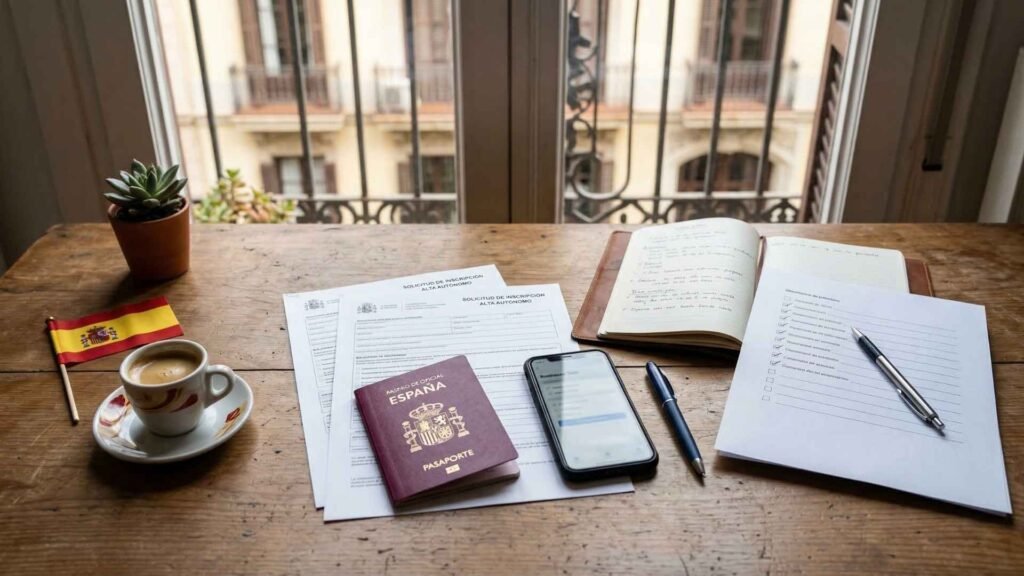
Starting a business in Barcelona is relatively straightforward — but the process can slow down quickly if the steps are handled in the wrong order. If you’re serious about starting a business in Barcelona, following the correct sequence is essential to avoid delays, extra costs, and unnecessary friction.
Step 1: Get Your NIE Number
The NIE (Foreigner Identification Number) is your legal identity in Spain.
👉 For the latest updates, always check the official government portal and review the official NIE application process in Spain.
You cannot:
- Open a bank account
- Register a company
- Pay taxes
without it.
💡 Pro Tip:
Book your NIE appointment early — waiting times can range from 1 to 4 weeks depending on demand.
Step 2: Register Your Business Name
Your company name must be:
- Unique
- Approved at a national level
You can submit multiple name options to speed up approval.
💡 Pro Tip:
Always prepare 2–3 alternative names to avoid delays.
Step 3: Open a Business Bank Account
Required for SL company formation.
You must deposit €3,000 in minimum capital.
💡 Important Note
While Spanish law allows SL companies to be formed with minimal capital, most banks and notaries still consider €3,000 as a practical and recommended starting capital.
Banking & Payments in Spain
Opening a business account can be slower than expected — especially for foreigners.
Typical Requirements:
- NIE number
- Proof of address
- Description of business activity
💡 Important Insight:
Some banks require in-person verification, even if you start the process online.
Many founders combine a traditional Spanish bank with a digital banking solution for greater flexibility and faster setup.
Step 4: Notary & Company Formation
Your company is officially created before a notary.
This step includes:
- Signing company documents
- Defining shareholders
- Registering legal structure
💡 Reality Check:
This is where delays happen if documents are incomplete.
Step 5: Tax Registration (Agencia Tributaria)
You must register your business activity with the Spanish tax authority.
This includes selecting your economic activity code (IAE).
💡 Pro Tip:
Choosing the wrong activity code can create tax complications later.
Step 6: Social Security Registration
Mandatory for:
- Autónomo
- Company directors
Monthly contributions start immediately.
Step 7: Local Licenses (If Required)
Depending on your business, you may need:
- Activity license
- Municipality approval
This is especially important for physical or local businesses.
💡 Key Insight
If your business is:
- Digital
- Remote
- Service-based
You can skip most local licensing complexity.
⏱️ Realistic Timeline
- With advisor: 2–3 weeks
- Without support: 4–8 weeks
⚡ Execution Strategy (Very Important)
👉 Prepare documents remotely
👉 Complete legal steps in Spain
👉 Launch with a simple structure
👉 Optimize later
Taxes in Spain for Starting a Business in Barcelona
When starting a business in Barcelona, understanding the tax system is not optional — it directly affects your profitability.
👉 For the most accurate and up-to-date information, always consult the Spanish tax authority (AEAT).
Instead of focusing only on taxes, smart founders build a structure:
Typical Strategy Path
- Start as Autónomo (low cost, fast entry)
- Validate income
- Transition to SL (tax optimization + scalability)
- Combine with Beckham Law (if eligible)
💡 Result
👉 Lower tax burden
👉 Higher net income
👉 More control over finances
⚠️ Common Tax Mistakes (Avoid These)
❌ Staying Autónomo too long
❌ Ignoring VAT rules
❌ Mixing personal and business finances
❌ Not using a local tax advisor
💡 Golden Rule
In Spain, tax mistakes are not small — they are expensive.
🔥 Final Insight
Barcelona is not a low-tax environment.
But with the right structure, starting a business in Barcelona becomes a high-efficiency, globally competitive base.
Beckham Law (High-Income Advantage)

For many foreign entrepreneurs, the Beckham Law is not just a benefit — it’s one of the main reasons to relocate to Spain.
What Is the Beckham Law?
A special tax regime that allows eligible individuals to pay a flat 24% tax rate instead of Spain’s progressive rates (up to 47%).
👉 To understand eligibility and official requirements, refer to the Beckham Law tax regime in Spain.
Why It Matters (Real Impact)
Without Beckham Law:
- You may pay up to 47% income tax
With Beckham Law:
- You pay around 24% flat tax
💡 Example: Real Tax Savings Scenario
If you earn €100,000/year:
- Standard taxation → ~€40,000+ tax
- Beckham Law → ~€24,000 tax
👉 Potential savings: €15,000+ per year
Who Can Benefit?
- Remote founders relocating to Spain
- High-income consultants
- Executives and company directors (with conditions)
Key Conditions (Simplified)
- You must become a Spanish tax resident
- You must not have lived in Spain in recent years
- You must apply within a limited timeframe after arrival
How Long Does It Last?
The Beckham Law benefit can last for up to 6 years — making it one of the most valuable long-term tax advantages available to foreign entrepreneurs in Spain.
💡 Strategic Insight
Combining an SL company with the Beckham Law can significantly increase your net income and overall tax efficiency.
⚠️ Important Note
Not everyone qualifies — and the structure must be set up correctly. This is where a local tax advisor becomes critical.
Tax laws and special regimes such as the Beckham Law are subject to change. Always verify the latest requirements with your gestor or tax advisor based on current 2026 regulations.
🔥 Power Closing Line
The Beckham Law doesn’t just reduce taxes.
It changes the entire financial equation of running a business in Barcelona.
Costs of Starting a Business in Barcelona
The cost of starting a business in Barcelona depends on your structure, business model, and long-term strategy.
Autónomo
- Setup: €100–€300
- Monthly: €250–€400
👉 Budget: €2,000 – €4,000 (with runway)
SL Company
- Setup: €1,500–€3,000
- Monthly: €300–€700
Total Realistic Budget
👉 €5,000 – €10,000 (setup + 6-month runway)
Do You Need a Lawyer or Business Advisor?
Technically, no — but in practice, not having one can cost you time, money, and unnecessary delays.
Here’s why it matters:
- Avoid costly legal mistakes that can delay your launch
- Speed up the entire setup process by weeks
- Build a proper tax structure from day one
💡 Key Insight
A local advisor is not just a convenience — it’s a strategic investment in speed, compliance, and long-term profitability.
💡 Local Insight
In Spain, your primary point of contact for administrative and financial matters is known as a “Gestor” (Gestoría). A gestor is a specialized professional who handles taxes, social security, and compliance — making them essential for most foreign entrepreneurs.
Can You Start a Business Before Moving to Spain?

Yes — but only partially.
This is a common question for entrepreneurs who are considering starting a business in Barcelona from abroad.
What You Can Do Remotely
- Reserve your company name
- Prepare legal and company documents
- Work with a local advisor (gestor)
- Define your business structure (Autónomo or SL)
If you plan to live and work remotely in Spain, it’s important to review the Spain Digital Nomad Visa requirements before starting your business setup process, as your residency status can directly affect how you structure your business.
What Requires Physical Presence in Spain
- Obtaining your NIE number
- Opening a Spanish bank account
- Signing documents at a notary
These steps are mandatory and cannot be fully completed online.
💡 Best Strategy (Recommended Approach)
👉 Prepare everything remotely
👉 Schedule all appointments in advance
👉 Travel to Barcelona for final execution (3–7 days)
⚠️ Common Mistake
Many entrepreneurs try to complete everything remotely — only to delay their launch by weeks.
Execution Timeline
- Remote preparation: 1–2 weeks
- In-person completion: 3–7 days
💡 Pro Insight
The fastest way to start a business in Barcelona is not fully remote — it’s strategically hybrid.
🔥 Power Closing Line
You don’t need to be in Barcelona to start planning your business — but you do need to be there to launch it properly.
Best Areas in Barcelona for Business

Location plays a key role when starting a business in Barcelona, especially for businesses that depend on local customers.
The right area can influence not only your visibility, but also your pricing power, client profile, and long-term positioning.
Eixample (Business & Professional Hub)
✔ Central location
✔ Strong corporate presence
✔ High purchasing power
👉 Best for:
- Consultants
- Agencies
- Professional services
💡 If your business relies on trust and premium clients, this is the safest choice.
Poblenou (Tech & Startup District)
✔ Barcelona’s innovation hub
✔ Home to startups and coworking spaces
✔ International business environment
👉 Best for:
- Tech startups
- SaaS companies
- Digital businesses
💡 Ideal if you want to be surrounded by a growth-focused ecosystem
Gràcia (Creative & Boutique Businesses)
✔ Local, artistic atmosphere
✔ Strong community identity
👉 Best for:
- Creative brands
- Designers
- Small boutique businesses
💡 Works best for brand-driven, niche businesses
El Born (Tourism & Experience Economy)
✔ High tourist traffic
✔ Strong retail and hospitality demand
👉 Best for:
- Retail
- Experience-based businesses
- Hospitality
⚠️ Note: High competition and seasonal fluctuations
💡 How to Choose the Right Area (Simple Rule)
Choosing the right location in Barcelona is not just about rent — it directly shapes your customer type, pricing, and long-term profitability.
👉 If your clients are global → location matters less
👉 If your clients are local → location is everything
⚠️ Common Mistakes to Avoid
❌ Choosing location based on price only
❌ Ignoring customer behavior
❌ Overestimating foot traffic
❌ Setting up in tourist areas without a clear strategy
💡 Strategic Insight
In Barcelona, location is not just a cost — it’s a positioning decision.
🔥 Power Closing Line
The best area is not the most popular one.
It’s the one that aligns with your business model and customer type.
FAQ: Starting a Business in Barcelona
How to start a business in Barcelona as a foreigner?
You need an NIE number, choose a business structure, open a business bank account, and register with Spanish authorities.
How much does it cost to start a business in Barcelona?
The total cost typically ranges between €5,000 and €10,000, including setup expenses and a 6-month financial runway, depending on your business model and structure.
Can I start a business without speaking Spanish?
Yes, but a local advisor helps.
How long does it take?
2–4 weeks with support.
What is the cheapest way to start a business in Barcelona?
Starting as an Autónomo is usually the most cost-effective option for freelancers and solo founders.
Can foreigners open a company in Spain?
Yes, with an NIE number and proper registration. In most cases, working with a local advisor makes the process faster and easier.
Is Barcelona good for startups?
Yes — fast-growing ecosystem.
Conclusion
Barcelona is not just a place to live.
It’s a place to build — strategically.
For many entrepreneurs, starting a business in Barcelona becomes the foundation for building a globally scalable lifestyle.
If you combine:
✔ The right structure
✔ The right business model
✔ The right financial planning
You don’t just start a business.
You build a location-independent system designed for long-term growth and global income.
Disclaimer
This guide is for informational and educational purposes only. While we aim to provide accurate and up-to-date insights on starting a business in Barcelona in 2026, regulations, tax laws (including the Beckham Law), and administrative procedures may change over time.
This content does not constitute legal, tax, or financial advice. Before making any business decisions, we strongly recommend consulting with a qualified gestor, tax advisor, or legal professional in Spain.