

New York: The Global Capital of Business and Opportunity
Few cities can match New York’s energy, diversity, and economic power.
Home to more than 8.5 million residents and welcoming over 60 million visitors each year, the Big Apple stands as a global capital where commerce, culture, and creativity converge.
It is a city that never slows — where financial institutions, global corporations, tech innovators, and luxury hospitality brands coexist within a 24-hour economy.
From Wall Street’s historic landmarks to Hudson Yards’ futuristic skyline, New York embodies both legacy and progress — a place where tradition meets innovation. Investors are drawn by its stable returns, international visibility, and diversified sectors, ranging from real estate and hospitality to finance, media, and technology.
For entrepreneurs and investors alike, New York represents more than a destination — it’s a statement of ambition, credibility, and global reach.
💬 “If opportunity had an address, it would be New York City.”
Why Investors Choose New York
New York’s economy stands on multiple pillars — finance, tourism, real estate, media, and innovation.
This diversity creates one of the world’s most resilient investment ecosystems, combining steady cash flow with prestige.
Key Strengths:
- 📊 Consistent ROI: Average hotel occupancy near 82%, ADR above $300/night.
- 💼 Corporate Powerhouse: 50+ Fortune 500 headquarters.
- 🌍 Dual Demand: Tourism + business travel ensure year-round occupancy.
- 🏦 Transparency & Security: Strong legal system and global investor confidence.
✅ Investor insight: New York’s “dual demand” model keeps cash flow stable even in global downturns — a rare feature in urban real estate markets.
Boutique Hotels & Extended-Stay Residences

Boutique hotels have redefined hospitality in New York.
Stylish, experiential, and neighborhood-driven, they attract both tourists and corporate travelers seeking personalized stays.
Meanwhile, extended-stay residences and serviced apartments have emerged as the city’s most resilient investment model — blending flexibility, compliance, and consistent returns.
| Model | Entry Capital | Net Yield | Risk | Prime Areas |
|---|---|---|---|---|
| Boutique Hotels | $5–20M | 5–6% | Medium | SoHo, Tribeca, Midtown |
| Extended-Stay Residences | $1–10M | 6–7% | Low | Chelsea, Hudson Yards |
| Mixed-Use Projects | $10M+ | 7–9% | Medium–High | Downtown Brooklyn, LIC |
🏨 Boutique hospitality now blends design, culture, and investment returns — where experience becomes equity.
The Investment Pipeline: 2025–2030

New York’s skyline keeps reinventing itself.
Ongoing large-scale projects promise not only visual impact but sustainable investor returns for the coming decade.
| Project | Type | Location | Status | Est. ROI |
|---|---|---|---|---|
| Hudson Yards Phase 2 | Mixed-Use | West Side | Planning | 7–8% |
| 175 Park Ave (Project Commodore) | Hotel + Office | Midtown East | Proposed | 8%+ |
| The Torch (740 Eighth Ave) | Luxury Hotel | Midtown | Under Construction | 6–7% |
| Pacific Park | Residential + Office | Brooklyn | Ongoing | 5–6% |
🧭 These developments anchor New York’s next investment wave — where ESG design meets corporate demand.
How to Invest in New York as a Foreign Investor

Foreign investors continue to play a major role in NYC’s hospitality and real estate sectors.
Here’s a streamlined path to enter the market successfully:
- Form an LLC or SPV – liability and tax benefits.
- Obtain an EIN (Tax ID) – required for business operations.
- Secure Financing – typical LTV: 50–60%.
- Review Zoning & Legal Rules – especially for hospitality/30+ night stays.
- Choose a Property Manager – branded or independent operator.
- Plan Your Exit – resale, refinance, or reposition strategy.
✅ Extended-stay assets and branded residences are the safest entry points for foreign investors — offering stable returns with minimal regulation risk.
Balancing Risk and Reward
Even the most stable markets fluctuate — but New York’s scale, liquidity, and transparency make it exceptionally resilient.
| Risk Factor | Potential Impact | Mitigation Strategy |
|---|---|---|
| Interest Rates | Affects loan costs | Use fixed-rate financing |
| Operating Costs | Margin pressure | Adopt automation & ESG efficiency |
| Rental Regulations | 30-day rule restrictions | Focus on extended-stay models |
| Market Volatility | Value fluctuations | Diversify by district & asset type |
🧩 Smart diversification across hospitality and mixed-use sectors minimizes downside risk while sustaining yield.
The Outlook: New York’s Next Chapter
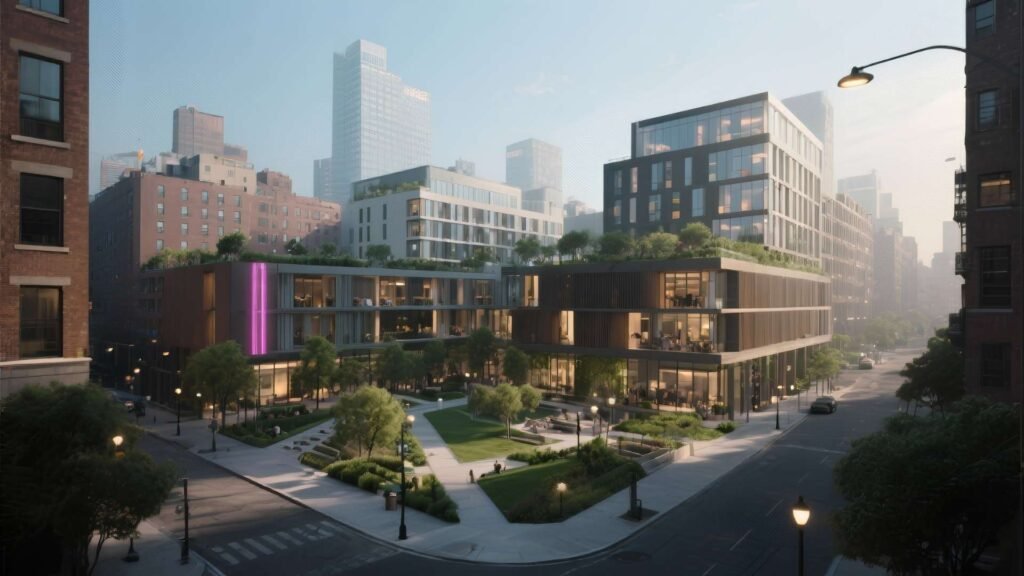
Between 2025 and 2030, New York’s property market will evolve toward sustainability, design, and experience.
Hybrid business travel, ESG standards, and flexible living models will define its future value.
Forecast Highlights:
- 12,000+ new rooms under construction
- Corporate travel up 4% annually
- ESG-certified hotels earn 10–15% premium valuations
- Hospitality yields projected 15–20% above pre-2020 levels
💬 In a global market of uncertainty, New York remains a constant — an address of ambition and sustainable growth.
❓ Investor FAQs
Is investing in New York still profitable in 2025?
Yes — demand from both business and leisure travel keeps occupancy and ADR strong.
What ROI can investors expect?
Typically 5–8% net, with extended-stay and mixed-use assets offering the best yields.
Which neighborhoods offer best value?
SoHo and Midtown for stability; Hudson Yards and Brooklyn for future growth.
Are there restrictions for foreign investors?
No — but compliance with 30+ night rental laws is essential.
Final Thought
New York remains a benchmark for ambition — where every block holds a story, and every investment builds a legacy.
For forward-looking investors, it’s not just a market — it’s a movement.
💬 “The city that never sleeps doesn’t rest on opportunity — it reinvents it.”
🔗 Continue Exploring
Investing in Paris Hospitality 👉 Investing in Paris: Boutique & Luxury Hospitality
Smart Investing in Hong Kong Rentals 👉 Investing in Hong Kong: Short-Term Rental ROI