

Airport transit rules can become surprisingly complicated, especially during Schengen connections, self-transfer flights, or overnight layovers.
Many travelers assume that staying inside the airport automatically means no visa is required. In reality, some connections still involve immigration control, baggage collection, or additional transit authorization.
This transit visa explained guide covers the most important airport transit rules in 2026 and the common mistakes travelers should avoid before international flights.
Quick Answer: Transit Visa Explained
A transit visa is a short-term authorization that allows travelers to pass through a country while continuing to another destination.
You may need a transit visa if:
- your connection requires immigration control
- you must collect and re-check baggage
- your flights are booked separately
- your layover is overnight
- you change airports or terminals
- your nationality requires airport transit authorization
The biggest misunderstanding is assuming:
“I’m not leaving the airport, so I don’t need a visa.”
Many international connections still require official entry into the transit country even when travelers never plan to visit the city itself.
3 Golden Rules for Visa-Free Airport Transit
Before booking any international connection, always verify these three things:
1. Will You Pass Immigration?
If immigration control becomes necessary, standard country entry rules usually apply instead of simple airport transit rules.
2. Are Your Flights on One Ticket?
Protected itineraries are usually safer and easier for international transit connections.
3. Will Your Baggage Transfer Automatically?
If you must collect baggage yourself, you may need to officially enter the country before checking in again.
💡 Most airport transit problems happen because travelers assume these details instead of verifying them before departure.
What Is a Transit Visa?
A transit visa allows travelers to pass through a country while continuing to another destination.
Unlike a tourist visa, it is generally intended for short airport connections, layovers, or international transfers rather than extended stays inside the country.
Depending on the country, this authorization may be called:
- Visitor in Transit Visa
- Airport Transit Visa (ATV)
- Transit Visa
- Direct Airside Transit Visa
Airport Transit vs Entering the Country

One of the biggest transit visa mistakes is confusing airport transit with officially entering the country.
| Airport Transit | Entering the Country |
|---|---|
| Stay inside transit zone | Pass immigration |
| No entry stamp | Official country entry |
| Usually no baggage collection | Often requires baggage collection |
| May not require visa | Standard visa rules apply |
| Remain airside | Enter landside area |
Staying Inside the International Transit Area
This is often called:
- airside transit
- sterile transit
- international transit
In these situations:
- travelers remain inside the secure airport zone
- immigration control is usually avoided
- baggage transfers automatically
- the next flight continues internationally
Officially Entering the Country
Travelers may officially enter the country if they:
- pass border control
- collect baggage
- check in again
- leave the transit area
- change airports
- stay in a hotel overnight
- travel on separate tickets
Once immigration is crossed, normal entry requirements usually apply.
This can include:
- passport validity rules
- transit visa rules
- proof of onward travel
- accommodation details
- short-stay visa requirements
Important Clarification About Airside Transit
Even if travelers remain inside the airport transit zone, some nationalities may still require an Airport Transit Visa (ATV) in certain countries.
This means that “airside transit” does not automatically mean “visa-free transit.”
Because transit rules can change depending on nationality, airport, and route, travelers should always verify official immigration requirements before departure.
Transit Visa vs Layover vs Stopover

These travel terms are frequently confused, but they are not identical.
Transit
Passing through a country while traveling to another destination.
Layover
The waiting period between flights.
Layovers are often shorter than 24 hours.
Stopover
A longer planned stay between flights that usually involves entering the country.
Self-Transfer
Flights booked separately without full airline connection protection.
Self-transfers are one of the biggest causes of airport transit confusion.
💡 Even a short layover can still require a transit visa if immigration clearance becomes necessary.
Schengen Transit Rules Explained
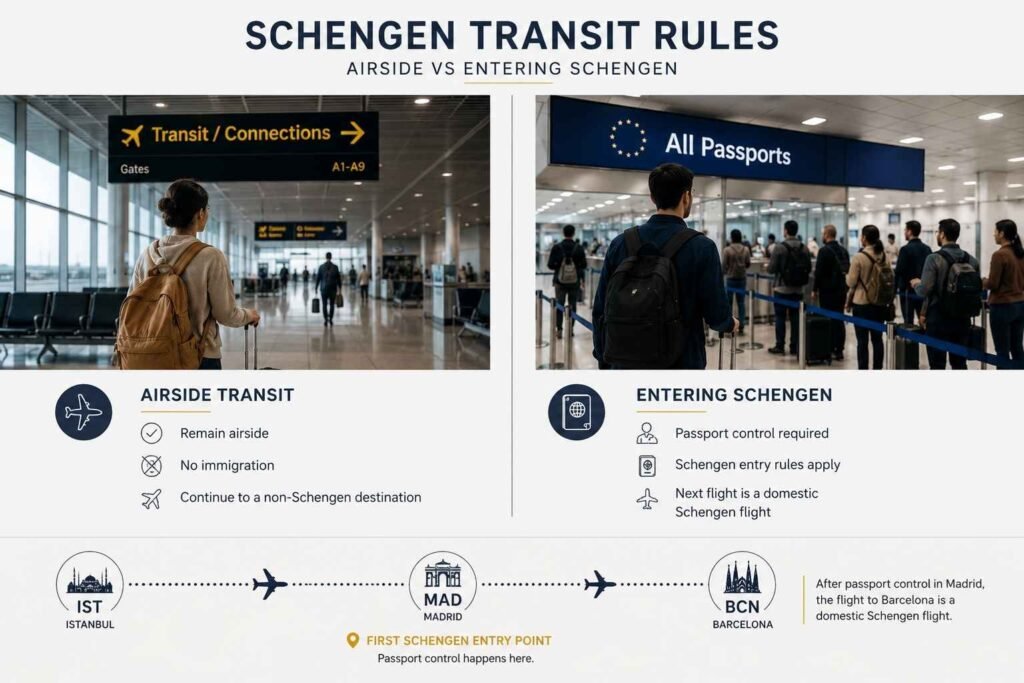
Schengen transit rules can be confusing because there are two very different situations:
- remaining airside without entering Schengen
- officially entering the Schengen Area during transit
These situations follow different immigration procedures.
Airside Schengen Transit
If travelers remain inside the international transit zone of a Schengen airport and continue to a non-Schengen destination, they may not officially enter the Schengen Area.
However, depending on nationality, some passengers may still require an Airport Transit Visa.
💡 Some Schengen countries may require Airport Transit Visas for certain nationalities, including on specific routes involving Turkish passport holders.
Entering Schengen During Transit
If immigration control becomes necessary during the connection, standard Schengen entry rules usually apply instead of simple airport transit rules.
Example Route
Istanbul → Madrid → Barcelona
In this case:
- Madrid becomes the first Schengen entry point
- passport control happens in Madrid
- Barcelona becomes a domestic Schengen flight
💡 If a traveler does not have the required Schengen entry permission, they may not be allowed to continue past immigration at the first Schengen airport.
👉You can also read: Schengen 90/180 Rule Explained (2026)
Common Transit Situations for Turkish Travelers
| Transit Country | Airside Transit | Landside / Overnight Transit |
|---|---|---|
| Schengen airports | May require ATV depending on route and nationality | Standard Schengen entry rules usually apply |
| United Kingdom | Additional transit authorization may apply | Entry permission usually required |
| United States | Transit authorization required in most cases | Standard entry authorization required |
| Qatar / UAE | Often simpler for international transit | Rules vary depending on stay duration |
💡 Transit rules can change frequently depending on nationality, airport, airline, and ticket structure. Travelers should always verify official immigration requirements before departure.
💡 Detailed country-specific transit rules for Turkish passport holders are covered in separate destination and airport transit guides.
👉 Germany Airport Transit Visa for Turkish Citizens (2026)
👉 UK Transit Visa & ETA Guide (2026)
👉 Self-Transfer Flights Explained (2026) — coming soon
Common Schengen Transit Airports

Many international travelers connect through:
- Madrid
- Barcelona
- Amsterdam Schiphol
- Paris CDG
- Frankfurt
- Munich
- Rome Fiumicino
Transit procedures may vary depending on:
- airport layout
- terminals
- baggage transfer systems
- airline partnerships
- nationality
- overnight transit procedures
Travelers should never assume all Schengen airports operate in exactly the same way.
Who Needs a Transit Visa?
Transit visa requirements depend on nationality, airport procedures, baggage transfer rules, and whether immigration control becomes necessary during the connection.
Travelers using separate tickets, overnight layovers, or self-transfer routes are more likely to face additional transit requirements.
Because airport transit policies can change frequently, travelers should always verify official immigration rules before booking international flights.
Digital Transit Authorizations in 2026
In 2026, some countries also require digital travel authorization systems in addition to traditional visa rules.
For example:
- the United Kingdom now uses ETA authorization for many travelers, including some transit passengers
- the European Union is gradually introducing ETIAS for visa-exempt travelers entering the Schengen Area
Even when a traditional transit visa is not required, digital authorization may still be necessary depending on nationality and route.
👉 You can also read: ETIAS Visa Waiver Guide (2026)
Do Turkish Citizens Need a Transit Visa?

Transit visa rules for Turkish citizens depend on:
- the transit country
- airport procedures
- whether immigration is crossed
- airline structure
- baggage transfer systems
- overnight layovers
There is no single universal rule for all airport transit routes.
Turkish Citizens May Not Need a Transit Visa If:
- they remain airside
- baggage transfers automatically
- flights are on one protected ticket
- no immigration control is required
- the transit country allows visa-free airside transit
Turkish Citizens May Need a Transit Visa If:
- they leave the airport
- they collect baggage
- they self-transfer between flights
- they stay overnight landside
- they officially enter the country
- the transit country requires Airport Transit Visa authorization
Popular Transit Countries for Turkish Travelers
Turkish travelers frequently connect through:
- Spain
- Germany
- France
- Netherlands
- United Kingdom
- Qatar
- United Arab Emirates
Transit rules can differ significantly between these countries and airports.
Self-Transfer Risks Explained
Self-transfer flights are one of the biggest causes of airport transit problems in 2026.
A self-transfer usually means:
- flights were booked separately
- airlines are not responsible for the entire journey
- missed connection protection may not exist
- baggage may not transfer automatically
This can transform a simple airport connection into a full immigration process.
For many travelers, these problems only become visible after booking the ticket.
A route that initially looks simple online can quickly become more complicated once baggage collection, immigration control, or overnight airport procedures become involved.
Why Self-Transfers Create Transit Problems
With separate tickets, travelers often need to:
- pass immigration
- officially enter the country
- collect baggage
- check in again
- pass security again
At that point, normal country entry requirements usually apply instead of basic airport transit procedures.
💡 Even partner airlines do not always guarantee baggage transfer on separately booked tickets.
Overnight Transit Rules

Overnight airport connections can create additional complications.
Some airports allow overnight airside transit.
Others require passengers to:
- leave the transit zone
- pass immigration
- remain landside until the next departure
This can immediately change transit visa requirements.
For many travelers, overnight transit issues only appear after the booking process is complete — especially when separate tickets or airport hotel transfers become necessary.
Overnight Transit May Require:
- hotel booking
- transit visa
- tourist visa
- proof of onward travel
- immigration clearance
Even travelers who never planned to visit the city may still need permission to enter the country during an overnight layover.
💡 Always verify whether the airport transit zone remains open overnight before booking long connections.
Transit Without Leaving the Airport
Many travelers attempt to avoid visa complications by remaining inside the airport.
This usually works best when:
- flights are on one ticket
- bags transfer automatically
- airlines cooperate on baggage transfer
- no terminal exit is required
- the airport supports international airside transit
- no overnight stay exists
However, airport design matters.
Some terminals require passengers to pass immigration even during international transfers.
That is why airport-specific transit procedures should always be verified before departure.
Countries Known for Strict Transit Rules
Travelers should also pay special attention when connecting through Canada, Australia, and New Zealand, where transit rules can sometimes be stricter than expected.
A route that appears simple on a booking website may still require additional authorization or entry documentation depending on nationality and airport procedures.
What Happens If You Don’t Have the Correct Transit Documents?
Many airport transit problems happen before boarding even begins.
Airlines frequently verify transit eligibility before passengers board international flights.
Without the correct documents, travelers may face:
- denied boarding
- missed flights
- immigration refusal
- forced rebooking
- unexpected hotel costs
- return to the departure country
This is why transit requirements should always be checked before purchasing complicated international itineraries or separate tickets.
Common Transit Visa Mistakes
Many transit visa problems happen because travelers assume all airport connections follow the same rules.
❌ Assuming “I’m Not Leaving the Airport”
Many travelers still pass immigration during airport connections without realizing it.
❌ Booking Separate Tickets Without Research
Self-transfer itineraries frequently create hidden transit visa problems.
❌ Ignoring Overnight Transit Rules
Some airport transit zones close overnight.
❌ Assuming All Schengen Airports Work the Same Way
Airport transit procedures vary significantly between terminals and countries.
❌ Forgetting Passport Validity Rules
Even transit passengers may need several months of passport validity beyond travel dates.
❌ Ignoring Baggage Transfer Policies
Automatic baggage transfer is never guaranteed.
❌ Relying Only on Booking Websites
Third-party booking platforms may not clearly explain airport transit requirements.
Always verify rules using official immigration or airline sources.
Transit Visa Checklist
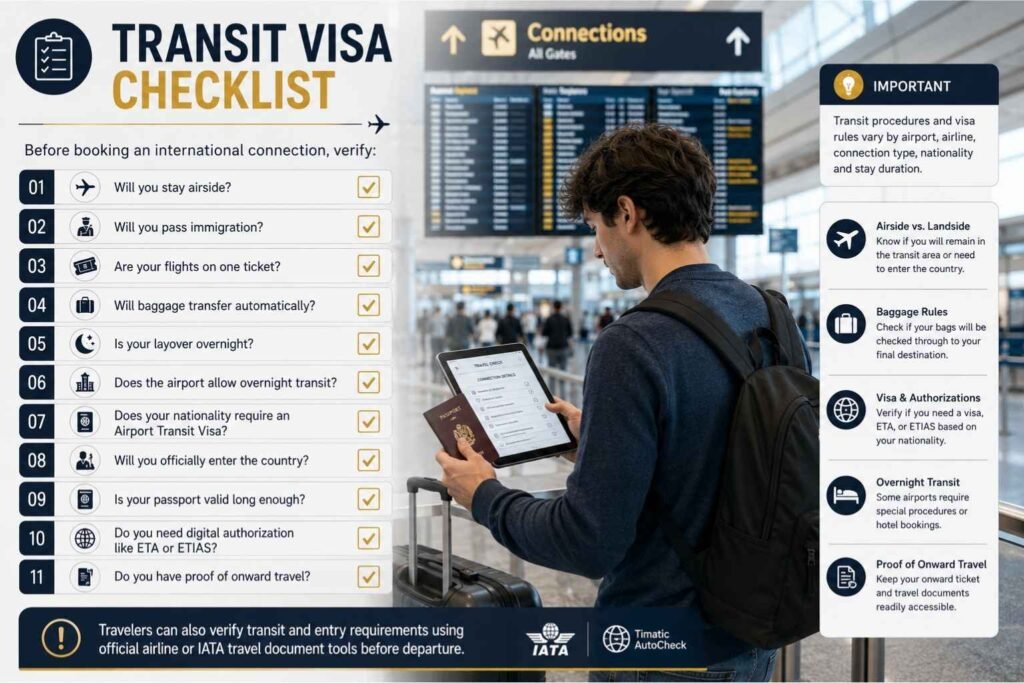
Before booking an international connection, verify:
✅ Will you stay airside?
✅ Will you pass immigration?
✅ Are your flights on one ticket?
✅ Will baggage transfer automatically?
✅ Is your layover overnight?
✅ Does the airport allow overnight transit?
✅ Does your nationality require an Airport Transit Visa?
✅ Will you officially enter the country?
✅ Is your passport valid long enough?
✅ Do you need digital authorization like ETA or ETIAS?
✅ Do you have proof of onward travel?
👉 Travelers can also verify transit and entry requirements using official airline or IATA travel document tools before departure.
Transit Documents for Connecting Flights
For most international airport connections, travelers should carry:
- valid passport
- onward flight confirmation
- destination visa or authorization
- transit visa if required
- accommodation details if entering the country
- travel insurance if necessary
- baggage transfer confirmation
- airline booking details
If you are traveling to Spain, you can also read: Spain Entry Requirements for Turkish Travelers
FAQ About Transit Visa Rules
Do I need a transit visa if I do not leave the airport?
Sometimes yes.
It depends on nationality, airport rules, airline structure, and whether immigration control becomes necessary.
Is airport transit the same as entering the country?
No.
Airport transit usually means remaining airside without crossing immigration control.
Entering the country means officially passing border control even during a short connection.
Do Turkish citizens need a transit visa for Schengen connections?
It depends on the route.
Turkish travelers may not need a transit visa for some airside connections but may require one if immigration control becomes necessary.
Do self-transfer flights require a transit visa?
They can.
Separate tickets often require baggage collection and re-check procedures that involve entering the country.
Can I stay overnight inside an airport without a transit visa?
Not always.
Some airports close transit zones overnight or require passengers to leave the secure area.
Does a Schengen airport connection count as entering Europe?
Often yes.
For many routes, the first Schengen airport becomes the official entry point into the Schengen Area.
Is a transit visa the same as a tourist visa?
No.
Transit visas are intended for passing through a country during international connections.
Can an airline deny boarding because of a missing transit visa?
Yes.
Airlines may deny boarding if passengers do not meet airport transit or immigration requirements.
Final Thoughts
A simple airport connection can sometimes require immigration clearance, additional authorization, or even full country entry.
That is why travelers should always verify whether their connection remains airside or requires passing immigration before flying.
A few minutes of research can prevent denied boarding, missed flights, and unexpected travel problems later.
👉 Spain Entry Requirements (2026): Important Visa, Passport & ETIAS Updates
👉 Spain Schengen Visa for Turkish Citizens (2026): Fees, Documents & Approval Tips