
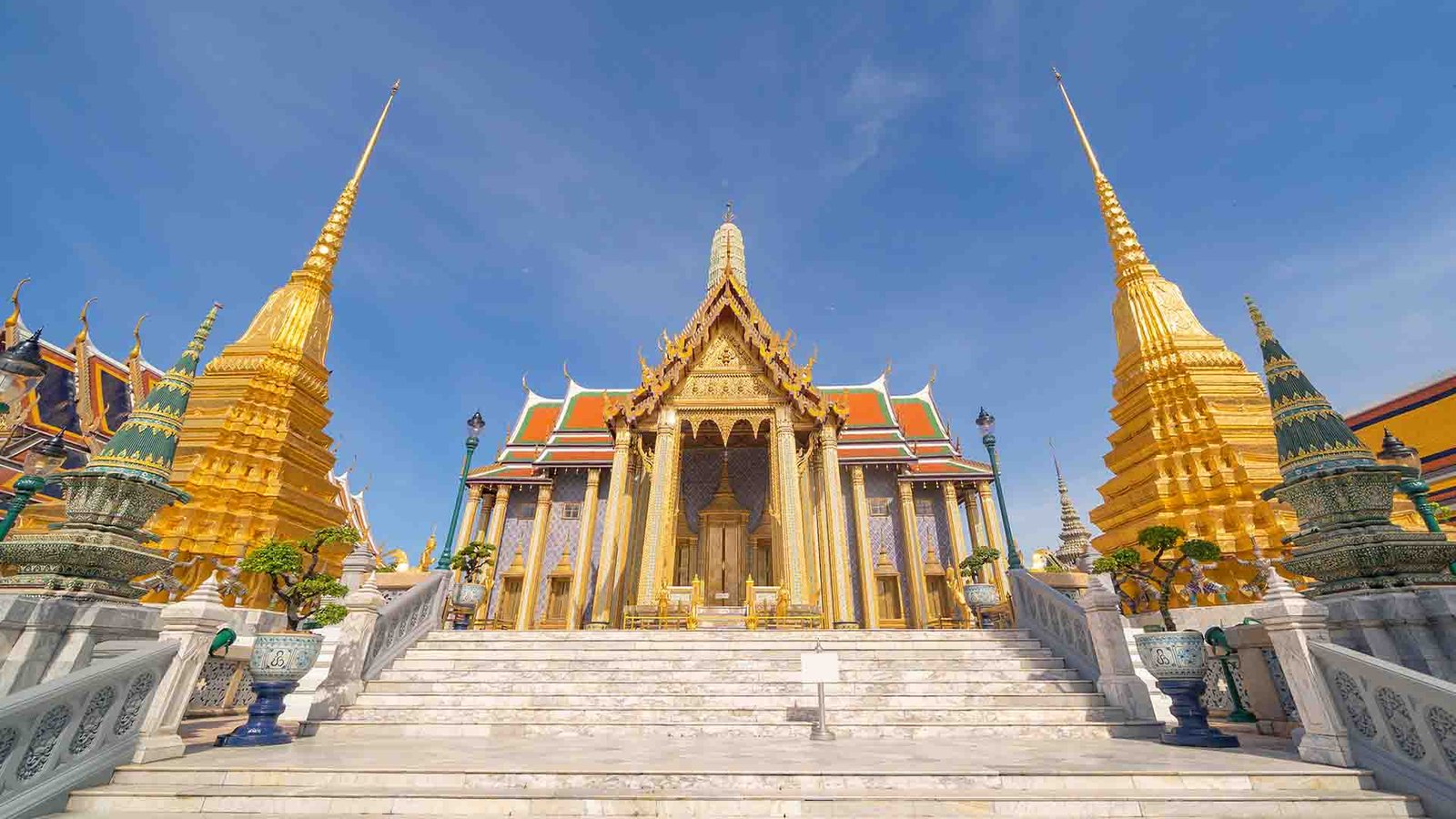
Wat Phra Kaew is not just another temple in Bangkok — it is the spiritual heart of Thailand. Deeply connected to the monarchy, national identity, and Buddhist belief, this royal temple represents the highest level of religious and cultural significance in the country.
To understand Bangkok’s history and Thailand’s spiritual foundations, visiting Wat Phra Kaew is essential. This guide explores the temple’s origins, sacred meaning, architectural design, and what visitors should know before entering this extraordinary site.
Historical Background: The Birth of a Royal Temple
Wat Phra Kaew, officially named Wat Phra Si Rattana Satsadaram, was established in 1782 by King Rama I, the founder of the Chakri Dynasty. Its construction coincided with the founding of Bangkok as Thailand’s new capital following the fall of Ayutthaya.
Unlike traditional temples, Wat Phra Kaew was built exclusively as a royal temple within the Grand Palace complex. It was never intended to serve as a monastery; instead, it functions as a ceremonial and spiritual sanctuary for the Thai monarchy.
From its inception, the temple symbolized the divine legitimacy of royal power and the central role of Buddhism in governing the kingdom.
The Emerald Buddha — Sacred Protector of the Nation
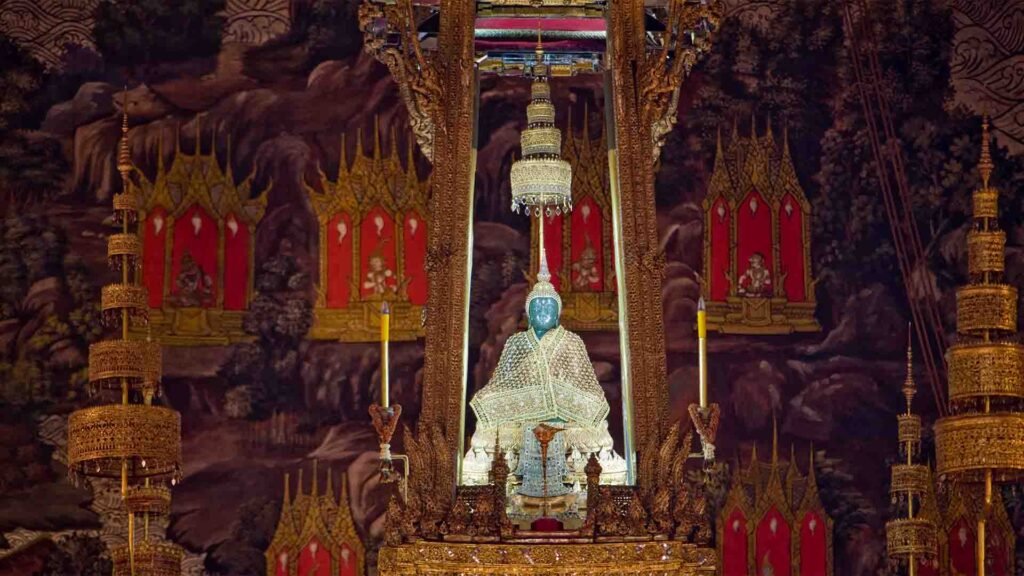
At the spiritual center of Wat Phra Kaew stands the Emerald Buddha (Phra Kaew Morakot), the most revered religious icon in Thailand. Despite its modest size, the statue holds immense symbolic and spiritual power, representing the protection, prosperity, and continuity of the Thai nation.
Carved from a single block of jade, the Emerald Buddha is believed to embody divine guardianship over the kingdom. According to historical belief, the presence of this sacred image legitimizes royal authority and ensures balance between the spiritual and earthly realms. Its placement within a royal temple — rather than a public monastery — reinforces its exclusive connection to the monarchy and the state.
For Thai people, the Emerald Buddha is not an object of artistic admiration alone; it is a living spiritual presence tied to national identity and collective belief.
Seasonal Robe Ceremony — A Royal Ritual
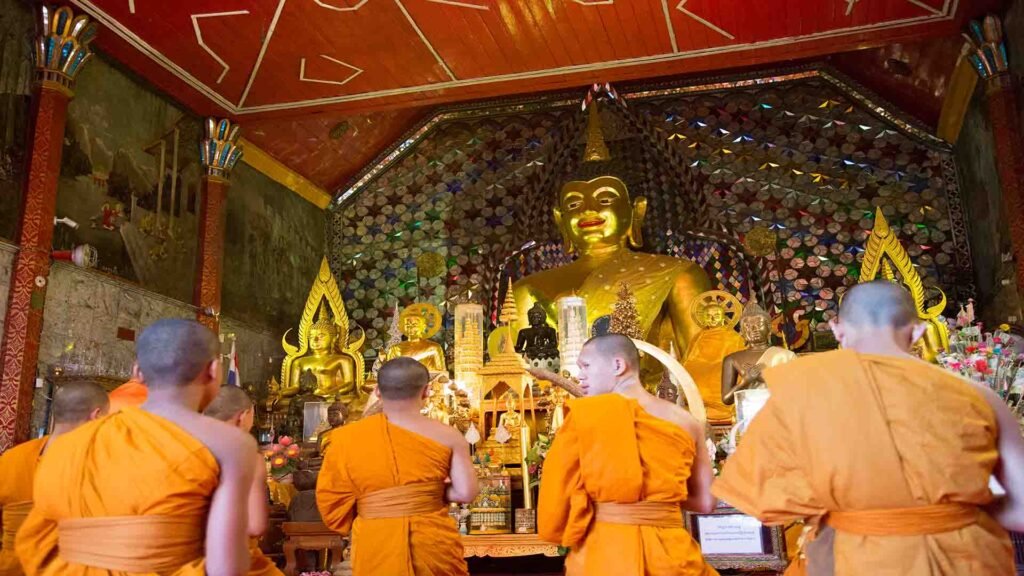
One of the most significant rituals associated with Wat Phra Kaew is the Seasonal Robe Ceremony, during which the Emerald Buddha’s golden attire is changed to mark Thailand’s three main seasons: hot, rainy, and cool.
This ceremony is performed exclusively by the King of Thailand, underscoring the sacred bond between the monarchy and Buddhism. The ritual is not symbolic theater; it is believed to directly influence the nation’s well-being, agricultural balance, and spiritual harmony.
Each seasonal robe differs in design and symbolism, reflecting the natural rhythms of the country. The ceremony serves as a powerful reminder that Thai kingship is not merely political, but also spiritual in nature.
Architectural Design: Sacred Geometry and Royal Symbolism
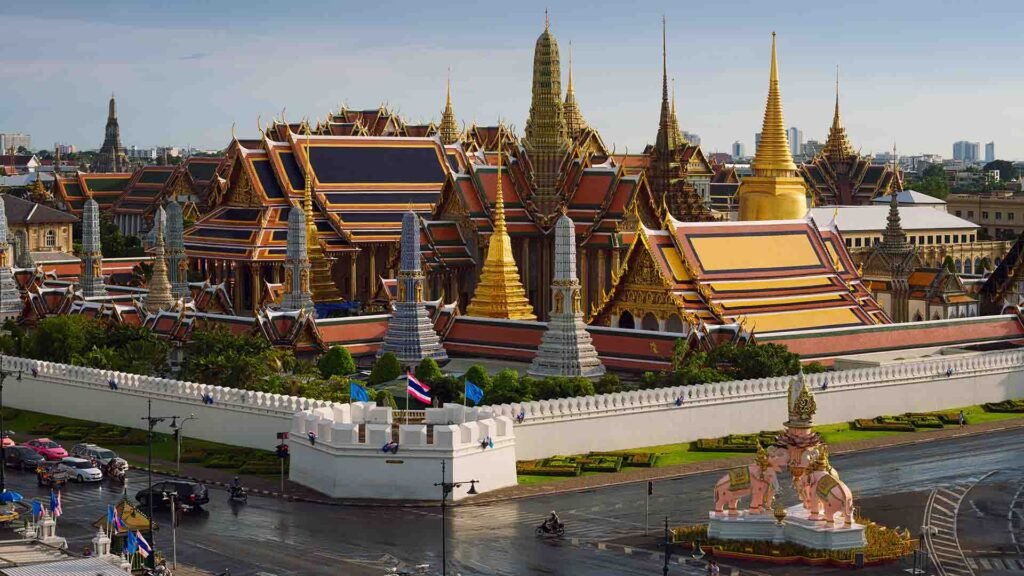
Wat Phra Kaew is a masterpiece of Thai royal architecture. Every structure within the temple complex carries symbolic meaning rooted in Buddhist cosmology.
Key Architectural Elements
- Ubosot (Ordination Hall): The most sacred building, housing the Emerald Buddha
- Golden Chedis: Represent enlightenment and contain relics
- Yaksha Guardians: Mythical giants protecting the temple
- Gilded Roofs & Mosaics: Symbolize heavenly realms
The temple’s design visually communicates cosmic order, spiritual hierarchy, and royal authority.
Ramakien Murals — Thailand’s Epic in Visual Form
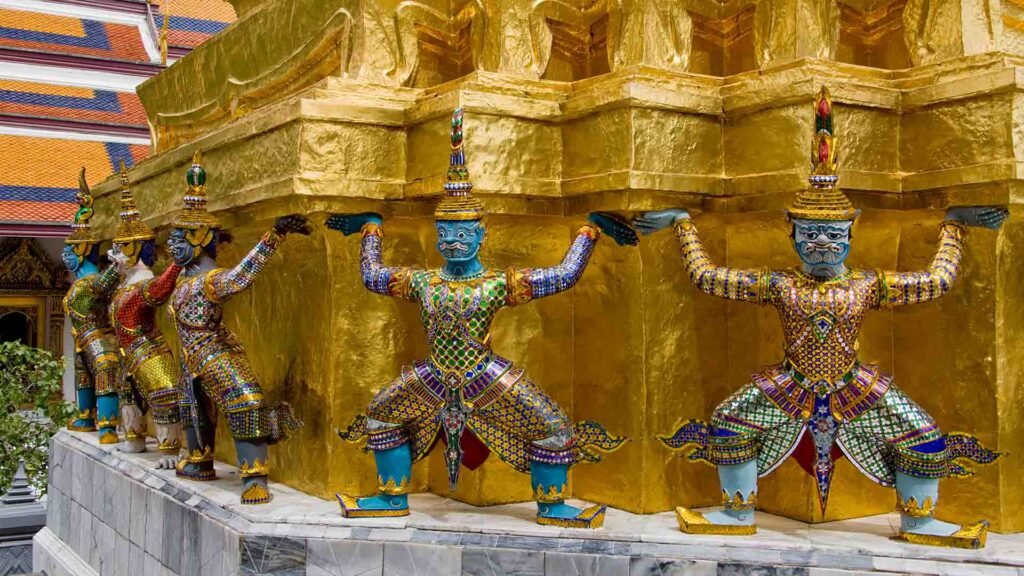
Surrounding the inner walls of Wat Phra Kaew are extensive murals depicting the Ramakien, Thailand’s national epic derived from the Indian Ramayana. These murals are among the most detailed and culturally significant artworks in the country.
Rather than functioning as decoration, the murals act as visual storytelling tools, illustrating themes of loyalty, moral duty, cosmic order, and righteous leadership. Scenes portray gods, heroes, demons, and battles, all woven into a narrative that reinforces ethical values central to Thai society.
For visitors, walking along these mural-lined corridors is equivalent to reading a historical and moral chronicle — one that blends mythology, religion, and royal ideology into a single visual language.
Religious Function & Royal Ceremonies
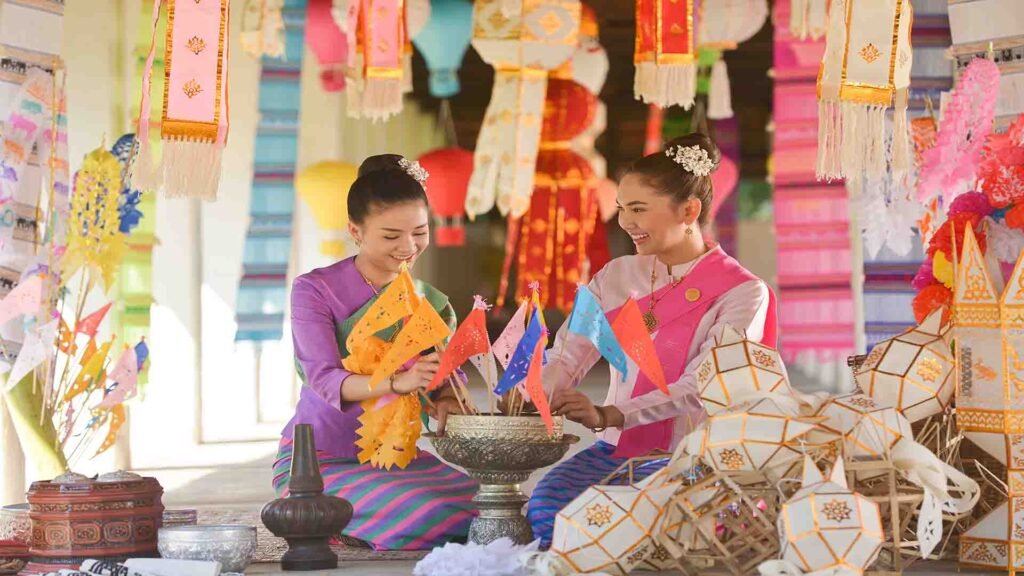
Wat Phra Kaew is distinct from other Bangkok temples because it does not function as a monastery. Instead, it serves as a royal ceremonial temple, reserved for state-sponsored religious activities directly connected to the Thai monarchy. Its role is symbolic, national, and ceremonial rather than communal.
The primary religious and royal functions of Wat Phra Kaew include:
- Hosting coronation-related rites and royal Buddhist ceremonies
- Serving as the spiritual center for royal merit-making rituals
- Preserving sacred traditions linked to the Thai state and monarchy
These functions reflect the belief that the King is the guardian of Buddhism and national harmony.
Through this ceremonial role, Wat Phra Kaew embodies the enduring relationship between Buddhism, royal authority, and national identity. Rather than daily worship, the temple stands as a living symbol of Thailand’s spiritual continuity and historical governance.
What Visitors Will See Inside Wat Phra Kaew
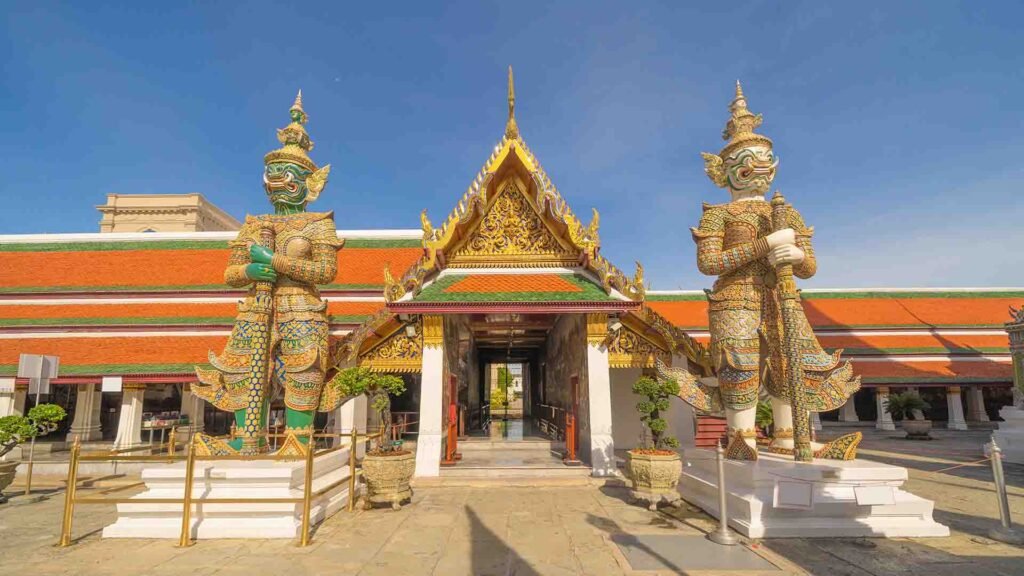
Entering Wat Phra Kaew is an immersive experience shaped by symbolism and sacred design. Visitors encounter a carefully structured environment where every element has meaning.
Inside the complex, visitors will see:
- Gilded chedis and stupas symbolizing enlightenment
- Sacred libraries preserving Buddhist scriptures
- Statues of mythical guardians (Yaksha) protecting holy spaces
- Open courtyards designed for ceremonial processions
The layout encourages slow movement and quiet observation, guiding visitors through a spiritual narrative rather than a conventional sightseeing route.
Essential Dress Code Rules for Bangkok Temples
Because Wat Phra Kaew is both a royal and sacred site, it enforces the strictest etiquette rules of any temple in Bangkok. Respectful behavior is not optional — it is essential.
Visitors must:
- Wear long trousers or skirts covering the knees
- Keep shoulders fully covered
- Avoid transparent, tight, or revealing clothing
- Speak quietly and behave respectfully
- Never touch sacred objects or Buddha images
Failure to comply may result in denied entry. These rules exist to preserve the temple’s sanctity and reflect its ongoing religious function.
How to Visit Wat Phra Kaew Meaningfully
Wat Phra Kaew rewards visitors who approach it with patience and awareness. Rather than rushing through, a meaningful visit involves understanding context and symbolism.
To deepen your experience:
- Visit early in the morning when the atmosphere is calmer
- Learn basic Buddhist and royal symbolism beforehand
- Spend time observing murals and architectural details
- Combine your visit with nearby historical sites such as the Grand Palace and Wat Pho
Approached thoughtfully, Wat Phra Kaew becomes more than a landmark — it becomes a place of insight into Thailand’s spiritual and cultural foundation.
Connection to Other Historical Attractions
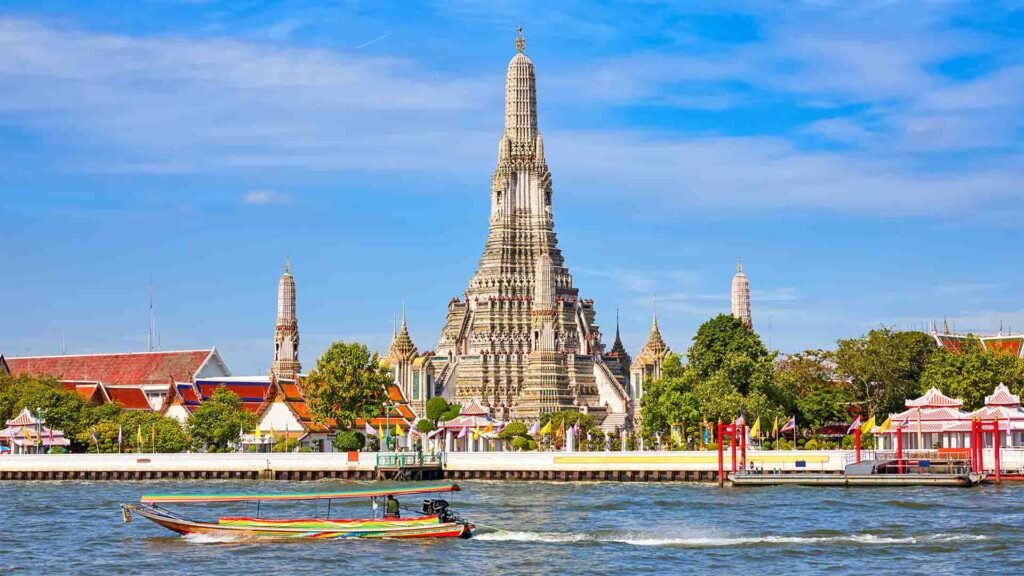
Wat Phra Kaew was never intended to stand alone as an individual monument. From the moment Bangkok was established as the capital, this royal temple was deliberately positioned within a wider historical and symbolic system. Its location, function, and meaning are inseparable from the surrounding landmarks that together shaped the political, spiritual, and cultural foundation of the city.
Wat Phra Kaew is directly connected to the following historical attractions:
- The Grand Palace, as part of the same royal complex
- Wat Pho, representing education, knowledge, and healing traditions
- Wat Arun, symbolizing protection and the river-based identity of early Bangkok
- Rattanakosin Old Town, the original urban framework of the capital
Together, these sites form a unified historical landscape rather than a collection of isolated landmarks, revealing how early Bangkok was intentionally shaped as an interconnected system of royal, religious, and urban spaces.
Conclusion: Wat Phra Kaew as Thailand’s Spiritual Anchor
Wat Phra Kaew is not merely a place to visit — it is a place that defines Thailand’s spiritual and cultural identity. Through its sacred imagery, royal rituals, and symbolic architecture, the temple represents continuity, protection, and national unity.
Wat Phra Kaew is officially recognized as Thailand’s most sacred royal temple and a key cultural landmark, as highlighted by the Tourism Authority of Thailand. For official visitor information and cultural context, you can explore their dedicated heritage resources.
Read Next :
Wat Pho Temple: 👉 Home of the Reclining Buddha and Thai massage heritage.
Wat Arun Temple: 👉 Thailand’s iconic Temple of Dawn and a symbol of renewal