

Living in Spain isn’t just about lifestyle. It’s about stepping into a slower rhythm where everyday life feels more intentional.
But before making the move, there’s one thing you need to understand clearly:
→ Taxes in Spain for foreigners
Because in Spain, your real income isn’t defined by what you earn — it’s defined by what you keep after taxes, social security, and hidden costs.
⚡ Quick Answer: Taxes in Spain for Foreigners (2026)
If you’re moving to Spain, here’s the reality of taxes in Spain for foreigners:
- Income tax can go up to ~47%
- Most expats pay 30%–45% effective tax
- Social security ranges from €205 to €590/month
- VAT (IVA) is typically 21%
Without planning, taxes in Spain for foreigners can be high — but with the right structure, they become far more manageable.
🇪🇸 Taxes in Spain for Foreigners: How the System Works
Understanding taxes in Spain for foreigners starts with one simple idea:
Your tax situation depends on residency, income level, and structure.
At first, the system can feel complex.
But once you understand how everything connects, it becomes easier to manage — and easier to optimize.
According to the official Spanish tax authority (AEAT), tax obligations are primarily determined by your residency status and the source of your income.
💡 This is why understanding the system early gives you a clear advantage — before mistakes become expensive.
🧠 Are You a Tax Resident in Spain?

Your tax residency is the single most important factor determining how taxes in Spain for foreigners apply to you.
✔ You are considered a tax resident if:
- you stay in Spain for more than 183 days per year
- your main life or economic interests are based in Spain
In this case, your global income becomes taxable in Spain.
✔ If you are NOT a tax resident:
- only your Spain-sourced income is taxed
💡 In simple terms: residency defines whether Spain taxes everything you earn globally — or only what you earn locally.
💰 Income Tax in Spain (Simple Reality)
Spain uses a progressive tax system, which directly impacts taxes in Spain for foreigners, especially for those earning above €60,000.
The key takeaway:
- Around €60,000+ → top tax rates (~47%) apply
- Most expats pay an effective rate of 30%–45%
💡 You don’t need every detail — just how it affects your net income.
💸 Real Net Income Example (What You Actually Keep)
This is where taxes in Spain for foreigners become real — not percentages, but actual money.
Scenario: Freelancer earning €5,000/month
- Income tax (~35%) → €1,750
- Social security → €300–€400
- Accountant (gestor) → €100
Net income: ~€3,150
💡 In practice, this means nearly 35–40% of your income goes to taxes and mandatory costs.
💼 Social Security (Autónomo System – 2026 Update)
Social security is a major part of taxes in Spain for foreigners, especially for freelancers.
- Low income tier: ~€205/month
- High income tier: up to ~€590/month
💡 A small additional contribution (MEI – Intergenerational Equity Mechanism) applies, currently around 0.9%, slightly increasing total contributions.
💡 For high earners exceeding the maximum contribution base (around €5,100/month), an additional solidarity contribution may also apply, further increasing total deductions.
💡 This is mandatory and directly impacts how much you keep each month.
💡 How to Legally Reduce Your Taxes in Spain
Understanding how to reduce taxes in Spain for foreigners is key to increasing your real income.
✔️ The most effective strategies:
- Apply for Beckham Law (24% flat tax)
- Choose the right structure (Autónomo vs SL)
- Deduct legitimate business expenses
- Work with a gestor (tax advisor)
💡 It’s not just about income — it’s about how you structure it.
🔥 Beckham Law (Why Everyone Talks About It)

Under Spain’s special tax regime (commonly known as the Beckham Law), eligible individuals can benefit from a simplified and highly predictable tax structure.
✔ 24% flat tax rate
✔ applied up to €600,000 annual income
✔ valid for up to 5 years
Compared to Spain’s standard progressive system (which can reach ~47%), this can offer a significant financial advantage.
⚠️ Key Condition
You must not have been a Spanish tax resident in the last 5 years.
This is one of the most common reasons applications are rejected.
💡 Why It Matters
For many remote professionals and high earners, the Beckham Law can dramatically reduce overall tax burden.
Instead of navigating multiple tax brackets, you operate under a fixed, predictable rate.
This makes long-term financial planning much easier — especially for digital nomads and international professionals.
⏱️ Application Timing
You generally have 6 months from the start of your professional activity in Spain to apply.
Missing this window can mean losing access to the regime.
Beckham Law → ~€60,800 net
💰 The Impact on Your Wallet (Example: €80,000 Income)
| Structure | Net Income | Notes |
|---|---|---|
| Standard System | ~€48,000 | Progressive rates up to ~47% |
| Beckham Law | ~€60,800 | 24% flat tax rate |
Difference: +€12,800 more in your pocket every year
Estimates may vary depending on personal circumstances.
🏢 Autónomo vs Company (SL)
One of the biggest decisions affecting taxes in Spain for foreigners is how you structure your work.
👤 Autónomo (Freelancer)
- Quick and simple setup
- Lower startup cost
- Higher effective tax burden
🏢 SL (Limited Company)
- Around 25% corporate tax
- More efficient at higher income levels
- Better financial control
💡 As your income grows, structure becomes more important than simplicity.
🌍 Regional Differences (Very Important)
Spain doesn’t operate as a single, uniform tax system.
Tax rates and regional policies can vary depending on where you live — often more than most expats expect.
📍 Key differences by region:
- Madrid / Andalusia : generally lower effective taxes
- Barcelona (Catalonia) : higher overall tax pressure, especially for mid-to-high incomes
The same income can lead to different net results depending on location.
Lower tax efficiency → Madrid or Andalusia
Lifestyle and international environment → Barcelona
💸 Hidden Costs Most People Ignore

When estimating taxes in Spain for foreigners, most calculations stop at income tax — but that’s only part of the picture.
Several ongoing costs quietly affect your real net income:
- Social security contributions (monthly, mandatory)
- Gestor (tax advisor): €100–€200/month
- Banking, compliance, and administrative costs
- Local waste tax (Tasa de Basura): ~€100–€300/year depending on municipality
💡 These costs are built into the system — and they directly reduce what you keep.
💡 Under recent housing regulations, municipalities may apply a surcharge of 50% to 150% on property tax (IBI) for long-term vacant properties.
For most expats, working with a gestor becomes part of the system.
🧾 VAT (IVA) — What Foreigners Need to Know
VAT is a core part of taxes in Spain for foreigners, especially if you work as a freelancer or run a business.
The basics:
- Standard VAT rate: 21%
- EU clients: different rules may apply depending on registration
- B2B services: often handled through the reverse charge mechanism
💡 VAT doesn’t always increase your cost — but misunderstanding it can.
It remains one of the most misunderstood parts of the system
Beyond income and VAT, some foreigners may also face additional tax exposure depending on their assets or property ownership.
🏠 Wealth Tax & Solidarity Tax (High-Net-Worth Alert)

Beyond income, taxes in Spain for foreigners may also include taxes on your total assets.
This is where Spain becomes significantly more complex for high-net-worth individuals.
- Wealth Tax: varies by region
- Solidarity Tax (2026): applies above €3 million
💡 Wealth Tax is regional, meaning some areas like Madrid and Andalusia effectively reduce it to zero.
💡 However, the Solidarity Tax is a national-level tax that overrides regional exemptions — meaning assets above €3 million may still be taxed regardless of where you live.
📍 Especially relevant for:
- High-income earners
- Investors and property owners
🏘️ Vacant Property Tax (2026 Update)
If you plan to buy property, it can directly affect taxes in Spain for foreigners — even if you don’t live in it full-time.
Owning a property that remains empty may trigger additional taxation or imputed income rules
💡 Property in Spain isn’t purely passive — it carries ongoing tax exposure
📊 Best Tax Strategy Based on Income
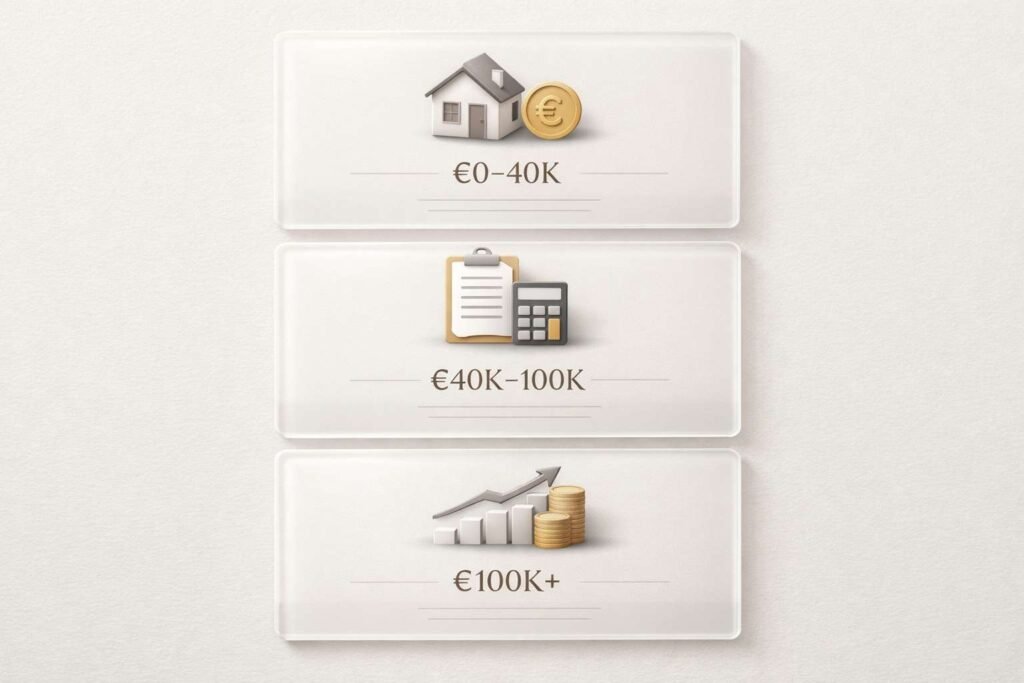
Earning more doesn’t always mean keeping more.
In Spain, the most effective tax strategy depends entirely on your income level.
There is no one-size-fits-all structure — efficiency changes as your earnings grow.
💶 €0 – €40K → Autónomo (Simple & Flexible)
At lower income levels, simplicity works best.
✔ low setup cost
✔ minimal administrative burden
✔ fast setup (24–48 hours)
💡 Ideal for freelancers and early-stage remote workers.
⚖️ €40K – €100K → Optimized Hybrid Approach
This is where tax pressure starts to increase — and strategy becomes essential.
✔ early-stage tax optimization
✔ better balance between flexibility and control
✔ evaluating SL or Beckham Law becomes relevant
💡 Many professionals begin restructuring at this stage to avoid unnecessary tax loss.
🚀 €100K+ → High-Efficiency Structure (Beckham Law or SL)
At higher income levels, structure becomes critical.
✔ strong tax optimization (e.g. 24% flat rate under Beckham Law)
✔ long-term scalability
✔ better financial and legal positioning
💡 Without proper structure, the same income can result in significantly lower net earnings.
💡 Pro Tip: The Tipping Point
For many professionals, the transition point is around €60K–€70K annual profit — where moving beyond Autónomo often becomes more efficient.
⚠️ Important Note
These ranges focus on income tax only.
Monthly social security contributions (€205–€590+) apply on top.
❌ Who Should NOT Move to Spain (Tax Perspective)
Spain isn’t the right fit for everyone — especially from a tax perspective.
Without proper planning, the system can become expensive and inefficient
🚫 This may not be ideal if you:
- Are a high earner without a clear tax strategy
- Rely heavily on Spanish clients
- Don’t plan your structure before relocating
💡 Spain rewards planning — not improvisation
📅 Key Tax Deadlines
Managing taxes in Spain for foreigners isn’t just about how much you pay — timing matters.
Missing deadlines can lead to penalties and unnecessary costs
📌 Main deadlines:
- Income tax return: May – June
- Quarterly VAT: April / July / October / January
💡 Staying on schedule is as important as optimizing your taxes
📋 Before You Move to Spain (Checklist)
Before dealing with taxes in Spain for foreigners, a few decisions make everything easier.
Early planning prevents costly mistakes
✔️ Define tax residency
✔️ Choose your structure
✔️ Work with a gestor
✔️ Understand real net income
💡 The earlier you structure your setup, the more control you have
🔗 Continue Your Spain Setup Journey
If you’re planning your move strategically, these next guides will help you go deeper:
Want to reduce your tax legally and understand how the system actually works in practice?
→ Spain Digital Nomad Visa Taxes Explained (Beckham Law Guide) (Coming Soon)
Want to lock your tax rate at 24% and move to Spain as a remote professional?
→ Spain Digital Nomad Visa 2026: Complete Guide
Planning to build a business structure in Spain?
→ Starting a Business in Barcelona (Coming Soon)
❓ Taxes in Spain for Foreigners: FAQs
Here are the most common questions expats ask about taxes in Spain:
What are taxes in Spain for foreigners?
Taxes in Spain for foreigners depend on your residency, income level, and structure.
Most expats pay between 30% and 45% without proper optimization.
Do foreigners pay tax in Spain?
It depends on your residency status.
If you are a tax resident, your global income is taxed.
If not, only Spain-sourced income is taxed.
Is Spain a high-tax country?
Generally, yes — especially for mid to high income earners.
However, proper planning can significantly reduce the effective burden.
Can taxes in Spain for foreigners be reduced legally?
Yes. With the right structure, such as the Beckham Law or a company setup,
you can lower your effective tax rate.
How much tax do freelancers pay in Spain?
Freelancers pay income tax plus social security contributions.
In most cases, the total burden is around 30–40%.
Do I need a tax advisor (gestor) in Spain?
In most cases, yes.
A gestor helps manage filings, avoid penalties, and optimize your setup.
Which city in Spain has lower taxes?
Tax differences vary by region.
Madrid and Andalusia are generally more tax-efficient,
while Barcelona has higher tax pressure.
🎯 Final Insight
Spain is not a low-tax country.
But once you understand how the system works, it becomes predictable — and manageable.
With the right structure, Spain shifts from a complex tax environment into a place where lifestyle and financial balance can coexist.
⚠️ Disclaimer (Legal & Tax Notice)
This article is for informational purposes only and should not be considered legal, tax, or financial advice.
Tax regulations in Spain — including income tax (IRPF), Beckham Law eligibility, and Social Security contributions — can change frequently and may vary depending on your personal situation.
For 2026, additional requirements such as digital invoicing (VeriFactu) and new contribution rules may also apply.
Before making any decisions related to residency, taxes, or business structure, it’s strongly recommended to consult a qualified Spanish tax advisor (gestor or asesor fiscal).
ClaraTravels is not responsible for any actions taken based on the information provided in this guide.