

Sleep doesn’t just happen. You don’t fall into deep sleep by accident — you arrive there. But most people try to sleep without ever preparing for it. They close their eyes… while their mind is still wide awake.
The result?
Restless nights.
Interrupted sleep.
Mornings that feel heavier than the night before.
In today’s fast-paced world, poor sleep is no longer just about being tired —
it affects your focus, mood, energy, and long-term health.
This is where a night routine for deep sleep becomes essential.
A well-structured night routine for deep sleep is not about doing more.
It’s about creating a predictable system your body can follow — every single night.
In this guide, you’ll learn exactly how to build a night routine for deep sleep, step by step —
so you can fall asleep faster, sleep deeper, and wake up truly refreshed.
⚡ Deep Sleep Routine: 3 Golden Rules
If you want to improve your night routine for deep sleep, start with these three essentials:
- Turn off screens 30–60 minutes before bed
- Go to sleep at the same time every night
- Reduce stimulation before bedtime
👉 These three habits help your brain recognize when it’s time to sleep.
💡 Why this works:
Reducing light, stabilizing your sleep schedule, and calming your nervous system support natural melatonin production — making it easier to fall asleep and stay asleep.
ClaraTravels Tip: Your body doesn’t understand time — it understands patterns.
🧠 Why You Need a Night Routine for Deep Sleep

Your brain doesn’t switch off instantly.
👉 It follows patterns.
Without a consistent night routine for deep sleep:
- Your nervous system stays active
- Your brain keeps processing stimulation
- Your body doesn’t recognize “sleep mode”
💡 Key Insight:
Consistency creates sleep signals — not exhaustion.
💡 Why this matters:
Your circadian rhythm relies on repeated cues.
Without a structured night routine for deep sleep, your body struggles to produce melatonin at the right time — making it harder to fall asleep and stay asleep.
🧬 Why Deep Sleep Matters
Deep sleep is when your body actually recovers.
During deep sleep:
- Your brain clears toxins
- Your body repairs muscles and tissues
- Your hormones rebalance
- Your memory consolidates
💡 Science Insight:
Deep sleep (slow-wave sleep) is the most restorative phase of your sleep cycle — supporting immune function, brain recovery, and long-term health.
👉 Without deep sleep, you don’t just feel tired —you operate below your potential.
💡 This is why building a consistent night routine for deep sleep is essential — it helps your body enter and maintain these deeper sleep stages naturally.
🌙 What Makes a Night Routine Actually Work?
A night routine for deep sleep works when it is:
✔ simple
✔ repeatable
✔ low-stimulation
✔ consistent in timing
👉 These elements help your brain recognize a clear transition from “awake mode” to “sleep mode.”
💡 Why this works:
Your body relies on circadian rhythm cues.
When your night routine for deep sleep is consistent, your brain begins to release melatonin at the right time — making it easier to fall asleep and stay asleep.
👉 The goal is not perfection — it’s predictability.
⚡ Step-by-Step Night Routine for Deep Sleep

Follow this structured night routine for deep sleep every night to train your body to relax, slow down, and enter deep sleep naturally.
📴 Step 1: Digital Sunset (30–60 Minutes Before Bed)
Turn off all screens:
- Phone
- Laptop
- TV
👉 Replace with calm, low-light activities.
💡 Why it matters:
Blue light suppresses melatonin, making it harder for your body to enter sleep mode.
💡 Step 2: Dim the Lights
Switch to warm, soft lighting.
👉 Your brain interprets this as:
✔ “time to slow down”
💡 Lower light = stronger sleep signals.
🚿 Step 3: Warm Shower or Reset
A warm shower helps relax your body.
👉 Afterward, your body temperature drops — supporting sleep onset.
💡 Science Note:
The rapid drop in body temperature after a warm shower signals the brain to release melatonin, helping you fall asleep faster.
📓 Step 4: Brain Dump (2–5 Minutes)
Write down:
- thoughts
- unfinished tasks
- worries
💡 Why it matters:
This clears mental clutter and reduces nighttime overthinking.
🍵 Step 5: Drink Something Calming

Choose:
- chamomile tea
- lemon balm
- warm milk
❌ Avoid caffeine and sugar.
💡 Herbal drinks support relaxation and nervous system balance.
📖 Step 6: Low-Stimulation Activity
Do:
- reading
- light stretching
- calm music
❌ Avoid:
- social media
- news
- emails
💡 The goal is to reduce mental stimulation — not replace it.
🛏️ Step 7: Consistent Sleep Time
Sleep at the same time every night.
👉 This stabilizes your circadian rhythm.
💡 Consistency is the foundation of a night routine for deep sleep.
🌡️ Step 8: Optimize Your Sleep Environment
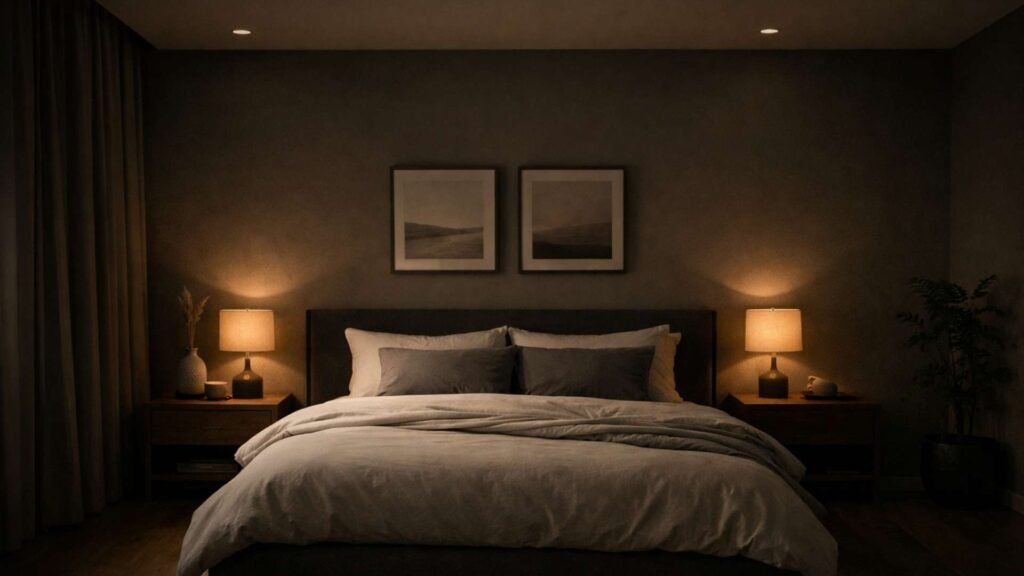
Ideal conditions:
- 18–20°C room temperature
- complete darkness
- minimal noise
👉 Small optimizations create big results.
💡 Your environment should support — not fight — your sleep.
🧘 Step 9: Breathing Reset (1–3 Minutes)
Try:
- Inhale → 4 sec
- Hold → 4 sec
- Exhale → 6 sec
👉 This activates your relaxation response.
💡 Slow breathing calms your nervous system and prepares your body for deep sleep.
🌑 Step 10: No “Last Scroll”
❌ Don’t check your phone
❌ Don’t check messages
❌ Don’t “scroll one last time”
💡 This instantly breaks your night routine for deep sleep by reactivating your brain.
👉 Follow this night routine for deep sleep consistently, and your body will begin to recognize sleep as a natural, automatic process — not something you struggle with.
⚡ Quick Night Routine for Deep Sleep (5-Minute Version)
Short on time?
This simplified night routine for deep sleep helps your body switch into sleep mode in just a few minutes:
- Turn off screens
- Dim the lights
- Drink something warm
- Breathe slowly
- Sleep at the same time
👉 These small actions reduce stimulation, calm your nervous system, and support natural melatonin release.
💡 Even a short night routine for deep sleep, done consistently, is more powerful than a perfect routine you don’t follow.
🌙 Ideal Night Routine Timeline
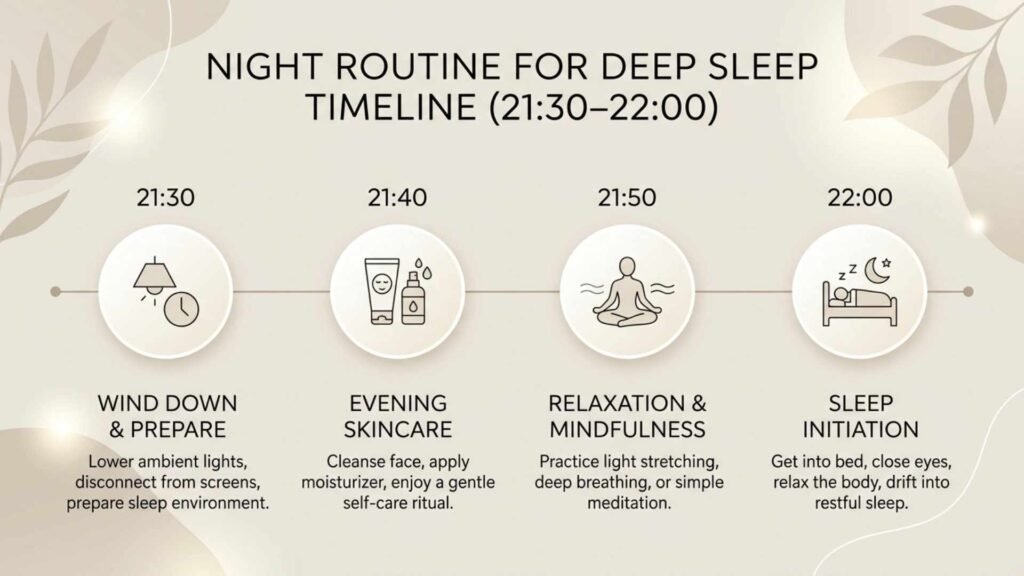
Here’s a simple timeline to follow your night routine for deep sleep:
- 21:30 → Digital sunset
- 21:40 → Shower / relax
- 21:50 → Tea + reading
- 22:00 → Lights off
👉 This sequence helps your body gradually transition from active mode to sleep mode.
💡 Why this works:
Your circadian rhythm responds to consistent timing. Repeating the same steps at the same hour every night strengthens your natural sleep signals.
💡 Pro Tip:
Your body doesn’t need perfection — it needs repetition.
🚫 What to Avoid Before Sleep
To protect your night routine for deep sleep, avoid:
- screens before bed
- caffeine after 2–3 PM
- heavy meals late at night
- mental overstimulation
- inconsistent sleep schedules
👉 These habits increase alertness, delay melatonin production, and make it harder for your body to enter deep sleep.
💡 Why this matters:
Even a strong night routine for deep sleep can fail if these disruptions are present.
👉 Removing bad habits is just as important as building good ones.
⌚ How to Use Sleep Tracking (2026 Insight)
Modern devices (smartwatches, smart rings) can help optimize your night routine for deep sleep by showing how your body responds to your habits.
Focus on:
- deep sleep duration
- REM cycles
- sleep consistency
👉 These metrics help you understand whether your night routine for deep sleep is actually working.
💡 How to use this data:
Look for patterns — not perfection.
- Are you sleeping at the same time each night?
- Is your deep sleep increasing over time?
- Do small changes improve your sleep quality?
💡 Important:
Don’t chase perfect numbers.
👉 Use data as guidance — not pressure.
Your goal:
✔ better rhythm
✔ better recovery
✔ better focus
⏳ How Long Until Your Night Routine Works?

With a consistent night routine for deep sleep, your body gradually adapts to new sleep signals:
- 1–3 days → calmer nights
- 5–7 days → fall asleep faster
- 2 weeks → deeper sleep cycles
- 3–4 weeks → full rhythm reset
👉 These changes happen because your circadian rhythm responds to repeated patterns over time.
💡 What to expect:
Small improvements come first — deeper sleep follows consistency.
👉 Consistency is everything.
⚠️ Common Mistakes in a Night Routine for Deep Sleep
Avoid these common mistakes that can silently break your night routine for deep sleep:
❌ Using your phone in bed
👉 Keeps your brain stimulated and delays melatonin release
❌ Sleeping at different times
👉 Disrupts your circadian rhythm and weakens sleep signals
❌ Overcomplicating your routine
👉 Makes it harder to stay consistent
❌ Expecting instant results
👉 Sleep improves gradually — not overnight
💡 Fix it:
Keep your night routine for deep sleep simple, repeatable, and consistent.
🔗 Build Your Full Energy System
A strong night routine for deep sleep works best when combined with the right daily habits.
👉 Sleep is not isolated — it’s part of a complete energy system.
- Start your day right → 10-Minute Morning Routine for Energy
- Improve mental clarity → Brain Fog Fix: Clear Your Mind Fast
- Reset your habits → Digital Detox Guide
👉 These habits work together to support deeper, more consistent sleep.
❓ FAQ — Night Routine for Deep Sleep
How long should a night routine be?
30–60 minutes is ideal. Even 15 minutes works if consistent.
What is the best time to sleep?
22:00–23:00 aligns best with natural circadian rhythm.
Can I customize my night routine?
Yes — but keep the structure consistent.
What is the most important part?
Consistency and removing screens.
Does a night routine really improve deep sleep?
Yes — because it trains your brain to recognize sleep signals.
🌙 Final Thoughts
Deep sleep is not something you force.
It’s something you allow.
When your night routine for deep sleep becomes consistent,
your body follows naturally.
Better nights → better mornings → better life.
Start simple.
Stay consistent.
Trust the process.
Still tired all the time? Here’s why 👉 Why Am I Always Tired? →