
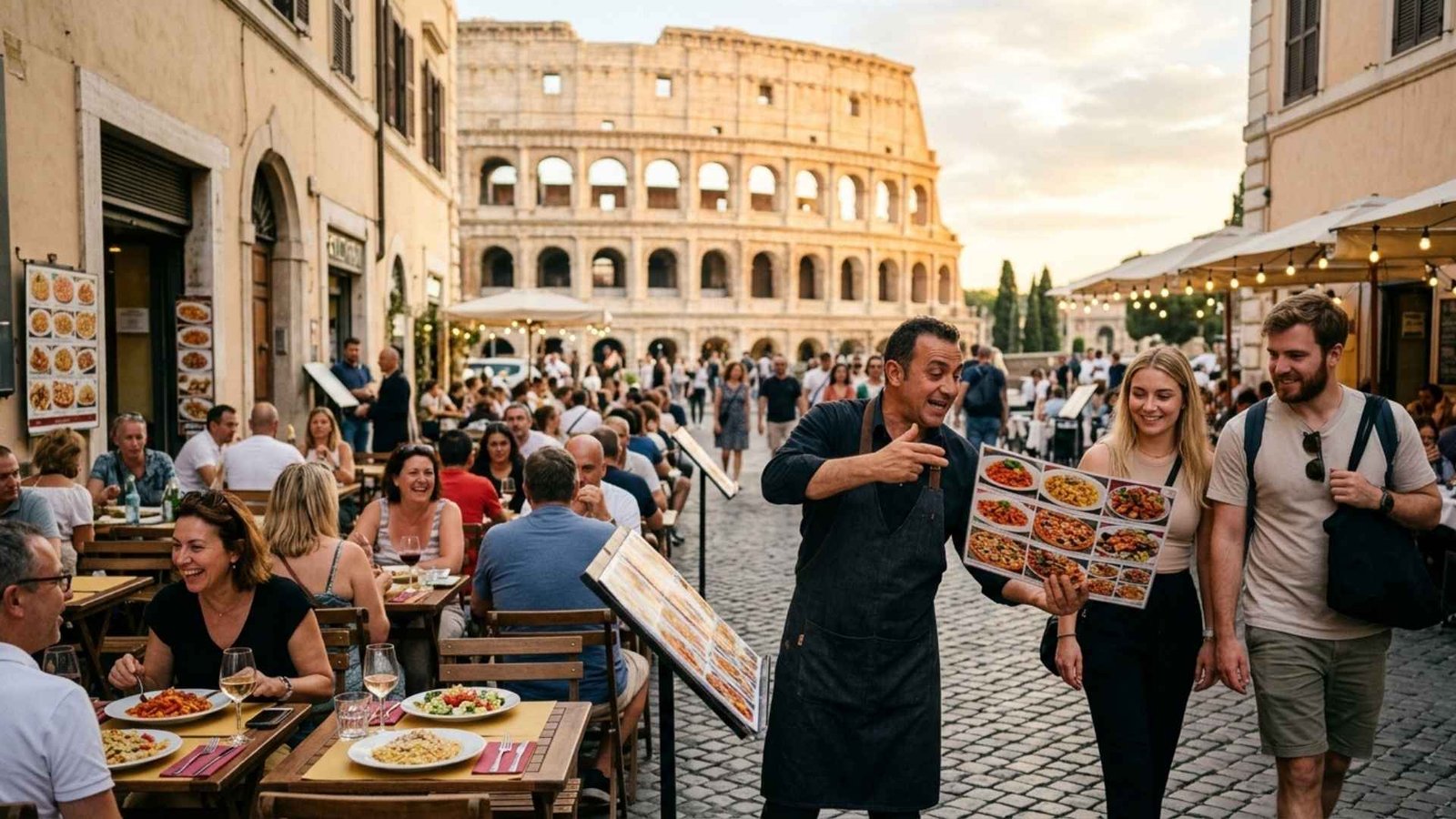
You sit down in a beautiful square, just steps from one of Rome’s most iconic landmarks. The setting feels perfect — warm light, lively atmosphere, a table ready for you.
The menu looks easy. Maybe a little too easy.
Photos of pasta. A waiter greeting you before you even slow down. Prices you don’t fully question — yet. A plate arrives. It looks right. But something feels… off.
Rome isn’t an expensive city. But the wrong place can make it feel that way — and that’s exactly how tourist traps in Rome work.
And here’s the truth most travelers don’t hear:
Rome is one of the best food cities in the world — but like any major destination, knowing where to go makes all the difference.
⚡ Quick Answer: What Are Tourist Traps in Rome?
Tourist traps in Rome are not about bad food — they’re about the wrong priorities.
These places typically:
✔ focus on location instead of quality
✔ rely on high turnover rather than repeat customers
✔ use visual tactics (menus with photos, aggressive invitations)
✔ serve simplified, tourist-adapted versions of real Roman dishes
The key difference is simple:
Authentic places cook for locals. Tourist traps cook for convenience.
🚫 Quick Checklist: Spot a Tourist Trap in 10 Seconds
✔ Someone invites you inside or tries to “convince” you
✔ Menu has photos of food
✔ Too close to major landmarks
✔ Too many items (everything from pasta to pizza to burgers)
✔ No Italian language on the menu
If you notice 2–3 of these, you’re likely facing tourist traps in Rome — walk away.
🚩 12 Tourist Traps in Rome You Should Avoid
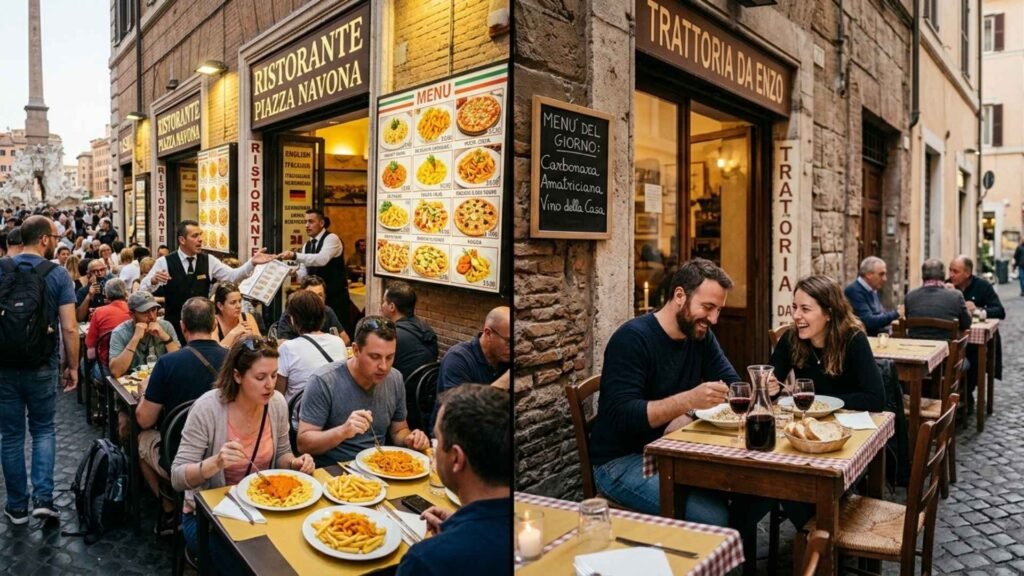
Rome doesn’t lack great food — in fact, it’s one of the richest culinary cities in Europe.
But in high-traffic areas, especially near major landmarks, some places are designed for speed, visibility, and one-time visitors rather than quality and tradition — this is where tourist traps in Rome quietly appear.
The following signs don’t mean a place is “bad” — but they usually mean you’re not getting the real Roman experience.
1. Restaurants with People Outside Trying to Pull You In
If someone is actively inviting you inside before you even stop, take a step back. In Rome, good restaurants don’t need to chase attention — they naturally attract it.
You’ll usually notice:
✔ someone calling out to you or waving you in
✔ menus being pushed into your hands
✔ a sense of pressure to sit quickly
In Rome, when the invitation is strong, the food usually isn’t.
2. Menus with Photos of Food
At first, it feels helpful — you see exactly what you’re ordering. But this is often designed to make decisions easier, not better.
Common signs include:
✔ large photos of every dish
✔ multiple languages dominating the menu
✔ layouts that feel more like a catalog than a selection
The more a menu tries to sell visually, the less it relies on quality.
📋 Tourist Menu vs Real Local Menu
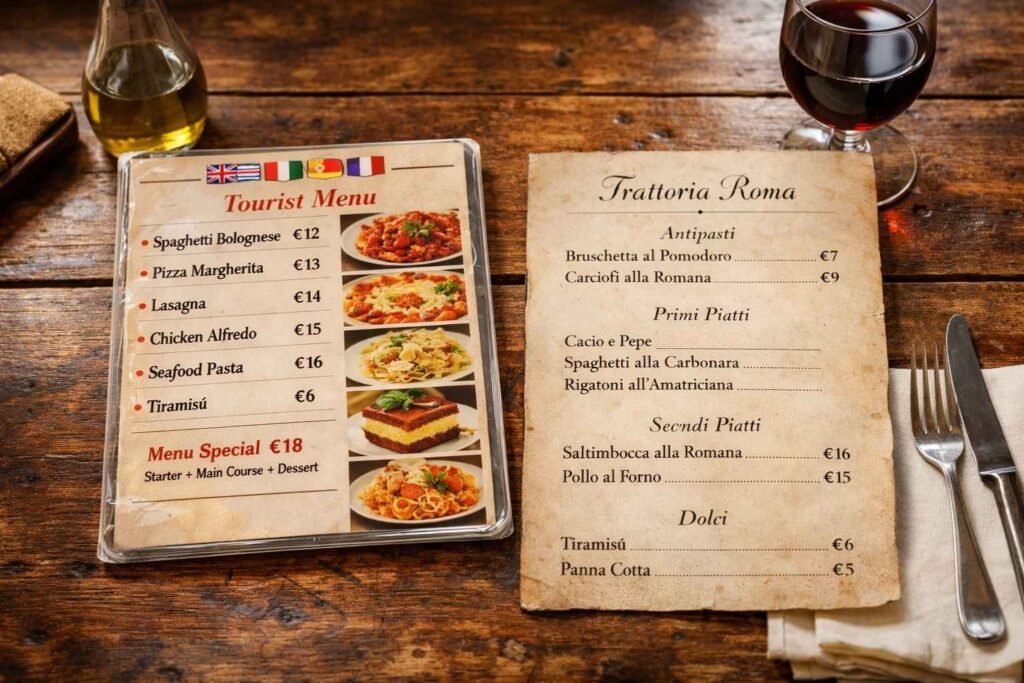
At first glance, both menus might seem fine. But small details reveal everything.
| Tourist Menu | Local Menu |
|---|---|
| Photos | No photos |
| Many languages | Mostly Italian |
| Overloaded | Minimal |
Tourist traps in Rome simplify decisions — real restaurants trust their food.
3. Restaurants Right Next to Major Landmarks
Colosseum, Trevi Fountain, Piazza Navona — beautiful, but risky when it comes to food. These locations attract visitors, which means restaurants don’t need to compete on quality.
Look for:
✔ menus displayed outside with aggressive pricing
✔ identical dishes across multiple nearby restaurants
✔ staff focused on passing tourists, not returning guests
Walk just 5–10 minutes away, and the difference is immediate.
4. “Tourist Menu” (Menu Turistico)
Fixed menus feel easy, especially when you’re tired and just want a quick meal. But in Rome, food isn’t meant to be rushed.
Typical signals:
✔ fixed starter + main + drink combinations
✔ limited choice with pre-selected dishes
✔ pricing that looks “too simple” for the location
Built for speed and volume — not for authentic Roman flavor.
5. Carbonara with Cream
This is one of the clearest red flags. Real Roman carbonara is simple and strict — eggs, pecorino, and guanciale.
Watch for:
✔ cream listed in the ingredients
✔ overly heavy or saucy texture
✔ menus adapting traditional dishes
If the recipe is changed, the experience already is too.
6. “Best Pizza in Rome” Signs
Bold claims are designed to catch your attention — not reflect reality. In a city like Rome, the best places don’t need to say it.
You’ll notice:
✔ large promotional signs outside
✔ exaggerated claims (“best”, “number one”)
✔ attention-focused marketing
The louder the claim, the weaker the authenticity.
🍕 Tourist Pizza vs Real Roman Pizza
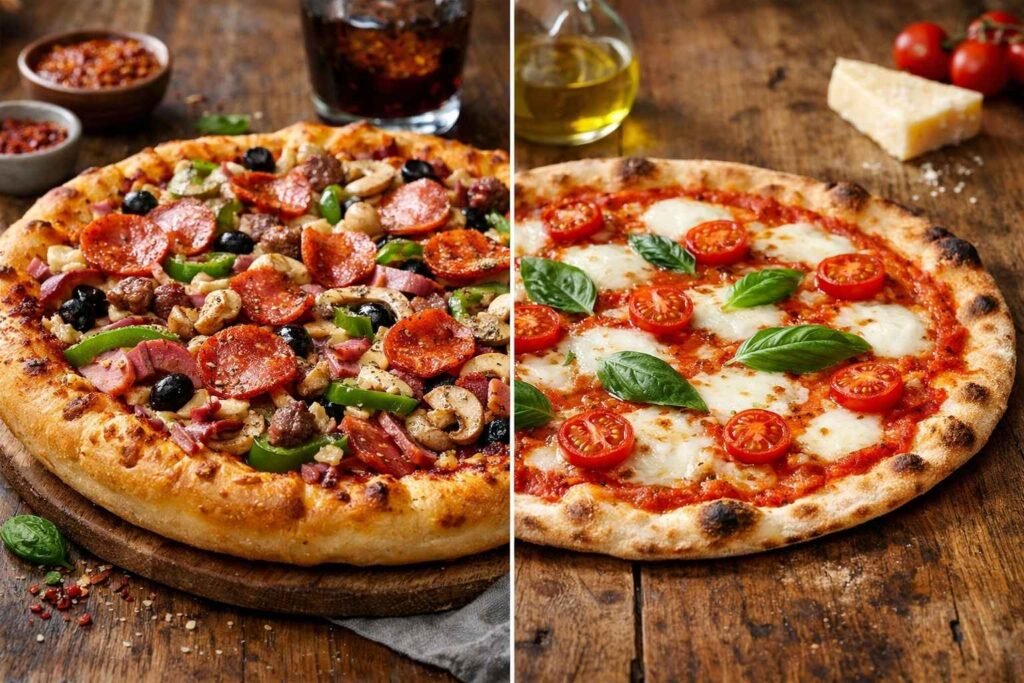
At first glance, both might look appealing. But the difference is in how it feels — and how it’s made.
| Tourist Pizza | Real Roman Pizza |
|---|---|
| Thick | Thin & crispy |
| Heavy | Light |
| Cheap ingredients | High-quality ingredients |
Tourist versions are often built to look filling.
Real Roman pizza is built around balance — texture, simplicity, and ingredient quality.
In Rome, great pizza isn’t overloaded — it’s precise, light, and intentionally simple.
7. Overly Long Menus
A menu that offers everything usually excels at nothing. In Rome, great restaurants are defined by focus.
You’ll notice:
✔ pasta, pizza, burgers, seafood all in one place
✔ dozens of options with no clear specialty
✔ inconsistent food styles mixed together
When everything is possible, nothing is exceptional.
8. Empty Restaurants at Peak Hours
Dinner in Rome is a ritual — especially between 7:30 and 9:00 PM. If a place is empty during these hours, it’s not random.
Pay attention to:
✔ empty tables while nearby places are full
✔ staff waiting outside instead of serving inside
✔ no visible local crowd
In Rome, locals vote with their presence — or absence.
9. Fake Reviews Outside
Some places try to replace real reputation with visual proof. Printed reviews and awards are often used to build quick trust.
Common signs:
✔ “Top Rated” signs placed outside
✔ printed TripAdvisor or Google reviews
✔ excessive awards displayed at the entrance
Real reputation is felt inside, not advertised outside.
10. Hidden Charges (Coperto)
A small cover charge is normal in Rome — but lack of clarity is not. This is where many tourist traps in Rome catch visitors off guard.
Watch for:
✔ no clear pricing on the menu
✔ unexpected extras on the bill
✔ unclear explanation of coperto
Transparency is a sign of a good restaurant.
11. English-Only Menus
Language reveals who the restaurant is for. In Rome, even tourist-friendly places keep Italian on the menu.
Look for:
✔ menus written only in English
✔ no Italian terms or dish names
✔ simplified descriptions for tourists
No Italian usually means no local connection.
12. 🍦 Fake Gelato (Bright Colors = Tourist Trap)
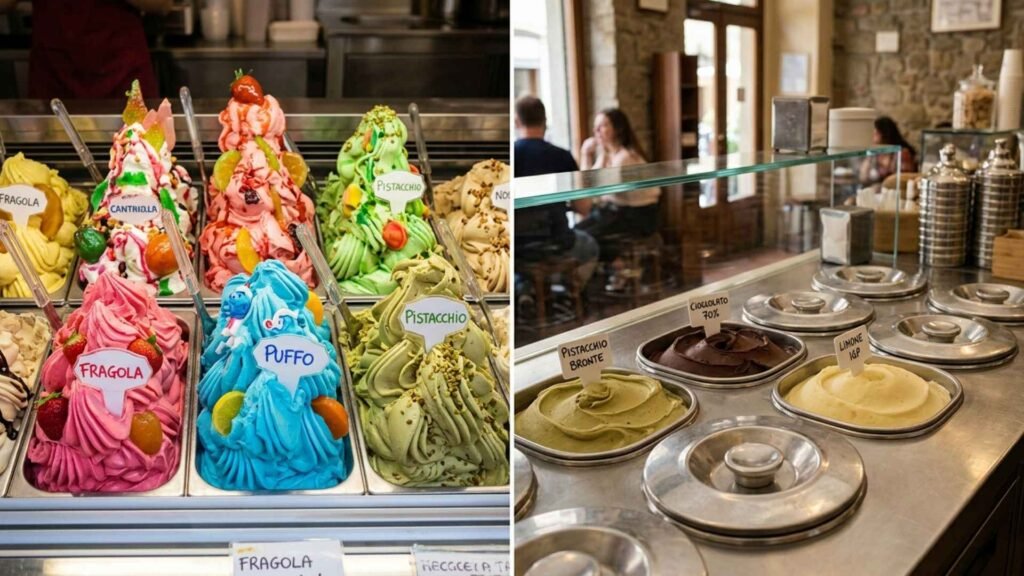
Gelato is one of Rome’s highlights — but also one of the easiest places to go wrong. What looks attractive isn’t always authentic.
Watch for:
✔ neon colors (especially bright green pistachio)
✔ huge, overflowing displays
✔ gelato piled high above the container
These are designed to catch your eye — not reflect real Italian gelato.
Real gelato is subtle, natural, and often kept in covered metal containers.
💡 Pro Tip: If you see banana gelato that’s bright yellow — walk away. Real banana gelato is pale and slightly grayish, just like a mashed banana.
💸 Tourist Trap Prices vs Real Local Prices in Rome
At first glance, the difference might not seem dramatic. But across a full meal, it adds up — quickly.
| Item | Tourist Trap | Real Price |
|---|---|---|
| Carbonara | €18 – €25 | €12 – €18 |
| Pizza | €15 – €22 | €10 – €15 |
| Water | €4 – €6 | €1 – €2 |
| Wine | €8 – €12 | €4 – €6 |
Tourist-focused places charge for location, not quality — so if something simple feels overpriced, it probably is.
💡 Note: Prices in central Rome have increased slightly in recent years, but local trattorias still offer better value than tourist-focused spots.
💧 The Water Scam (Local Secret)
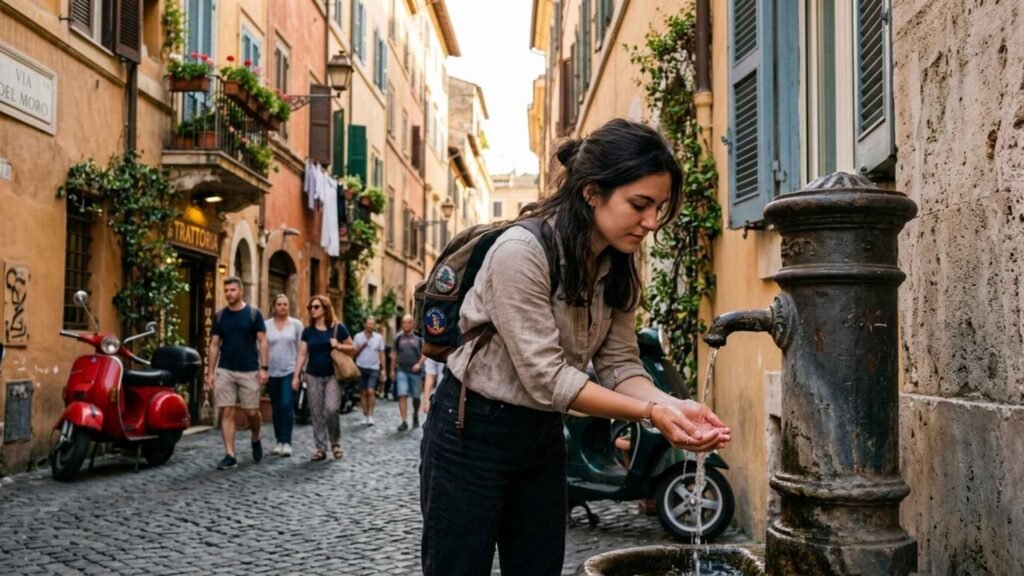
You sit down and order water — it arrives in a glass bottle, and later you notice €5 on the bill.
Meanwhile, just outside, Rome offers free, clean drinking water across the city.
These fountains are called:
Nasoni
✔ constantly flowing
✔ fresh and cold
✔ completely free
Locals use them every day — and once you notice them, you’ll start seeing them everywhere.
💡 Local Tip: You can easily find these fountains using apps like “I Nasoni di Roma”, which map free drinking water points across the city.
🧠 Why Tourist Traps Work
Tourist traps don’t exist by accident — they work because they match how people behave while traveling.
✔ you’re tired
✔ you’re hungry
✔ you’re close to a landmark
✔ you don’t want to overthink
And in that moment, convenience wins over quality.
That’s exactly what these places are built for.
🍝 How to Avoid Tourist Traps in Rome
Avoiding tourist traps in Rome doesn’t require effort — just small shifts in how you choose.
✔ walk just 5–10 minutes away from major landmarks
✔ choose places with short, focused menus
✔ notice where locals are actually sitting
✔ ignore places that try too hard to pull you in
In Rome, the best meals are rarely the most visible ones.
📍 Areas in Rome with Fewer Tourist Traps
If you want a more authentic experience, location matters more than you think.
✔ Testaccio → deeply local, traditional food culture
✔ Trastevere (side streets) → lively but still authentic if you avoid main strips
✔ Prati → calmer, more residential feel
✔ Monti → balanced mix of local and curated spots
Often, the best decision is simply walking one street further.
🍷 What a Real Roman Restaurant Feels Like
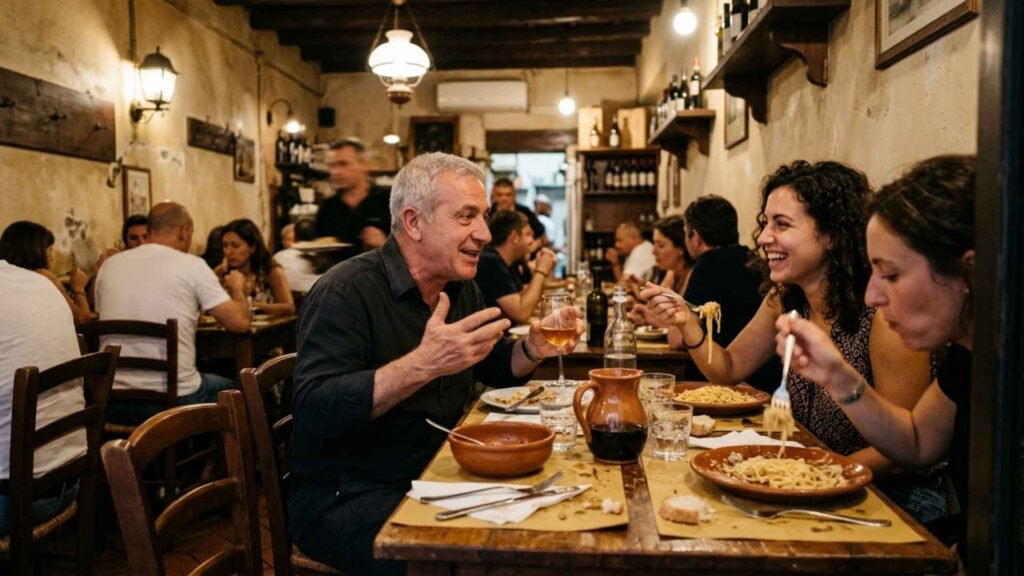
A real Roman restaurant doesn’t try to convince you.
There’s no one calling you inside.
The menu is short. Focused. Familiar.
You hear conversations more than music.
Wine arrives without explanation. Bread is already on the table.
Nothing is designed to impress you — and that’s exactly why it feels real.
⚠️ Common Food Mistakes Tourists Make
Most bad food experiences in Rome don’t come from bad restaurants — they come from small decisions.
❌ sitting too close to landmarks
❌ rushing meals
❌ modifying traditional dishes
❌ choosing convenience over curiosity
Rome rewards those who slow down.
⚖️ Are Tourist Traps Always Bad?
Not necessarily.
In a city like Rome, even what people call tourist traps in Rome can sometimes offer something valuable.
Sometimes you’re paying for:
✔ the view
✔ the location
✔ the atmosphere
And that can still be worth it.
The key is awareness — knowing what you’re paying for, and deciding if it fits the experience you want.
🔗 Continue Exploring Rome Like a Local
You’ve learned how to avoid tourist traps in Rome — now it’s time to experience the city the right way.
These guides will take you one step deeper into real Roman food culture:
🍝 What to Eat in Rome
Discover the must-try Roman dishes — from carbonara to cacio e pepe — explained simply and authentically.
👉 Know exactly what to order (and what to avoid)
🥪 Roman Street Food Guide
Quick, local, and full of flavor — explore what Romans actually eat on the go.
👉 Perfect for eating well without sitting down
📍 Where Locals Eat in Rome
Skip the tourist zones and find neighborhoods and spots where locals really go.
👉 This is where Rome starts to feel real
🏁 Final Thoughts: Avoid Tourist Traps in Rome Like a Local
Tourist traps in Rome are easy to fall into — not because you’re careless, but because the city is designed to pull you in.
But here’s what most people don’t realize: you’re never far from something better. Walk one street away, and everything changes — the menu, the atmosphere, the experience.
Rome isn’t about avoiding mistakes. It’s about recognizing them — and choosing better.